
Madagascar
The world's fourth-largest island, cast off from Africa so long ago that its wildlife evolved down its own strange path - nine in ten of its creatures live nowhere else.
WHAT THE FLAG MEANS ◢
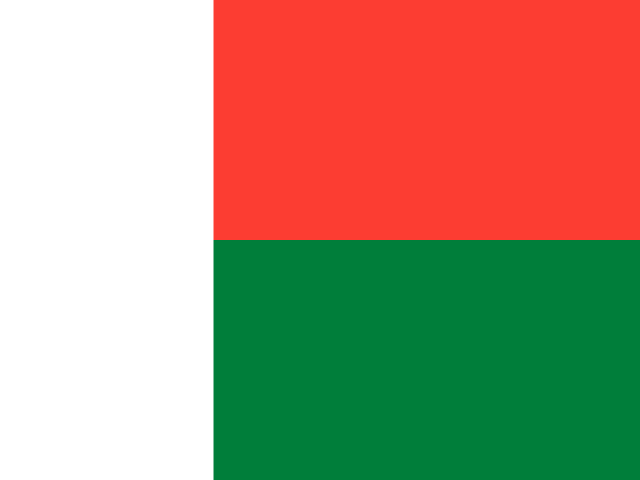
A white vertical band at the hoist beside two horizontal bands of red over green, the three of equal dimensions. Every constitution since 1959 has named the tricolour as the Republic's emblem and set out that arrangement without assigning any colour a meaning. Outside the constitution the white is read for purity and for the lamba and the rice harvest, the red for sovereignty and for the clay brick of Malagasy houses, and the green for hope and for the greenness of the island.
Source: assemblee-nationale.mg · cnlegis.gov.mg · mef.gov.mg · presidence.gov.mg · britannica.com · crwflags.com · checked 2026-08-26
Madagascar FACTS ◢
| Capital | Antananarivo |
|---|---|
| Continent | Africa |
| Population | 32,740,678 (2025) |
| Area | 587,295 km² |
| Population density | 56/km² |
| Currency | Ariary (MGA) |
| Official languages | French, Malagasy |
| Calling code | +261 |
| Internet TLD | .mg |
| Time zone | UTC+03:00 |
| Drives on the | Right |
| ISO codes | MG / MDG |
DID YOU KNOW? ◢
- Around 90% of its wildlife, including all its lemurs, is found nowhere else on Earth.
- It's the fourth-largest island in the world, after Greenland, New Guinea and Borneo.
- The baobab, a tree that stores water in its swollen trunk, has six of its eight species living only here.
- Its people speak Malagasy, a language whose closest relatives are spoken thousands of kilometres away in Borneo.
Madagascar QUICK ANSWERS ◢
What is the capital of Madagascar?
The capital of Madagascar is Antananarivo.
What is the population of Madagascar?
Madagascar had a population of 32,740,678 in 2025.
What currency does Madagascar use?
Madagascar uses the Ariary (MGA).
What languages are spoken in Madagascar?
The official languages of Madagascar are French and Malagasy.
Think you know your flags? Play Flag Daily → · Browse all countries →
MORE ON THE FLAG ◢
Four republics have written a constitution for Madagascar, and all four put the national symbols in a single article. In each one the motto is the first of the symbols, the flag's sentence follows it, and the anthem comes further down.
The motto changed every time. In 1959 it was Fahafahana, Tanindrazana, Fandrosoana. The socialist republic of 1975 replaced it with Tanindrazana, Tolom-Piavotana, Fahafahana. The 1992 text made it Tanindrazana, Fahafahana, Fahamarinana, and the constitution in force since 2010 opens article 4 with Fitiavana, Tanindrazana, Fandrosoana.
The sentence underneath it hardly moved. Sixty-seven years and four republics later it still gives the same three colours in the same three places, and it still says nothing about what any of them stands for. Madagascar has published an answer to that question. It was on a different page, written by a different institution, and it is in Malagasy.
Key Takeaways
- The flag is described in one sentence of the constitution, and across four republics that sentence has gained one adjective, lost two conjunctions, turned a colon into a comma and gained a comma where one of those conjunctions had been.
- The constitution sends the seals of the State and the arms of the Republic to be defined by law. It does not do the same for the flag, and no flag law appears in the national legislation database.
- A Malagasy state gloss does exist, in Malagasy, on a Presidency of the Republic symbols page that has since gone offline, and it reads the green as the greenness of the whole island rather than of the coast.
- The reading in English that gives the green to a coastal peasantry splices together two published glosses that contradict each other.
- The constitution fixes no proportions and no shades of red and green, and no instrument that does appears in Madagascar's national legislation database.
| The text | Date | Article | Motto in that text | What it says about the colours |
|---|---|---|---|---|
| Constitution of the First Republic | 29 April 1959 | Article 2 | Fahafahana, Tanindrazana, Fandrosoana | Nothing |
| Constitution of the Second Republic | 31 December 1975 | Article 10 | Tanindrazana, Tolom-Piavotana, Fahafahana | Nothing |
| Constitution of the Third Republic | 18 September 1992 | Article 4 | Tanindrazana, Fahafahana, Fahamarinana | Nothing |
| Constitution of the Fourth Republic | 11 December 2010 | Article 4 | Fitiavana, Tanindrazana, Fandrosoana | Nothing |
Nearly the same sentence has described Madagascar's flag since 1959
The constitution in force says this, at article 4:
"Son emblème national est le drapeau tricolore blanc, rouge, vert, composé de trois bandes rectangulaires d'égales dimensions, la première verticale de couleur blanche du côté de la hampe, les deux autres horizontales, la supérieure rouge et l'inférieure verte."
Rendered into English: its national emblem is the tricolour flag of white, red and green, made up of three rectangular bands of equal dimensions, the first vertical and white in colour on the staff side, the other two horizontal, the upper red and the lower green.
Three Malagasy state copies of that text were compared character by character for this article and they agree word for word, once the two apostrophe codepoints in use are treated as the same character: the Presidency's own referendum edition hosted by the Assemblée nationale, the copy published by the Commission Nationale de Législation, and the copy on the Ministry of Economy and Finance site.
Go back to 1959 and the sentence is already there. Article 2 of the First Republic's constitution reads "Son emblème est le drapeau tricolore blanc, rouge et vert", and then continues into the same three-band description. The 1975 constitution of the Democratic Republic puts it at article 10, still as "Son emblème est le drapeau tricolore blanc, rouge, vert". The 1992 text at article 4 is the first to say "Son emblème national est le drapeau tricolore", which is the wording the 2010 constitution kept.
That is the whole of the distance between the first text and the current one. Set the 1959 wording beside the 2010 wording and the differences are one added adjective, two dropped conjunctions, a colon that turned into a comma, and a comma added where the first of those conjunctions had been. The 1975 and 1992 texts survive as gazette scans, the 1975 printing clean and the 1992 a faded, low-contrast newsprint page, so both were rendered as images and transcribed by hand rather than trusted to their embedded text layers, which mangle the phrase for equal dimensions and break words across spaces.
The seals and arms are for a law to define, and the flag is not
The most useful thing in article 4 of the constitution in force is not the flag sentence. It is the sentence four lines below it.
"Les sceaux de l'Etat et les armoiries de la République sont définis par la loi." In English: the seals of the State and the arms of the Republic are defined by the law. That delegation has been in every constitution since 1959 too, and it is a deliberate hand-off: the drafters knew perfectly well how to send an emblem out to be legislated in detail, and for two of the three great state emblems they did exactly that.
They did not do it for the flag. The flag is settled inside the constitution and delegated to nobody. There is no article saying a law shall fix its proportions, its shades, its manner of display or its meaning, so nothing in the constitution points to a flag law existing anywhere else.
That has a consequence a reader can check. Madagascar's national legislation database, run by the Commission Nationale de Législation under the Prime Minister's office, indexes the statute book by the subject line of each instrument. Searching it for drapeau returns seven results, every one of them the French military idiom for being called up for service. Under emblème there are three: two on the Geneva Conventions, and one choosing an emblem for the Malagasy office of posts and telecommunications. The word armoiries returns nothing at all, which is to say that the law these constitutions have been calling for since 1959 does not appear in the database either. Searches on hymne, symboles and tricolore return nothing either.
Three bands of equal dimensions, no ratio and no colour specification
Read closely, the flag sentence contains exactly one quantity: the three bands are "d'égales dimensions".
It cannot mean equal side lengths. The white band runs the full height of the flag and a third of its length. Each coloured band runs half the height and two thirds of the length. No two of those three rectangles share a pair of measurements.
Read as equal areas it is exact, and it is exact at any proportion you like. A white band one third of the length by the full height covers a third of the flag. A red band two thirds of the length by half the height covers a third of the flag. So does the green. Make the flag short and square or long and thin, and all three bands still cover a third each. The constitution does not explain the phrase, and this is arithmetic rather than the state's reading, but it does show why no ratio was ever needed: the sentence's only measurement is one that holds at whatever ratio the flag is made in.
So the constitution fixes no ratio. The widely quoted 2 to 3 comes from flag reference works rather than from the constitution or from anything in the national legislation database, and the same is true of every Pantone value in circulation.
The Flags of the World archive opens its own colour section by noting that the constitution "defines the national flag (Article 4)" but does not give a colour specification, and then prints at least three conflicting Pantone sets: a warm red with 348 green from the Album des Pavillons and the London 2012 Olympic flag manual, PMS 032 with PMS 355 from the Beijing 2008 manual, and 186C with 354C from Vexilla Mundi. Of the Olympic set alone the archive says that "these specifications may not be the official, government, version of each flag", since they are the shades each National Olympic Committee approved for the London games.
The arrangement itself is not the plain vertical or horizontal tricolour that many other former colonies of France took up, since only one of Madagascar's three bands is vertical.
Madagascar's colour meanings were published by the Presidency, in Malagasy
The Presidency of the Republic used to run a page called Les symboles de la République, or Ireo famantarana ny Repoblika. Its section on the flag is written in Malagasy, and it is the one page found in this research where a Malagasy institution sets out what the colours are for.
It opens by putting them together rather than apart. The three colours, it says, "Mitory ny endrin-javaboahary misy eto Madagasikara ireo loko telo ireo ary mitory ny firaisam-pirenena", which is to say that they express the natural forms found in Madagascar, and express national unity.
Then it takes them one at a time, and every one of the three readings runs well past the one-word abstraction that circulates in English.
The red is given as "mena ràn’omby", ox-blood red. It is "mariky ny fiandrianinana, ny fandresena", the mark of sovereignty and of victory, and the page says it was "loko natokana hoan’ny mpanjaka tany aloha", a colour set apart for the sovereign in earlier times. What it became afterwards is domestic rather than royal: the colour of national unity, because it is "lokon’ireo biriky tanimanga mandrafitra ny ankamaroan’ny trano miorina manerana ny Nosy", the colour of the clay bricks that most of the houses standing across the island are built from.
The white is "mariky ny fahadiovana, ny filaminana ary ny fahalalahana", the mark of purity, of calm and of freedom, and then it becomes cloth and food: the mark of the lamba that Malagasy women wear every day, in gladness and in grief, and white bending like ears of rice at harvest, rice being "ny vary izay fototsakafon’ny Malagasy", the staple food of the Malagasy.
The green is "mariky ny fanantenana", the mark of hope, and it belongs to the whole island rather than to any part of it. The page says the green shows the verdure of the island "izay mampifandray ny Malagasy iray manontolo", which links all Malagasy as one, and finds it "na ny ravinala izany mandrafitra ny any anindrantany, na ireo voly sy ala maintso manemotra ny afovoantany", whether in the ravinala that make up the coastal country or in the crops and green forests that clothe the highlands.
That page has gone. The last archived capture to answer is 19 October 2025, and every capture from 4 December 2025 onwards returns a 404, so the Malagasy quoted in this section was read out of the capture of 30 September 2025 rather than off the live site. Readings like those are what most people carry away from a flag; recognising the flag itself is a different test, and a daily flag round gives you three guesses at one.
The coastal-peasantry reading is two glosses spliced together
The English-language reading of the green is different, and it is worth knowing that it is two readings rather than one.
Encyclopaedia Britannica's flag article, written by the vexillologist Whitney Smith, gives the familiar trio and then says of the third colour that "the green represents the coastal regions and symbolizes hope". Smith's earlier 1975 treatment, quoted in the Flags of the World archive, is blunter: "Green was added for the coastal people."
A different reference work quoted on the same archive page says something incompatible. The DK pocket book of 1997 gives the green not to the coast but "for the Hova, the former peasant class". The archive's contributor sets the two side by side and comes down against Smith: the hova were the free commoners of the Merina kingdom, the coastal peoples he names belong to different ethnic groups, and the confusion is one that colonial-era writing invited by using Merina and Hova as synonyms.
A reading that gives the green to a coastal peasantry is those two published claims spliced into one phrase, and no Malagasy source carries it. The Presidency's page is neither of them: green for hope, and for a greenness it is careful to place on the coast and in the interior at once.
Britannica's opening is worth reading for the same reason. It traces white and red back through the Merina rulers to the Sakalava kingdom of Menabé, whose name it glosses as "great red", and offers a further descent from Indonesian practice. That last step is written as a possibility rather than a finding, it is a claim about where a people came from rather than a reading of a flag, and no Malagasy state text carries it.
What is dated 14 October 1958, and what is not
Ask when Madagascar's flag was adopted and the answer is usually 21 October 1958. Britannica's flag article does not print that date. What it says is that the Malagasy Republic became autonomous on 14 October 1958 and that "one week later it adopted a national flag". Only the first of those two dates has an instrument behind it.
Loi n° 58-001 of 14 October 1958 erected Madagascar into a member state of the Community and proclaimed the Malagasy Republic, and the national legislation database records it as published in the official gazette of 18 October 1958 at page 2313. Article 1 of the 1959 constitution refers back to that vote: the people of Madagascar, having sovereignly adopted the Community's constitution on 28 September 1958, decided on 14 October 1958, by the vote of its representatives, to form a member state of the Community.
For the flag itself there is no such record. A date search of that database covering 1 September to 31 December 1958 returns 58 instruments, running from 3 September to 31 December, and not one of them concerns the flag, the arms or the anthem. Nothing sits between the founding law of 14 October and a set of rent-assessment orders of 22 October. On the evidence of the state's own database, the earliest Malagasy text that fixes the flag is the constitution of 29 April 1959.
The 14 October date had an afterlife of its own, and that part is in the database. Ordonnance n° 60-062 of 20 July 1960 declared 14 October the day of the national holiday, gazetted on 23 July 1960 at page 1253. Twelve years later Ordonnance n° 72-038 of 17 October 1972 repealed it, its subject line reading "Portant abrogation de l'ordonnance n°60-062 déclarant le 14 Octobre jour de fête nationale", and gazetted on 11 November 1972 at page 3002. The national day today is 26 June, the date of full independence in 1960, and that is the date the Presidency's symbols page gives.
The flag rules the database does hold are about other flags
Two instruments in force in the database do regulate flags, and neither one is about the national flag.
Décret n° 60-226 of 28 July 1960 concerns the pavillon of the President of the Republic together with the honorific marks and distinctions of ministers and other authorities. Arrêté n° 1475/60 of 25 August 1960 regulates the policing of the merchant, fishing and pleasure ensign. The database cross-references each to the other and records both as in force.
So Madagascar legislates the President's standard and the ensign a fishing boat flies, and on the evidence of its own legislation database leaves the national flag to one constitutional sentence. That looks less like an oversight than a settled habit: four constitutions have now had the chance to add a meaning, a ratio or a shade, and four have declined.
So what the colours mean has two answers rather than none. In the constitution, the geometry and nothing else. From the state, the Presidency's Malagasy page about bricks and lambas and rice and ravinala, which is a good deal richer than the trio of abstractions that usually travels on its own. If you would rather work a country out with no flag to lean on, guessing it from three written clues is the harder game.
Frequently asked questions
What do the colours of the Madagascar flag mean?
Madagascar's constitution describes the flag and stops there, as every Malagasy constitution since 1959 has, and no law assigning the colours a meaning appears in the national legislation database. A gloss does exist on a Presidency of the Republic symbols page, written in Malagasy and offline since late 2025, which gives the red as ox-blood red, the mark of sovereignty and victory and formerly a colour reserved to the sovereign, and later the colour of the island's clay bricks; the white as purity, calm and freedom, the colour of the lamba and of ripe rice; and the green as hope and as the greenness of the island, coast and highlands alike.
That wording was read from an Internet Archive capture of the Presidency page taken on 30 September 2025. Every capture of that page from 4 December 2025 onwards returns a 404.
Does Madagascar have a flag law?
Not in the state's own record. Article 4 of the constitution in force describes the flag itself and delegates nothing, which is a deliberate contrast with the clause four lines below it sending the seals of the State and the arms of the Republic to be defined by law. A subject-line search of the national legislation database run by the Commission Nationale de Législation finds no instrument on the national flag, and none on the arms either.
The two flag instruments the database holds in force cover other flags: a 1960 decree on the President's standard, and a 1960 order on the merchant, fishing and pleasure ensign.
When was Madagascar's flag adopted?
The date usually given is 21 October 1958, though Britannica's flag article gives it only as one week after the Malagasy Republic became autonomous on 14 October 1958, the date Loi n° 58-001 proclaimed it. That founding law is in the national legislation database, published in the gazette of 18 October 1958 at page 2313; no instrument adopting the flag is, and a listing of everything the database holds from September to December 1958 turns up 58 items with nothing on the flag among them.
On the state's own record, the earliest Malagasy text that fixes the flag is article 2 of the constitution of 29 April 1959.
What are the official proportions and colours of Madagascar's flag?
None appears in the state's own record. The constitution gives the flag no width-to-length ratio and no colour specification, and no instrument that does appears in the national legislation database, so the 2 to 3 proportion and the Pantone values in circulation come from flag reference works rather than from either of those. The Flags of the World archive prints at least three conflicting sets of Pantone values: a warm red with 348 green from the Album des Pavillons and the London 2012 Olympic manual, PMS 032 with PMS 355 from the Beijing 2008 manual, and 186C with 354C from Vexilla Mundi. Of the Olympic set the archive notes that these may not be the government's version.
Are the three bands on Madagascar's flag really the same size?
By area, yes, and equal areas is the reading of the constitution's phrase that the geometry actually supports: the white band covers a third of the flag, and so do the red and the green. It cannot mean equal side lengths, because the white band is taller and narrower than either coloured band. The constitution does not explain the phrase, and this reading is arithmetic rather than an official interpretation, but it is one reason the text never needed to fix a ratio, since the thirds come out equal at whatever proportion the flag is made in.
Sources
- Présidence de la République de Madagascar, Constitution de la Quatrième République, référendum du 17 novembre 2010, hosted by the Assemblée nationale - retrieved 26 August 2026.
- Commission Nationale de Législation (Secrétariat général du Gouvernement), Constitution de la République de Madagascar, Constitution de la Quatrième République - retrieved 26 August 2026.
- Ministère de l'Économie et des Finances, Constitution de la Quatrième République - retrieved 26 August 2026.
- Commission Nationale de Législation, record and full text of the Constitution de la Première République, 29 avril 1959 - retrieved 26 August 2026.
- Commission Nationale de Législation, Constitution de la République Démocratique de Madagascar, 1975, gazette scan - retrieved 26 August 2026.
- Commission Nationale de Législation, Constitution de la République de Madagascar, 1992, gazette scan - retrieved 26 August 2026.
- Commission Nationale de Législation, subject searches on drapeau, emblème, pavillon, armoiries, hymne, symboles, tricolore and fête nationale - the last returning the records of Ordonnance n° 60-062 and Ordonnance n° 72-038 - and the date listing for 3 September to 31 December 1958, at cnlegis.gov.mg - run 26 August 2026.
- Présidence de la République de Madagascar, Les symboles de la République / Ireo famantarana ny Repoblika - the live page returns 404; read from the Internet Archive capture of 30 September 2025, retrieved 26 August 2026.
- Internet Archive, Wayback Machine CDX listing for presidence.gov.mg/presidence/les-symboles-de-la-republique.html from 2025, at web.archive.org - last capture answering 19 October 2025, every capture from 4 December 2025 returning 404 - retrieved 26 August 2026.
- Whitney Smith, flag of Madagascar, Encyclopaedia Britannica - read from the Internet Archive capture of 25 July 2026, retrieved 26 August 2026.
- Flags of the World, Madagascar, quoting Smith (1975) and the DK pocket book (1997) - retrieved 26 August 2026.
PLAY ANOTHER →
One quote, one scrambled alphabet. Crack it before tomorrow.
CRACK THE QUOTEDAILYDaily TriviaFive questions a day. Everyone gets the same five.
FIVE QUESTIONSDAILYGuess the CountryThree clues, three guesses. Work out where in the world it is.
THREE CLUESDAILYOn This DayOne thing that happened today in history. Every day, a new one.
TODAY IN HISTORY