
Malawi
A slender country wrapped around one of Africa's Great Lakes - Lake Malawi is so full of colourful fish that biologists come here to study evolution in action.
WHAT THE FLAG MEANS ◢
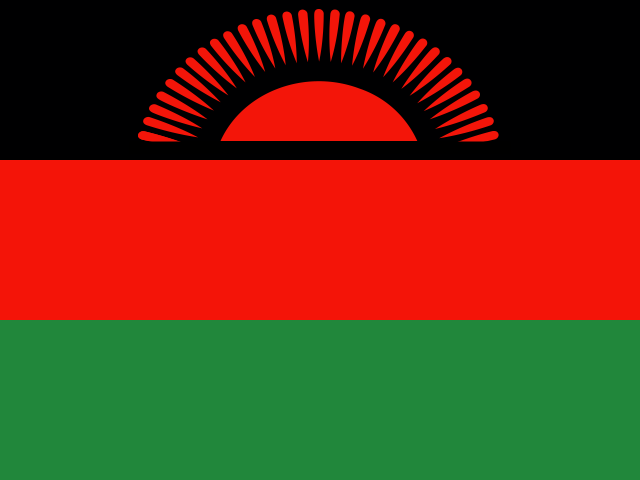
Three horizontal bands of black, red and green, with a red rising sun on the black band. The meanings are prescribed rather than conventional: the First Schedule to the Protected Flag, Emblems and Names Act gives the black as the people of the Continent of Africa, the rising sun as the dawn of hope and freedom for the whole Continent of Africa, the red as the blood of the martyrs of African freedom, and the green as the ever green nature of Malawi. Section 2 of the constitution says only that Malawi shall have a National Flag; the design and the meanings are set out in that Act. Parliament replaced the design in 2010 with one carrying a full white sun and restored it in 2012.
Malawi FACTS ◢
| Capital | Lilongwe |
|---|---|
| Continent | Africa |
| Population | 21,201,635 (2026) |
| Area | 118,484 km² |
| Population density | 179/km² |
| Currency | Malawian kwacha (MWK) |
| Official language | English |
| Calling code | +265 |
| Internet TLD | .mw |
| Time zone | UTC+02:00 |
| Drives on the | Left |
| ISO codes | MW / MWI |
DID YOU KNOW? ◢
- Lake Malawi holds more species of fish than any other lake on Earth, most of them found nowhere else.
- The lake stretches about 580 kilometres, covering roughly a third of the country.
- It's nicknamed 'the Warm Heart of Africa' for the friendliness of its people.
- Explorer David Livingstone reached the lake in 1859 and called it the 'Lake of Stars'.
Malawi QUICK ANSWERS ◢
What is the capital of Malawi?
The capital of Malawi is Lilongwe.
What is the population of Malawi?
Malawi had a population of 21,201,635 in 2026.
What currency does Malawi use?
Malawi uses the Malawian kwacha (MWK).
What languages are spoken in Malawi?
The official language of Malawi is English.
Think you know your flags? Play Flag Daily → · Browse all countries →
MORE ON THE FLAG ◢
Ask what Malawi's flag means and you will usually get four confident lines: black for the African people, red for blood shed for freedom, green for the land, and the rising sun for the dawn of independence. Only one of those four is close to the mark, and none of them is the wording that governs.
Malawi is one of the countries whose statute book answers the question outright. The Protected Flag, Emblems and Names Act, Chapter 18:03 of the Laws of Malawi, describes the flag in Part I of its First Schedule, and beneath the description, under the heading Significance, it assigns a meaning to each element in four short lines.
The constitution is a different matter. It mentions the flag once, in one sentence, and says nothing about what it looks like or what it stands for. That split is the whole story of this flag, because it is what made it possible to change the design in 2010 by ordinary legislation, and to change it back two years later.
Key Takeaways
- Malawi's flag meanings are prescribed by statute, in the First Schedule to the Protected Flag, Emblems and Names Act, not left to convention.
- The Act gives the green as the ever green nature of Malawi, not as the land, and the rising sun as the dawn of hope and freedom for the whole Continent of Africa, not as independence.
- Section 2 of the constitution is one sentence and carries no description. It is an entrenched section, so Malawi's entitlement to have a flag is harder to amend than the flag itself.
- A dimensioned drawing in the same Schedule spaces the sun's rays six degrees apart and names British Standard shade numbers for the red and the green. No ray count is legible anywhere in it.
- Parliament replaced the design in 2010 and restored it on 28 May 2012, and the consolidated Act records both amendments against the same Schedule.
| Date | What happened | Instrument |
|---|---|---|
| 6 July 1964 | The flag is first hoisted at independence | Not established here; no earlier Malawian instrument could be opened for this article |
| 28 July 1967 | The Act comes into force, describing the flag and assigning each element a meaning | Protected Flag, Emblems and Names Act, Chapter 18:03 |
| 18 May 1994 | The constitution comes into force with one sentence about the flag | Constitution, section 2 |
| 29 July 2010 | The replacement design is adopted, and is first hoisted on 7 August | Act 24 of 2010, per the consolidation's annotations |
| 28 May 2012 | Parliament passes the bill restoring the 1964 design | Act 10 of 2012, per the consolidation's annotations |
Malawi's statute book assigns each element a meaning
Part I of the First Schedule prints the design, then a short block headed Significance. It reads, in full and in the Act's own capitals:
"BLACK represents the people of the Continent of Africa."
"THE RISING SUN represents the dawn of hope and freedom for the whole Continent of Africa."
"RED represents the blood of the martyrs of African freedom."
"GREEN represents the ever green nature of Malawi."
Four lines, and each one is doing something slightly different from the paraphrase that circulates.
The black is the one line the paraphrase nearly gets. The Act does give it to the people of a continent. What the popular version adds, Britannica's account included, is "of the country", and the Schedule does not narrow it that way.
The red is not blood shed in general but the blood of martyrs, and again the martyrs of African freedom rather than of Malawian independence. The rising sun is not independence. It is the dawn of hope and freedom, and the Schedule extends that to the whole continent too.
The green is the one that gets rewritten most often. Accounts routinely give it as the land, or the vegetation, or the countryside. The Act says the ever green nature of Malawi, which is the only one of the four lines that is about Malawi rather than about Africa.
Read together, three of the four lines look outward to the continent rather than inward to Malawi. The Schedule says why for none of them.
Section 2 of Malawi's constitution is one sentence long
It says this, and only this: "Malawi shall have a National Flag, a National Coat of Arms, a National Anthem and a Public Seal."
That is the entire provision. There is no description, no ratio, no colour, no meaning. Anyone citing the constitution for what the Malawian flag stands for is citing a sentence that does not address the question.
The section is not trivial, though. It is listed in the Schedule of entrenched provisions, which states that the sections listed in it "shall not be amended except in accordance with section 196". Section 196 requires that the provision to be amended "have been put to a referendum of the people of Malawi and the majority of those voting have voted for the amendment", with the Electoral Commission certifying the result to the Speaker, unless the Speaker certifies that the amendment "would not affect the substance or the effect of the Constitution" and two thirds of the National Assembly vote for it.
So the sentence guaranteeing that Malawi has a flag is behind a referendum lock. The design of that flag is in the schedule to an ordinary Act, amendable by a simple parliamentary majority. That asymmetry is a consequence of the drafting rather than an accident in it, and in 2010 it mattered a great deal.
The Schedule draws the flag as well as describing it
The written description is compact: "From the top of the Flag to the bottom thereof, three equal horizontal stripes of black, red and green with a red rising sun superimposed in the centre of the black stripe." The Design block repeats it and adds the proportions, "Three to two", worked through in feet.
A dimensioned engineering drawing beneath it holds the real specification. The drawing is an image rather than text, so it is invisible to anyone searching the Act, and it fixes more than the prose does.
The drawing sets the flag out as 180 units by 120, with the top band 40 deep, and strikes the sun from a centre point on the boundary between the black band and the red one. The outermost arc, through the tips of the rays, is at radius 40, which is exactly the depth of the black band. A note with a leader to the ray tips reads "RED SUNRAYS" and then gives their spacing as six degrees equidistant.
Beside the drawing is a specifications note giving "British Standard Shade Number 0-005" for the red and "British Standard Shade Number 0-010" for the green. It leaves the black unspecified, and it does not say which British Standard it means. That is a lighter touch than the equivalent for the maritime signal flags, whose colours and shapes are set by an international code rather than by one country's statute.
No ray count appears in the Schedule's prose, and none is legible in the drawing. One short numeral sits on the same leader as the ray note, and it is not legible at the 700 dpi render, the highest available here. The figure of 31 that circulates is arithmetic rather than legislation: rays six degrees apart across a half circle come to 31 if the two lying along the horizontal are counted. That is a reasonable reading of the drawing. It is still not something the instrument states in words, and a flag quiz that marks you wrong on the count is testing a convention rather than a rule. If you want the harder version of that skill, Flag Daily gives you one flag and three guesses at the country.
The bands were a party flag before they were Malawi's
Those bands were not invented for the state. They were the colours of the Malawi Congress Party, the dominant political force at independence, and the national flag adopted on 6 July 1964 took them over. Britannica's account, written by the vexillologist Whitney Smith, records that the red half sun was added to the top stripe to distinguish the national flag from the party one.
There is a gap in the record here worth naming rather than papering over. The consolidated Act gives its commencement date as 28 July 1967, three years and three weeks after the flag was first flown. Some vexillological references date the Act itself to 1964, but the Act's own commencement line does not support that, and no earlier Malawian instrument prescribing the design could be opened for this article. What prescribed the flag between July 1964 and July 1967 is not established here.
Changing the flag in 2010 did not require a referendum
Because the design is set out in the schedule to an ordinary Act, changing it needed nothing more than an amending Act. In 2010 the government of President Bingu wa Mutharika brought one.
The consolidated Act, revised and consolidated in the Fifth Revised Edition of the Laws of Malawi, prints amendment annotations against the provisions each amending Act touched. Act 24 of 2010 appears against the definition of the National Flag, the definition of protected colours, several of the penalty provisions, the list of protected names, and at the foot of the First Schedule itself. Act 10 of 2012 appears in only two of those places: the protected colours definition and the foot of the First Schedule. The narrower footprint is exactly what a restoring amendment would look like.
Britannica dates the adoption of the replacement to 29 July 2010 and its first hoisting to 7 August, and describes it: "The stripes in the flag were reordered to red-black-green, and the rising half-sun was removed. In its place appeared a full white sun, with 45 rays radiating from it, centred in the flag." On the rationale it records that "whereas the half-sun symbolized the new emerging country", the full sun was taken to signify the country's maturity as a nation.
Mutharika made the same argument in his own words. In AFP's account of the launch he said the half rising sun was "inherited from the British as part of their claim that they had brought light in darkness", and added: "We don't have to live permanently in the past. There comes a time things have to change and the change of the flag was no exception." Leckford Thotho, described by AFP as the information minister, put it more plainly: "The symbol of the half rising sun at independence made a lot of sense because it was dawn for freedom and hope," and then, of the years since, "But there has been a lot of development that has taken place since and we cannot still be at dawn."
That is an argument about the Schedule's own words. The Act's Significance block gives the rising sun the dawn of hope and freedom, and the 2010 case for changing it was that the dawn was over.
The old flag lost the Act's protection
The Act that prescribes the flag also protects it, and the same short statute does both jobs. Section 4 of the Act makes it an offence to do any act or utter any words "calculated to or liable to insult, ridicule or to show disrespect to or with reference to the President, the National Flag", with the offender "liable to a fine of K250,000 and to imprisonment for two years". Section 4 carries a 2010 amendment annotation of its own, so the section as printed is at least partly the work of the same Act that changed the flag. What the amendment altered, the annotations do not say, and the K250,000 figure may or may not be its doing. Section 2 of the same Act defines the protected colours as "the colours of the National Flag, that is to say, black, red and green successively arranged in that order".
Once the Schedule was amended, the flag that had flown since independence was no longer the National Flag those provisions protected. The BBC's report is dated 16 August 2010, nine days after the launch. It says the government "has warned anyone who displays the country's old national flag will face arrest and prosecution", that the information minister spoke nearly a week after the launch, and that until then most government offices were still flying the old design. It does not say which provision the warning relied on. Football supporters turned up at a qualifier in Blantyre wrapped in the old flag anyway.
That is worth stating carefully. Nothing here shows that anyone was in fact prosecuted, only that the government said they would be.
How Parliament put the rising sun back
Mutharika died in April 2012 and was succeeded by Joyce Banda, who had said she would restore the old design. On 28 May 2012 the Minister of Justice and Attorney General, Ralph Kasambara, presented the amending bill and it passed on a voice vote.
Banda's stated reason was procedural rather than aesthetic. Opening the 2012 session she said that "there was no compelling reason for changing the independence flag" in the opinion of the Cabinet, and that the 2010 process had not involved adequate national consultation. Henry Phoya, the Leader of the House, told the chamber the change had been "an attack on nationhood", and the Mail and Guardian reports him making the consultation charge in the chamber too and calling the rising-sun design a "sacred symbol" of Malawian nationhood. John Tembo, the Leader of the Opposition, supported the bill.
Cost was part of the case against the change from the start. The Mail and Guardian put the bill to taxpayers at "2.6-billion kwacha", attributing the figure to local press reports rather than to any official account. In 2010 a group of Catholic priests had put the objection in a statement quoted by the BBC: "We have to change everything that bears the old flag. We could have better usage for that money considering that this year some parts of Malawi will starve," they said.
The Act as consolidated prints the description, the proportions and the Significance block with the rising sun back in place, and the two amendment annotations at the foot of the First Schedule are that Schedule's only trace of the intervening 22 months.
What could not be checked for this article
Two things, and both matter to the account this article gives.
The texts of Act 24 of 2010 and Act 10 of 2012 could not be obtained. MalawiLII holds the consolidated Act and no separate record of either amending Act. The Malawi Government Gazette for the relevant weeks sits behind a login on the archive that serves it. So the effect of each amendment is taken from the consolidation's annotation apparatus and from contemporaneous reporting, and not from the amending instruments themselves. Whether the 2010 Act rewrote the Significance block as well as the design is not established here.
The parliamentary record is also missing. The Malawi Parliament's own site is behind a bot challenge, and the archived copies of its Hansard collection cover 2007 and 2014 onward, with nothing from either 2010 or 2012. The debates are described here from press reports of the day rather than from the official record.
Frequently asked questions
What do the colours of the Malawi flag mean?
Malawian legislation prescribes them. The First Schedule to the Protected Flag, Emblems and Names Act gives the black as the people of the Continent of Africa, the red as the blood of the martyrs of African freedom, and the green as the ever green nature of Malawi. Two of those three are continental readings rather than national ones, and only the green is about Malawi.
What does the rising sun on the Malawi flag mean?
The Act's own words are that the rising sun represents the dawn of hope and freedom for the whole Continent of Africa. It is often paraphrased as the dawn of independence, which narrows it: the Schedule does not mention independence, and it extends the meaning past Malawi to the continent.
Does Malawi's constitution describe the flag?
No. Section 2 says only that Malawi shall have a National Flag, a National Coat of Arms, a National Anthem and a Public Seal. There is no description and no meaning in the constitution at all. The description and the meanings are in the First Schedule to the Protected Flag, Emblems and Names Act.
How many rays does the sun on the Malawi flag have?
The law does not give one in words. The Schedule's dimensioned drawing spaces the rays six degrees apart across the half circle, which yields 31 if the two lying along the horizontal are counted, and that arithmetic is where the widely quoted figure comes from. One short numeral on the drawing's ray note is not legible at the 700 dpi render, the highest available here, so a count in the drawing cannot be ruled out. Nothing in the Act's text fixes one.
When did Malawi change its flag, and when did it change back?
The replacement design, with a full white sun and the bands reordered, was adopted on 29 July 2010 and first hoisted on 7 August. Parliament passed the bill restoring the 1964 design on 28 May 2012, so the replacement was the national flag for roughly 22 months.
Sources
- Malawi Legal Information Institute, Protected Flag, Emblems and Names Act, Chapter 18:03, consolidated at 31 December 2014 in the Fifth Revised Edition of the Laws of Malawi (L.R.O. 1/2018). The First Schedule Part I description, proportions, Significance block, dimensioned drawing and specifications note, plus sections 2 and 4 and the amendment annotations for Act 24 of 2010 and Act 10 of 2012. Retrieved 27 August 2026.
- Malawi Legal Information Institute, Republic of Malawi (Constitution) Act, consolidated at 3 November 2020. Section 2 of the Constitution set out in that Act, section 196 and the Schedule of entrenched provisions. Retrieved 27 August 2026.
- Whitney Smith, Flag of Malawi, Encyclopaedia Britannica. Read from the Internet Archive capture of 26 December 2025, the live site being unreachable from here. The 1964 party-flag origin, the half sun added to distinguish the national flag, and the 2010 design and rationale. Retrieved 27 August 2026.
- BBC News, Malawi arrest warning over flying old flags, 16 August 2010. The arrest warning, and the statement by a group of Catholic priests about the cost of replacing everything bearing the old flag. Retrieved 27 August 2026.
- News24 / AFP, Malawi changes national flag, 8 August 2010. Mutharika's remarks at the Lilongwe rally and Leckford Thotho's comments. Retrieved 27 August 2026.
- Nyasa Times, Malawi Parliament approves to revert to original flag, 28 May 2012. The bill's presentation by Ralph Kasambara, the voice vote, and the remarks of Joyce Banda, Henry Phoya and John Tembo. Retrieved 27 August 2026.
- David Smith, New dawn: Malawi restores 'rising sun' flag, Mail and Guardian, 31 May 2012. Henry Phoya's consultation charge and his "sacred symbol" wording, and the 2.6 billion kwacha cost figure, which the paper attributes to local press reports. Retrieved 27 August 2026.
PLAY ANOTHER →
A short message, hidden in a different cipher every day.
ONE CIPHER A DAYDAILYDaily CryptogramOne quote, one scrambled alphabet. Crack it before tomorrow.
CRACK THE QUOTEDAILYOn This DayOne thing that happened today in history. Every day, a new one.
TODAY IN HISTORYDAILYDaily TriviaFive questions a day. Everyone gets the same five.
FIVE QUESTIONS