
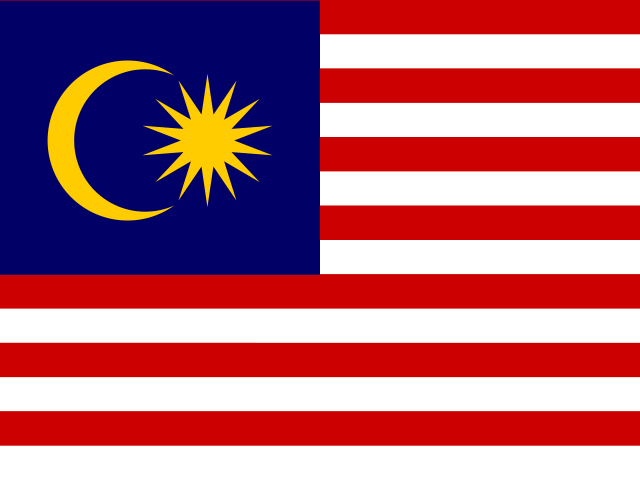
Malaysia
Split in two by the South China Sea, Malaysia keeps its cities on the peninsula and its rainforests on Borneo - home to some of the oldest jungle on the planet.
WHAT THE FLAG MEANS ◢
Fourteen alternating red and white horizontal stripes with a blue canton bearing a yellow crescent and fourteen-pointed star, the Jalur Gemilang. The Federal Constitution gives Parliament power over flags and emblems but nowhere describes the national flag or assigns it meanings. The official reading now current gives the fourteen stripes to the thirteen states together with the federal government, the red to bravery, the white to purity, the blue to unity, and the yellow of the crescent and star to the royal colour of the Malay rulers. The fourteen points of the star and the crescent as a sign of Islam are earlier official readings that the current one drops.
Malaysia FACTS ◢
| Capital | Kuala Lumpur |
|---|---|
| Continent | Asia |
| Population | 35,977,838 (2025) |
| Area | 330,803 km² |
| Population density | 109/km² |
| Currency | Malaysian ringgit (MYR) |
| Official language | Malay |
| Calling code | +60 |
| Internet TLD | .my |
| Time zone | UTC+08:00 |
| Drives on the | Left |
| ISO codes | MY / MYS |
DID YOU KNOW? ◢
- The Petronas Towers in Kuala Lumpur were the tallest buildings in the world from 1998 to 2004.
- Its share of Borneo holds rainforest estimated to be over 130 million years old, older than the Amazon.
- It's home to the rafflesia, which produces the largest individual flower on Earth.
- The country is split into two halves separated by hundreds of kilometres of sea.
Malaysia QUICK ANSWERS ◢
What is the capital of Malaysia?
The capital of Malaysia is Kuala Lumpur.
What is the population of Malaysia?
Malaysia had a population of 35,977,838 in 2025.
What currency does Malaysia use?
Malaysia uses the Malaysian ringgit (MYR).
What languages are spoken in Malaysia?
The official language of Malaysia is Malay.
Think you know your flags? Play Flag Daily → · Browse all countries →
MORE ON THE FLAG ◢
Malaysia has thirteen states. Its flag counts to fourteen twice, once in the stripes and once in the points of the star. The Malaysian government's current explanation of the stripes is that they mark thirteen states and one federal government.
That explanation is true of the flag today. It is not what the fourteen was for when it was chosen. On 16 September 1963 the Federation had exactly fourteen states, because Singapore was one of them, and Malaysia's Parliament was discussing the new flag's fourteen points in those terms four weeks before Malaysia Day.
Singapore was gone by August 1965. The constitution's list of states dropped to thirteen. The flag kept its fourteen, and what the fourteen is said to stand for changed.
Key Takeaways
- The Federal Constitution's own amendment notes take the Federation from eleven states in 1957 to fourteen on 16 September 1963, the fourteenth being the State of Singapore.
- A member of the Dewan Rakyat explained the star's fourteen points in August 1963 as one point per unit of the Federation, Sabah, Sarawak and Singapore among the units.
- Singapore's departure was backdated to 9 August 1965 in the constitution. A senator asked in December 1965 for the flag to be cut to thirteen. It never was.
- The Federal Constitution never describes the national flag. The word flag appears once in the whole document, in a list of things Parliament may legislate about.
- The name Jalur Gemilang was given in 1997. In the Attorney General's Chambers legislation database it appears no earlier than 31 October 2012, in a schedule of emblems and names no one may use commercially without the Minister's written permission.
Fourteen stripes, and a federation that had fourteen states
The Federal Constitution's own amendment notes record what the Federation's membership was in each of the relevant years, and the numbers line up.
On Merdeka Day in 1957, Article 1(2) read: "The States of the Federation are Johore, Kedah, Kelantan, Negeri Sembilan, Pahang, Perak, Perlis, Selangor and Terengganu (formerly known as the Malay States) and Malacca and Penang (formerly known as the Settlements of Malacca and Penang)." That is eleven.
The Malaysia Act, recorded in the reprint as Act 26/1963 and in force from 16 September 1963, rewrote the clause into three paragraphs. Paragraph (a) kept "the States of Malaya, namely, Johore, Kedah, Kelantan, Malacca, Negeri Sembilan, Pahang, Penang, Perak, Perlis, Selangor and Terengganu;", the same eleven. Paragraph (b) added "the Borneo States, namely, Sabah and Sarawak". Paragraph (c) read, in full, "(c) the State of Singapore."
That is fourteen states, and fourteen is the count on the flag, twice over.
Matching the flag's fourteen to that list of states is not a later invention. In the Dewan Rakyat on 20 August 1963, debating the constitutional amendment that would create Malaysia, Enche' Mohamed Asri bin Haji Muda, member for Pasir Puteh, argued about the new flag directly. He described it as carrying a "bintang 14 buchu yang erti-nya tiap satu buchu itu merupakan satu unit di-dalam negara Persekutuan", a fourteen-pointed star whose every point stands for one unit within the federal state.
His point was constitutional rather than decorative. If each Malayan state is a unit on the flag, he argued, then each Malayan state is the equal of Sabah, Sarawak and Singapore, and should have been given the same chance to take part in the negotiations that made the new federation. The flag was evidence in an argument about who counted.
A senator asked for thirteen, and nobody changed anything
Singapore separated in 1965, and the constitution treats the change as having taken effect on the day it happened. The reprint's note on Article 1 records that Act 59/1966 deleted paragraph (c), "in force from 09-08-1965 (i.e. the date Singapore left Malaysia)".
A little over four months after that date, on 22 December 1965, a member of the Dewan Negara pointed out that the flag had not followed. Enche' Amaluddin bin Darus put it plainly: "apabila Singapura keluar bererti satu bintang atau satu jalor di-dalam bendera kita ikut keluar", which says that when Singapore left, one star or one stripe in the Malaysian flag left with it.
He then asked for the change outright. "Dia mesti di-ubah sa-hingga tinggal angka 13-13 buchu bintang, 13 jalor di-bendera kita. Sampai hari ini Kerajaan belum mengubah." It must be altered down to thirteen, he said, thirteen star points and thirteen stripes, and to this day the Government has not altered it.
He offered two guesses at why. One was superstition about thirteen as a Western unlucky number, which he put to the Alliance ministers as a question. The other was that the Government was still hoping Brunei would join, a hope he dismissed.
No Malaysian instrument opened for this article records an answer. The flag still has fourteen of each.
The Department of Information's reading of the fourteen
The current official gloss is published on the government's MyGovernment portal, on a page headed Bendera Malaysia. The Malay page names its own source at the foot, "Rujukan: Jabatan Penerangan Malaysia", the Department of Information, and dates itself in the line below that: "Tarikh dikemaskini: 7/11/2025", 7 November 2025.
On the stripes it says: "Jalur-jalur ini menandakan keanggotaan 13 buah negeri dan sebuah kerajaan Persekutuan", the stripes mark the membership of thirteen states and one federal government. The page then names the fourteen: the thirteen states, and Wilayah Persekutuan as the fourteenth, with Kuala Lumpur, Labuan and Putrajaya in brackets after it.
Those three are the Federal Territories that Article 1(4) of the constitution excludes from state territory and declares to be territories of the Federation, and none existed in 1963. That clause names the Acts that established each of them: Kuala Lumpur was taken out of Selangor by a 1973 amendment, Labuan out of Sabah in 1984, Putrajaya out of Selangor in 2001. The fourteenth stripe's present occupants arrived one at a time across those twenty-eight years, long after the seat they stand in fell empty.
The colours get four short entries and nothing else. Red on the stripes is glossed as "gagah berani", bravery, and white as "suci murni", purity. Blue is described as symbolising "perpaduan melalui keamanan dan kepatuhan di kalangan rakyat Malaysia", unity through peace and obedience among Malaysians. Yellow gets the most careful sentence: "Digunakan pada bulan dan bintang adalah warna Diraja yang melambangkan Raja-Raja Melayu", used on the crescent and star it is the royal colour that stands for the Malay Rulers.
The page assigns the crescent no meaning of its own, and it never mentions the star's point count at all. Both are in the popular account and neither is there.
What Malaysian law actually says about the flag
Very little, and the gap between what people expect each instrument to say and what it says is the whole story.
| Instrument | What it says about Malaysia's national flag |
|---|---|
| Federal Constitution (Reprint 2020) | Nothing descriptive. The word flag occurs once, at Ninth Schedule, List I, item 4(g), as a federal legislative power |
| National Emblems (Control of Display) Act 1949 (Act 193) | Nothing. Its "national emblem" means the emblem of a foreign State, which it defines to exclude Malaysia |
| Emblems and Names (Prevention of Improper Use) Act 1963 (Act 414) | Names it, as Schedule Part I item 8 and Part II item 5, since 2012. Does not describe it |
| P.U. (B) 360/2012 | The notification that added the flag and its name to the Act 414 Schedule, dated 16 October 2012 and gazetted on 31 October 2012 |
The Federal Constitution's silence is the sharpest of the four. Searching the 2020 reprint, published by the Commissioner of Law Revision, the word flag occurs exactly once in the whole text, in any form, and it is in List I of the Ninth Schedule, which Article 74(1) identifies as the Federal List: "use or exhibition of coats of arms, armorial bearings, flags, emblems, uniforms, orders and decorations other than those of a State".
That is a grant of legislative power. The constitution says Parliament may make law about flags, and then says nothing at all about this one. Its Third Schedule is headed Election of Yang di-Pertuan Agong and Timbalan Yang di-Pertuan Agong, and concerns neither flags nor emblems.
The Act with National Emblems in its title is about other people's flags
The obvious place to look for a Malaysian flag law is Act 193. Its own section 2 defines the Act's subject as the flags of other countries, in wording short enough to check for yourself. The long title is "An Act to control the display of national emblems."
Section 2 defines a "national emblem" as "any flag, banner or other emblem being or purporting to be the flag, banner or other emblem of any State", which sounds like it covers the Jalur Gemilang until you read the next definition. In the same section, "State" means "any State or country, other than Malaysia and any State included in Malaysia".
So the Act's subject is expressly everything except Malaysia. In force in Peninsular Malaysia from 31 December 1949 and extended to Sabah and Sarawak in 1965, it bans the display of foreign flags in public or at any school, with exceptions for accredited diplomats and for vessels and aircraft. It has nothing to say about the national flag of Malaysia, and never did.
The Jalur Gemilang reached the Malaysian statute book in 2012
The Attorney General's Chambers legislation database returns six documents for the phrase Jalur Gemilang, and only two of them contain it: P.U. (B) 360 of 2012, and the consolidated text of Act 414 that carries what P.U. (B) 360 added. The other four are lists of licensed money changers and money-services businesses, in which the two words fall separately, inside company names. So in that database the flag's earliest appearance by name is 31 October 2012, when the Federal Government Gazette carried P.U. (B) 360.
It is a notification under section 7 of Act 414, made by the Yang di-Pertuan Agong, and it adds three lines to that Act's Schedule. To Part I it adds: "The Malaysian Flag - Jalur Gemilang." and an entry for ministry and federal agency emblems. It adds to Part II: "The name of the Malaysian Flag - Jalur Gemilang". The Malay text of the same instrument reads "Bendera Malaysia - Jalur Gemilang." and "Nama Bendera Malaysia - Jalur Gemilang."
Take the 2012 additions back out and what Part I protected before that date is the royal standards and seals, the Public Seal of the Federation, "The Federation Coat-of-Arms.", the United Nations emblem, the Orders and decorations instituted by statutes of the Yang di-Pertuan Agong, Interpol's emblem and the Central Bank's. The country's arms were on that list. Its flag was not.
What Act 414 does with the flag is narrow. It makes the flag a specified emblem and its name a specified name, which under section 3 means nobody may use either "for the purpose of any trade, business, calling or profession" without the Minister's written permission. Being a commercial-misuse statute, it still never says how many stripes the flag has, what colour they are, or what any of it means.
Parliament's own record dates the name to October 1997
The name can be dated from the other direction, by looking for the moment it starts being used.
Malaysia's Digital Hansard covers sittings from September 1959 to the present. Searching all three chambers, the phrase Jalur Gemilang returns 287 results, and the earliest falls in October 1997. In the thirty-eight years of record before that, it appears zero times. The word bendera, flag, occurs in almost every year of the same corpus from 1960 onward, so the silence is the phrase's and not the archive's.
The first hit is the Dewan Rakyat on 21 October 1997, where Abdul Hadi bin Haji Awang uses it in a speech about what independence should mean beyond flying a flag and singing the anthem. One follows in 1998 and two in 1999, then the count climbs through the 2000s.
The sourcing thins out on how the name was chosen, and two Malaysian newspapers tell it differently. The Star's QuickCheck column of 10 August 2026 says the idea came from Datuk Hashim Mat Idris, was put to Prime Minister Mahathir Mohamad on 11 July 1995, went to a committee chaired from the Prime Minister's Department, and produced a shortlist of Jalur Gemilang, Jalur Nusa Gemilang and Jalur Sinar Gemilang, from which the Cabinet chose. Free Malaysia Today, writing in September 2025, describes a 1997 naming competition limited to invited participants, lists Seri Setia Negara, Mega Perkasa and Tuah Nusa among the proposals, and has Mahathir making the choice himself.
The Star puts the moment two minutes before midnight on the eve of 31 August 1997, at Dataran Merdeka, for the fortieth anniversary of independence. Free Malaysia Today gives the year and not the night. Neither is a state record, and no Malaysian government instrument opened for this article records the naming at all. There is a state publication on the subject, and it is a book rather than an instrument: The Star's own source list names Menghormati Lambang-Lambang Kebesaran Negara, issued by the Department of Information in November 2020 under ISBN 978-983-54-0610-2. It is not one of the sources this article draws on, and nothing here rests on it. The statute book waited fifteen more years to notice.
The crescent, Islam, and a page that came down
The reading most accounts give, that the crescent stands for Islam, does have a state source. It is just not a current one, and it is not the law.
The MyGovernment portal's older page on the flag and coat of arms, captured by the Internet Archive in August 2009, is explicit on every point the present page leaves out. "The union contains a crescent which symbolises Islam, the official religion of Malaysia." And: "The 14 points of the star signify the unity of the 13 states with the Federal Government." And: "The colour yellow signifies the royal colour of the Rulers."
That same page is where the English gloss "Jalur Gemilang (Stripes of Glory)" sits, and it describes the flag as "14 horizontal red and white stripes of equal width (along the fly), representing the 13 component States and the Federal Government."
The current page keeps the royal yellow and drops the other two. Whether that is editing or policy is not something this article can establish, and the portal does not say. What can be said is that the crescent-means-Islam reading is the Malaysian government's own former wording rather than an outsider's invention, and that the constitution which does declare "Islam is the religion of the Federation", at Article 3(1), never connects that to the flag.
Gaps in the record before 1963
The design history before 1963 is the weakest part of the record here, and it is worth naming rather than papering over.
Parliament's Digital Hansard begins in September 1959, so the Federal Legislative Council proceedings of 1949 and 1950, in which the flag was chosen and adopted, fall outside it. The National Archives of Malaysia's online independence material carried, in an Internet Archive capture of April 2012, a piece about a flag: the lowering of the Union Jack at Padang Banda Hilir in Melaka on 30 August 1957. It does not mention the competition, the designer, or anything at all between 1948 and 1950, so it does not touch the design history.
So the account of the design competition here comes from Malaysian press reporting and not from a state record, and the two papers do not even agree on when it opened. The Star dates the competition to May 1948. Free Malaysia Today has the Federal Legislative Council launching it a year after the Federation of Malaya was formed in 1948, which puts it in 1949. From there they agree: 373 entries, a winning design by Mohamed Hamzah, a young architect in the Johor public works department, the Conference of Rulers approving it in February 1950 after asking that the crescent and star be recoloured from white to yellow, and the Federal Legislative Council adopting it on 19 April 1950.
Free Malaysia Today is also the only source here for what the flag counted before Malaysia: eleven stripes, and a star expanded from five points to eleven during the changes that preceded the 1950 approval, with three stripes added and the star taken to fourteen points when Malaysia was formed. No Malaysian state record opened for this article gives the eleven, or records the moment either count changed.
Treat all of that as newspaper history. What comes from the record itself is the constitution's fourteen states, the fourteen-pointed star the Dewan Rakyat was debating in August 1963, the fourteen stripes and fourteen star points a senator asked to have cut to thirteen in December 1965, and the change in what the fourteen is said to stand for.
If you want to see how much of a flag you actually retain, Flag Daily shows one flag a day and gives you three guesses at the country.
Frequently asked questions
What do the 14 stripes on the Malaysian flag mean?
The Malaysian government's MyGovernment portal, citing the Department of Information, says the fourteen stripes mark the membership of thirteen states and one federal government, and lists the thirteen states plus the Federal Territories of Kuala Lumpur, Labuan and Putrajaya to fill them out.
That is the current reading, and it is not the one Parliament was using in 1963. The federation then had fourteen states, Singapore included, and a member of the Dewan Rakyat described the flag's fourteen-pointed star that August as one point per unit of the Federation.
Why does the Malaysian flag have 14 stripes if Malaysia has 13 states?
Malaysia was formed on 16 September 1963 with fourteen states, Singapore among them, and just over two years later its Parliament was debating a flag of fourteen stripes and fourteen star points. Singapore's separation took effect on 9 August 1965 and the constitution's list of states dropped to thirteen. The flag was never altered to match.
A senator raised exactly this in the Dewan Negara on 22 December 1965, asking for thirteen stripes and thirteen star points. No Malaysian instrument opened for this article records a reply, and the government's published reading now gives the fourteenth stripe to the federal government, filled out with the three Federal Territories.
Does the crescent on the Malaysian flag officially mean Islam?
The Federal Constitution does not say so, and neither does either Act that touches national emblems, but the Malaysian government's own portal did. The constitution declares Islam the religion of the Federation at Article 3(1) and never mentions the flag. The MyGovernment portal's pre-2010 page said the crescent symbolises Islam as the official religion, and the portal's current flag page assigns the crescent no meaning at all.
So the popular reading is a state reading rather than an outsider's invention, and it is a withdrawn one. All the current page gives anywhere near the crescent is the colour: the yellow on the crescent and star as the royal colour of the Malay Rulers.
Does Malaysian law describe the national flag?
None of the Malaysian instruments that name or govern the flag describes its design. The word flag appears once in the Federal Constitution, in the Ninth Schedule list of matters Parliament may legislate about, and that is a grant of power rather than a description.
The National Emblems (Control of Display) Act 1949 is about foreign flags, since it defines State to exclude Malaysia. The Emblems and Names (Prevention of Improper Use) Act 1963 names the Jalur Gemilang in its Schedule, added by gazette notification in 2012, so that commercial use requires the Minister's written permission. None of them gives a stripe count, a colour or a meaning.
When did the Malaysian flag get the name Jalur Gemilang?
The name was given in 1997, for the fortieth anniversary of independence, and The Star places the moment on the eve of 31 August at Dataran Merdeka. Malaysian newspapers disagree about how it was selected, and the gazette notification that later put the name in the statute book does not record the naming either.
Parliament's Digital Hansard supports the date from the other direction. Across a corpus running from September 1959, the phrase does not appear once before October 1997, and the first sitting to use it is the Dewan Rakyat of 21 October 1997.
Sources
- Federal Constitution, Reprint as at 15 October 2020, Commissioner of Law Revision, Malaysia, via the Attorney General's Chambers Laws of Malaysia portal. Article 1, its amendment notes, Article 3(1) and the Ninth Schedule, List I, item 4(g). Retrieved 26 August 2026.
- National Emblems (Control of Display) Act 1949 (Act 193), Reprint as at 1 January 2006, Attorney General's Chambers. Long title and sections 2 to 5. Retrieved 26 August 2026.
- Emblems and Names (Prevention of Improper Use) Act 1963 (Act 414), online version of updated text as at 1 March 2018, Attorney General's Chambers. Sections 2, 3 and 7 and the Schedule. Retrieved 26 August 2026.
- P.U. (B) 360, Notification under Section 7 of the Emblems and Names (Prevention of Improper Use) Act 1963, Federal Government Gazette, 31 October 2012, published by the Attorney General's Chambers. Retrieved 26 August 2026.
- Bendera Malaysia, MyGovernment portal, Government of Malaysia, referenced on the page to the Department of Information. The Malay page is linked here and the English version sits at /en/government/learn-about-malaysia/flag-of-malaysia. Both read 26 August 2026.
- Malaysian Flag and Coat of Arms, myGovernment portal, Government of Malaysia. The page is no longer published on malaysia.gov.my. This link is the Internet Archive capture of 15 August 2009. Retrieved 26 August 2026.
- Bendera Union Jack Diturunkan di Melaka, Arkib Negara Malaysia, the National Archives of Malaysia, in the Internet Archive capture of 18 April 2012. The only National Archives page on a flag found for this article, and it is about the end of British rule in Melaka in 1957 rather than about the design. Retrieved 26 August 2026.
- Digital Hansard, Parliament of Malaysia. Dewan Rakyat sitting of 20 August 1963, Dewan Negara sitting of 22 December 1965, Dewan Rakyat sitting of 21 October 1997, and phrase counts across the September 1959 to August 2026 corpus. Retrieved 26 August 2026.
- Laws of Malaysia legislation search, Attorney General's Chambers. Full-text search of the legislation database for the phrase Jalur Gemilang, returning six documents, of which two contain the phrase. Retrieved 26 August 2026.
- QuickCheck: Is it true that the name "Jalur Gemilang" was only given to our flag in 1997?, The Star, 10 August 2026. Newspaper reporting, used only for the naming process and for the design competition, which it dates to May 1948. Retrieved 26 August 2026.
- The history of the Jalur Gemilang: from federation to flag gaffes, Free Malaysia Today, 21 September 2025. Newspaper reporting, and the source here for the design competition, which it puts a year after the 1948 federation, the flag's stripe and star-point counts before 1963, the three stripes and the fourteen-pointed star it says were adopted when Malaysia was formed, and the conflicting account of the 1997 naming. Retrieved 26 August 2026.
PLAY ANOTHER →
One quote, one scrambled alphabet. Crack it before tomorrow.
CRACK THE QUOTEDAILYDaily CodeA short message, hidden in a different cipher every day.
ONE CIPHER A DAYDAILYGuess the CountryThree clues, three guesses. Work out where in the world it is.
THREE CLUESDAILYDaily TriviaFive questions a day. Everyone gets the same five.
FIVE QUESTIONS