
Maldives
A scattering of nearly 1,200 coral islands spread across the Indian Ocean, the Maldives is the flattest country on the planet - you can't find a hill anywhere in it.
WHAT THE FLAG MEANS ◢
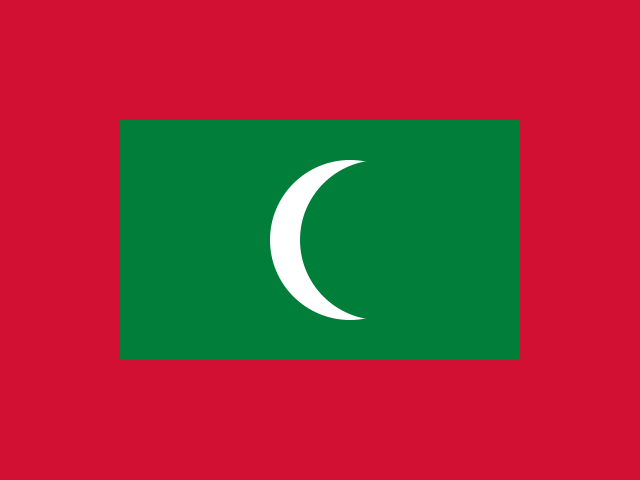
A green rectangle bearing a white crescent, surrounded by a red border. Schedule 3 to the constitution builds it precisely - the border a quarter of the flag's width, the crescent drawn from two points at nine sixteenths and five eighths along the green field and opening away from the staff when hoisted - and pins every colour to two British Admiralty Colour Code numbers, one for nylon worsted bunting and one for other bunting. It assigns none of them a meaning. A 2017 regulation on the flag's use calls the whole flag the symbol of the country's independence and sovereignty, and gives its parts nothing. The red is conventionally read for the blood of national heroes, the green for peace and prosperity, and the crescent for Islam.
Maldives FACTS ◢
| Capital | Malé |
|---|---|
| Continent | Asia |
| Population | 529,676 (2025) |
| Area | 298 km² |
| Population density | 1,777/km² |
| Currency | Maldivian rufiyaa (MVR) |
| National language | Dhivehi |
| Calling code | +960 |
| Internet TLD | .mv |
| Time zone | UTC+05:00 |
| Drives on the | Left |
| ISO codes | MV / MDV |
DID YOU KNOW? ◢
- It's the lowest-lying country in the world, with an average ground level of about 1.5 metres above sea level.
- It's made up of around 1,190 coral islands grouped into a chain of atolls.
- The word 'atoll' entered English from Dhivehi, the local language.
- Its territory is more than 99% water.
Maldives QUICK ANSWERS ◢
What is the capital of the Maldives?
The capital of the Maldives is Malé.
What is the population of the Maldives?
The Maldives had a population of 529,676 in 2025.
What currency does the Maldives use?
The Maldives uses the Maldivian rufiyaa (MVR).
What languages are spoken in the Maldives?
The Maldives designates no official language. The national language of the Maldives is Dhivehi.
Think you know your flags? Play Flag Daily → · Browse all countries →
MORE ON THE FLAG ◢
Red for the blood of national heroes, green for peace and prosperity, the crescent for Islam. That is the reading of the flag of the Maldives you will meet almost anywhere you look for one.
It is also not in the constitution, which is odd, because on every other question about this flag the constitution is extraordinarily talkative. It gives the border as a fraction of the width. It strikes the crescent from two named points measured in sixteenths and eighths along the green field. It fixes each of the three colours to a British Admiralty Colour Code number, then gives a second number for each in case the cloth is not nylon worsted.
Then it stops. Having specified the flag closely enough for a sailmaker to cut one without asking a question, it says nothing whatever about what any of it stands for.
Key Takeaways
- Article 12 of the 2008 constitution gives the composition, and its Schedule 3 builds the flag from fractions: width two thirds of length, red border one quarter of the width, and the crescent struck from points at nine sixteenths and five eighths along a centre line of the green.
- Schedule 3 of that constitution fixes each colour by British Admiralty Colour Code number, and gives two numbers per colour, one for nylon worsted bunting and one for other bunting.
- Neither Article 12 nor Schedule 3 assigns any element a meaning, and the flag reaches the constitution's operative text in only one other place, Article 67(i).
- A Maldivian instrument does assign the flag a meaning, but to the whole flag rather than its parts: a 2017 Home Ministry regulation opens by calling it the symbol of the country's independence and sovereignty.
- H.C.P. Bell's 1883 account of the islands describes the Maldive flag as flown on their vessels as plain red, only rarely relieved by a white crescent.
What Schedule 3 actually builds
Article 12(a) of the Constitution of the Republic of Maldives 2008 gives the composition in one sentence. The flag "consists of a white crescent in the centre of a green rectangle", and that rectangle is "surrounded by a red border". Article 12(b) then sends you to Schedule 3 for the "dimensions and colour code of the national flag and the placing of the crescent".
The arithmetic is in Schedule 3, which both texts set out in four headed parts: the flag itself, reproduced as a plate, and then Composition, Dimensions and Colours. Between the last three they leave the maker very little to decide, and the one thing they do leave open is settled by a separate sentence about how the flag is hung.
| What Schedule 3 fixes | The value it gives |
|---|---|
| Overall shape | Width two thirds of the length |
| Red border | One quarter of the width of the flag |
| Crescent arcs | Both radii one third of the width of the green rectangle |
| First arc centre | Nine sixteenths along the centre line, from one end of it |
| Second arc centre | Five eighths along the centre line, from the same end |
| Crescent placement | Struck on a centre line running the length of the green rectangle |
| Mounting | The crescent's outer edge to the flagstaff side |
| Green | British Admiralty Colour Code T 1143, or T 817 A |
| Red | British Admiralty Colour Code T 1144, or T 818 A |
| White | British Admiralty Colour Code T 1145, or T 819 A |
Those two arc centres make the shape between them. Both circles have the same radius, one third of the width of the green rectangle, and the second sits one sixteenth of the green field's length beyond the first. Take the second circle away from the first and what is left is a crescent lying at the end the measuring began from, its opening toward the other end. Which end that is decides which way the crescent faces, and the constitution's two texts settle that question by different routes. On the finished flag the convex edge is toward the staff and the opening faces the fly.
One small pleasure of reading the Dhivehi original: it writes those fractions as numerals rather than words. The forms 2/3, 1/4, 1/3, 9/16 and 5/8 sit on the page in Arabic numerals in the middle of the Thaana script. The 2017 regulation, restating the same figures nine years later, spells every one of them out in Dhivehi words instead.
The colours are British naval bunting numbers, not colour values
The Colours part of Schedule 3 does not print a colour value anywhere. It prints six catalogue numbers.
Each colour gets two, and the split is by material. Green is No. T 1143 "for nylon worsted bunting" and No. T 817 A "for other bunting". Red is T 1144 and T 818 A on the same terms, and white is T 1145 and T 819 A. The Dhivehi text transliterates the standard's name straight out of English, as ބްރިޓިޝް އެޑްމިރަލްޓީ ކަލަރކޯޑް in Thaana letters.
So this is a flag defined by reference to a British naval colour card, and the reference survived into a constitution ratified in 2008.
It is also a definition that does not resolve into anything a printer or a screen can use. A colour code of that kind points at a physical dyed sample kept as the standard rather than at a set of coordinates, and no published table of these particular Admiralty numbers turned up in the research for this article. So the constitution is at once more precise about its colours than most flag laws and less usable than any of them. It tells you exactly which shade, by pointing at a piece of cloth.
That gap between a legal colour and a visible one is worth keeping in mind the next time a flag looks almost right and you cannot say why. It is the position Flag Daily puts you in: one flag a day, three guesses at the country.
Nobody in the Maldives constitution says green is peace
Read Article 12 and Schedule 3 of the constitution end to end and there is no interpretive clause anywhere. No colour is given a referent. The crescent is a shape defined by two radii and two centres, and the schedule leaves it at that.
That is not because the document shies away from symbolism. Article 10 of the same constitution makes Islam the religion of the state and a basis of its laws, and Article 11 makes Dhivehi the national language. The constitution is perfectly willing to say what things are for. It simply never does it for the flag.
The flag reaches the constitution's operative text in only one other place. Article 67 lists the responsibilities of citizens, and paragraph (i) makes one of them "to respect the national flag, state emblem and the national anthem". That is a duty, not a gloss.
There is a structural reason to work from the Dhivehi rather than the English. The English text published by the President's Office is not the enacted instrument, and it says so on its own title page, which reads "Functional Translation of the Constitution of the Republic of Maldives", credited to Ms Dheena Hussain and prepared at the request of the Ministry of Legal Reform, Information and Arts. The Dhivehi is the text that was enacted, and the English was prepared afterwards at a ministry's request. On the question of meaning the two do not diverge at all. Both are silent.
So where does the familiar reading come from? Not from any Maldivian state page that could be opened for this article. One English wording turns up on a commercial Maldivian travel site rather than a government one, giving green to life, progress and prosperity, the crescent to the Islamic faith, and the red border to the sacrifices of national heroes in the fight for independence and sovereignty. It reads like an old tourism-board text, and it may well be one, but no organ of the Maldivian state was found publishing it.
There is more than one such wording. That commercial page gives green to life, progress and prosperity, where the familiar reading gives it peace and prosperity. No publisher of the familiar wording was tracked down for this article either; what can be said is that it is not the commercial one's. The two are close enough to pass for each other and different enough that neither can be quoting the other, which is roughly what you would expect of a reading that no instrument fixes.
Where a Maldivian instrument does say what the flag stands for
The constitution is not the last word. On 8 March 2017 the Ministry of Home Affairs published a regulation in the Government Gazette, volume 46, issue 44, on the use of the Maldivian national flag.
Article 1(a) of that regulation, its opening clause, carries the only assignment of meaning by a Maldivian instrument that this research turned up. It states that the flag is the symbol of the country's independence and sovereignty: the operative words are މިނިވަންކަމާއި ސިޔާދަތުގެ ރަމްޒެވެ in the Dhivehi. Everything else in the regulation follows from that, and its stated purpose is to honour the flag, ޙުރުމަތްތެރިކޮށް ހިތުމަށްޓަކައި in the same clause, by setting out where it may be used, how it is to be placed, and the standards and sizes to be observed.
Note carefully what that does and does not do. It gives a meaning to the flag entire. It says nothing about the green, the red, the white or the crescent, and Article 2 of the same regulation restates the constitutional geometry and all six Admiralty numbers without adding a word of interpretation.
The distinction matters, because the popular reading is a reading of the parts. The state has said what the object means. It has never said what the colours mean.
Which way the crescent faces, and why it keeps having to be said
Here the Dhivehi and the English part company, and it is one of the clearest illustrations of why the original text is worth the trouble.
The functional translation closes the Dimensions paragraph with "When the flag is hoisted the curvature of the crescent should face out." Face out from what? The sentence can be read two ways and neither is obviously right.
The Dhivehi is not ambiguous. It puts the rule the other way round and says the outer edge of the crescent shall be on the flagstaff side, ހަނދުފަޅީގެ ބޭރުކައިރި ދިދަ ދަނޑިއާވީ in the 2017 regulation's wording of the same rule. Convex side to the staff, horns pointing out to the fly. The English leaves that sentence open. The Dhivehi does not.
There is a second difference between the two texts in the same paragraph, and it runs the other way. The two arc centres are given as fractions along a line drawn down the length of the green, and the Dhivehi takes the first fraction from one end of that line and the second from the same end. It never says which end. The English names one: the fractions are measured, it says, from "the side nearer to the staff".
The end decides the answer. Both circles have the same radius and the second centre is the further along, so the crescent left when the second circle is taken from the first lies at the end the measuring began from, with its horns pointing away. Begin at the staff and the crescent opens to the fly. Begin at the fly and it opens back at the staff.
So each text pins the orientation, and each pins it with a different sentence. The English fixes the end the fractions are measured from and then renders the mounting rule vaguely. The Dhivehi leaves the end open and relies on the mounting rule instead. Read either text whole and the same flag comes out.
It is not the first time somebody has had to settle it. The Admiralty's flag book, Drawings of the Flags of All Nations, was ordered to carry a plate of Maldivian flags under an authority numbered N.L. 642/35. Amendment slips pasted into a surviving copy show the Admiralty correcting that plate afterwards under two authorities, S.D. 412/40 and N.L. 520/41. The digits after the stroke are the year, which is how the sequence is dated here.
The 520/41 slip says of the Sultan's Flag that "The position of the crescent and star should be reversed so that the crescent is nearest the head of the flag facing the fly." The same slip then deletes the item the plate had labelled National Flag, states that the national flag is instead the one the plate describes as flown on Government buildings, and adds of that one: "The crescent should be reversed so that it faces the fly of the flag."
The plate itself is not bound into the copy consulted; three inked marginal notes send the reader to a supplementary volume, which was not opened. What survives is the correction, and the correction is the point. The Admiralty in 1941 and the constitutional drafters in 2008, sixty-seven years apart, both found the orientation of this crescent worth stating in terms. That is a fair sign it is easy to get wrong, and it is one of the things that separates this flag from other crescent flags such as Pakistan's, which sets its crescent beside a white bar at the mast.
What the Maldives flew before the green rectangle
The oldest firm description of a Maldivian flag reachable for this article is a footnote. H.C.P. Bell's 1883 account of the islands, written for the Ceylon government, records that in 1753 the Dutch authorities at Batavia extended to the Maldives the privilege of flying a flag and pennons, which Bell reads as a virtual recognition of the islands' quasi independence. He then adds, in the footnote to that sentence:
"The Máldive flag as displayed on modern gundras is the ordinary plain Muslim red, rarely relieved by a white crescent."
Bell glosses gundras elsewhere in the same book as Maldive vessels. So the flag reported on Maldivian vessels in 1883 was red, plain, and only sometimes carried a crescent at all. No green, and no border.
Xavier Romero-Frias reaches the same picture from Maldivian sources. His paper, hosted by the Maritime Asia Heritage Survey at Kyoto University, opens with a commission: in 1987 Ahmed Shafeeg told him somebody should publish an account of all the flags of the Maldives, and he set out to do it and found the material thin. It states flatly that "Before the beginning of the 20th century there was no such thing as a national flag of the Maldives." What existed were royal standards, pennons and streamers, chiefly in the royal red, a colour he was told had been chosen for its visibility against the sea. Not all of them: he records that the royal three-tailed flags were white, among them the Amān Dida, the flag of surrender, carried before the king in procession to signal that his intentions were peaceful. He dates the first national flag to about 1903, a red rectangle with a band of small black and white parallelograms at the hoist called the daṇḍimati. He also records that a rectangular royal standard bearing a crescent and star was designed in the 1930s to replace the older pennons. That is very likely the flag the Admiralty's Plate 27A carried as the Sultan's Flag, since the 1941 correction slip describes that flag as bearing a crescent and a star. It is an inference from two records rather than a documented identification, and the plate itself was not available to check.
His account is oral history and he says so, naming the Maldivian historians he consulted and noting where they disagreed with each other and with the printed sources. He is explicit that the decree that would have dated the hoist band has been lost. Take the dates as the best available rather than as documented.
What is not established by anything opened for this article is when the green rectangle arrived, or when the black and white hoist band was dropped. Both changes are commonly dated to the twentieth century and the second to independence in 1965, and no Maldivian state source carrying either date could be opened from here. The Admiralty slips do at least bracket the crescent. By 1941 the Royal Navy understood the Maldivian national flag to be the one flown on government buildings and to carry a crescent, because it went to the trouble of correcting which way round that crescent should face.
Eight sizes for official use, a round-the-clock list and a right-hand rule
Past that opening clause, the 2017 regulation stops interpreting and starts prescribing. It is a practical code, and reading it tells you more about how the Maldives treats its flag than any colour gloss would.
It prescribes eight sizes for general use on government buildings and at official occasions, every one of them in the constitutional two-thirds proportion, running from 270 by 180 centimetres down to 24 by 16, and requires that the size chosen suit the place. Making the flag at other sizes is allowed elsewhere in the same regulation, provided the proportions hold. It lists nine entries where the flag flies around the clock, including the President's Office, the presidential residence, the People's Majlis chamber, the Supreme Court and the headquarters of the defence force and the police, with any further place the government designates as the ninth. Where it flies overnight it must be lit. Everywhere else on its lists, which cover state institutions, government offices and companies, and registered political party offices, the flag goes up at six in the morning and comes down at six in the evening.
It requires the flag to be replaced once its colour has changed or the cloth is worn or damaged. It forbids any other flag on an island from being flown higher than the highest national flag a state institution, government office or company flies there. Where the national flag is displayed alongside another it takes the right-hand position, and it may be crossed only with the flag of an independent country.
It permits a great deal too. Flying and waving the flag anywhere as an expression of national feeling is allowed outright, and so is carrying it at gatherings, rallies and marches, with responsibility for the flag's dignity resting on whoever organises them. Badges, stickers, logos and cufflinks bearing it are permitted. A fringe in gold or a colour close to it is confined to a short list of presidential settings. The President's own flag is the national flag with a five-pointed star set inside the crescent, ފަސް ފިޔައިގެ ތަރިއެއް in the regulation's words, and nobody else may use it or anything resembling it.
That regulation is the only instrument with the flag in its title in the Government Gazette, whose searchable run begins in 2013. Until something more reaches the gazette, the Maldivian flag is defined by a constitutional schedule that measures it to a sixteenth and interprets nothing, and governed by a ministerial regulation that names it a symbol of independence and then gets on with the practicalities. Other states divide that work between instrument and interpretation quite differently, which you can see across the country factsheets.
Frequently asked questions
What do the colours of the Maldives flag mean?
No Maldivian instrument opened for this article assigns the colours a meaning. The 2008 constitution defines the green, red and white by British Admiralty Colour Code number and stops there, and the 2017 national flag regulation restates those numbers without interpreting them. Two wordings answer the question instead, and they differ: the familiar one gives green to peace and prosperity, red to the blood of national heroes and the crescent to Islam, while a version on a commercial Maldivian travel page gives green to life, progress and prosperity. Neither was traced to a publisher for this article, and no government source carrying either could be opened.
Does the Maldives constitution say what the flag means?
It does not. Article 12 of the 2008 constitution gives the composition, its Schedule 3 gives the dimensions and the colour codes, and neither assigns any element a referent. The flag reaches the constitution's operative text in only one other place, Article 67(i), which makes respecting it a responsibility of citizens.
Which way does the crescent on the Maldives flag point?
Its opening faces the fly, away from the flagstaff. The Dhivehi text of Schedule 3 of the 2008 constitution puts it the other way round and says the crescent's outer edge goes toward the staff, which comes to the same thing. The English functional translation renders that mounting rule vaguely, as the curvature facing out, but the same paragraph settles the question a second way, by measuring both arc centres from the side nearer to the staff. Each text fixes the orientation with a different sentence, and the two agree.
What are the official colours of the Maldives flag?
Schedule 3 of the 2008 constitution gives six British Admiralty Colour Code numbers. Green is T 1143 for nylon worsted bunting and T 817 A for other bunting, red is T 1144 and T 818 A, and white is T 1145 and T 819 A. These are catalogue references to standard bunting shades rather than colour values, so no official hex or Pantone equivalent follows from the constitution.
Who is allowed to fly the Maldives flag?
Anyone may fly it, under the 2017 regulation of the Ministry of Home Affairs. Flying the national flag anywhere as an expression of national feeling is expressly permitted there, as is carrying it at gatherings, rallies and marches. Permanent display at a place not on the regulation's own lists needs written permission from the ministry, and the regulation's Article 11 provides that the flag may not be used except as the regulation allows. The President's flag, which is the national flag with a five-pointed star inside the crescent, is reserved to that office and may be used by nobody else.
Sources
- Constitution of the Republic of Maldives 2008, Dhivehi original, People's Majlis - Article 12 and Schedule 3. Read from the Internet Archive Wayback Machine capture of 13 June 2010, retrieved 27 August 2026. The file's own creation date is 7 August 2008.
- Constitution of the Republic of Maldives 2008, English text, The President's Office - titled a Functional Translation, by Ms Dheena Hussain at the request of the Ministry of Legal Reform, Information and Arts. Retrieved 27 August 2026.
- Ministry of Home Affairs, regulation on the use of the Maldivian national flag, Government Gazette of the Maldives, volume 46, issue 44, 8 March 2017 - retrieved 27 August 2026.
- H.C.P. Bell, The Maldive Islands: An Account of the Physical Features, Climate, History, Inhabitants, Productions, and Trade (Colombo, 1883), pages 26 and 33, Internet Archive - retrieved 27 August 2026. The scan is the Asian Educational Services reprint of 2004, which keeps the original pagination.
- Admiralty, Drawings of the Flags of All Nations, 1930 edition with pasted amendment slips for Plate 27A, Internet Archive - retrieved 27 August 2026.
- Maldives Traveller, Where is Maldives located and country profile - retrieved 27 August 2026. Cited only as one example of the circulating colour gloss. It is a commercial site, published by Tropical Paradise Private Limited per its own footer, not a Maldivian government publication.
- Xavier Romero-Frias, Ancient Flags of Maldives, undated, Maritime Asia Heritage Survey, Center for Southeast Asian Studies, Kyoto University - retrieved 27 August 2026.
PLAY ANOTHER →
Three clues, three guesses. Work out where in the world it is.
THREE CLUESDAILYDaily TriviaFive questions a day. Everyone gets the same five.
FIVE QUESTIONSDAILYOn This DayOne thing that happened today in history. Every day, a new one.
TODAY IN HISTORYDAILYDaily CryptogramOne quote, one scrambled alphabet. Crack it before tomorrow.
CRACK THE QUOTE