
Pakistan
Pakistan runs from the Arabian Sea coast up to some of the highest mountains on Earth, packing over 220 million people into the world's fifth-most-populous country. The Indus River has fed civilisations here for millennia.
WHAT THE FLAG MEANS ◢
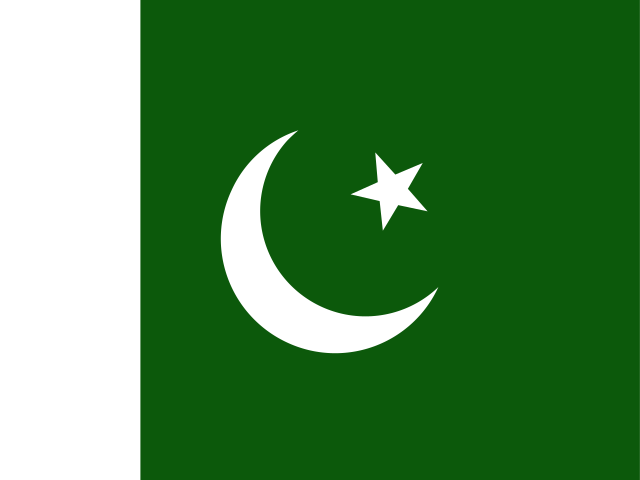
A dark green field with a white vertical bar at the mast, a white crescent on the green and a five-pointed white heraldic star. The design comes from a 1947 Constituent Assembly resolution which sets out its geometry and assigns no meanings, and no Pakistani constitution mentions the flag. The white was explained at adoption as the space for the country's religious minorities. The green is conventionally read for the Muslim majority, and the crescent for progress and the star for light and knowledge, but no instrument assigns those.
Pakistan FACTS ◢
| Capital | Islamabad |
|---|---|
| Continent | Asia |
| Population | 255,219,554 (2025) |
| Area | 796,096 km² |
| Population density | 321/km² |
| Currency | Pakistani rupee (PKR) |
| Official languages | English, Urdu |
| Calling code | +92 |
| Internet TLD | .pk |
| Time zone | UTC+05:00 |
| Drives on the | Left |
| ISO codes | PK / PAK |
DID YOU KNOW? ◢
- It shares K2, the world's second-highest mountain, on its border with China.
- The ancient Indus Valley Civilisation, with planned cities like Mohenjo-daro, flourished here over 4,000 years ago.
- The Karakoram Highway, linking Pakistan and China, is one of the highest paved international roads on the planet.
- Its national sport, field hockey, has brought the country multiple Olympic gold medals.
- The markhor, a wild goat with corkscrew horns, is its national animal.
Pakistan QUICK ANSWERS ◢
What is the capital of Pakistan?
The capital of Pakistan is Islamabad.
What is the population of Pakistan?
Pakistan had a population of 255,219,554 in 2025.
What currency does Pakistan use?
Pakistan uses the Pakistani rupee (PKR).
What languages are spoken in Pakistan?
The official languages of Pakistan are English and Urdu.
Think you know your flags? Play Flag Daily → · Browse all countries →
MORE ON THE FLAG ◢
Ask what the crescent and star on Pakistan's flag stand for and you will be told the crescent is progress and the star is light and knowledge, as the summary further up this page does. That reading is Pakistani and it was official. The earliest copy of it anyone can now open is a web page from 2004, its publisher was a ministry site that no longer resolves, and the document that adopted the flag does not contain it.
The resolution the Constituent Assembly of Pakistan passed on 11 August 1947 runs to about 285 words. It fixes a ratio, names its two colours, sets the width of the white bar, and then gives a construction: draw this diagonal, mark these two points, swing these two arcs. That is the whole of it. Nothing in it says what any part of the flag stands for.
This is the gap between those two things, and where each of the familiar meanings actually comes from.
Key Takeaways
- The flag was moved, debated and adopted in one sitting on 11 August 1947, three days before independence.
- The resolution is a drawing instruction. It assigns the green, the white, the crescent and the star nothing.
- "The crescent on the Flag represents progress" is the wording of a Ministry of Information page whose domain no longer resolves.
- The national anthem, in the state's own English rendering, says the flag leads the way to progress and perfection. It says it of the whole flag.
- None of Pakistan's three constitutions, of 1956, 1962 and 1973, contains the word "flag", in the National Assembly's published edition to February 2012.
| Instrument | Date | What it says about the design | What it says the design means |
|---|---|---|---|
| Constituent Assembly resolution | 11 August 1947 | Ratio, dark green, white bar, arcs for the crescent and star | Nothing |
| Constitutions of 1956, 1962 and 1973 | 1956, 1962, 1973 (1973 text read to Feb 2012) | Nothing. The word "flag" does not appear | Nothing |
| Pakistan Names and Emblems Act, Schedule | 30 April 1957 | "The Pakistan flag", four words, no description | Nothing |
| Cabinet Division flag instructions, para. 41 | notified 31 December 2025 | Reproduces the 1947 resolution, with two passages missing | Nothing |
| Ministry of Information website | captured 2004 and 2009 | Green, white bar, crescent, a star it calls five-pointed then five-rayed | Progress, light and knowledge, minorities, Muslim majority |
| National anthem, official English rendering | approved August 1954 | Names the flag only | "Leads the way to progress and perfection" |
Pakistan's flag resolution of 11 August 1947, line by line
Liaquat Ali Khan, sitting for East Bengal, moved it. The Assembly's own record prints the text he read.
It opens with the shape: "A dark green rectangular flag in the proportion of length to width 3 : 2 with a white vertical bar at the mast, the green portion bearing a white crescent in the centre and a five pointed white heraldic star."
Then the proportions: "The size of the white portion being one-fourth the size of the flag, nearest the mast, the remainder three-fourths being dark green."
Then, for the rest of its length, geometry. Draw the diagonal from the top right corner of the green portion to the bottom left. Mark point A at the centre of the green portion and point B at "13/20th the width of the flag" from the top right corner. Swing an arc of radius "3/10th the width of the flag" from A and a second of radius "1.1/4 th the width of the flag" from B. "The enclosure made by these two arcs forms the crescent."
The star gets the same treatment. Its size comes from "a circle 1/10th the width of the flag" that "surrounds the five points of the heraldic star", and its placement from where the crescent's larger arc, if completed, cuts the diagonal, with one of its points aimed at the top right corner.
That is the end of the resolution. No colour is explained, no charge is interpreted, and the words progress, knowledge, Islam and minority appear nowhere in it. If you want to know what the flag means, the founding instrument is not merely silent by omission. It is silent while being extremely talkative about everything else.
One thing to expect if you read the record yourself. The members speak throughout of the flag having to fly on the 15th, Liaquat Ali Khan warning that it would be odd if "on the 15th, when the Pakistan State is born, that State should have no national flag". Pakistan keeps 14 August as Independence Day, and the flag instructions in force list it that way, so the debate and the modern calendar are a day apart on the page.
So who says the crescent means progress?
The Ministry of Information and Broadcasting did, on a website called infopak.gov.pk.
Its flag page ran a three-line gloss. "The white and dark green field represents Minorities & Muslim majority, respectively.", then "The crescent on the Flag represents progress.", then "The five-rayed star represents light and knowledge." The Internet Archive has that wording at two different addresses on the site, one captured in December 2004 and one in March 2009, so it was still there four years later.
That is a Pakistani state source, and it is where the reading traces back to. The English Wikipedia article on the flag cites that exact archived page, and nothing else, for its crescent-and-star clause. It is also the weakest possible thing to be resting on, for three reasons.
The domain is dead. infopak.gov.pk no longer resolves in DNS at all, so the page is reachable only through an archive. The Ministry's current website links no replacement for it.
The same page makes a claim the 1947 record contradicts. Its first sentence reads: "The Pakistan Flag was designed by Quaid-i-Azam Muhammad Ali Jinnah, the founder of Pakistan." On the floor of the House the man moving the resolution told the Assembly the flag had been designed in Delhi by a group of them, and named nobody.
And the page cannot keep the star straight within its own gloss. Describing the flag it says "a five-pointed star", which is the resolution's charge; interpreting it further down the same page it says "The five-rayed star represents light and knowledge." A page that changes the charge between describing it and interpreting it is not reading from the resolution when it interprets.
The Ministry of Foreign Affairs today publishes a page headed "Pakistan's Flag" under its National Symbols menu, and it consists of an image with no prose on it at all, assigning no meaning to anything.
The mover was asked about the crescent, and answered about the moon
The most interesting thing about the 11 August sitting is that the symbolism question was put directly, by the opposition, and got an answer that appears in none of the modern glosses read for this article.
Dhirendra Nath Datta objected that the design was too close to the Muslim League's: "this flag is almost identical with the Party flag of the Muslim League." Liaquat Ali Khan denied both that and any religious character, then said this about the charges themselves: "As a matter of fact, moon and stars are as common to my Honourable friend and they are as much his property as mine."
Kiran Sankar Roy pushed: "Would you have the sun also, which is also a common property ?"
Liaquat's reply is the only point in the debate where anything at all is read into the crescent, and it is not progress: "The only objection is that the sun's heat is scorching and moon's light is soothing. I do not want our flag to be scorching. I want our flag to give the light that will soothe the nerves."
Datta then supplied the word the modern gloss uses, and he supplied it about the wrong body: "Sun indicates rapid progress." The word progress occurs exactly once in the whole flag debate, and that is the occurrence: an argument for putting a sun on the flag instead of a moon.
On the colours generally, Liaquat was blunt about the whole exercise: "it is not really the piece of cloth of the Flag that matters. It is not its colouring that matters. But it is what the Flag stands for", which he then gave as "Freedom, Liberty and Equality of all the citizens of the Pakistan State".
The one element he did explain is the white. "we have tried to give quite a prominent place to white in this flag which I have presented. More than one-fourth of the flag is white, and, as my Honourable friends know, white is made up of seven different colours and thank God we have not got seven different minorities in Pakistan. Therefore, there is room for not only all the minorities that are today but for any other minorities that might spring up hereafter."
So of the four elements people ask about, only the white gets a plain explanation from the mover on the day of adoption. That reading is better attested than the other three.
Two more things from the same exchange are worth having. Bhim Sen Sachar moved an amendment to hand the design to a seven-member committee of Kiran Sankar Roy, Dhirendra Nath Datta, himself and four members the President would nominate, reporting by ten o'clock the next morning; it was negatived, and Kiran Sankar Roy then told the House "we accept this Flag as the Flag of the State." And on who drew it, Liaquat said only: "This Flag was designed in Delhi by a few of us", adding that even the Muslim members of the Assembly were seeing it for the first time. He named nobody. No Pakistani instrument names a designer either.
The Congress tricolour is how India comes into a Pakistani flag debate, Datta arguing that it stood for the virtues of the nation rather than for a community. He and Kiran Sankar Roy both sat for East Bengal, now Bangladesh, as did Liaquat Ali Khan himself.
The national anthem ties the flag to progress. The flag rules never do
One Pakistani state text does put the flag and progress together, and it is not a statute. It is the national anthem, approved in August 1954, with verses by Abul Asar Hafeez Jullundhri.
The verses are in Urdu, and the Ministry of Information published its own English wording of them. One line reads "This Flag of the Crescent and Star", and the line directly beneath it reads "Leads the way to progress and perfection".
That makes the anthem the only Urdu text among the instruments this article has read. The resolution, the 1957 Act, the three constitutions and the flag instructions are all in English, which Article 251 of the 1973 Constitution permits "for official purposes until arrangements are made for its replacement by Urdu", the national language it names in the clause above.
That matters in two directions. It is a real official association of the flag with progress, which is more than the resolution offers. But it is said of the flag entire, not of the crescent, and a line of verse is not a definition. Turning a line about the whole flag leading the way into a statement that the crescent represents progress is the sort of move that happens between a poem and a fact sheet, and once it has happened it is very hard to walk back.
The state emblem shows how differently the same charges get read when a different page is doing the reading. The Ministry's emblem page describes its crescent and star crest as "a traditional symbol of Islam". Its flag page describes the flag's crescent as progress. Same ministry, same two shapes, two incompatible glosses, and the man who moved the flag resolution had denied that the flag was a religious one at all.
No Pakistani constitution mentions the flag
This is worth stating flatly because it is easy to assume the opposite. The 1973 Constitution, in the National Assembly's own published edition as modified up to 28 February 2012, contains no flag provision anywhere: not in the articles, not in the schedules, not in the Federal Legislative List. The word does not occur, and neither does emblem, insignia or anthem.
Nor did its predecessors. The Constitution of 1956 and the Constitution of 1962, both published by the Council of Common Interests, contain the word "flag" zero times each. Seventy years of constitutional drafting, in the editions read for this article, has produced no description of the national flag and no statement of what it means.
The federal statute book is nearly as quiet. Reading the Pakistan Code's own A-to-Z index of federal laws end to end, 1,369 title rows, exactly one names the subject: the Pakistan Names and Emblems (Prevention of Unauthorised Use) Act, 1957. Its definition clause makes "emblem" mean "the flag, emblem, seal, insignia or coat-of-arms specified in the Schedule", and the Schedule's second item reads, in full: "The Pakistan flag."
Four words. The Act's job is to stop people putting the flag on trade marks and patents without permission, and the consolidated text records a fine cap now standing at fifty thousand rupees. It does not describe the flag and it does not interpret it.
The rules in force today copy 1947, and the copy has a hole in it
Day-to-day, the flag is governed by the "Instructions on the Design and Use of the Pakistan Flag and Use of Flags of Foreign Countries in Pakistan, 1989", issued by the Ministry of Interior on 13 April 1989 and reissued by the Cabinet Division, updated, on 20 October 2025 and again on 31 December 2025. They are live law: on 13 August 2026 the Cabinet Division invoked "the proviso to Paragraph 32" of them to let the flag fly around the clock at Yadgar-e-Fatah in Islamabad.
Forty-three paragraphs cover when to fly it, who may fly it on a car, how to hang it on a wall, and how to dispose of one that is finished, "preferably by burning". None of them says what it means.
Paragraph 41 supplies the description, and it does so by reproducing the 1947 resolution. Before the 2025 rewrite the Cabinet Division published, as its authority on the design, a photocopy of pages 21 and 22 of the Constituent Assembly Debates, highlighter marks and all. It is still on the site.
Set the reproduction beside the original and a passage is missing. Where 1947 reads "With centre point 'A' and radius 3/10th the width of the flag describe the arc of a circle. With centre point 'B' and radius 1.1/4 th the width of the flag describe a second arc", the notified 2025 text reads only "With centre point 'A' and radius 1.1/4th the width of the flag describe a second arc." The 1.1/4 fraction is set as each source prints it, the 1947 page with a space and the 2025 notification without; the difference is typographic and carries no meaning.
A complete sentence and the opening of the next have dropped out, and the consequences run together. The first arc is gone. The second arc's centre has moved from B to A. Point B is still defined in the sentence before and is now never used for anything. And the very next sentence still says "The enclosures made by these two arcs form the crescent", when only one has been described.
A second elision hits the star. The 1947 text has it lying "with one point on the diagonal and pointing to the top right hand corner of the flag", with the tip of that point landing where the extended arc cuts the diagonal. The 2025 text runs the two sentences together and loses the orientation clause.
This is not a transcription quibble. Paragraph 41 is the operative description of the national flag, and as notified it cannot be drawn from. The error is in both the Gazette of Pakistan text of 21 October 2025 and the Cabinet Division's own December file, so it is not an artefact of one scan. The remedy is on the same website: the photocopy of the 1947 pages, which is correct.
From dark green to a Pantone code
The resolution's entire colour specification is the word "dark". Dark green, and white.
The Instructions now do better. Paragraph 42 gives Pakistan Green as Pantone 19-5917, in the TPX range for paper flags and TCX for fabric, with white as 12-4306, and paragraph 43 says any other colour system must be the equivalent of those. That is a real specification, and it is the only one inside the flag rules themselves.
What cannot be established from these documents is when it arrived. The December 2025 text footnotes its historic insertions carefully, dating additions to 1989, 1997, 2003, 2009, 2011 and 2025, and paragraph 42 carries no footnote at all. So the Instructions do not date their own colour codes, and this article will not guess.
There is a second route, and it is older. The Pakistan Standards and Quality Control Authority lists, in its Textile Division catalogue, PS: 1700-1985, "National Flag of Islamic Republic of Pakistan." Pakistan's national flag is a standardised textile product with a 1985 standard number. The standard itself is sold rather than published, and it could not be read for this article, so what it specifies is a declared gap here rather than a summarised one.
Which leaves the odd position that the flag now has a Pantone number, a textile standard and forty-three paragraphs of protocol, and still no official sentence saying what it stands for. If you want to test how well you know it as a shape rather than as a symbol, Flag Daily puts up one flag a day and gives you three guesses at the country.
Frequently asked questions
What do the crescent and star on Pakistan's flag mean?
No Pakistani constitution, federal statute or flag regulation assigns them a meaning. The readings you will find, the crescent for progress and the star for light and knowledge, come from a Ministry of Information and Broadcasting web page at infopak.gov.pk, captured by the Internet Archive in December 2004 and March 2009. That domain no longer resolves, and the ministry's current site links no replacement for it. The 1947 resolution that adopted the flag describes both charges geometrically and interprets neither.
Does the white stripe on Pakistan's flag represent minorities?
Yes, as the mover's own explanation, though the resolution's own text assigns the white nothing. This is the best attested of the flag's meanings. Moving the resolution on 11 August 1947, Liaquat Ali Khan told the Constituent Assembly "we have tried to give quite a prominent place to white in this flag which I have presented", that "More than one-fourth of the flag is white", and that there was room in it "for not only all the minorities that are today but for any other minorities that might spring up hereafter."
That is on the record, on the day of adoption.
When was Pakistan's flag adopted?
On 11 August 1947, by a resolution of the Constituent Assembly of Pakistan, three days before the independence day Pakistan now marks on 14 August. It was moved, debated, amended against, voted on and adopted in one sitting, and Liaquat Ali Khan unfurled a specimen in the chamber while introducing it.
An amendment by Bhim Sen Sachar to refer the design to a seven-member committee, naming Kiran Sankar Roy, Dhirendra Nath Datta and himself, was put first and defeated.
Who designed Pakistan's flag?
No Pakistani instrument read for this article names a designer, and the archived Ministry of Information page crediting Muhammad Ali Jinnah personally is contradicted by the record of the day. The only account from the day is Liaquat Ali Khan's remark to the Assembly that "This Flag was designed in Delhi by a few of us", with the note that even the Muslim members of the House were seeing it for the first time.
That attribution sits on the same page as the crescent-and-star gloss. The name most often attached to the design in secondary accounts, Syed Amir-uddin Kedwaii, appears in no Pakistani instrument read for this article either.
What colour green is Pakistan's flag?
The current Cabinet Division instructions give Pakistan Green as Pantone 19-5917, TPX for paper flags and TCX for fabric, with the white as 12-4306, and require any other colour system to be the equivalent of those. There is also a Pakistan Standard for the flag, PS: 1700-1985, catalogued by PSQCA under its Textile Division.
The 1947 resolution itself says only "dark green".
Sources
- Constituent Assembly of Pakistan, Debates, Monday 11th August 1947, pages 21 to 29, published by the National Assembly of Pakistan - retrieved 26 August 2026. The scan's OCR layer is unreliable, so every passage quoted here was transcribed from the page images at 300 dpi.
- Cabinet Division, Instructions on the Design and Use of the Pakistan Flag and Use of Flags of Foreign Countries in Pakistan, 1989, notification No. 11-1/2021-Min-II of 31 December 2025 - retrieved 26 August 2026.
- Cabinet Division, the same Instructions as notified on 20 October 2025, printed in the Gazette of Pakistan Extraordinary, Part III, 21 October 2025 - retrieved 26 August 2026.
- Cabinet Division, National Flag of the Federation of Pakistan, the photocopy of Debates pages 21 and 22 published as the design authority - retrieved 26 August 2026.
- Cabinet Division, notification of 13 August 2026 on hoisting the National Flag at Yadgar-e-Fatah - retrieved 26 August 2026.
- Ministry of Law and Justice, The Pakistan Names and Emblems (Prevention of Unauthorised Use) Act, 1957, Act No. XXVIII of 1957, in the Pakistan Code - retrieved 26 August 2026. The 1,369 title rows were read from the Code's own alphabetical index, letters A to Z, page by page. The site's search box was not used: it returns "No Records Found." for every query tried, including "penal".
- National Assembly of Pakistan, The Constitution of the Islamic Republic of Pakistan - retrieved 26 August 2026.
- Council of Common Interests, Constitution of Pakistan 1956 and Constitution of Pakistan 1962 - retrieved 26 August 2026.
- Ministry of Information and Broadcasting, Pakistan Flag - the domain no longer resolves; read from the Internet Archive capture of 5 March 2009, with the same text at
infopak.gov.pk/flag/flag_description.htmlcaptured 5 December 2004, which differs only in spacing. - Ministry of Information and Broadcasting, National Anthem - read from the Internet Archive capture of 22 June 2007, for the official English rendering and the August 1954 approval date.
- Ministry of Information and Broadcasting, The State Emblem - read from the Internet Archive capture of 5 December 2004.
- Ministry of Foreign Affairs, Pakistan's Flag - retrieved 26 August 2026.
- Pakistan Standards and Quality Control Authority, Textile Division standards catalogue, entry 214, PS: 1700-1985 - retrieved 26 August 2026.
- Wikipedia, Flag of Pakistan - retrieved 26 August 2026, and cited here only for what it cites: its own reference list is what shows the crescent-and-star clause resting on the archived Ministry of Information page. Nothing in this article is sourced to it.
PLAY ANOTHER →
Five questions a day. Everyone gets the same five.
FIVE QUESTIONSDAILYDaily CryptogramOne quote, one scrambled alphabet. Crack it before tomorrow.
CRACK THE QUOTEDAILYGuess the CountryThree clues, three guesses. Work out where in the world it is.
THREE CLUESDAILYOn This DayOne thing that happened today in history. Every day, a new one.
TODAY IN HISTORY