
Bangladesh
One of the most densely populated large countries on Earth, laced with rivers and delta. Bangladesh is where the Ganges and Brahmaputra fan out toward the sea.
WHAT THE FLAG MEANS ◢
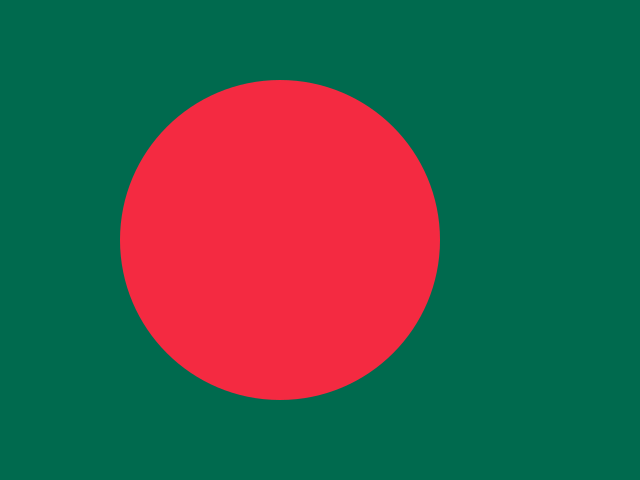
A red disc set slightly towards the hoist on a bottle-green field, in the proportion 10:6, the disc's radius one-fifth of the flag's length and its centre at nine-twentieths of the length from the hoist. Bangladeshi law describes the flag without interpreting it: neither Article 4(2) of the Constitution nor the Flag Rules, 1972 assigns the red or the green any meaning. Popularly the disc is read as the rising sun over Bengal and the blood shed in the 1971 liberation war, and the green as the country's landscape.
Source: cabinet.portal.gov.bd
Bangladesh FACTS ◢
| Capital | Dhaka |
|---|---|
| Continent | Asia |
| Population | 175,686,899 (2025) |
| Area | 147,570 km² |
| Population density | 1,191/km² |
| Currency | Bangladeshi taka (BDT) |
| Official language | Bangla |
| Calling code | +880 |
| Internet TLD | .bd |
| Time zone | UTC+06:00 |
| Drives on the | Left |
| ISO codes | BD / BGD |
DID YOU KNOW? ◢
- It sits on the largest river delta in the world, formed by the Ganges and Brahmaputra rivers.
- It shares the Sundarbans, the world's largest mangrove forest and a stronghold of the Bengal tiger.
- Cox's Bazar boasts one of the longest natural sea beaches on the planet.
- It's one of the most densely populated large countries in the world.
Bangladesh QUICK ANSWERS ◢
What is the capital of Bangladesh?
The capital of Bangladesh is Dhaka.
What is the population of Bangladesh?
Bangladesh had a population of 175,686,899 in 2025.
What currency does Bangladesh use?
Bangladesh uses the Bangladeshi taka (BDT).
What languages are spoken in Bangladesh?
The official language of Bangladesh is Bangla.
Think you know your flags? Play Flag Daily → · Browse all countries →
MORE ON THE FLAG ◢
The Bangladesh flag is specified down to a dye recipe and a fraction of its own length, and never explained. Three legal texts describe it, and the most detailed of them spends its words on a ratio, a radius and two dye recipes.
None of the three says what the red circle stands for, or the green.
Key Takeaways
- The Constitution describes the flag in one sentence at Article 4(2): a circle "coloured red throughout its area, resting on a green background", with no meaning attached.
- The Flag Rules, 1972 fix the shape: proportion 10:6, circle radius one-fifth of the length, centre at nine-twentieths of the length from the hoist.
- Nine-twentieths is 0.45 where true centre is 0.5, and the Rules give no reason for it.
- The colours are specified as dyes, not colour codes, and the red is Procion Brilliant Orange H-2RS.
- The sun-and-blood reading is the designers' own. It comes from the 1970 meeting that settled the design, not from any Bangladeshi instrument.
- The 1971 flag carried a golden map of the country inside the red circle. By the time the flag was written into law, the map was gone.
The Bangladesh flag's colours have no official meaning
Officially, nothing has been assigned to either. Three instruments define the flag, and not one of them interprets it.
| Instrument | What it fixes | On what the colours mean |
|---|---|---|
| Constitution, Article 4(2) | A circle "coloured red throughout its area, resting on a green background" | Silent |
| President's Order No. 130 of 1972, Article 3 | That same sentence, plus a schedule of specifications | Silent |
| Flag Rules, 1972, rule 3 | Proportion, circle radius, circle position, both dyes | Silent |
Article 4(2) is the whole constitutional description, at twenty-one words, and Article 4(4) then hands everything further to ordinary law. The Order that sits between them was made on 31 October 1972. The Flag Rules already existed by then: Article 6 of the Order continues them in effect rather than creating them.
The Flag Rules, published by the Cabinet Division, are the detailed one. They run to nine rules covering the description, the days the flag is flown, its use at missions and on government buildings, and a long list of things nobody may do with it. Rule 7 goes as far as directing that a flag too worn to use "shall be disposed of in a dignified manner, preferably by burying". Symbolism appears nowhere in them.
Banglapedia, the national encyclopedia of the Asiatic Society of Bangladesh, describes the flag the same way and assigns the colours no meaning either.
So the familiar reading is not the state's. It is the designers'. The Daily Star's account of the night the design was settled comes from A S M Abdur Rob, the student leader who first hoisted the flag. He has the meeting choosing bottle green for "the country's greenery with its youthfulness" and blood red for "the sacrifices and bloodshed of freedom fighters and those killed by the occupying force", with the map set "against the backdrop of a red, blazing sun".
The meaning is real. It lives in the account of the people who made the flag rather than in the law that describes it.
Why is the red circle not in the middle?
Because the rule puts it there, in exact terms. Rule 3 of the Flag Rules sets the flag "in bottle green and rectangular in size in the proportion of length to width 10 : 6 bearing a red circle on the body of the green", then fixes the circle:
"The red circle will have a radius of one-fifth of the length of the flag. Its centre will be placed on the intersecting point of the perpendicular drawn from the nine-twentieth part of the length of the flag and the horizontal line drawn through the middle of its width."
Nine-twentieths is 0.45, where true centre would be 0.5. The circle is also large: a radius of one-fifth of the length makes it two-fifths of the length across. "Width" here is the flag's height, so on a 10:6 flag that disc is two-thirds of the height.
What rule 3 never does is explain itself. The offset is often explained as making the circle look centred once the flag is flying, but that explanation appears in none of the three Bangladeshi texts.
Bangladesh is not alone in the choice. Palau's flag also carries a disc shifted towards the hoist. Japan's flag, the comparison most people reach for, keeps its disc centred.
The first Bangladesh flag had a golden map inside the disc
The design is older than the war. The national news agency BSS records that student leaders met on 6 June 1970 at Dhaka University's Iqbal Hall and designed the flag there. Shib Narayan Das, then a Chhatra League leader, painted the map of the country into the red circle in gold.
That flag was first hoisted in front of the university's Arts Building on 2 March 1971, just over three weeks before the war began. Banglapedia records that the Mujibnagar government, the provisional wartime government, adopted the pattern unfurled that day.
The map did not survive the following year. Banglapedia puts it plainly: "Initially the flag had the map of Bangladesh in the centre, which was withdrawn later." By the time any of the three legal texts described the flag, it was a plain red circle on green with nothing inside it.
The Daily Star names the artist and the reason. In 1972 Quamrul Hassan was asked to redesign the flag without the map, because the contortion of the country's southern islands made it hard to place inside the red circle. The objection was to drawing it, not to what it stood for.
What colour is the flag, exactly?
Rule 3 answers that, and the answer is not a colour code. The green base "will be of Procion Brilliant Green H-2RS 50 parts per 1000", and the red circle "will be of Procion Brilliant Orange H-2RS 60 parts per 1000".
Those are reactive dyes for cotton, named by trade name and strength. The rule is written for a dye vat rather than a screen, which is why the flag's official red is mixed from a dye whose own name is orange.
Any hex value or Pantone number quoted for the Bangladesh flag is a later conversion of that specification: useful for printing, and not itself the standard.
Knowing the numbers is most of what it takes to redraw a flag from memory, which is the whole trick in flag quizzes. Or go the other way and name the country from its outline.
Frequently asked questions
Do the flag's colours have an official meaning?
No Bangladeshi legal text assigns either colour a meaning. Article 4(2) of the Constitution, Article 3 of President's Order No. 130 of 1972 and rule 3 of the Flag Rules, 1972 all describe the flag without interpreting it. The popular reading, red as the rising sun and the blood of the 1971 liberation war and green as the country's land, is tradition rather than law.
Why is the red circle off-centre on the Bangladesh flag?
Rule 3 of the Flag Rules, 1972 puts the circle's centre at nine-twentieths of the flag's length from the hoist, one-twentieth of the length nearer the hoist than the middle, and gives no reason for it. The common explanation, that the offset makes the circle look centred when the flag is flying, has no standing in any of the three texts.
Did the Bangladesh flag ever have a map on it?
Yes. The flag first hoisted at Dhaka University on 2 March 1971 carried a golden map of the country inside the red circle, painted by Shib Narayan Das. Banglapedia records that the map "was withdrawn later", and every legal description of the flag from 1972 onward is a plain circle with nothing inside it.
What are the official proportions of the Bangladesh flag?
The Flag Rules, 1972 set the proportion of length to width at 10:6 and give the red circle a radius of one-fifth of the flag's length. That makes the circle two-fifths of the length across, which is two-thirds of the flag's height.
Which law governs the Bangladesh flag?
The Bangladesh National Anthem, Flag and Emblem Order, 1972, made on 31 October 1972 as President's Order No. 130 of 1972, is the parent instrument, and its Article 6 continues the earlier Flag Rules, 1972 in effect. Article 4 of the Constitution sits above both.
Sources
All retrieved 12 August 2026.
- Cabinet Division, Government of the People's Republic of Bangladesh, People's Republic of Bangladesh Flag Rules, 1972 (revised up to May 2010) - rule 3 and rule 7, item XXII.
- Legislative and Parliamentary Affairs Division, The Constitution of the People's Republic of Bangladesh, Article 4 - national anthem, flag and emblem.
- Legislative and Parliamentary Affairs Division, Bangladesh National Anthem, Flag and Emblem Order, 1972 - President's Order No. 130 of 1972, Articles 3 and 6.
- Asiatic Society of Bangladesh, Banglapedia: National Flag.
- Fayeka Zabeen Siddiqua, The man who raised the flag first, The Daily Star, 17 December 2015 - Rob's account of the 1970 meeting and the 1972 redesign.
- Bangladesh Sangbad Sangstha, National flag's 1st designer Shib Narayan Das passes away, 19 April 2024.
PLAY ANOTHER →
Five questions a day. Everyone gets the same five.
FIVE QUESTIONSDAILYGuess the CountryThree clues, three guesses. Work out where in the world it is.
THREE CLUESDAILYOn This DayOne thing that happened today in history. Every day, a new one.
TODAY IN HISTORYDAILYDaily CryptogramOne quote, one scrambled alphabet. Crack it before tomorrow.
CRACK THE QUOTE