
Palau
Palau is a scatter of hundreds of islands in the western Pacific, home to barely more people than a small town but famous with divers the world over. Its Rock Islands are a UNESCO World Heritage Site.
WHAT THE FLAG MEANS ◢
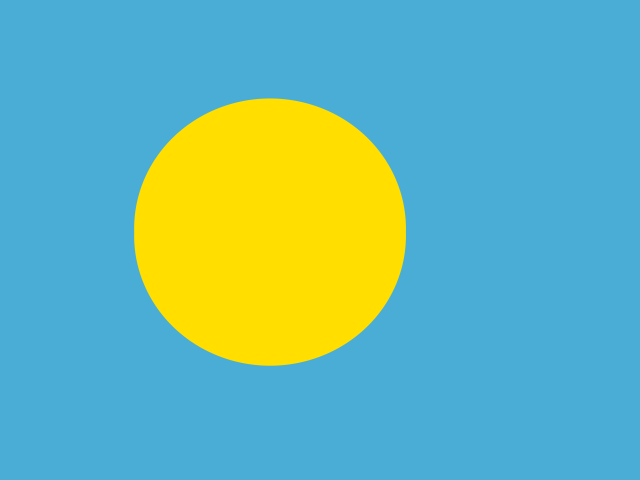
A sky-blue field with a golden-yellow full moon set slightly toward the hoist. The constitution has no flag provision, but the national code calls it a golden-yellow full moon on a field of sky-blue and fixes its geometry, putting the centre of the moon seven tenths of the flag width from the hoist edge. The code assigns the colours and the moon no meaning. The national government reads the full moon as the traditional time for fishing, planting and harvesting, and the published accounts of the blue differ, giving it as the surrounding ocean, as the natural environment, and as the passing of foreign administration.
Source: paclii.org · palauosp.org · palaugov.pw · bdarop.com · britannica.com · crwflags.com · palaushipreg.com · checked 2026-08-27
Palau FACTS ◢
| Capital | Ngerulmud |
|---|---|
| Continent | Insular Oceania |
| Population | 17,663 (2025) |
| Area | 466 km² |
| Population density | 38/km² |
| Currency | United States dollar (USD) |
| Official languages | English, Palauan |
| Calling code | +680 |
| Internet TLD | .pw |
| Time zone | UTC+09:00 |
| Drives on the | Right |
| ISO codes | PW / PLW |
DID YOU KNOW? ◢
- It created the world's first shark sanctuary, banning commercial shark fishing across its waters in 2009.
- Jellyfish Lake lets swimmers float among millions of jellyfish that have lost most of their sting.
- Every visitor must sign the Palau Pledge, stamped in their passport, promising to protect the environment.
- Its capital, Ngerulmud, is one of the least-populated national capitals in the world.
- Around 80% of its waters are set aside as a fully protected marine reserve.
Palau QUICK ANSWERS ◢
What is the capital of Palau?
The capital of Palau is Ngerulmud.
What is the population of Palau?
Palau had a population of 17,663 in 2025.
What currency does Palau use?
Palau uses the United States dollar (USD).
What languages are spoken in Palau?
The official languages of Palau are English and Palauan.
Think you know your flags? Play Flag Daily → · Browse all countries →
MORE ON THE FLAG ◢
Ask what the gold disc on Palau's flag is and you get two answers, because a plain disc on a plain field is a shape other flags use for the sun. The question has a settled answer, and it is not a matter of interpretation or tradition. It is in the statute book.
Chapter 5 of Title 1 of the Palau National Code opens with one sentence: "The flag of the Republic shall be a golden-yellow full moon slightly off-centered on a field of sky-blue." The law names the charge. It is a moon, and it is a full moon, because that is the word the Code carries.
Two things follow from that sentence. It settles what the disc depicts, which is the first question a flag of one shape on one colour invites. And it settles nothing else: the section goes on to fix exactly how far off centre the moon sits, and then says nothing about what the moon or the blue is supposed to mean. The meanings people quote come from somewhere else, and the sources they come from do not agree with each other.
Key Takeaways
- The Palau National Code, 1 PNCA section 501, calls the charge "a golden-yellow full moon", so the sun reading is ruled out by the instrument rather than by custom.
- The same section fixes the offset numerically: the centre of the moon is 0.7 of the flag's width from the hoist edge, where the true midpoint of a 1 to 1.6 flag is 0.8.
- Chapter 5 runs to six sections covering description, reproduction, display, desecration and a trusteeship-era protocol. None of them assigns a colour or the moon a meaning.
- The adopting law is Public Law No. 7-6-2, a 1980 act of the pre-Republic Palau Legislature, passed before the constitution took effect.
- Five published accounts give the blue field a meaning and none of them settles it: two Palauan government pages say the ocean, Whitney Smith's Britannica entry says in terms that it is not the ocean, and two others give the surrounding natural environment and independence.
Is the gold disc on Palau's flag a sun or a moon?
A moon, and the flag law says so in its first sentence.
The wording matters because Palau's answer does not depend on anybody's reading. The charge is identified in the operative text of the statute that adopted the flag, in the same clause that gives the colours, so there is nothing left to interpret.
Even so, the identification does not always travel intact. Palau's own national government page hedges it, describing the yellow circle as something that "allegedly resembles the full moon" rather than stating what its statute states outright. That phrasing concedes ground the statute does not.
The law does not hedge. It says full moon, and it says it once.
The confusion has an obvious source. A plain coloured disc on a plain field is the design the flag of Japan made famous, and that disc is a sun. Smith's entry names a second lookalike, the flag of Bangladesh, noting that the two flags "have different colours and symbolisms". One shape, used by more than one country, for more than one thing.
Section 501, in full, and the arithmetic in it
Section 501 is short enough to read end to end, and worth reading that way, because every later argument about the flag rests on it.
After the description sentence, it gives four measurements:
"The width of the flag shall bear the ratio to its length of 1.0 to 1.6."
"The diameter of the moon shall bear the ratio to the width of the flag of 0.6 to 1.0."
"The distance from the side of the flag nearest the mast or staff to the center of the moon shall bear the ratio to the width of 0.7 to 1.0."
"The distances from the top and bottom of the flag to the center of the moon shall be equal."
Those four measurements fully determine the flag. The proportion is 1 to 1.6, which is 5:8. The moon's diameter is six tenths of the hoist. The moon is centred vertically. And the horizontal position is pinned to one decimal.
The third of those, the 0.7 ratio, is the whole of the off-centre question, so it is worth doing the arithmetic. Take the width as 1.0, which makes the length 1.6 and the true horizontal midpoint 0.8. The statute puts the moon's centre at 0.7. The offset is one tenth of the width toward the hoist, or one sixteenth of the flag's length.
The moon's radius is 0.3, so its leading edge falls at 0.4 from the hoist, which is exactly a quarter of the way along the flag. That is the construction Flags of the World gives for Palau, drawn from Album des Pavillons and Ultimate Pocket Flags of the World: the disc's hoist-side tangent sits "at 1/4 of the flag length". Whether those references worked from the act or from a drawing is not something the saved sources establish, so the agreement is a cross-check rather than independent confirmation.
Two explanations for the offset, and they do not match
The law prescribes the shift and does not say why. It has been explained twice in public, and the two explanations are not the same explanation.
The Republic of Palau's national government site gives a practical one. Its flag page says the circle is "centered slightly toward the left side of the flag", and then: "When the flag is hung it creates an impression that the circle is located right in the center of the flag." The page claims an effect, not a mechanism: the shift is there so that a hanging flag looks as though its disc is centred. The familiar reason for such a correction, that cloth falls away and folds toward the fly, is not something the page says, so it is a reading rather than the government's explanation.
The Palau Ship Registry publishes a different one. It is a private company, headquartered in Piraeus, and it describes itself as an authorised ship registry service provider for the Government of the Republic of Palau; it is not an organ of the state. Its page says: "The placement of the moon slightly to the hoist side reflects a sense of movement and continuity."
One of those is about how the flag looks when it hangs. The other is about what the placement is supposed to say. Neither is in the statute, and neither cites the other. The government page is the one closer to the state, and it is the one claiming an observable effect rather than an intention.
The law that adopted the flag was not a law of the Republic
The Palau National Code prints a source note beneath each section, naming the act the codified text came from. Under section 501 it reads: "PL 7-6-2 § 1(a), modified." The same act supplies sections 502 through 506.
That citation is not a Republic of Palau Public Law. Republic laws are cited RPPL, numbered by the Olbiil Era Kelulau that passed them, and the First OEK did not sit until 1981: article XV section 2 of the constitution set the first election for 4 November 1980 and had those elected "installed on January 1, 1981". The prefix therefore points at the Palau Legislature, the body that governed the Palau District of the United States-administered Trust Territory of the Pacific Islands before the Republic existed. The constitution itself names that district, providing at article XV section 4 that the national government "shall succeed to any right or interest acquired by" the Administering Authority, the Trust Territory and "the government of Palau District". Flags of the World reads the number the same way, as the Seventh Palau Legislature.
The act's title and its session are known here only from that one reference, which is volunteer-compiled and is the only account of the act's passage that could be located. It records the title as "To provide for the Flag of the Republic of Palau", passed at the Legislature's sixth regular session on 18 September 1980 and taking effect when the Trust Territory's Deputy High Commissioner approved it on 22 October 1980. Britannica gives the same October date, attributing the approval to "the new government" rather than to a trusteeship official.
So the flag was legislated for a Republic that did not yet exist. The constitution supplies the bridge. Article XV, section 1 provides that "This Constitution shall take effect on January 1, 1981, unless otherwise provided herein", and section 3(a) of the same article brings the old statute book across: "All existing law in force and effect in Palau immediately preceding the effective date of this Constitution shall, subject to the provisions of this Constitution, remain in force and effect until repealed, revoked, amended or until it expires by its own terms."
The flag law was never repealed, so it survived into the Republic and was later codified. The Code's own footnote for the national flag points at the Palau Legislature, not at the national congress.
The constitution itself has nothing to say about the flag. Published texts of it were read from three sources for this article, and none of them contains the word flag, or moon, or emblem, or banner, anywhere in the document. Palau's flag is entirely a creature of statute.
The original text of PL 7-6-2 as enacted could not be obtained. Palau's legal record is thinly published online, and the Code text quoted here was itself read from an archived copy of the Pacific Islands Legal Information Institute's Palau National Code file.
Where the Code says the section was "modified" in codification, the size of that modification is not something this article can check, and there is one visible reason to keep the question open. The Bureau of Domestic Affairs published the description clause on the Ministry of State's website as "The National Flag of the Republic of Palau shall be a golden-yellow moon slightly off-centered on a filed of sky-blue". That differs from the Code on two axes, not one: it opens "The National Flag of the Republic of Palau" where the Code opens "The flag of the Republic", and it drops the word "full" that the Code carries and that this article's argument rests on. A rewritten opening clause is exactly the shape a codifier's note reading "modified" would produce, which makes it a live possibility that the Bureau is quoting the act as enacted and that "full" is the codifier's word.
Three things cut the other way, and they are why the Code text is preferred here. Both PacLII editions of the Code agree word for word. The Bureau's copy misspells "field" in the same sentence, which marks it as loose transcription rather than a competing text. And the Bureau's own page uses the fuller phrase twice more in its next two sentences, writing that "The full moon signifies Palau's emergence as an independent sovereign country", so its own reading of the flag is of a full moon whatever its transcription of the clause says. Flags of the World reproduces the Bureau's wording, likewise without "full", but corrects the typo, and it cites the Bureau's page as its source, so it is not independent evidence. None of that settles what the 1980 act said. It does mean the sun reading stays ruled out by the operative text either way.
Blau Skebong and the 1979 contest
The design came from a public competition rather than a committee. The Bureau of Domestic Affairs of Palau's Ministry of State published the account on its website in the early 2000s: "The Palau National Flag was the winning entrant by Mr. Blau Skebong in the 1979 ROP Flag Contest and was adopted by the Olbiil Era Kelulau through Public Law No. 7-6-2 on September 1980."
Britannica puts a number on the field: "A competition had been held in 1979 that resulted in more than a thousand proposals; the one chosen was created by Blau Skebong and was approved by the new government on October 22, 1980."
Parts of the Bureau's sentence do not survive contact with the Code. PL 7-6-2 was a law of the Palau Legislature, not of the Olbiil Era Kelulau, which had not yet been constituted in September 1980. And the government's current flag page dates the adoption to 1 January 1981 rather than to 1980 at all. Britannica puts a flag-raising on that day, saying a separate state and government "was realized on January 1, 1981, and a Palauan flag was hoisted on that occasion", which is a date of first flying rather than a date of enactment. A country's own pages can carry a date that is the wrong kind of date.
The law says nothing about the blue, and the published accounts disagree
The statute assigns the sky-blue field nothing. In the absence of a legal meaning, other accounts have filled the gap, and the conflict between them is real rather than a matter of wording.
| Who says it | What the blue means | What the moon means |
|---|---|---|
| Palau National Code, 1 PNCA section 501 | Nothing assigned; the colour is named "sky-blue" and left there | Nothing assigned; the charge is named as a full moon |
| Republic of Palau national government, palaugov.pw | "the Pacific Ocean that surrounds the islands" | An "important period" for fishing, planting and harvesting |
| Bureau of Domestic Affairs, Ministry of State, published c. 2002 to 2004 | The ocean, as constancy: "the constancy of Palau through the years, surviving through various foreign dominations" | "harvests, reproductive cycles, and launching of events in traditional Palau", and separately "The full moon signifies Palau's emergence as an independent sovereign country" |
| Whitney Smith, in Britannica | Not the ocean: "the final passage of the foreign administering authority from our land" | "the best time for fishing, planting, and other activities", and "a feeling of warmth, tranquillity, peace, love and domestic unity" |
| The Palau Ship Registry, a private company | "peace, stability, and the surrounding natural environment" | "harmony, balance, and community life", and an auspicious time for fishing and planting |
| Nathan Augustine and Željko Heimer, Flags of the World, 1995 | "The blue field is supposed to represent the independence" | "a symbol of national unity and destiny" |
The disagreement is not cosmetic. The current national government page says the blue is the Pacific Ocean. Smith's entry says in terms that it is not the ocean, and gives it as the departure of the trusteeship administration instead. Those two cannot both be the flag's meaning, and no instrument decides between them, because the instrument declines to say.
The Bureau of Domestic Affairs version starts from the ocean and ends up somewhere close to Smith. It reads the ocean itself as endurance under foreign rule: "The blue ocean signifies the constancy of Palau through the years, surviving through various foreign dominations to finally emerge at the fullmoon." The noun is the government's, the story is the departure of an administering power.
The moon is steadier, though not unanimous either. Four of the five accounts that assign it a meaning read it as a marker in the working year, but they do not name the same work: three name planting, three name fishing, and two name harvest. Palau's own page puts it plainly: "They believe that activities such as fishing, planting and harvesting are much more effective during this moon-phase." The fifth account, the 1995 Flags of the World entry, never mentions the working year at all and reads the disc as "a symbol of national unity and destiny" instead.
The Bureau of Domestic Affairs goes further again. Alongside the working-year reading it attaches a second one to the same word the statute uses, and no other account of the moon carries it: "The full moon signifies Palau's emergence as an independent sovereign country." On that telling the fullness of the moon is the independence, not the fishing calendar. So even the one element the law does name is not read the same way twice.
No official shade for Palau's flag: two colour words and no values
Section 501 gives two colour words, "golden-yellow" and "sky-blue", and no values. Nothing else in Chapter 5 supplies any, and Palau's government flag page carries an illustration and no specification.
The consequence is a set of competing figures published by people who needed one. Flags of the World's survey of the standard manuals records that the Beijing 2008 flag manual used PMS 292 for the blue and PMS 102 for the yellow. The London 2012 manual used Process Blue and PMS 109. Album des Pavillons gives Pantone 299c and 101c. Those are three different blues. As the survey puts it, "There is no official source that gives exact colors of the national flag".
That is what happens when the only colour words are the two a 1980 statute used, and it is worth stating plainly rather than picking one of the three and presenting it as Palau's. Anyone printing the flag is choosing a blue, not reproducing one.
The rest of the flag chapter, including a section that has expired
Sections 502 to 506 are the practical half, and two of them are worth knowing.
Section 503 sets the display rules. The flag "shall be displayed in the open only from sunrise until sunset", and "shall be hoisted and lowered briskly and ceremoniously". Subsection (c) delegates to the President the power to make rules for half-mast display "upon the death of a government or traditional leader or distinguished citizen of the Republic", which puts traditional leaders alongside government officeholders in the text of the flag law.
Section 506 makes desecration an offence. Anyone who "knowingly casts contempt upon any flag of the Republic by mutilating, defacing, defiling, burning or trampling upon it" faces a fine of up to one thousand dollars, six months' imprisonment, or both. The section extends to reproductions "having the same or different dimensions as the flag of the Republic", so the protection is not limited to official flags.
Section 505 is the curiosity. Headed "Display until termination of Trusteeship", it set the order of precedence when Palau's flag flew alongside those of the United States and the United Nations, and it closes by disposing of itself: "This section shall expire and be of no force and effect upon termination of the Trusteeship Agreement." The trusteeship ended on 1 October 1994. The section has had no legal effect for over thirty years, and the printed Code still carries it, a fossil of the arrangement under which the flag was first raised.
None of which helps at speed. If you want to find out whether you can actually pick Palau's moon out of a line of discs and crescents, Flag Daily shows one flag a day and gives you three guesses at the country.
Frequently asked questions
Is the circle on Palau's flag the sun or the moon?
The moon. Palau's flag statute, codified at 1 PNCA section 501 of the Palau National Code, describes the flag as "a golden-yellow full moon slightly off-centered on a field of sky-blue", so the identification comes from the operative text of the law rather than from custom or commentary.
Why is the moon on Palau's flag off centre?
The statute requires it and does not say why. Section 501 puts the centre of the moon at 0.7 of the flag's width from the hoist edge, where the true midpoint of a 1 to 1.6 flag would be 0.8, an offset of one sixteenth of the length. Palau's national government explains the shift as an optical correction, writing that "When the flag is hung it creates an impression that the circle is located right in the center of the flag."
What law adopted the flag of Palau?
Public Law No. 7-6-2, an act of the pre-Republic Palau Legislature passed in September 1980 and approved that October, before the Republic's constitution took effect on 1 January 1981. The Palau National Code cites that act as the source of every section of its flag chapter. The constitution of Palau contains no flag provision at all.
Who designed the flag of Palau?
Blau Skebong, whose entry won a public design competition held in 1979. Palau's Ministry of State published the attribution on the Bureau of Domestic Affairs website, and Britannica records that the competition drew more than a thousand proposals.
What are the official colours of Palau's flag?
There are none beyond the two words in the statute, "golden-yellow" and "sky-blue". The flag chapter of the Palau National Code gives no values, and Palau's government flag page carries an illustration and no specification, so the flag manuals that needed a number have published at least three different blues between them.
Sources
- Palau National Code, Title 1 (General Provisions), Chapter 5 (Flag), sections 501 to 506 - Pacific Islands Legal Information Institute, University of the South Pacific. The live site answers a security challenge to every access method tried, so the file was read from the Internet Archive capture of 22 December 2024. Retrieved 27 August 2026.
- Constitution of the Republic of Palau - published by the Office of the Special Prosecutor, Republic of Palau. Article XV sections 1 and 3(a). Retrieved 27 August 2026.
- Constitution of the Republic of Palau (Palau Constitutional Convention text) - Pacific Islands Legal Information Institute, read from the Internet Archive capture of 28 August 2015. Second of the three texts used to check that no flag provision appears anywhere in the constitution. Retrieved 27 August 2026.
- Palau's Constitution of 1981 with Amendments through 1992 - Comparative Constitutions Project, distributed on constituteproject.org. Third of the three texts used for the same absence check. Note that its article XV gives the commencement date as 1 January 1980; the two texts above both give 1 January 1981, which is the date used here. Retrieved 27 August 2026.
- Flag of Palau - Republic of Palau National Government, palaugov.pw. Retrieved 27 August 2026.
- The Palau National Flag - Bureau of Domestic Affairs, Ministry of State, Republic of Palau, originally at bdarop.com. That domain has since passed to an unrelated commercial site, so the link goes to the Internet Archive capture of 7 April 2004 rather than to the live host. Retrieved 27 August 2026.
- Flag of Palau - Whitney Smith, Encyclopaedia Britannica. Read from the Internet Archive capture of 21 February 2026. Retrieved 27 August 2026.
- Palau - Flags of the World, a volunteer-compiled vexillological reference. Used for the act's title, session and dates as reported by Christopher Southworth; for the construction summary Ivan Sache draws from Album des Pavillons and Ultimate Pocket Flags of the World; and for the survey of published colour specifications. Retrieved 27 August 2026.
- The Flag of the Republic of Palau - The Palau Ship Registry, a private commercial ship registry headquartered in Piraeus which describes itself as an authorised ship registry service provider for the Government of the Republic of Palau. Retrieved 27 August 2026.
PLAY ANOTHER →
A short message, hidden in a different cipher every day.
ONE CIPHER A DAYDAILYGuess the CountryThree clues, three guesses. Work out where in the world it is.
THREE CLUESDAILYDaily TriviaFive questions a day. Everyone gets the same five.
FIVE QUESTIONSDAILYDaily CryptogramOne quote, one scrambled alphabet. Crack it before tomorrow.
CRACK THE QUOTE