
Japan
An archipelago of more than 14,000 islands where bullet trains, ancient temples and neon cities share the same timetable. Japan turns precision into a national sport.
WHAT THE FLAG MEANS ◢
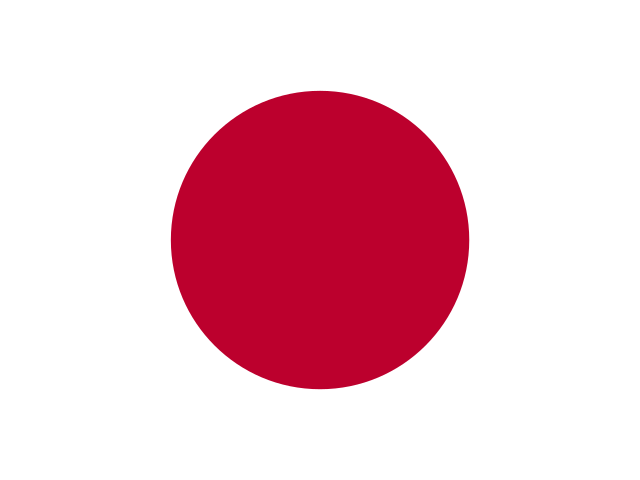
A white field with a large red disc at the centre, the 'Hinomaru', or circle of the sun. The constitution has no flag provision, and before 1999 there was no written rule about the national flag as such: the rule that drew it was an 1870 shipping regulation prescribing the flag merchant ships were to fly. The Act on National Flag and Anthem of 1999 sets the disc at three fifths of the flag's height, centred, and assigns it no meaning. The disc is generally read as the sun, after the name Japan uses for itself; the white ground is left unexplained.
Source: shugiin.go.jp
Japan FACTS ◢
| Capital | Tokyo |
|---|---|
| Continent | Asia |
| Population | 123,366,734 (2025) |
| Area | 377,972 km² |
| Population density | 326/km² |
| Currency | Japanese yen (JPY) |
| Main language | Japanese |
| Calling code | +81 |
| Internet TLD | .jp |
| Time zone | UTC+09:00 |
| Drives on the | Left |
| ISO codes | JP / JPN |
DID YOU KNOW? ◢
- It's made up of more than 14,000 islands by the latest official count, though most people live on just four of them.
- It's home to the world's oldest continuously operating company, founded in 578 AD.
- More than 70% of the country is mountainous, which is why its cities crowd the coasts.
- It has one of the longest life expectancies of any nation on Earth.
Japan QUICK ANSWERS ◢
What is the capital of Japan?
The capital of Japan is Tokyo.
What is the population of Japan?
Japan had a population of 123,366,734 in 2025.
What currency does Japan use?
Japan uses the Japanese yen (JPY).
What languages are spoken in Japan?
Japan designates no official language. The language of government and education is Japanese.
Think you know your flags? Play Flag Daily → · Browse all countries →
MORE ON THE FLAG ◢
Ask what the Japanese flag means and there is a government answer to read, because somebody asked for one in writing.
On 20 May 1999 a member of the House of Representatives, Ishigaki Kazuo, submitted a formal written question about the flag and the anthem. Item 5 of its first section pointed at France, whose constitution, the question noted, deals with the tricolour, and then asked what the white ground and the red disc of Japan's flag mean.
The Cabinet's answer came back on 11 June 1999 over the Prime Minister's name. This is the whole of its reply on that point:
"日の丸の意味について一義的に特定することは困難であるが、日の丸は太陽を表すとするのが一般的であると承知している。白地については、不詳である。"
Rendered into English: it is difficult to fix the meaning of the Hinomaru in a single sense, but it is understood that the Hinomaru is generally taken to represent the sun; as for the white ground, it is 不詳. That last word, 不詳, is the ordinary official term for unknown or not established.
Key Takeaways
- The government's own written answer of 11 June 1999 says the disc is generally taken to represent the sun and that the white ground is not known.
- The flag article of the law passed two months later is two sentences plus a table. It fixes proportions and two colour names, and says nothing about meaning.
- That law calls the flag the Nisshoki, not the Hinomaru, and the officials explained the choice on the record in committee.
- Until 1999 there was no written rule about the national flag as such. The rule that drew the flag was an 1870 merchant shipping regulation, which the government said set the form of the flag for ships.
- The 1870 sheet drew one flag and tabulated two more sizes, and put the sun disc slightly off centre, toward the pole. The 1999 Act still allows a flag made that way, for the time being.
| Instrument | What it fixes | Meaning it assigns |
|---|---|---|
| Constitution of Japan, 1946 | Nothing. It has no flag provision | None |
| Proclamation No. 57 of Meiji 3 (1870), the shipping regulations | The flag merchant ships must fly, when to hoist it, and three sizes | None |
| Act No. 127 of 13 August 1999, Article 1 | That the national flag is the Nisshoki | None |
| Act No. 127, Appended Table 1 | Two thirds proportion, a disc three fifths of the height, centred, a white ground and a disc in 紅色 | None |
| Act No. 127, supplementary provision 3 | That the older seven tenths flag with the offset disc may still be used | None |
| Cabinet written answer, 11 June 1999 | Nothing | Assigns none. Reports the disc as generally taken for the sun, and the white ground as not known |
The question that named France, and the sentence that came back
Ishigaki's question ran to twenty seven items on the flag alone, and item 5 is the one that matters here. It set France beside Japan, on the ground that the French constitution addresses the tricolour, and then asked two things. What does Japan's design of a white ground and a red disc mean? And what did the prewar Ministry of Education elementary school reader say the national flag meant?
Two things about the reply are worth slowing down for.
The first is that the government split the design in half and answered the two halves differently. For the disc it reported a general reading rather than an official one, and hedged it twice: hard to fix in a single sense, and generally taken to. For the white it did not report a reading at all. It reported an absence.
The second is that the same sentence appears twice in the same document. Item 12 of the question had asked for the government's unified view on the competing readings of the Hinomaru, the land where the sun rises and the rest. The answer to item 12 is the first sentence again, word for word, and this time without the clause about the white.
Item 5's other half, the one about the textbook, is where the answer gets longer, and the result is the more useful part. The book is the twelfth volume of the Ministry of Education's ordinary elementary school national language reader, published in 1923, and its thirteenth lesson is called The National Flag. This is the sentence the government quoted back:
"各國の國旗は、或は其の建國の歴史を暗示し、或は其の國民の理想・信仰を表すものなれば、國民の之に對する尊敬は、即ち其の國家に對する忠愛の情の發露なり。"
The flags of the various countries, it says, hint at the history of a nation's founding or express the ideals and beliefs of its people, so that the respect citizens show them is an expression of loyal affection toward the state.
The government's own preamble to that quotation says the lesson discusses the flags of Japan and of the main foreign countries. What it chose to quote out of the lesson is one sentence about flags in general, and that sentence never reaches the Hinomaru. The questioner had nominated the readers himself, and what the government brought back from them does not answer the question he asked with them.
The flag article of Japan's 1999 law is two sentences long
The Act on National Flag and Anthem, Act No. 127 of 1999, was promulgated on 13 August 1999 and came into force the same day. Its Article 1 is the flag article in its entirety:
"国旗は、日章旗とする。"
"日章旗の制式は、別記第一のとおりとする。"
The national flag shall be the Nisshoki. The form of the Nisshoki shall be as set out in Appended Table 1. Article 2 does the same job for the anthem in the same two moves. After that come the supplementary provisions and two appended tables, and the Act is finished.
Appended Table 1 is where the flag is actually described, and it is a table with three measurements and two colour names. The height is two thirds of the width, a proportion Takeshima described to the House of Representatives Cabinet Committee on 1 July 1999 as the so-called United Nations format. The disc has a diameter of three fifths of the height and its centre is the centre of the flag. The ground is white, 白色. The disc is 紅色.
Nothing in the table is a meaning. It is a specification, of the kind you would hand to somebody who has to sew one.
Spanish law takes the other route. Article 1 of Ley 39/1981 opens by declaring that the flag symbolises the nation, is a sign of the sovereignty, independence, unity and integrity of the patria, and represents the superior values expressed in the Constitution. Only after that does Spain's flag law reach the stripes.
There is one more thing in the law worth noticing, and it sits in the signature block rather than the text. The published version records the Prime Minister and the Minister of Transport as the signing ministers. The supplementary provisions go some way toward explaining why a transport minister is on a flag law: the second of them repeals a shipping regulation.
Why the law reaches past the ordinary word for red
The Act's wording was not casual, and the officials were made to defend it in committee.
Take 紅色 first. Japanese has a perfectly ordinary word for red, 赤, and it is the everyday word for this flag's disc. The bill did not use it. Takeshima Kazuhiko, director of the Cabinet's domestic affairs deliberation office and the government's witness on the bill, explained why to a House of Councillors special committee on 2 August 1999:
"日章旗の色でございますが、鮮やかな赤をあらわすということで紅色という表現にさせていただきました。赤といたしますと非常に幅が広いということでございまして、その中の鮮やかな赤という気持ちを特に表現したいということでこういう用語を使わせていただいた次第でございます。"
His point, in summary, is that 赤 covers too wide a band, and 紅色 was chosen to pin the particular vivid red the flag actually uses. He had put the same argument to the House of Representatives Cabinet Committee on 1 July, describing the range of 赤 as running from a red close to white to a red close to black.
That is as close as the law comes to specifying a colour. There is no coordinate, no tolerance and no colour standard anywhere in the Act. It names two words and stops.
The sharpest objection to the word came from one of the bill's supporters. Yamazaki Chikara, speaking for the original bill in the House of Councillors on 9 August, said he had started out lukewarm about legislating any of this, and that seeing 紅色 rather than 赤 in the text had jarred. He then pointed out what the choice does to the song a colleague had sung in committee shortly before, whose line describes the flag as 白地に赤く, red on a white ground: on the law's wording, that line is strictly incorrect.
The name of the flag was argued in the same way. The bill says Nisshoki, 日章旗, where the everyday word is Hinomaru, 日の丸. Takeshima's reason, given to the House of Representatives Cabinet Committee on 1 July, was ambiguity: 日の丸 is used both for the whole flag and for the red disc alone, so a statute using it would be unclear about which it meant. Nisshoki, he said, is the more precise term for a statute, and the two words describe the same object.
Twice, then, the government explained on the record exactly why it chose one word over another. Asked what the design those words describe actually stands for, it had already answered that the white was not known.
Japan's flag had no written rule of its own until 1999
There was a written rule before 1999, and it was about ships.
Proclamation No. 57 of Meiji 3, dated the twenty seventh day of the first month in the calendar Japan then used, is one sentence long, and all it does is announce that the postal and merchant shipping regulations have been settled as per the annexed volume. The regulations are in the annex, and they are ship's business throughout: buying western style vessels, registration certificates, port procedure, freight tariffs, running lights.
The flag clauses sit in that annex, and they are practical rather than symbolic. The flag is never to be taken down, and one must be kept flying even on a ship's boat. It goes up at eight o'clock by the western clock every morning and comes down by sunset. Then this:
"但右御國旗引揚無之節ハ海賊船之取扱請候而モ申譯ナキ事萬國普通之公法タル事"
If the flag is not flown, a ship has no cause for complaint at being treated as a pirate, that being the common public law of all nations. The 1870 rule does not tell a Japanese sailor what his flag means. It tells him what happens if he does not fly it.
The government was entirely clear about the limits of this. Chief Cabinet Secretary Nonaka Hiromu told the House of Representatives on 29 June 1999:
"商船規則は、船舶に掲げるべき国旗の様式を定めたものでございまして、国旗一般について定めた法律ではございません。"
The shipping regulations set the form of the flag that ships are to fly; they are not a law about the national flag generally. The written answer of 11 June puts the same thing in almost the same words, and adds that the provisions of the 1870 rule concerning the form of the national flag were, at that date, still in force. It also notes that the Cabinet Legislation Bureau had said the same thing to the House of Councillors Budget Committee on 15 March 1988.
Other statutes did use the words national flag. Omori Masasuke, the Director-General of the Cabinet Legislation Bureau, named four of them to the House of Representatives Cabinet Committee on 21 July 1999, and described all four as imposing a duty to fly the flag in defined circumstances: the Ship Act, the Japan Coast Guard Act, the Self-Defence Forces Act and the Trademark Act. That grouping is his, and it does not fit the last of them. The written answer describes the Trademark Act's national flag as a bar on registering a mark identical or similar to it, which is not a duty to fly anything.
What none of those statutes does is say which flag. Omori's answer was that the custom supplies the content, so that what the word national flag means inside those provisions is settled as a legal effect of the customary rule. The written answer reaches the same conclusion independently, about Article 102(1) of the Self-Defence Forces Act, which it treats as presupposing that the Hinomaru is, as a matter of customary law, the form the national flag takes.
So custom filled the gap. The written answer states the position in the technical language of customary law: by long practice the recognition that the Hinomaru is the national flag has become established, and a legal conviction, 法的確信, can be seen to exist. Prime Minister Obuchi Keizo put it to the House of Councillors on 28 July 1999 as legislating in written form what had until then settled as customary law.
The Act's second supplementary provision then does the tidying. It repeals the 1870 regulations outright, 129 years after they were issued.
Three flags, and a sun that is not quite in the middle
The 1870 annex says the flag's dimensions are as per a separate sheet, and the separate sheet survives in the official compilation of the laws of Meiji 3. It is worth looking at, because it is where the flag stops being a description and becomes a set of numbers.
It draws one flag, captioned as the large flag for use on festival days, with every measurement in the carpenter's shaku. Beneath the drawing it tabulates two more, captioned for ordinary use and for wind and rain.
| Flag | Length | Height | Disc | Gap, fly side | Gap, pole side |
|---|---|---|---|---|---|
| Large, festival days | 13 shaku | 9.1 shaku | 5.46 shaku | 3.9 shaku | 3.65 shaku |
| Medium, ordinary days | 10 shaku | 7 shaku | 4.2 shaku | 3 shaku | 2.8 shaku |
| Small, wind and rain | 6 shaku | 4.2 shaku | 2.52 shaku | 1.8 shaku | 1.68 shaku |
Every row is seven tenths as tall as it is long, and in every row the disc is three fifths of the height. The sheet says so in words as well as figures: the disc is three fifths of a breadth of nine shaku one sun, and the gap above it is one fifth of the same.
The interesting figures are the two gaps. The gap on the pole side is smaller than the gap on the fly side in all three sizes, which means the sun is not in the middle. Work the medium flag through and the disc's centre falls 4.9 shaku from the pole edge against a mid-point of 5, so it is displaced by 0.1, which is one hundredth of the length. The small flag gives exactly one hundredth as well.
The large flag does not. Its three figures along the length add up to 13.01 shaku against a stated length of 13 shaku, so the drawing's own numbers overshoot by one bu, and its displacement works out slightly under one hundredth. Two of the three sizes are exact and the biggest one is not.
The sheet disagrees with the regulation in one more place, and this one is about use rather than arithmetic. The sheet captions the middle size for ordinary use and the smallest for wind and rain. The regulation's own clause sends the large flag up on festival days and the small flag up on ordinary days, and never mentions the middle size at all. Whether the 1870 document contradicts itself or the printed compilation carries a slip is not something this article can settle. What is not in doubt is the printed character: the clause reads 小旗, small flag, and it reads it twice.
That hundredth is still law. Supplementary provision 3 of the 1999 Act says that for the time being, and notwithstanding Appended Table 1, the flag may be made seven tenths as tall as it is long with the disc's centre displaced from the flag's centre toward the pole by one hundredth of the length. Takeshima told the House of Representatives Cabinet Committee on 1 July that the government set no end date for that period, and that the intention was simply that nobody should have to throw away a flag: replace it with a two-to-three flag if you like, or keep to the shipping tradition.
He also offered a reason for the displacement, and was careful to label it. He said it was the government's own reading, これは我々の解釈でございますが, that a flag hoisted on a pole looks better balanced with the disc set slightly toward the pole. So there is an official explanation of where the disc sits, and it arrives with a warning that it is an interpretation.
How far back the Japanese government will go on the flag's origin
Item 11 of the written question asked for the origin and history of the Hinomaru. The reply is another exercise in declared uncertainty. The origin is not clear, つまびらかではない, though there are records of use before the Edo period. Then it gives four dates and stops: the Hinomaru was fixed as the shogunate's mark in 1634, made the general ship mark of Japan in 1854, made the general mark of the country in 1859, and given its form for ships by the 1870 regulations.
Four administrative adoptions, no explanation of any of them. The government will tell you when officials started using the design. It will not tell you why they picked it.
The United Kingdom's flag is in a similar position for a different reason: the 1801 proclamation that created it defines it in a single sentence of heraldry that assigns its crosses nothing at all. A design can be perfectly well defined and completely unexplained.
The bill that nearly got there 68 years early
One footnote deserves rescuing, because it makes 1999 look less like an inevitability.
Japan came close to a flag law in 1931. A private member's bill, the Empire of Japan National Flag Bill, was submitted to the 59th Imperial Diet by Ishihara Zenzaburo on 19 February 1931. The House of Representatives passed it on 26 March and sent it to the House of Peers. The session's final day was 28 March. The Peers never took it up, and it lapsed.
Takeshima gave the same account in committee, adding that in the following Diet a dissolution of the House of Representatives meant the bill never saw the light of day. Under the Meiji constitution, he said, so far as the government knew, there was nothing else on the subject apart from the 1870 shipping regulations.
If you want to test how well you know the world's flags, Flag Daily shows one flag a day and gives you three guesses at the country.
Frequently asked questions
What does the red circle on the Japanese flag mean?
The Japanese government's written answer of 11 June 1999 says the meaning is difficult to fix in a single sense, but that the disc is generally understood to represent the sun. That is a report of a common reading rather than an official assignment. The 1999 Act assigns the disc no meaning: it describes the design and stops.
The government's answer does not connect the disc to the name Japan uses for itself, 日本, sun and origin, and it makes no connection of its own beyond reporting the sun.
What does the white on the Japanese flag mean?
The government's answer is that it is not known. Asked in 1999 what the white ground of the flag means, the Cabinet replied 白地については、不詳である, which is to say that as for the white ground, it is 不詳, unknown.
Two things are worth noticing about that answer. It declines to supply a symbolism rather than reaching for one, and it treats the two halves of a single design differently: a hedged reading for the disc, an admission of ignorance for the field around it.
Is the flag called the Hinomaru or the Nisshoki?
Both, for the same object. Hinomaru, 日の丸, is what almost everybody says. Nisshoki, 日章旗, is what the 1999 Act says, in the sentence 国旗は、日章旗とする.
The official who took the bill through the Diet explained the choice. Hinomaru is used both for the flag as a whole and for the red disc by itself, so a statute using it would leave which one it meant unclear; Nisshoki was chosen for the sake of precision.
Why is the sun disc sometimes not in the centre of the flag?
Because a flag made to the older specification is still lawful. Appended Table 1 of the 1999 Act puts the disc's centre at the flag's centre, but supplementary provision 3 allows a flag, for the time being, that is seven tenths as tall as it is long with the disc displaced toward the pole by one hundredth of the length.
That older shape comes from the 1870 shipping regulations, whose dimension sheet gives every size in that proportion. The government's stated reason for the displacement is its own reading rather than anything the 1870 documents say: that a flag on a pole looks better balanced that way.
When did the Hinomaru legally become Japan's national flag?
On 13 August 1999, when the Act on National Flag and Anthem was promulgated and came into force the same day. Before that there was no law about the national flag as such.
There was a written rule from 1870, but the government's consistent position, stated in the House of Representatives in June 1999 and by the Cabinet Legislation Bureau as far back as 1988, is that it prescribed the flag ships were to fly rather than the national flag generally. What made the Hinomaru the flag in the meantime was custom, which the 1999 written answer describes in the language of legal conviction, 法的確信.
Sources
- Act on National Flag and Anthem (国旗及び国歌に関する法律), Act No. 127 of 13 August 1999 - e-Gov law search, Ministry of Internal Affairs and Communications. Retrieved 14 August 2026.
- Act No. 127 as published by the House of Representatives - Shugiin, enacted law list, 145th Diet. Retrieved 14 August 2026.
- Written answer to the question by Ishigaki Kazuo on the legislation of the flag and anthem, Cabinet answer No. 31, 11 June 1999 - House of Representatives. Retrieved 14 August 2026.
- The written question of 20 May 1999, question No. 31 - House of Representatives. Retrieved 14 August 2026.
- 法令全書 明治三年, published by the Cabinet Gazette Bureau - National Diet Library Digital Collections, pages 19 and 24 to 31, for Proclamation No. 57 and the flag dimension sheet. Retrieved 14 August 2026.
- Nonaka Hiromu, House of Representatives plenary, 29 June 1999 - Diet proceedings search system, National Diet Library. Retrieved 14 August 2026.
- Takeshima Kazuhiko on the one hundredth displacement, House of Representatives Cabinet Committee, 1 July 1999 - Diet proceedings search system, National Diet Library. Retrieved 14 August 2026. The same sitting carries his answers on the two thirds proportion at /39, on the range of the word 赤 at /31, on the choice of 日章旗 over 日の丸 at /33, and on the 1931 bill at /227.
- Takeshima Kazuhiko on 紅色, House of Councillors Special Committee on the National Flag and Anthem, 2 August 1999 - Diet proceedings search system, National Diet Library. Retrieved 14 August 2026.
- Omori Masasuke, Director-General of the Cabinet Legislation Bureau, House of Representatives Cabinet Committee, 21 July 1999 - Diet proceedings search system, National Diet Library. Retrieved 14 August 2026.
- Obuchi Keizo, House of Councillors plenary, 28 July 1999 - Diet proceedings search system, National Diet Library. Retrieved 14 August 2026.
- Yamazaki Chikara, House of Councillors plenary, 9 August 1999 - Diet proceedings search system, National Diet Library. Retrieved 14 August 2026.
- Ley 39/1981, regulating the use of the flag of Spain and that of other flags and banners - Boletin Oficial del Estado, consolidated text, for Article 1. Retrieved 14 August 2026.
- Proclamation of 1 January 1801, The London Gazette issue 15324, pages 2 to 3 - The Gazette, official public record of the United Kingdom, for the blazon of the Union Flag. Retrieved 14 August 2026.
PLAY ANOTHER →
A short message, hidden in a different cipher every day.
ONE CIPHER A DAYDAILYGuess the CountryThree clues, three guesses. Work out where in the world it is.
THREE CLUESDAILYDaily TriviaFive questions a day. Everyone gets the same five.
FIVE QUESTIONSDAILYDaily CryptogramOne quote, one scrambled alphabet. Crack it before tomorrow.
CRACK THE QUOTE