
Malta
A cluster of sun-baked islands in the middle of the Mediterranean, Malta packs more history per square kilometre than almost anywhere - its temples predate the Egyptian pyramids.
WHAT THE FLAG MEANS ◢
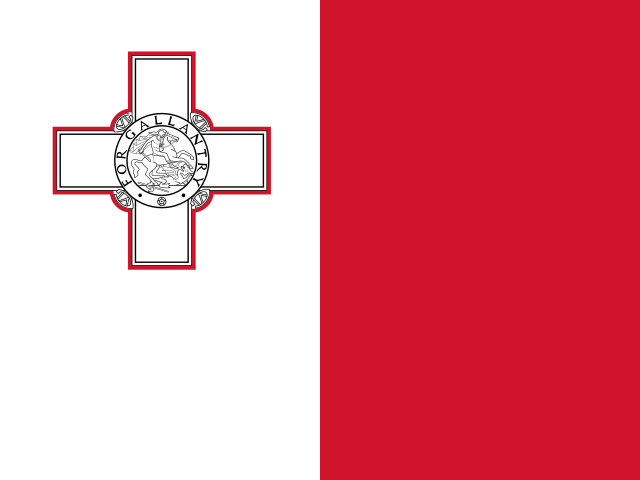
Two equal vertical halves, white at the hoist and red at the fly, with a red-edged George Cross in the upper hoist corner. Section 3 of the constitution records that the cross was awarded to Malta by King George the Sixth on the 15th April, 1942, and assigns no meaning to it or to the two colours.
Malta FACTS ◢
| Capital | Valletta |
|---|---|
| Continent | Europe |
| Population | 579,704 (2025) |
| Area | 316 km² |
| Population density | 1,835/km² |
| Currency | Euro (EUR) |
| Official languages | English, Maltese |
| Calling code | +356 |
| Internet TLD | .mt |
| Time zone | UTC+01:00 |
| Drives on the | Left |
| ISO codes | MT / MLT |
DID YOU KNOW? ◢
- Its megalithic temples are among the oldest free-standing stone structures in the world, older than the pyramids of Giza.
- It's one of the smallest and most densely populated countries in the world.
- Valletta, its capital, was built by the Knights of St John in the 16th century.
- Both Maltese and English are official languages, and Maltese is the only Semitic language written in the Latin alphabet.
Malta QUICK ANSWERS ◢
What is the capital of Malta?
The capital of Malta is Valletta.
What is the population of Malta?
Malta had a population of 579,704 in 2025.
What currency does Malta use?
Malta uses the Euro (EUR).
What languages are spoken in Malta?
The official languages of Malta are English and Maltese.
Think you know your flags? Play Flag Daily → · Browse all countries →
MORE ON THE FLAG ◢
Ask what the Maltese flag means and the answer that comes back is usually a reason rather than a symbolism: the George Cross is there because of what the islanders did under siege. Nothing here disputes that. It is simply not something any Maltese instrument says.
The constitution describes the flag in two sentences and interprets none of it. There is no clause giving the white a virtue or the red a sacrifice. There is no clause saying the cross stands for bravery. Maltese law is perfectly willing to interpret a national symbol when it wants to, and the statute that defines the national emblem interprets two of its elements. It just never does it for the flag.
What the flag provision spends its explanatory energy on instead is unexpected. It names a monarch, an exact date and a decoration, and leaves the reader to work out the rest.
Key Takeaways
- Section 3 of the constitution describes the flag in two subsections, assigns no meaning to the white, the red or the George Cross, and gives provenance instead: an award made to Malta by King George the Sixth on 15 April 1942.
- The claim that the constitution fixes the flag's proportions appears as early as a Government Notice of 25 July 1990, which states that the breadth of the flag is one and a half times its height and attributes that to the constitution. The constitution contains no dimension at all.
- The Act that turned Malta into a republic in 1974 reached provision after provision of the constitution, and re-enacted the flag section with a British king still named in it.
- The Emblem and Public Seal of Malta Act does assign meanings, telling you what the mural crown represents and calling the olive and palm symbols of peace, which shows Maltese drafters glossing a symbol when they want to.
- The Royal Warrant that created the George Cross in 1940 sets out who is eligible for it, and every limb of that list names persons.
Section 3 names a king, and both official languages keep him
The Constitution of Malta puts the flag at section 3, in Chapter 1, under the marginal note National Flag. Its own terminology wobbles: the consolidated text heads its contents "ARRANGEMENT OF ARTICLES" and cross-refers internally to articles, while the 1964 Order and the 1974 amending Act both call the same provisions sections. This piece follows the Acts, and says article only for the ordinary statutes. In the official English it reads:
"The National Flag of Malta consists of two equal vertical stripes, white in the hoist and red in the fly."
and then, as subsection (2):
"A representation of the George Cross awarded to Malta by His Majesty King George the Sixth on the 15th April, 1942 is carried, edged with red, in the canton of the white stripe."
The Maltese text of the same section is the more interesting of the two, because of what it declines to translate. It gives the stripes as "bajda mal-arblu u ħamra n-naħa ta’ barra", white at the flagstaff and red on the outer side, which is a plainer way of saying hoist and fly. Then it leaves the decoration in English: "Rappreżentazzjoni tal-George Cross mogħti lil Malta mill-Maestà Tiegħu r-Re Ġorġ Sitta fil-15 ta’ April, 1942". The award keeps its English name inside the Maltese constitution. The king is naturalised into Maltese as Ġorġ Sitta and the honorific is rendered as Maestà Tiegħu, but George Cross stays exactly as it was.
The two texts also part company on placement. The English uses the heraldic term, the canton, which fixes the cross in the upper corner at the hoist. The Maltese says only "fir-rokna tal-istrixxa l-bajda", in the corner of the white stripe, and does not say which corner. Section 74 decides which text wins when they disagree. "Save as otherwise provided by Parliament", it says, every law is enacted in both languages and, "if there is any conflict between the Maltese and the English texts of any law, the Maltese text shall prevail". Priority rests with the vaguer of the two. Nothing turns on that here, because on its face a text that says less does not conflict with one that says more, but the tie-break runs toward the version that leaves the corner unnamed.
Neither text gives a proportion. Neither gives a colour value. Neither says what the flag means.
Malta became a republic and kept the king
Malta became a republic on 13 December 1974, by Act No. LVIII of 1974, the Constitution of Malta (Amendment) (No. 2) Act. Its own enacting formula still ran in the old style, "BE IT ENACTED by Her Majesty the Queen, by and with the advice and consent of the House of Representatives of Malta", and the assent at the head of the printed Act is the Governor-General's.
That Act rewrote the constitution wholesale. The consolidated text still carries its footprints in the marginal notes, provision after provision, cited from LVIII.1974.2 through to LVIII.1974.69. Its opening sections do the constitutional work you would expect. Section 2 of the Act replaced the title of Chapter 1: for "The State" there was substituted "The Republic of Malta". Section 3 of the Act replaced section 1 of the constitution with a new one opening "Malta is a democratic republic founded on work and on respect for the fundamental rights and freedoms of the individual". Section 4 of the Act rewrote the constitution's section 2 on religion, adding a new subsection (3) on religious teaching in State schools. Section 6 then repealed section 10, whose subject was that same religious teaching, two sections after the Act had re-enacted it.
Section 5 of that same Act then reached the flag, and this is what it did with it:
"For section 3 of the Constitution there shall be substituted the following section:"
followed by the flag text set out above, with King George the Sixth in it. The 1964 independence constitution had already said the same thing in one undivided paragraph, and the substitution split it into subsections (1) and (2), added a comma after "stripes", and wrote the date as "the 15th April, 1942" where 1964 had "15th April 1942". That is the whole of the change.
So an Act that reached provision after provision of the constitution, and rewrote both of the sections immediately before the flag, re-enacted the flag sentence with the King in it. It did not paraphrase him out. It did not convert the award into a symbolism the new republic could own. It re-passed the sentence.
The same statute book will gloss a crown
If Maltese law simply never explained its symbols, the flag's silence would mean nothing. It does explain them, in a separate instrument, the Emblem and Public Seal of Malta Act of 1975, Chapter 253, whose long title promises only "To make provision concerning the Emblem and Public Seal of Malta", and whose emblem and flag provisions in their present form were substituted and added by Act XXIX of 1988.
Article 2(1) of that Act blazons the national emblem, and it interprets as it goes. The shield is "an heraldic representation of the National Flag of Malta". Above it sits "a mural crown in gold with a sally port and eight turrets (five only being visible) representing the fortifications of Malta and denoting a City State". Around it is a wreath of two branches, "the dexter of Olive, the sinister a Palm, symbols of peace and traditionally associated with Malta". Dexter and sinister are the shield's own right and left, which are the viewer's left and right, so the olive branch is the one on the viewer's left.
Read those clauses next to section 3 and the contrast is exact, with one date to keep in view: the glossing was done in 1988, fourteen years after the republic re-passed the flag sentence untouched. The crown is given a referent and a claim. The branches are given a meaning and a tradition. The shield, which is the flag, is given only a cross-reference.
| Instrument | What it fixes | What it interprets |
|---|---|---|
| Constitution s. 3(1) | Two equal vertical stripes, white in the hoist, red in the fly | Nothing |
| Constitution s. 3(2) | A George Cross, edged with red, in the canton of the white stripe | Nothing; it gives the award, the awarding king and the date |
| Emblem Act art. 2(1), shield | An heraldic representation of the national flag | Nothing |
| Emblem Act art. 2(1), crown | A gold mural crown, sally port, eight turrets, five visible | The fortifications of Malta, denoting a City State |
| Emblem Act art. 2(1), wreath | Olive on the dexter, palm on the sinister | Symbols of peace, traditionally associated with Malta |
Article 2(2) is worth a line of its own, because it dates the previous sets: the 1988 emblem replaced both the 1975 emblem and "the armorial ensigns assigned for Malta by warrant dated 2nd September, 1964", published by Government Notice No. 550 the following month. That is the same date as the Malta Independence Order itself, made in Council at Buckingham Palace on 2 September 1964, which appointed 21 September 1964 as the day the new constitution would take effect. The warrant assigning Malta its arms and the Order that scheduled its constitution are dated to the same day. Malta has since had three sets of arms, two changes between them, and the current set since 1988. Those are the sets since independence; a fourth, granted in 1944, appears later in this article. The flag has not changed at all.
The warrant that created the cross was written about people
The George Cross was instituted by Royal Warrant given at St James's on 24 September 1940 and published in the London Gazette on 31 January 1941, countersigned "By His Majesty's Command, Winston S. Churchill".
Its third clause ordains that "the persons eligible for the Decoration of the Cross shall be" the following, and then lists three limbs. The first is "Our faithful subjects and persons under Our protection in civil life, male and female" of the United Kingdom, India, Burma, the colonies and territories under Crown suzerainty, protection or jurisdiction. The second is persons of any rank in the naval, military or air forces of the same places. The third extends the first two to any other part of the Dominions, but only to a part whose government "has signified its desire that the Cross should be awarded under the provisions of this Our Warrant". The warrant adds that the cross "is intended primarily for civilians", and that it "shall be awarded only for acts of the greatest heroism or of the most conspicuous courage in circumstances of extreme danger". Its second clause requires that "the reverse of the Cross shall be plain and bear the name of the recipient", along with the date of the award.
Every one of those limbs is about people, and three later clauses are built on the same assumption. The eighth entitles the recipient "to have placed after his or her names the letters" G.C. The tenth requires a register of names, kept at the Central Chancery of the Orders of Knighthood. The thirteenth provides for cancelling "the award to any person". The warrant names plenty of places, but always as where a recipient comes from; nothing in it contemplates a place as the recipient, and an engraving rule, a post-nominal rule and a register of names all assume someone with a name.
The Crown was perfectly capable of addressing a place when it meant to. On 22 February 1944, from Downing Street, the London Gazette recorded that the King had been pleased, by warrant to the Earl Marshal and recorded in the College of Arms, "to ratify confirm and assign unto the Island of Malta and its Dependencies the following Armorial Bearings", blazoned "Per pale Argent and Gules on a Canton Azure a representation of the George Cross proper". That is a grant to an island, in the ordinary form, less than two years after the award. It is a grant of arms rather than of the flag, and its canton is blue where the flag's is not, but it shows the machinery existed and was used.
Eighteen months later the award went to an island, and thirty-two years after that a Maltese constitution written for a republic still recorded the fact in its third section. Whatever the George Cross means on that flag, the meaning was made by the doing of it rather than by any text.
No source opened here records the Count Roger story
Here the record thins out. Not one Maltese instrument opened for this article says where the flag's two colours came from, and none assigns them a meaning.
The account in circulation is that Count Roger of Sicily gave Malta a piece of his own red and white banner when he took the islands from Arab rule around 1090. It is a good story and it is repeated confidently, and no primary source establishing it could be opened for this article. One negative observation is worth recording: Badger's 1838 Description of Malta and Gozo, which narrates Roger's arrival in some detail and dates it to about 1090, connects him to no banner and no colours at all.
Treat the Roger story as tradition rather than record until somebody produces the record. The instruments support something narrower and more useful. Section 3 dates the cross, and only the cross, to 1942. The stripes are older than anything that describes them here: the earliest instrument opened for this article that fixes white and red for Malta is the 1944 warrant of arms, which blazons them "Per pale Argent and Gules" and gives no reason either. They came through the 1944 grant, through independence and through the republic, and no drafter at any of those points thought it necessary to say why those two colours. Another Mediterranean island republic settled the same question in an entirely different way, and the Cyprus flag is worth reading beside this one.
The government of Malta adds a proportion the constitution never gives
The Maltese government's own guidance on flags and their use opens with a summary of section 3 and then adds a measurement to it:
"The Constitution provides that the National Flag of Malta consists of two equal vertical stripes, white in the hoist and red in the fly, with a representation of the George Cross, edged with red, in the canton of the white stripe; the breadth of the flag is one and a half times its height."
Everything up to the semicolon is section 3, compressed accurately, minus the award, the king and the date, which is to say minus the only explanatory content section 3 has. The clause after the semicolon is not in section 3 at all. The word "breadth" is doing duty for the horizontal dimension, which the notice's own Maltese column settles: it gives the same clause as "il-wisa’ tal-bandiera huwa wieħed u nofs tal-għoli tagħha", the width of the flag is one and a half of its height. So the ratio being stated is three to two, and it is the ratio the government's own guidance uses. But the constitution does not give a dimension, a ratio or a colour value for the flag anywhere in its text. Searching the whole document for the word flag returns two lines: the contents entry, and the provision.
The website is not the author of that sentence. It is reproducing one, and the original is twenty-five years older than the page read here.
Government Notice No. 517, printed in the Malta Government Gazette number 15,310 on Wednesday 25 July 1990, is headed "Instructions on the Use of Flags" and opens by publishing rules "operative within the Public Service". Its first paragraph is the sentence above, word for word, breadth clause included. The notice runs to six pages in parallel Maltese and English columns, ending at page 3352, describing six flags and pennants before it turns to protocol at its second paragraph, is dated 25 July 1990 and carries the file reference OPM/382/89, and is the source of the guidance the government still publishes.
So the misattribution is not a website's slip. A Government Notice told the public service in 1990 that the constitution provides a proportion, the constitution has never provided one, and the government still publishes the sentence. Note what the notice does not do. It does not lay down a proportion; it recites one, as something already provided elsewhere. No instrument opened for this article actually fixes the flag's dimensions.
One detail of the notice is worth having. Its Maltese column places the George Cross "fir-rokna ta’ fuq ta’ l-istrixxa l-bajda", in the upper corner of the white stripe. The Maltese of the constitution does not say which corner. The 1990 notice supplies in Maltese a corner the constitutional Maltese never named.
The rest of the government's page is mostly protocol rather than law, and it is unusually specific. On buildings and stationary flagstaffs in the open the flag is customarily flown only from sunrise to sunset, and it may also be displayed at night on special occasions, in which case "it should preferably be floodlit". No flag or pennant may be placed above it or to its right. When the flag covers a coffin, it should be "so placed that the George Cross is at the head and over the left shoulder". The cross has an orientation of its own elsewhere too, and the sharpest instance is this: "The National Flag shall never be displayed with the George Cross down save as a signal of dire distress." An upside-down George Cross is a distress signal. Military aircraft get a position rule rather than an orientation one: their fin flash bears a George Cross "across its top third".
The flag is legally fenced off
The Emblem and Public Seal of Malta Act reaches the flag in three places, which is odd for an Act whose title mentions only the emblem and the seal. It puts the flag inside the emblem at article 2(1), and then regulates it twice on its own account.
Article 3(2) makes it unlawful for any person to incorporate the National Flag of Malta within any design, "for any purpose whatsoever, without the written authority of the Prime Minister, or not in accordance with any condition contained in any such written authority". Not to misuse it, and not to deface it. To incorporate it in a design at all, and a permission that comes with conditions does not cure a breach of them.
Article 6 separately makes it unlawful to publicly vilify the flag or the emblem by "words, gestures, written matter, whether printed or not, or pictures", or by some other visible means, or in any manner to deface either. Article 7 sets the penalty as a fine between 116.47 and 2,329.37 euro, with a daily addition of at least 2.33 euro for a continuing offence, and requires the Attorney General's consent before any prosecution is brought.
A flag with no legislated meaning turns out to be closely legislated in every other respect. You may not be told what it stands for, and you may not put it in a poster without a letter from the Prime Minister. If you would like to see how many national flags you can actually recognise before reading their law, Flag Daily shows you one a day and gives you three guesses at the country.
Frequently asked questions
Does the Maltese constitution say what the colours of the flag mean?
No. Section 3 of the Constitution of Malta describes the flag as two equal vertical stripes, white in the hoist and red in the fly, with a George Cross edged with red in the canton of the white stripe, and stops there. It assigns no meaning to the white, the red or the cross, and it does not give a proportion or a colour specification.
The readings in circulation, white for purity and red for sacrifice, are conventional. No Maltese instrument opened for this article states them.
Why is there a George Cross on the flag of Malta?
Because the decoration was awarded to Malta and the constitution records the fact. Section 3(2) describes the charge as "A representation of the George Cross awarded to Malta by His Majesty King George the Sixth on the 15th April, 1942".
That is provenance rather than symbolism. The constitution says where the cross came from and who gave it, and never says what it is supposed to represent.
Did Malta change its flag when it became a republic in 1974?
No. Act No. LVIII of 1974 replaced the title of Chapter 1 with "The Republic of Malta" and rewrote section 1, then substituted section 3 with wording that kept King George the Sixth in it. The changes to the flag text itself were the split into two subsections, one added comma and a reformatted date.
The 1964 independence constitution already had the same sentence, set as one undivided paragraph.
What are the official proportions of the flag of Malta?
Three to two in the government's own guidance, but no Maltese instrument opened for this article fixes a proportion. The earliest source found stating one is Government Notice No. 517, published in the Malta Government Gazette number 15,310 on 25 July 1990, and it does not lay the ratio down. It recites it, introducing it with the words "The Constitution provides that". The constitution contains no dimension at all.
The government's flags page carries the same sentence today.
Is it against the law to use the Maltese flag in a design?
Yes, without permission. Article 3(2) of the Emblem and Public Seal of Malta Act makes it unlawful for any person to incorporate the National Flag of Malta within any design, for any purpose whatsoever, without the written authority of the Prime Minister, or otherwise than in accordance with any condition attached to such an authority.
Article 6 of the same Act separately prohibits publicly vilifying or defacing the flag, and article 7 sets a fine of between 116.47 and 2,329.37 euro, with prosecution requiring the Attorney General's consent.
Sources
- Constitution of Malta, section 3, official English text - Legislazzjoni Malta, consolidated text at 28 July 2026. Retrieved 30 August 2026.
- Constitution of Malta, section 3, Maltese text - Legislazzjoni Malta, consolidated text at 28 July 2026. Retrieved 30 August 2026.
- The Malta Independence Order 1964, S.I. 1964/1398, section 3 of the scheduled Constitution - The National Archives, legislation.gov.uk. Retrieved 30 August 2026.
- Act No. LVIII of 1974, Constitution of Malta (Amendment) (No. 2) Act, sections 2 to 6 - Legislazzjoni Malta. The published Act is a scan without a text layer, so the pages were rendered and transcribed for this article. Retrieved 30 August 2026.
- Emblem and Public Seal of Malta Act, Chapter 253 - Legislazzjoni Malta. Retrieved 30 August 2026.
- Royal Warrant instituting the George Cross, 24 September 1940 - The London Gazette, issue 35060, pages 622 to 623, 31 January 1941. Retrieved 30 August 2026.
- Flags, Symbols and their uses - Government of Malta. The live page was unavailable, so it was read from this Internet Archive capture of 29 June 2015. Retrieved 30 August 2026.
- Government Notice No. 517, Instructions on the Use of Flags - The Malta Government Gazette No. 15,310, 25 July 1990, six pages in parallel Maltese and English, ending at page 3352. A scan without a text layer, read from the Internet Archive capture of 1 June 2015 because the live document link is refused, and transcribed for this article. Retrieved 30 August 2026.
- Grant of armorial bearings to the Island of Malta and its Dependencies, 22 February 1944 - The London Gazette, issue 36393, page 912. Retrieved 30 August 2026.
- What could not be checked: the file recording the award itself, War in the Mediterranean: George Cross awarded to Malta, CO 926/1/14 at The National Archives, covering dates June 1941 to April 1942, is not digitised, and no claim here rests on it. The separate National Flag Graphical Specifications PDF that the government page links beside Government Notice No. 517 could not be opened from this machine, so nothing here describes the drawing. Retrieved 30 August 2026.
- George Percy Badger, Description of Malta and Gozo, 1838 - Internet Archive full text. Retrieved 30 August 2026.
PLAY ANOTHER →
One quote, one scrambled alphabet. Crack it before tomorrow.
CRACK THE QUOTEDAILYGuess the CountryThree clues, three guesses. Work out where in the world it is.
THREE CLUESDAILYDaily TriviaFive questions a day. Everyone gets the same five.
FIVE QUESTIONSDAILYOn This DayOne thing that happened today in history. Every day, a new one.
TODAY IN HISTORY