
Cyprus
An eastern Mediterranean island where Greek and Turkish cultures meet, Cyprus was, according to legend, the birthplace of Aphrodite, the goddess of love.
WHAT THE FLAG MEANS ◢
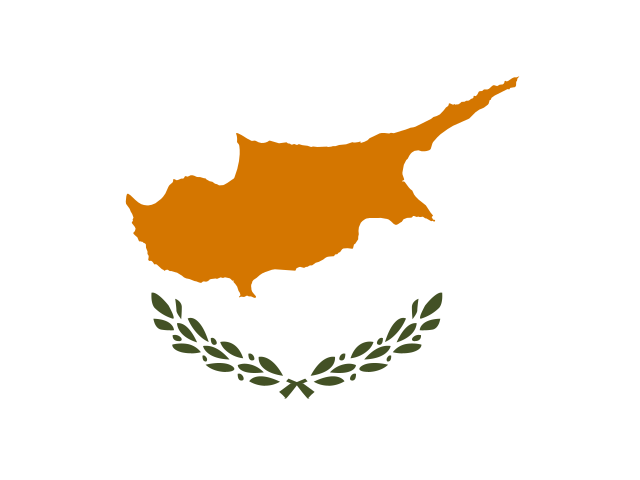
A white field bearing a copper-coloured silhouette of the map of the island above two crossed olive-green olive branches. Article 4 of the 1960 Constitution requires only a flag of neutral design and colour, chosen jointly by the President and the Vice-President, and assigns the copper and the branches nothing; the widely repeated ban on blue, red, crosses and crescents is not in it either. The government's own published gloss reads the olive branches simply as symbols of peace and ties the copper to the island's long association with the metal. The word copper descends from the island's name, not the other way round, and the reading that the branches stand for peace between the Greek and Turkish communities is a popular addition rather than an official one.
Cyprus FACTS ◢
| Capital | Nicosia |
|---|---|
| Continent | Europe |
| Population | 1,370,754 (2025) |
| Area | 9,234 km² |
| Population density | 148/km² |
| Currency | Euro (EUR) |
| Official languages | Greek, Turkish |
| Calling code | +357 |
| Internet TLD | .cy |
| Time zone | UTC+02:00 |
| Drives on the | Left |
| ISO codes | CY / CYP |
DID YOU KNOW? ◢
- In Greek mythology, the goddess Aphrodite was said to have risen from the sea off its coast.
- It's the third-largest island in the Mediterranean.
- Its capital, Nicosia, is the last divided capital city in Europe.
- It produces Commandaria, often described as one of the world's oldest named wines still in production.
Cyprus QUICK ANSWERS ◢
What is the capital of Cyprus?
The capital of Cyprus is Nicosia.
What is the population of Cyprus?
Cyprus had a population of 1,370,754 in 2025.
What currency does Cyprus use?
Cyprus uses the Euro (EUR).
What languages are spoken in Cyprus?
The official languages of Cyprus are Greek and Turkish.
Think you know your flags? Play Flag Daily → · Browse all countries →
MORE ON THE FLAG ◢
The flag of the Republic of Cyprus is the outline of the island in copper, set above two crossed olive-green olive branches, on a white field. Almost every account explains the design the same way: the new state was forbidden blue, forbidden red, forbidden a cross and forbidden a crescent, and a map with a peace symbol under it was what remained.
The document usually cited for that ban is Article 4 of the 1960 Constitution. Article 4 contains none of it.
What it contains is one adjective. The Republic is to have a flag "ουδετέρου σχεδίου και χρώματος" (oudeterou schediou kai chromatos), of neutral design and colour, chosen jointly by the President and the Vice-President. No colour is named. No emblem is prescribed. Nothing is prohibited by name, and nothing on the finished flag is given a meaning.
Key Takeaways
- Article 4 of the Constitution of Cyprus requires only a flag "of neutral design and colour", chosen jointly by the Greek Cypriot President and the Turkish Cypriot Vice-President.
- The words blue, red, cross, crescent, copper and olive appear nowhere in the Constitution. Neither the copper colour nor the olive branches are assigned any meaning by it.
- The peace reading is the Presidency's, not the Constitution's: its State Symbols page says in as many words that the olive branches "are symbols of peace".
- The flag was designed by Ismet Vehit Güney, a Turkish Cypriot artist and teacher, and chosen by Archbishop Makarios III with the Vice-President's assent.
- The English word copper descends from Cyprus, not the other way round. Latin cuprum derives from aes Cyprium, the metal of Cyprus.
| The claim | Where it actually comes from | What that source establishes |
|---|---|---|
| A flag "of neutral design and colour" | Constitution of Cyprus, Article 4(1) | The only design requirement the founding text imposes |
| Design and colour fixed by the two leaders together | Article 4(1), restated at Article 47(a) | A joint act of the President and Vice-President, not a legislative one |
| The olive branches are symbols of peace | Presidency of the Republic, State Symbols | An executive gloss published later, not a constitutional definition |
| Copper recalls the island's mineral history | Presidency of the Republic, State Symbols | Two readings offered, one of them hedged by the Presidency itself |
| No blue, no red, no cross, no crescent | Not in Article 4 | Reported as the design competition's conditions, not as constitutional text |
What does the Cyprus flag actually show?
The Republic's own description is unusually precise about colour and unusually silent about symbolism.
The Presidency of the Republic publishes the specification on its State Symbols page: "The background is white with a copper-coloured (pantone 1385 C) silhouette of the map of Cyprus in the centre of the flag above two crossed olive-green-coloured (pantone 574 C) olive branches."
Two named Pantone references, an outline of the whole island, and two branches. The Greek version of the same page adds a detail the English one drops: the branches are "δύο σταυρωτά κλαδιά ελιάς χρώματος πράσινου-λαδί με καρπούς", two crossed olive-green olive branches with fruit on them. The olives are part of the specification, not an artist's flourish.
One thing the specification does not date is itself. The Presidency's page opens "The flag of the Republic of Cyprus was defined in 1960" and mentions no later change, in either language, yet accounts outside the Cypriot state date the current version, with these two Pantone references, to a revision in April 2006. No Cypriot instrument for that revision could be found for this article. So the honest statement is narrower than either version: the Republic publishes this specification as the flag's specification, without saying when these particular colour references were fixed.
The island shown is the whole island, north included. That is the detail most often passed over, and it is not a cartographic choice so much as a political one, for reasons the last section of this article takes up.
What does the Constitution say about the flag?
Article 4 is four paragraphs long and its first one is the whole design brief.
"Η Δημοκρατία έχει ιδίαν σημαίαν ουδετέρου σχεδίου και χρώματος, την οποίαν επιλέγουσιν από κοινού ο Πρόεδρος και ο Αντιπρόεδρος της Δημοκρατίας." In the English text lodged with the United Nations Office on Drugs and Crime's legal library, that reads: "The Republic shall have its own flag of neutral design and colour, chosen jointly by the President and the Vice-President of the Republic."
The Greek matters, because the Greek is one of the two original texts. Article 180 provides that both the Greek and the Turkish texts "είναι πρωτότυπα και έχουσι το αυτό κύρος και την αυτήν νομική ισχύν", are originals and have the same validity and the same legal force. English has no standing here. Every English quotation of this article, including the one above, is a translation.
The word carrying the entire design constraint is therefore ουδετέρου, neutral. And searched end to end, in both the Greek text published on the Republic's own portal and the Greek text held by CyLaw, the Constitution contains no instance of σταυρός (cross), ημισέληνος (crescent), κυανό or μπλε (blue), κόκκινο (red), χαλκός (copper) or ελιά (olive). Nor of the formal equivalents the 1960 text would actually have used, since it is written in katharevousa rather than in the modern language: ερυθρός for red, γαλάζιος for blue, ελαία for the olive. Zero occurrences of any of them, in either copy. The word χρώμα, colour, occurs three times in the entire document. Two of the three are the flag: Article 4(1), and Article 47(a), which restates it. The third, in Article 28(2), forbids discrimination on grounds of colour. So the Constitution mentions the flag's colour twice and names a colour neither time.
The two officeholders who had to agree on the design were, by the same Constitution's first article, one from each community: the state is a republic "the President being Greek and the Vice-President being Turk elected by the Greek and the Turkish Communities of Cyprus respectively". So the neutrality requirement in Article 4 is not only about the artwork. It is enforced by who holds the pen.
The remaining paragraphs of Article 4 are about flying it rather than designing it. They give the authorities of the Republic the right to fly the Greek and the Turkish flags beside the Republic's own on holidays, communal authorities the right to fly one or the other, and any citizen of the Republic, or any organisation of its citizens, the right to fly the Republic's flag, or the Greek flag, or the Turkish flag on their own home or business premises, "άνευ οιουδήποτε περιορισμού", without any restriction. A flag designed to be neither was written into a text that guarantees both may fly next to it.
Where does "no blue, no red, no cross, no crescent" come from?
Not from Article 4, and that is the sharpest thing to know about this flag.
The enumerated ban circulates widely, and it is frequently attached to the Constitution directly. Wikipedia's article on the flag quotes the requirement of a "neutral design and colour" accurately, then continues in its own voice that the flag "should not include either blue or red colours" and should not portray a cross or a crescent, and cites Article 4 for the whole sentence. Article 4 supports the quoted phrase and supplies none of the continuation. The prohibitions are an editor's inference presented as statute, and it is the version that has propagated.
Greek Cypriot press accounts put the four prohibitions where they are far more likely to belong: in the terms of the design competition rather than in the constitutional text. The Cypriot news portal Dialogos, recounting the flag's history, introduces them with the word for preconditions and attaches them to the competition: "Προϋποθέσεις ήταν στη σημαία να μην εικονίζεται σταυρός ή ημισέληνος, και να μην περιέχονται το μπλε και το κόκκινο χρώμα, σύμβολα και τα δυο της Ελλάδας και της Τουρκίας." The conditions were that no cross or crescent be depicted on the flag, and that it not contain blue or red, both being symbols of Greece and Turkey.
That is a newspaper account rather than an instrument, and it should be read as one. What it gets right is the category: these were terms set for entrants, not text enacted in a constitution.
The Constitution does point at where the constraint was negotiated, even though it does not restate it. Article 180(2) directs that any contradiction between the two original texts be resolved by reference to the draft signed in Nicosia on 6 April 1960 and its annex of 6 July 1960. It then adds a second instruction: "λαμβανομένου υπ’ όψιν και του κειμένου των συμφωνιών Ζυρίχης της 11ης Φεβρουαρίου, 1959, και Λονδίνου της 19ης Φεβρουαρίου, 1959, κατά τε το γράμμα και πνεύμα αυτών". Taking into account, that is, the text of the Zurich agreements of 11 February 1959 and the London agreements of 19 February 1959, in their letter and their spirit.
So the founding text names the two 1959 agreements as the interpretive authority for its own wording. That is exactly where the phrase about neutrality is reported to have originated. The text of those agreements could not be opened from here. The Basic Structure agreed at Zurich is quoted secondhand in every account consulted here and reproduced in full by none of them, so this article does not assert what it says. What can be established is the chain: Article 4 says neutral, and Article 180 says read neutral in the light of Zurich and London.
One further trace of that period survives in a catalogue. The National Archives at Kew holds file FCO 141/4070, "Cyprus: design of the flag for the Republic of Cyprus", covering 1 January 1959 to 31 December 1960, formerly the colonial administration's C.423/1959 and released in 2013 among the migrated archives of former colonial administrations. The file is not digitised and its contents were not read for this article. Its existence and its dates are worth recording anyway: the question of what the new flag could show was an administrative file a year and a half before there was a Republic to fly one.
Who designed the Cyprus flag, and was he ever paid?
A Turkish Cypriot art teacher, whose design a Greek Cypriot archbishop chose.
Ismet Vehit Güney was a teacher, cartoonist and painter, and he won the competition, which Dialogos describes as an international one ("διεθνή διαγωνισμό"). His flag was adopted on 16 August 1960, the day sovereignty passed to the Republic. The Cyprus Mail, reporting his death in June 2009, records that he designed the flag, the emblem and the Cyprus lira, and that the design "was selected by Archbishop Makarios after Guney submitted his proposal along with a message from then Vice President Fazil Kucuk". Its summary of the constraint is the plain one: "Both the Greek blue and Turkish red were avoided at the time." Dialogos puts the choice more squarely as a joint one, saying the design "επιλέχθηκε από τον Πρόεδρο της Κυπριακής Δημοκρατίας, Μακάριο Γ΄ και τον αντιπρόεδρο Φαζίλ Κιουτσούκ", was chosen by President Makarios III and Vice-President Fazil Kucuk, which is what Article 4 required of them.
The flag's first appearance was as muted as the ceremonies around it. Alan James, writing on the making of the settlement in The Cyprus Review, records that sovereignty passed at midnight on 15 and 16 August 1960 with no handover of flags at all: "There was, however, no flag-lowering and raising ceremony at midnight: the Union Jack was taken down at dusk the previous evening, and the Cypriot flag raised for the first time the next morning."
Two loose ends in his record are worth naming rather than smoothing over. The Cyprus Mail's obituary gives his birth year as 1932 and his age at death as 77. TURKSOY, the intergovernmental organisation of Turkic culture, declared 2023 the Year of Ismet Vehit Güney "in commemoration of the 100th anniversary of the birthday", which puts his birth in 1923 and disagrees with the obituary by nine years. Published accounts do not agree, and this article does not pick one.
The second is money. The same obituary records that in 2006, forty-six years after the flag was adopted, Guney sought payment from the government for the design along with compensation for use of the copyright, and that Turkish Cypriot press reports said Makarios had promised him twenty pounds a year and that he was never paid. The Presidency's own State Symbols page, which specifies the flag down to two Pantone numbers, does not name its designer at all.
Which came first, the island's name or the metal's?
Both claims are made, they are claims about two different words, and only one of them is settled.
The settled one runs from the island to the metal. Latin had aes for copper and its alloys, and marked the Cypriot metal by adding the island's adjective; aes Cyprium contracted to cuprum, which is where English copper and the chemical symbol Cu come from. Vasiliki Kassianidou, of the Archaeological Research Unit at the University of Cyprus, states it directly in the opening line of her survey of Cypriot mining in Metalla 20.2: "the Latin word Cuprum derives from Aes Cyprium, Cypriot copper", the term she notes Pliny used in the Natural History for the pure metal rather than one of its alloys.
Pliny's usage is visible in his own Latin. Discussing the kinds of copper and their alloys in Book 34, he treats the island's adjective as the name of the metal itself, describing the ductile grade as the sort "quale omne Cyprium est", which all Cyprian metal is. There is no noun for the metal in that clause at all: the island's adjective stands alone and does the naming.
The unsettled claim runs the other way, and the Cypriot state is careful with it. The Presidency's page says the copper colour "has a dual symbolism", and its first limb is that "the name of the island is said to derive from an ancient word for copper (Eteocypriot or Sumerian)". The Greek text hedges in the same place: "το όνομα του νησιού λέγεται ότι προέρχεται από αρχαία λέξη για το χαλκό", the name of the island is said to derive from an ancient word for copper. Said to. The second limb, that copper has been closely associated with Cyprus since antiquity, needs no hedge at all.
So the direction depends on which word is meant. Cuprum from Cyprus is documented. Kypros from a word for copper is a hypothesis about a pre-Greek or Near Eastern etymology that the Republic itself reports rather than asserts. A sentence saying the colour recalls the island's copper ore and its name runs the two together and states the weaker one as though it were the stronger.
What do the copper and the olive branches officially mean?
The copper has an official reading and the olive branches have an official reading, and neither of them is in the Constitution.
Article 4 assigns the flag no symbolism whatsoever, and Article 47 confirms how narrow the constitutional treatment is. It lists the executive powers the President and Vice-President exercise jointly, and the first item on that list, item (a), is "τον καθορισμόν του σχεδίου και του χρώματος της σημαίας της Δημοκρατίας, ως εν άρθρω 4 ορίζεται", the determination of the design and the colour of the flag of the Republic, as provided in article 4. The flag heads the list of things neither leader could settle alone. What the finished design would mean is not on the list at all.
The meaning comes from the Presidency, and it is worth quoting at its actual width. On the olive branches, the whole of it is one sentence: "The olive branches are symbols of peace." Peace, full stop. The Greek is equally short: "Τα κλαδιά ελιάς συμβολίζουν την ειρήνη."
The common expansion, that they stand for peace between the island's Greek and Turkish communities, is a reasonable inference from the circumstances and it is not what the Republic publishes. It is also not idle: the Republic's coat of arms carries a dove with an olive branch, and the Presidency describes the dove and the arms' olive branches together as "symbols of peace" in the same undifferentiated way.
The white field is the largest element on the flag and the only one nobody officially glosses at all. The Greek page gives it a sentence of its own and then moves on: "Το φόντο της σημαίας είναι λευκό", the background of the flag is white. The English folds the same fact into the head of the specification sentence quoted earlier. Neither attaches a meaning to it. The peace-and-freedom reading of the white that circulates comes from the same press account that carries the competition conditions: Dialogos has it that "το λευκό φόντο συμβολίζει την ειρήνη και την ελευθερία", the white background symbolises peace and freedom. That is a newspaper's reading. No Cypriot state source consulted for this article assigns the white anything, which makes the largest area of the flag the emptiest part of the record.
There is one more piece of neutrality hiding in the same document, and it makes the flag look less like an aesthetic compromise and more like a constitutional habit. The word ουδέτερος does further work in the 1960 text. The Supreme Constitutional Court was to consist of "ενός Έλληνος, ενός Τούρκου και ενός ουδετέρου δικαστού", one Greek, one Turkish and one neutral judge, and the neutral judge was to preside. The High Court under Article 153 was two Greek judges, one Turkish and one neutral, and there the neutral judge presided holding two votes. A neutral flag and a neutral judge are the same drafting instinct. Where the two communities could not both be satisfied, the Constitution reached for a third thing that belonged to neither.
Whose flag is it now?
The Republic's, and the answer is contested in ways the flag's own design anticipated and could not prevent.
The Security Council has been seized of Cyprus since 1964. The official compilation that carries the resolution quoted below records the United Nations peace-keeping force in Cyprus as "established under resolution 186 (1964)", and extends its mandate again in the same volume. In November 1983 the Turkish Cypriot authorities declared a separate state in the north, which flies a different flag of its own. The Council took that declaration up within days. Resolution 541 of 18 November 1983 records the Council's concern at a declaration "which purports to create an independent State in northern Cyprus", considers it "legally invalid", calls for its withdrawal, and calls upon all states not to recognise any Cypriot state other than the Republic of Cyprus. Its preamble reaches back no further than the Council's own resolutions 365 (1974) and 367 (1975).
Those are the Council's words and the Council's position, and this article does not extend them. On the other side of the question, one indication that Turkey receives the northern administration as a state comes from TURKSOY, an intergovernmental cultural body of which Turkey is a member. Its account of its own commemorative event for the flag's designer lists among the guests "the Ambassador of the Turkish Republic of Northern Cyprus (TRNC) to Ankara". How many other states have done likewise is not something either document records, and no count is asserted here. What can be said without adopting anybody's framing is what the founding text says: the Republic's flag was required to be neither Greek nor Turkish, its design was to be fixed by a Greek Cypriot and a Turkish Cypriot acting together, and the design that resulted was the shape of an island that neither community would have to concede.
If you want to test whether you would recognise it, Flag Daily puts up one flag a day and gives you three guesses at the country. An island in outline is an unusually literal thing to put on a flag, which is what makes this one recognisable at all.
Frequently asked questions
What do the colours on the Cyprus flag mean?
The Constitution assigns them nothing. Article 4 requires only a flag "of neutral design and colour" and names no colour and no meaning. The readings that circulate come from the Presidency of the Republic's State Symbols page, which gives the copper colour a dual symbolism tied to the island's copper mining and to a hedged claim about the origin of the island's name, and says of the branches simply that "The olive branches are symbols of peace."
Why does the Cyprus flag have a map on it?
Because the design had to avoid the emblems and colours of both Greece and Turkey, and the island itself was the one image neither community could object to. The requirement in Article 4 is stated as neutrality of design and colour rather than as a list of banned devices, so the four prohibitions usually quoted come from accounts of the competition's conditions and not from the constitutional text.
Who designed the flag of Cyprus?
Ismet Vehit Güney, a Turkish Cypriot artist and teacher, whose entry won the competition. The Cyprus Mail reports that Archbishop Makarios selected it after Guney submitted it with a message from the then Vice-President, Fazil Kucuk. Published accounts disagree about Guney's birth year, giving both 1923 and 1932.
Is copper named after Cyprus or Cyprus after copper?
Copper is named after Cyprus. Latin aes Cyprium, the metal of Cyprus, contracted to cuprum, which gives English copper and the symbol Cu, and the Latin adjective is used that way in Pliny's Natural History. The reverse claim, that the island's name comes from an ancient word for copper, is a separate hypothesis that the Presidency of the Republic itself reports as something the name "is said to" derive from.
Does the Cyprus flag mean the same thing to both communities?
No, and the flag's own founding article shows the state expected that. Article 4 required a design belonging to neither community, then guaranteed that the Greek and the Turkish flags could be flown beside it, by public authorities on holidays and by private citizens on their own home or business premises without any restriction. Since 1983 the north has flown a separate flag, under a declaration that United Nations Security Council resolution 541 of that year considers "legally invalid", and that same resolution calls on all states not to recognise any Cypriot state other than the Republic of Cyprus.
Sources
- Republic of Cyprus, Secretariat of the Council of Ministers, Σύνταγμα της Κυπριακής Δημοκρατίας 1960 - Greek text, articles 4, 47, 133, 180 - retrieved 12 August 2026.
- CyLaw (Cyprus Bar Association legal database), Το Σύνταγμα της Κυπριακής Δημοκρατίας - Greek text, used to cross-check every quotation - retrieved 12 August 2026.
- United Nations Office on Drugs and Crime legal library, Cyprus Constitution 1960 - English text of Article 4 - retrieved 12 August 2026.
- Presidency of the Republic of Cyprus, State Symbols and Σύμβολα του Κράτους - the flag specification and the official symbolism - retrieved 12 August 2026.
- Vasiliki Kassianidou, "Mining Landscapes of Prehistoric Cyprus", Metalla 20.2 (2013), pages 5 to 57, via a third-party rehost of the article PDF - the derivation of cuprum from aes Cyprium - retrieved 12 August 2026.
- Pliny the Elder, Naturalis Historia, Book 34, Latin text at LacusCurtius, University of Chicago - the substantival use of Cyprium for the metal, book 34 chapter 20 section 94 - retrieved 12 August 2026.
- United Nations Security Council, resolution 541 (1983) of 18 November 1983 - the official compilation page, which also carries resolutions 535 and 544 and their references to resolution 186 (1964) - retrieved 12 August 2026.
- Alan James, "The Making of the Cyprus Settlement, 1958-60", The Cyprus Review - the transfer of sovereignty and the flag-raising - retrieved 12 August 2026.
- Stefanos Evripidou, "Cyprus flag designer dies", Cyprus Mail, June 2009, archived copy captured 26 June 2009 - retrieved 12 August 2026.
- The National Archives (UK), catalogue entry for FCO 141/4070, "Cyprus: design of the flag for the Republic of Cyprus" - catalogue description only, file not digitised - retrieved 12 August 2026.
- Dialogos, Η ιστορία της κυπριακής σημαίας, 1 October 2020 - a Greek Cypriot press account of the competition's conditions - retrieved 12 August 2026.
- TURKSOY, 100th Anniversary of the Birthday of the Northern Cypriot artist Ismet Vehit Güney, 17 November 2023 - retrieved 12 August 2026.
- Wikipedia, Flag of Cyprus - listed as the circulating claim this article corrects, not as a source relied on for any fact - retrieved 12 August 2026.
PLAY ANOTHER →
Three clues, three guesses. Work out where in the world it is.
THREE CLUESDAILYDaily TriviaFive questions a day. Everyone gets the same five.
FIVE QUESTIONSDAILYDaily CodeA short message, hidden in a different cipher every day.
ONE CIPHER A DAYDAILYOn This DayOne thing that happened today in history. Every day, a new one.
TODAY IN HISTORY