
Turkey
Straddling Europe and Asia across the Bosphorus, Turkey is the bridge where two continents meet and where Istanbul has served as an imperial capital for well over a millennium.
WHAT THE FLAG MEANS ◢
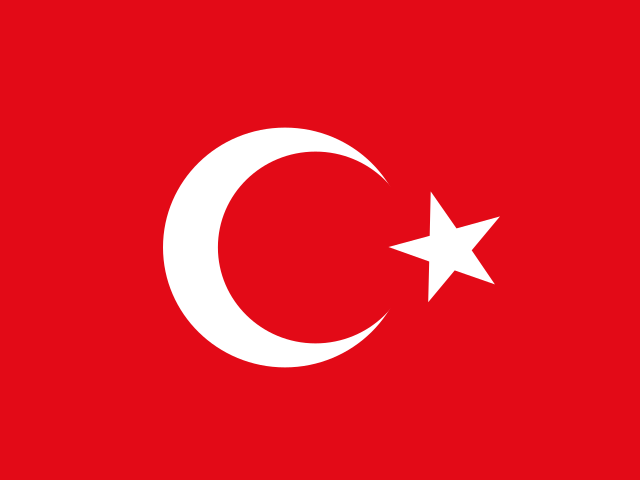
A red field charged with a white crescent and five-pointed star. The constitution, the flag law and its regulation all describe the flag without assigning the colour or the charges any meaning. The crescent is conventionally read as a symbol of Islam. The star is a later addition, carried in eight-pointed form on Ottoman army and navy flags before it took five points in the nineteenth century.
Turkey FACTS ◢
| Capital | Ankara |
|---|---|
| Continent | Asia, Europe |
| Population | 85,878,556 (2025) |
| Area | 783,562 km² |
| Population density | 110/km² |
| Currency | Turkish lira (TRY) |
| Official language | Turkish |
| Calling code | +90 |
| Internet TLD | .tr |
| Time zone | UTC+03:00 |
| Drives on the | Right |
| ISO codes | TR / TUR |
DID YOU KNOW? ◢
- It sits on two continents, with Istanbul spanning both Europe and Asia.
- Istanbul was the capital of the Roman, Byzantine and Ottoman empires in turn.
- The surreal fairy-chimney landscape of Cappadocia is dotted with entire cities carved underground.
- The ancient site of Gobekli Tepe here is often called the world's oldest known temple complex.
Turkey QUICK ANSWERS ◢
What is the capital of Turkey?
The capital of Turkey is Ankara.
What is the population of Turkey?
Turkey had a population of 85,878,556 in 2025.
What currency does Turkey use?
Turkey uses the Turkish lira (TRY).
What languages are spoken in Turkey?
The official language of Turkey is Turkish.
Think you know your flags? Play Flag Daily → · Browse all countries →
MORE ON THE FLAG ◢
No official meaning is fixed. Turkish law fixes almost everything else about the flag, in unusual detail.
Turkey's constitution describes the flag in one clause and then places that clause beyond amendment. Its flag law hands the shape to a measured drawing bound into the statute. The regulation under that law gives the red three colour coordinates and a tolerance, defines the white by how much light it reflects at two named wavelengths, lists the fabrics the flag may be woven from, and builds the star with a compass.
In all of that, across a constitution, two flag laws and a regulation, there is not one word about what the colour or the charges stand for.
Key Takeaways
- Article 3 of the 1982 constitution describes the flag, and article 4 makes article 3 unamendable, barring anyone from even proposing a change.
- The flag law gives the design to an annexed drawing whose eight dimensions are all expressed as fractions of the flag's height.
- Neither flag law nor the regulation calls the star five-pointed. Its shape comes from a construction instead: divide a circle into five and join the points, skipping one each time.
- The 1985 regulation fixes the red as three coordinates with a tolerance in NBS units, and the white as a reflectance test at 460 and 620 nanometres.
- One figure on the original 1936 plate is ten times the figure given by the 1983 annex and the 1985 regulation, and at the 1936 value the crescent cannot be drawn at all.
| Dimension | Letter | 1936 plate | 1983 annex |
|---|---|---|---|
| Centre of the crescent's outer circle, from the hoist | A | 1/2 G | 1/2 G |
| Diameter of the crescent's outer circle | B | 1/2 G | 1/2 G |
| Between the crescent's inner and outer centres | C | 0,625 G | 0,0625 G |
| Diameter of the crescent's inner circle | D | 0,4 G | 0,4 G |
| Star circle offset (defined differently on the two plates) | E | 1/3 G | 1/3 G |
| Diameter of the star's circle | F | 1/4 G | 1/4 G |
| Length of the flag | L | 1 1/2 G | 1 1/2 G |
| Width of the hoist sleeve | M | 1/30 G | 1/30 G |
G is the flag's height. The same note is printed on both plates: whatever the flag's height, the coefficients do not change. Seven of the eight rows agree, and the eighth is the subject of a section below.
Turkey's constitution puts the flag's description beyond amendment
Article 3 of the 1982 constitution deals with the state's integrity, its language, its flag, its anthem and its capital in four short provisions. The flag gets one: "Bayrağı, şekli kanununda belirtilen, beyaz ay yıldızlı al bayraktır."
Rendered into English, that is: its flag is the red flag with white crescent and star, the form of which is specified in its law. The constitution describes the charges and the colour, then sends the form out to statute.
What it does not do is say what any of it represents. There is no clause of purpose, no gloss, no colour symbolism. The sentence describes and stops.
Article 4 is what makes this unusual. It provides that the form of the state as a republic in article 1, the characteristics of the republic in article 2, and the provisions of article 3 "değiştirilemez ve değiştirilmesi teklif edilemez".
They cannot be amended, and their amendment cannot be proposed. The flag's description belongs to the small set of provisions that the constitution puts outside its own amendment procedure. A future parliament may not change the wording, and may not table a bill that would.
So the most protected sentence about the Turkish flag in Turkish law assigns it no meaning at all.
The flag law describes the design in one sentence and points at a drawing
The Türk Bayrağı Kanunu, law number 2893, was adopted on 22 September 1983 and published in the Resmî Gazete on 24 September 1983. Its article 2 holds the description: "Türk Bayrağı, bu Kanuna ekli cetvelde gösterilen şekil ve oranlarda olmak kaydıyla beyaz ay - yıldızlı albayraktır."
The Turkish flag is the red flag with white crescent and star, provided it is in the shape and proportions shown in the table annexed to this law. Most of the work in that sentence is done by the cross-reference, because the law never describes the geometry itself. It points at a plate.
That plate is bound into the statute. It shows the flag on its staff, labels the field AL and the hoist sleeve BEYAZ, and marks the flag's height as G and eight further dimensions with the letters A, B, C, D, E, F, L and M. Underneath sits the table reproduced above, every entry a fraction or a decimal multiple of G.
Article 10 of the same law repealed its predecessor, the flag law of 29 May 1936. Article 11 gave the new law six months before it took effect.
The rest of law 2893 governs handling rather than design: when the flag is flown, who salutes it, whose coffins it may cover, and what may not be done to it. On what the crescent and star are for, it says nothing from the first article to the twelfth.
How Turkey's regulation builds the crescent and star
The detail the law defers to is set out in the Türk Bayrağı Tüzüğü, the regulation brought into force by a Council of Ministers decision of 25 January 1985 and published on 17 March 1985.
That 1985 regulation is still served as consolidated current legislation, and getting there is slightly odd. A decree in 2018 rewrote law 2893 so that every reference to a tüzük became a reference to a yönetmelik issued by the President. No regulation under that name appears in the state's own legislation database. A title search there for "Türk Bayrağı" returns exactly two records: the 1983 law and the 1985 Tüzük. The law points at a yönetmelik the database does not list, and the instrument it does list is the one from 1985.
Its article 4 sets out the construction. The length is one and a half times the height. Of the crescent it says "Ay, iç ve dış çemberlerinin birbirini kesmesinden meydana gelir": the crescent is produced by its inner and outer circles cutting each other. The outer circle's diameter is half the flag's height. The inner circle's diameter is four tenths of it, and its centre stands offset toward the fly. Article 4 adds that "Ayın ağzı uçum yönüne bakar", the crescent's mouth faces the fly.
Then the star. Neither the constitution, the two flag laws nor the regulation calls it five-pointed in words. The regulation instead describes a circle whose diameter is a quarter of the flag's height, "beş eşit parçaya bölündüğü farzedilen bir çemberin bölüşme noktaları birer atlanarak meydana getirilir": taken to be divided into five equal parts, with its division points joined skipping one each time.
Divide a circle into five and join every second point and you have drawn a pentagram. The number of points follows from the instruction rather than appearing as an adjective in it. The regulation then fixes where the star sits: one of its points lies on the intersection of the flag's axis with the line taken to pass through the crescent's two tips.
The red is three numbers and the white is a reflectance test
Article 3 of the regulation, in the form given to it in 1995, does something most flag law never attempts. It specifies the colours as measurements.
For the red, which Turkish law calls al rather than the ordinary modern kırmızı, it gives three coordinates: lightness 27,5, redness against greenness 44,8, yellowness against blueness 15,6. It then allows a tolerance of at most 3 NBS colour difference units, without naming the colour space on its face, and refers the remaining detail on fabrics and materials to a mandatory Turkish Standard.
The white is stranger and more specific. The regulation defines the whiteness of the crescent and star as a relationship between two reflectance measurements: twice the reflectance percentage at a wavelength of 460 nanometres, less the reflectance percentage at 620 nanometres. That figure must reach at least 15 per cent in silk and synthetic blend fabrics, and at least 60 per cent in others.
Article 3 also lists what the flag may be made of: 100 per cent nylon, 100 per cent polyester, half silk with half wool, or half silk with half nylon or polyester, the last two reserved for special occasions. Manufacturers are required to hold a Turkish Standards Institute certificate.
Article 5 sets the sizes. The flag's height is 50 centimetres or a multiple of it, and a flag for a passenger vehicle is 20 by 30 centimetres. Smaller flags may be flown in heavy wind and rain.
Algeria's flag law goes the same way. Its 1963 annexe fixes the star's radius and the wavelengths of the two colours, giving the green a wavelength of 5.411 and the red 6.562, as the annexe prints them, without a unit, with positions 600 and 285 on the normal spectrum, and says nothing about what either colour means. A state can be exact about a flag's colours without saying what they mean.
One figure on the 1936 plate is ten times the modern one
The plate annexed to the 1936 law was printed in colour at the back of the Resmî Gazete of 5 June 1936. Its table has the same nine rows as the modern one, the height row G included, in older vocabulary: kutru for diameter where the later text says çapı, dairesi for circle where the later text says çemberi. Row E is relabelled rather than translated: the 1936 wording measures the star's circle from the crescent's inner circle, while the 1983 wording measures it to the point where that circle cuts the flag's axis.
Row C is the exception. Every other dimension has the same value.
Row C gives the distance between the centres of the crescent's inner and outer circles. The 1936 plate puts it at 0,625 G. The 1983 annex puts it at 0,0625 G. The 1985 regulation, setting out the same measurement in words, also says 0,0625. So does the copy of the law published by the Türk Tarih Kurumu, the Turkish Historical Society, which reproduces the 1936 row labels alongside the modern figure.
The arithmetic shows which of the two can be built. The outer circle's diameter is half the flag's height, so its radius is 0,25 G. The inner circle's diameter is four tenths, so its radius is 0,2 G. Circles meet only where the distance between their centres is less than the sum of their radii, and that sum is 0,45 G.
At 0,0625 G the circles overlap deeply and leave the familiar crescent. At 0,625 G they are nowhere near each other. There is no crescent, because the regulation's own definition requires the two circles to cut one another and at that separation they never do.
The drawing printed directly above that table shows the two centres almost on top of each other, which is what 0,0625 G looks like. The plate contradicts itself, and the figure that survived into the later instruments is the small one.
The 1936 law required the flag to be woven from Turkish cloth, with one escape
The repealed law rewards reading for its own sake, because its first article regulates something no modern flag law bothers with.
Article 1 of law 2994 reads: "Türk bayrağı, bu kanuna bağlı örnekte gösterilen şekil ve nisbetlerde olmak ve al zemin üzerine beyaz ay - yıldız konmak, şartile, yerli şaliden yapılır."
The Turkish flag is made of domestic shalloon, a light woollen cloth, provided it is in the shape and proportions shown in the sample annexed to the law and that a white crescent and star are placed on a red ground. The design arrives as a proviso. The main verb governs the fabric.
The article then allows an escape: "Ancak şalinin tedarikinde zorluk olur ise en büyük mülkiye memurunun iznile zemin rengi al olmak üzere başka kumaştan da yapılabilir." If the cloth proves hard to obtain, another fabric may be used with the permission of the senior civil official, so long as the ground remains red.
A note on the plate ran in the same spirit: "Yaprak genişliği 50 santimetredir." The width of a panel is 50 centimetres, and the plate is captioned 3 YAPRAKLI, three panels, so the flag drawn stands 150 centimetres tall. The same figure reappears in the 1985 regulation, which makes 50 centimetres, or a multiple of it, the height of the whole flag rather than the width of one panel. Whether the modern module descends from the 1936 panel is not something the instruments say.
Article 8 gave the law an unusually long runway: "Bu kanun neşri tarihinden bir sene sonra muteberdir." It took effect one year after publication.
The crescent is old, the star is not
Treating the crescent and star as one ancient emblem flattens two different histories, and the standard Turkish reference work separates them.
The TDV İslâm Ansiklopedisi, published by the Turkish Religious Foundation, carries a long article on the flag by Orhan F. Köprülü. It records that in Kâşgarlı Mahmud's time, the eleventh century, the emblem placed at the tip of a spear was "kırmızı ipek kumaştan yapılıyordu", made of red silk, and that the banners of the Karakhanid rulers were "al denilen turuncu ipektendi", of the orange silk called al, a sentence it footnotes to the dictionary Dîvânü lugāti't-Türk.
The encyclopaedia stops to say which colour that is. The al explained as orange, Köprülü writes, is "bugün aynı kelimenin ifade ettiği açık kırmızı renktir", the light red that the same word expresses today. The sentence identifies the two colours rather than putting a change between them.
What runs continuously from that dictionary into the statute book is the word. Al is what the constitution and both flag laws call the field of the Turkish flag.
The star arrives very late. Köprülü writes that Selim III, sultan from 1789 to 1807, "orduya ve donanmaya ait bayraklar üzerindeki hilâle sekiz köşeli yıldızı da ilâve ettirdi": he had an eight-pointed star added to the crescent on army and navy flags.
Eight points, not five. The change came later still, under Abdülmecid, sultan from 1839 to 1861: "Bu padişahın son devirlerinde sekiz köşeli yıldız beş köşeli olarak değiştirilmiştir." In the later part of that sultan's reign the eight-pointed star was changed to a five-pointed one.
Article 23 of Azerbaijan's constitution still describes a white crescent and eight-pointed star on its flag, a useful reminder that five was a choice rather than a given.
On the crescent, the same encyclopaedia's article on the moon calls it "Genel olarak İslâm'ın sembolü olan hilâl", the crescent, generally the symbol of Islam, and notes its presence on the flags of Algeria, Libya, Malaysia, Pakistan and Tunisia among others. That is a scholarly generalisation about the charge, offered with a hedge. It is not a reading of the Turkish flag issued by the Turkish state, and the encyclopaedia does not present it as one.
Köprülü's account ends with the 1936 law and the regulation of 1937, and at no point assigns the crescent or the star a meaning on the Turkish flag.
The blood legend, and the citation behind it
The story most often told is that the flag records a battlefield: red for the blood of the fallen, with the moon and a star reflected in a pool of it, usually placed at the first battle of Kosovo in 1389.
It does not appear in the constitution. It does not appear in law 2994 or law 2893. It does not appear in the 1985 regulation. It does not appear in the encyclopaedia article that spends thousands of words on the flag's history.
Following where it does come from takes very little effort, because the chain is short. The Turkish Wikipedia article on the flag states the legend, hedged as a legend, and hangs one footnote on it. That footnote points at a page on a commercial map website, preserved in an Internet Archive capture of November 2020, which introduces the story with the words "Rumor has it".
So a story that reaches most readers as folklore with an encyclopaedia behind it rests, at that link in the chain, on a search-optimised page hedging its own claim. That does not make the legend false, and legends do not need statutory backing to be worth knowing. It does mean nobody should present it as the documented origin of the design.
The honest position is the one the instruments themselves take. Turkish law describes the flag with unusual precision and declines to interpret it, and the leading Turkish scholarly account of the flag does the same.
What Turkey's flag law forbids
Where law 2893 becomes emphatic is article 7, a list of prohibitions rather than meanings.
The flag may not be used torn, unstitched, patched, holed, dirty, faded or creased, or in any way that damages the moral value it deserves. Outside official oath ceremonies it may not be spread over tables or lecterns. It may not be placed where people sit or tread, and its shape may not be applied to such places or to similar objects.
It may not be worn: "Elbise veya uniforma şeklinde giyilemez", it cannot be worn in the form of clothing or a uniform. It may not be used as the background or ground of the emblem or pennant of a political party, association or foundation. It may not be insulted in word, writing or gesture, torn, burned or thrown on the ground.
Article 8, in the form given to it in 2008, makes breach an administrative fine imposed by the local civil authority under the Misdemeanours Law, where the conduct does not amount to a criminal offence. The 1936 law had instead referred offenders to article 526 of the penal code of the day.
Article 4 of law 2893 sets the one fixed day of mourning. The flag is flown at half mast on 10 November, the date printed in capitals in the statute itself, and the Presidency announces any other occasion.
A body of law this attentive to how a flag is treated, and this quiet on what it stands for, tells you something about where the Turkish state locates the flag's significance. Not in an assigned symbolism, but in the object and its handling.
Frequently asked questions
Do Turkey's flag laws assign the colours a meaning?
No. The constitution, the 1983 flag law, the repealed 1936 law and the 1985 regulation each describe the flag, and none of them assigns the red, the crescent or the star a meaning. The regulation specifies the red as three colour coordinates with a tolerance and still does not interpret it.
Is the star on the Turkish flag officially five-pointed?
Effectively yes, but not by that name. Neither Turkey's constitution, its 1983 flag law, the repealed 1936 law nor the 1985 regulation uses the words. The 1985 regulation defines it by construction instead: a circle a quarter of the flag's height in diameter, taken to be divided into five equal parts, with the division points joined skipping one each time. That produces five points.
Why does the Turkish flag have a crescent and a star?
No Turkish instrument says why. The record gives chronology instead, and the crescent and the star have separate histories. The banners of Karakhanid rulers are recorded from the eleventh century in a colour called al, the same word the constitution and both flag laws use for the field today. The TDV İslâm Ansiklopedisi describes that cloth as orange and identifies its colour with the light red al denotes now. The same encyclopaedia describes the crescent as generally the symbol of Islam. The star was added much later, by Selim III, and in eight-pointed form. It became five-pointed under Abdülmecid.
Can the description of Turkey's flag be changed?
Not by ordinary amendment. The description is in article 3 of the 1982 constitution, and article 4 provides that article 3 cannot be amended and that its amendment cannot even be proposed. It belongs to a small group of entrenched provisions.
What are the official proportions of the Turkish flag?
The flag's length is one and a half times its height, so the ratio is 2:3. Every other dimension in the annexed table is expressed as a fraction of the height: the crescent's outer circle is half of it in diameter, the inner circle four tenths, the star's circle a quarter, and the hoist sleeve one thirtieth.
Sources
- Türkiye Cumhuriyeti Anayasası (Constitution of the Republic of Turkey, 1982), articles 3 and 4, consolidated text, Mevzuat Bilgi Sistemi - retrieved 22 August 2026.
- Türk Bayrağı Kanunu, law no. 2893 of 22 September 1983, with its annexed plate, consolidated text, Mevzuat Bilgi Sistemi - retrieved 22 August 2026.
- Türk Bayrağı Tüzüğü, Council of Ministers decision 85/9034 of 25 January 1985, consolidated text, Mevzuat Bilgi Sistemi - retrieved 22 August 2026.
- Türk Bayrağı Kanunu, law no. 2994 of 29 May 1936, and its annexed colour plate, in Resmî Gazete no. 3322, 5 June 1936 - retrieved 22 August 2026.
- Orhan F. Köprülü, "BAYRAK", TDV İslâm Ansiklopedisi - retrieved 22 August 2026.
- "AY", TDV İslâm Ansiklopedisi - retrieved 22 August 2026.
- Kemal Beydilli, "SELİM III", and "ABDÜLMECİD", TDV İslâm Ansiklopedisi, for the regnal dates - retrieved 22 August 2026.
- Türk Tarih Kurumu, Türk Bayrağı Kanunu - retrieved 22 August 2026.
- Mevzuat Bilgi Sistemi, title search for "Türk Bayrağı" - retrieved 22 August 2026, returning two records and no Türk Bayrağı Yönetmeliği.
- Journal officiel de la République algérienne, Loi n° 63-145 du 25 avril 1963, no. 26, 30 April 1963, p. 394: article 1 and the annexe defining the colours and proportions - retrieved 22 August 2026.
- Constitution of the Republic of Azerbaijan, article 23, President of the Republic of Azerbaijan - retrieved 22 August 2026.
Examined rather than relied on, for the section tracing the legend's citation:
- Türk bayrağı, Turkish Wikipedia, wikitext read through the MediaWiki API - retrieved 22 August 2026. Used only to trace where the legend's single footnote leads.
- Map Universal, Turkey Flag Map and Meaning, in the Internet Archive capture of 25 November 2020 that the footnote cites - retrieved 22 August 2026.
PLAY ANOTHER →
One thing that happened today in history. Every day, a new one.
TODAY IN HISTORYDAILYDaily CodeA short message, hidden in a different cipher every day.
ONE CIPHER A DAYDAILYGuess the CountryThree clues, three guesses. Work out where in the world it is.
THREE CLUESDAILYDaily CryptogramOne quote, one scrambled alphabet. Crack it before tomorrow.
CRACK THE QUOTE