
Azerbaijan
A country on the Caspian Sea where natural gas seeps up and burns from the ground, earning it the nickname 'Land of Fire'. Azerbaijan straddles the line between Europe and Asia.
WHAT THE FLAG MEANS ◢
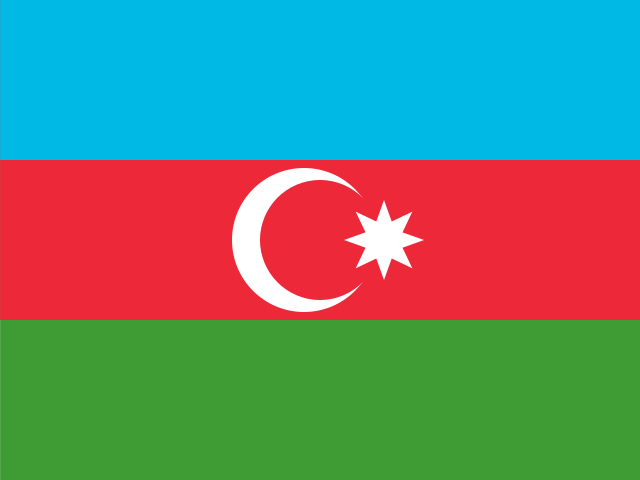
Three horizontal bands of blue, red and green with a white crescent and eight-pointed star centred on the red band. The presidency gives the blue as the Turkic origin of the Azerbaijani people, the red as the desire to build a modern society and develop democracy, and the green as belonging to Islamic civilisation. No Azerbaijani state text assigns a meaning to the crescent or to the star's eight points.
Source: president.az
Azerbaijan FACTS ◢
| Capital | Baku |
|---|---|
| Continent | Asia |
| Population | 10,246,996 (2025) |
| Area | 86,600 km² |
| Population density | 118/km² |
| Currency | Azerbaijani manat (AZN) |
| Official language | Azerbaijani |
| Calling code | +994 |
| Internet TLD | .az |
| Time zone | UTC+04:00 |
| Drives on the | Right |
| ISO codes | AZ / AZE |
DID YOU KNOW? ◢
- It's nicknamed the 'Land of Fire' for the natural flames that burn from its gas-rich ground.
- It borders the Caspian Sea, the largest inland body of water on Earth.
- Its capital Baku sits about 28 metres below sea level, making it one of the world's lowest-lying capital cities.
- Roughly half the country's land is mountainous, dominated by the Greater and Lesser Caucasus ranges.
Azerbaijan QUICK ANSWERS ◢
What is the capital of Azerbaijan?
The capital of Azerbaijan is Baku.
What is the population of Azerbaijan?
Azerbaijan had a population of 10,246,996 in 2025.
What currency does Azerbaijan use?
Azerbaijan uses the Azerbaijani manat (AZN).
What languages are spoken in Azerbaijan?
The official language of Azerbaijan is Azerbaijani.
Think you know your flags? Play Flag Daily → · Browse all countries →
MORE ON THE FLAG ◢
Azerbaijan is unusually precise about its flag. The Constitution fixes the three stripes and the 1:2 ratio. A Constitutional Law fixes the exact Pantone shade of each colour and the direction the crescent's horns point.
Then it stops. Every one of those texts describes the white crescent and eight-pointed star on the red band of the Azerbaijani flag, and none of them says what either one means. The three colours have official meanings. The star does not.
Key Takeaways
- Article 23 of the Constitution describes the flag without interpreting it: equal blue, red and green stripes, a white crescent and eight-pointed star on the red band.
- The presidency gives blue as Turkic origin, red as the desire for a modern society and democracy, and green as belonging to Islamic civilisation.
- No Azerbaijani state text explains the crescent or the star's eight points. Both popular explanations are tradition, not law.
- The star is older than the tricolour, and was on the republic's first flag of 21 June 1918: a red field modelled on an older Ottoman design.
- The tricolour was adopted on 9 November 1918, lowered on 3 May 1920, restored on 5 February 1991.
What the Azerbaijani flag's colours officially mean
Blue for Turkic origin, red for modernisation, green for Islam. Those readings are official, but they appear in neither the Constitution nor the Constitutional Law of 2 November 2018 that fixes the flag's description.
Article 23 of the Constitution only describes. Its second clause reads, in part: "The upper stripe is blue, the middle stripe is red, and the lower stripe is green, with a white crescent and eight-pointed star depicted in the middle of the red stripe on both sides of the flag."
The meanings live on the presidency's State Symbols page instead. There, blue "has the meaning of Turkic origin of the Azerbaijani people", red "reflects the desire to establish a modern society, and develop democracy", and green signifies "belonging to the Islamic civilization".
That trio is older than the flag. It restates a slogan of the writer Ali bey Huseynzade, usually rendered "Turkify, Islamize, Europeanize"; Flags of the World, citing Pierre C. Lux-Wurm's study of Islamic flags, attaches the same three colours to it.
That makes the red band the odd one out. Blue and green say what the country is. Red says what it meant to become.
The eight-pointed star has no official meaning
The state describes the star with care and interprets it nowhere.
The Constitutional Law of 2 November 2018 approving the flag's description is the most detailed text there is, and it reads as a manufacturing specification. Its first article settles the geometry: the ends of the crescent are directed towards the star that sits to the crescent's right. Its second article ties the colours to Pantone 306C, Pantone Red 032C and Pantone 362C for industrial production and printing. The Azerbaijani-language version of the presidency's page carries the same wording as the English one, not a fuller account.
Two explanations circulate anyway, and both have counting problems.
The eight Turkic peoples. The points are said to stand for a pre-Soviet classification of the Turkic world, but published lists do not agree on the eight. A widely reproduced version names Azeris, Ottomans, Jagatais, Tatars, Kipchaks, Seljuks and Turkomans. Flags of the World prints that list, notes in the same breath that it is only seven, and reconstructs an eighth by splitting the Kipchaks into Kazakhs and Kyrgyz. Other versions insert the Kazakhs directly. A symbol with a settled meaning would not need its arithmetic repaired.
The eight letters of the name. This one is credited to Fatali Khan Khoyski, the republic's first prime minister, who is said to have counted the letters of "Azerbaijan" in Arabic script. The count depends on the spelling. Written آذربایجان the name runs to nine letters; written آذربیجان, dropping the alif after the be, it runs to eight. Which spelling he meant is not recorded.
Either may be true to how Azerbaijanis read the star. Neither is something the state has put its name to.
Azerbaijan leaves the crescent just as bare. Two folk readings circulate, Islam and the Turkic world, and no Azerbaijani state text confirms either, exactly as with the star.
Where the eight-pointed star came from
It predates the tricolour by four and a half months, and it arrived on a red flag.
The Azerbaijan Democratic Republic declared independence on 28 May 1918. With Baku held by a hostile council, the government moved to Ganja, and it was there on 21 June that it approved its first national flag: a red field with a white crescent and an eight-pointed star.
The Presidential Library is blunt about where that came from. It records the design as almost the same one the Ottoman Empire flew from the late eighteenth century to the mid-nineteenth, except that the Ottoman flag "depicted a five-pointed star", and says that in adopting it "Azerbaijan was supposed to be the part of the Turkish world."
The one thing the record shows is a departure: eight points where, on the library's account, the Ottoman flag that Turkey succeeded had five. Kinship, without a copy.
The Council of Ministers replaced the red flag with the tricolour on 9 November 1918, raising it over the building where they met, now the state oil company's Azneft Production Union office in Baku. Soviet Russian troops occupied the country the following spring, and the Presidential Library dates the flag's removal, outside the parliament building, to 3 May 1920.
How the Azerbaijani flag came back
Seventy years after 1920 the flag came back, and it came back from the edge of the country rather than the centre.
On 17 November 1990 the Supreme Assembly of the Nakhchivan Autonomous Republic adopted the old republic's flag as its own, on Heydar Aliyev's initiative, and asked the Azerbaijan SSR's Supreme Soviet to recognise it nationally. On 5 February 1991 the Supreme Council did so, in a law "On the National Flag of the Azerbaijan Republic". An order signed on 17 November 2009 then made 9 November State Flag Day, dating the holiday to the 1918 decision rather than the 1991 one.
One tricolour survived the whole gap in private hands. The National Museum of History of Azerbaijan holds a flag, inventory number 3192, sewn by Mammad Amin Rasulzade in exile in Turkey around 28 May 1952 and brought to Baku by a former émigré, Gulmirza Baghirov. It reached the museum in June 2003.
The same crescent turns up across the region and never in quite the same company: compare Turkmenistan and Uzbekistan, or test how well you can tell them apart on Flag Daily.
Frequently asked questions
What does the eight-pointed star on the Azerbaijani flag mean?
Azerbaijan has never assigned it an official meaning. The Constitution and the 2018 Constitutional Law describe the star's position and colour and the direction the crescent faces, and stop. The two popular explanations, eight Turkic peoples and the eight letters of "Azerbaijan" in Arabic script, appear in no state text.
Is the meaning of the colours written into Azerbaijani law?
No. Article 23 of the Constitution and the Constitutional Law of 2 November 2018 describe the stripes, the crescent's orientation and the exact Pantone shades, and interpret none of them. The readings of blue as Turkic origin, red as modernisation and democracy, and green as Islamic civilisation are published by the presidency on its State Symbols page, not enacted in either text.
When was the Azerbaijani flag adopted?
The Council of Ministers of the Azerbaijan Democratic Republic approved the tricolour on 9 November 1918, replacing a red flag adopted on 21 June that year. It came down on 3 May 1920 after the Soviet occupation, and was restored on 5 February 1991.
Why is Azerbaijan's State Flag Day on 9 November?
Because that is the date the tricolour was first approved, in 1918. The holiday is much newer: an order of 17 November 2009 set 9 November, so it marks the original adoption rather than the 1991 restoration.
Why do the flags of Azerbaijan and Turkey look alike?
They share a white crescent and star on red, because Azerbaijan's first flag of June 1918 was modelled on an older Ottoman design. Azerbaijan's star has eight points where Turkey's has five, and since November 1918 Azerbaijan has carried its crescent and star on the middle band of a tricolour, not a plain red field.
Sources
- Constitution of the Republic of Azerbaijan, Article 23, via the Office of the President, Constitution - retrieved 12 August 2026.
- Office of the President, State Symbols, quoting articles 1 and 2 of Constitutional Law No. 1331-VKQ of 2 November 2018; also read in Azerbaijani - retrieved 12 August 2026.
- Presidential Library of Azerbaijan, Azerbaijan Democratic Republic, Flag - retrieved 12 August 2026.
- National Museum of History of Azerbaijan, news item of 27 May 2021 on the Republic-era flag it holds, in Azerbaijani, inventory 3192 - retrieved 12 August 2026.
- Flags of the World, Azerbaijan, on the eight Turkic peoples list and Pierre C. Lux-Wurm's account of the colours - retrieved 12 August 2026.
PLAY ANOTHER →
Five questions a day. Everyone gets the same five.
FIVE QUESTIONSDAILYDaily CryptogramOne quote, one scrambled alphabet. Crack it before tomorrow.
CRACK THE QUOTEDAILYOn This DayOne thing that happened today in history. Every day, a new one.
TODAY IN HISTORYDAILYDaily CodeA short message, hidden in a different cipher every day.
ONE CIPHER A DAY