
Uzbekistan
A Central Asian crossroads where Silk Road caravan cities like Samarkand still gleam with turquoise-tiled domes. Uzbekistan is one of only two doubly landlocked countries on Earth.
WHAT THE FLAG MEANS ◢
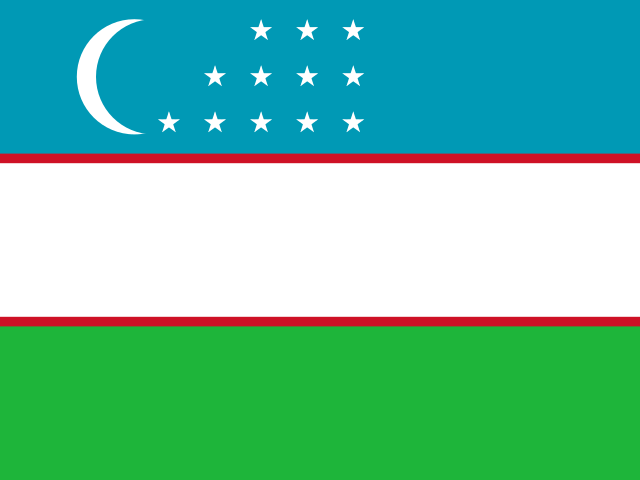
Horizontal bands of deep blue, white and deep green divided by thin red fimbriations, with a white crescent and twelve white five-pointed stars in the upper hoist. Article 5 of the constitution leaves the state symbols to be approved by law, and the 1991 flag law sets the design out in centimetres without interpreting any element of it. Different state publications give different readings: the blue as the sky and water or as strength and stability, the white as peace, the green as nature, the red as the life force or the blood of ancestors, the crescent as the young republic or as Islam, and the twelve stars as a number standing for completeness.
Uzbekistan FACTS ◢
| Capital | Tashkent |
|---|---|
| Continent | Asia |
| Population | 38,236,704 (2026) |
| Area | 448,978 km² |
| Population density | 85/km² |
| Currency | Uzbek som (UZS) |
| Official language | Uzbek |
| Calling code | +998 |
| Internet TLD | .uz |
| Time zone | UTC+05:00 |
| Drives on the | Right |
| ISO codes | UZ / UZB |
DID YOU KNOW? ◢
- The Aral Sea on its northern border has shrunk so far that fishing boats now sit rusting on dry salt flats.
- Samarkand and Bukhara were legendary Silk Road hubs, famed for their tiled mosques and madrasas.
- Its Registan square in Samarkand is one of the most celebrated architectural ensembles in the Islamic world.
- It's one of the world's biggest cotton growers, though the crop it calls 'white gold' now feeds its own mills instead of being exported raw.
Uzbekistan QUICK ANSWERS ◢
What is the capital of Uzbekistan?
The capital of Uzbekistan is Tashkent.
What is the population of Uzbekistan?
Uzbekistan had a population of 38,236,704 in 2026.
What currency does Uzbekistan use?
Uzbekistan uses the Uzbek som (UZS).
What languages are spoken in Uzbekistan?
The official language of Uzbekistan is Uzbek.
Think you know your flags? Play Flag Daily → · Browse all countries →
MORE ON THE FLAG ◢
Sky and water, peace, nature, the life force, a young republic: the readings attached to Uzbekistan's flag are real and they are published by Uzbek state bodies. What they are not is law.
The Law of the Republic of Uzbekistan on the State Flag, number 407-XII of 18 November 1991, was enacted with thirteen articles, and the consolidated text on lex.uz now runs to fifteen after two further articles were inserted between articles 5 and 6. It fixes the flag at 250 by 125 centimetres, sets each band at 40, sets the red edging at 2.5, puts the crescent inside a 30-centimetre circle and each of the twelve stars inside a 6-centimetre one. It arranges those stars in rows of three, four and five, and it places the bottom row 3.5 centimetres from the lower tip of the crescent.
It never says what any of those elements stands for. Neither does the annex, because the annex is a set of drawings.
Key Takeaways
- The 1991 flag law describes the flag to the half centimetre and assigns no meaning to any colour, to the crescent or to the twelve stars.
- Article 1 approves a schematic and a colour depiction rather than a written description, so the annex interprets nothing either.
- Article 2 interprets the whole flag rather than its parts, making it the symbol of state sovereignty.
- Uzbekistan's emblem law does the opposite. Adopted on 2 July 1992, seven and a half months after the flag law, it names the octagon and the Humo bird as symbols inside the statute.
- The state's own published glosses disagree with each other on the blue, on the red and on the crescent.
Uzbekistan's flag law gives the twelve stars a diameter and no meaning
Everything except why there are twelve.
Article 4 of the 1991 law is the descriptive article, and its sixth paragraph is the one that covers the stars. In the consolidated Uzbek text on lex.uz, the national legal database, it opens: "Oʻn ikkita oq rangli besh qirrali yulduz diametri 6 santimetrli doiraga sigʻadi." That is a specification, and specification is the whole of what the law offers on the subject: twelve white five-pointed stars, each fitting a circle six centimetres across.
The paragraph continues with the spacing, six centimetres between circles, and then with the arrangement, given as "yuqori qatorda uchta, oʻrta qatorda toʻrtta va quyi qatorda beshta yulduz". Three in the top row, four in the middle, five in the bottom. Then the distance from the crescent, 3.5 centimetres, measured from its lower tip.
Article 4's fifth paragraph gives the crescent the same treatment. The law positions it "vertikal holatda doʻng tomoni dastaga qaratilgan", upright with its convex side turned toward the staff, twenty centimetres from that staff, inside a circle thirty centimetres in diameter. The crescent and the stars together are placed to fit a rectangle of 75 by 30 centimetres.
Neither the stars nor the crescent gets a word about months, calendars, faith or independence.
The five centimetres the three bands do not account for
The statute states the parts and never states the sum, so this one has to be worked out.
The flag is 125 centimetres across the hoist. Each of the three bands is 40, which comes to 120. The missing five centimetres are the red: article 4 puts borders "kengligi 2,5 santimetrga teng qizil hoshiyalar" along the edges of the middle white band, and two of them at 2.5 centimetres each account for the remainder exactly.
The statutory wording on its own is ambiguous between an inset and an addition. The annex decides between them. The schematic drawing annexed to the law is a dimensioned engineering elevation, and down its right-hand edge it stacks five figures: 40, 2.5, 40, 2.5, 40. The red is not a slice taken out of the white band. It is additional to it, so the flag reads as three bands plus edging rather than as five stripes, which is what the law's opening sentence says as well: a rectangular cloth made up of three bands running the whole length, "toʻq moviy rang, oq rang va toʻq yashil rangli uchta endan tarkib topgan toʻgʻri toʻrtburchak shaklidagi matodir", deep blue, white and deep green.
The same drawing is labelled with the rest of article 4's figures, in centimetres: 250 for the length, 30 for the crescent's circle, 20 from the staff, 6 for a star's circle, 6 between them, 3.5 from the crescent's lower tip, and 75 by 30 for the rectangle that holds the whole device. The one number it never carries is the 125-centimetre width, which is the sum both the statute and the drawing leave the reader to add up. It is the only part of the annex that says anything at all, and everything it says is a measurement.
The statutory colour words are worth keeping. The law says deep blue and deep green where most descriptions say blue and green, and it does not give colour values of any kind. There is no Pantone reference, no percentage and no named shade anywhere in the statute, in the original thirteen articles or the two added since.
Article 5 of the constitution refers the question back to the law
It refers the question straight back to the law that declines to answer it.
Article 5 of the Constitution of the Republic of Uzbekistan says the Republic has its own state symbols, the flag, the emblem and the anthem, approved by law. The operative words in the official Uzbek text are "qonun bilan tasdiqlanadigan o‘z davlat ramzlari". A second sentence follows, "Davlat ramzlari davlat himoyasidadir.", putting the symbols under the protection of the State.
That second sentence is new. Uzbekistan adopted a heavily amended constitution by referendum on 30 April 2023, and the articles were renumbered around it. The provision on the Republic of Karakalpakstan moved from article 70 in the 1992 text to article 85 in the current one. The symbols provision did not move. It was article 5 in 1992 and it is article 5 now, and lex.uz's 1992 version of the constitution shows it carrying only the first of the two sentences.
So the 2023 rewrite reopened this article, and what the drafters added was protection rather than interpretation. Uzbekistan has now had two constitutions and neither has ever said what the flag's colours mean.
The meaning the flag statute does assign
The flag law's article 2 is the exception, and it is worth stating precisely, because it is easy to overstate in both directions.
In its current wording, replaced by the amending law of 24 December 2010, article 2 reads: "Oʻzbekiston Respublikasining Davlat bayrogʻi Oʻzbekiston Respublikasi davlat suverenitetining ramzidir." The flag is the symbol of the state sovereignty of the Republic of Uzbekistan. Article 3, in its current wording, adds that it stands for the Republic in international relations.
The 1991 original said the same thing in slightly shorter form. So there is a legislated meaning here, and it attaches to the flag as an object. Nothing in the statute distributes that meaning across the flag's parts, and no article gives the blue, the white, the green, the red, the crescent or the stars anything at all.
Article 1 closes the last door. It approves "Oʻzbekiston Respublikasi Davlat bayrogʻining sxematik va rangli tasviri", the schematic and colour depiction of the flag, and adds that it is annexed. The annex to the Uzbek flag law is not a written description that could have held a gloss. It is a colour depiction of the front, a colour depiction of the reverse and the dimensioned schematic, and article 10 requires every flag and every reproduction of it to correspond exactly to them. Article 4 puts the crescent and stars near the staff on the face and on the back alike, so the annexed reverse shows the device mirrored rather than seen through.
The emblem law writes its symbolism into the statute
This is the comparison that makes the silence look deliberate rather than accidental.
The Law on the State Emblem of the Republic of Uzbekistan, number 616-XII, was adopted on 2 July 1992, seven and a half months after the flag law, by the same body, in the same series of symbol statutes. Its article 3 describes the emblem, and in the middle of that description it interprets two elements outright.
The octagon at the top of the emblem is put there, in the statutory text, "Respublika hurligining ramzi sifatida", as a symbol of the freedom of the Republic. The bird at the centre is described as "baxt va erksevarlik ramzi", a symbol of happiness and of the love of freedom, before the article gets around to naming it as the Humo with its wings spread.
Both phrases are in the 1992 original as well as in the current consolidated text on lex.uz, so this is not a later addition. Uzbekistan's legislature knew how to write symbolism into a symbols law. It did it for the emblem and it did not do it for the flag.
lex.uz lists nine later versions of the flag law, the most recent in force from 10 October 2024. The 2010 amendment reopened five of article 4's six paragraphs and re-enacted each one, adding the colour and the count of the stars to a sentence that had merely said stars. Only the opening paragraph was left alone, word for word as it was in 1991. Even that pass did not add a meaning.
The state's own glosses of the Uzbekistan flag disagree
The glosses exist. They are simply not the law, and the versions that can be opened do not speak with one voice.
The fullest of the Uzbek-language versions opened for this article is on bolahuquqlari.uz, a children's legal-literacy portal that its own about page says was developed by the Ministry of Justice of the Republic of Uzbekistan and launched on 1 June 2019, under a presidential decree of 9 January 2019 on raising legal awareness. Almost the same four colour paragraphs appear on the site of the Alisher Navoi Tashkent State University of Uzbek Language and Literature, so this is one text with more than one publisher rather than two independent readings.
The second is a signed feature by Rustam Jabborov, published by UzA, the national news agency, on 18 November 2022. It gives the same six elements different content.
| Element | Ministry of Justice portal | UzA feature, 18 November 2022 |
|---|---|---|
| Blue | The eternal sky and the water of life, and in the language of symbols goodness, wisdom, honesty, glory and loyalty | Strength and power, peace and stability |
| White | Sacred peace; purity and innocence | Purity and innocence |
| Green | The renewal of nature; youth, hope and joy | Renewal, and also nature, age-old values and faith |
| Red lines | The streams of life force flowing in the body | The blood of ancestors in our veins, a mark of eternity |
| Crescent | Bound up with historical traditions, and a symbol of the independence gained | Goodness and hopes, everlasting traditions, and the religion of Islam |
| Twelve stars | Historical traditions and the ancient calendar, with the science of the stars behind the number, read as a striving for perfection | Twelve as completeness in the ancient East, illustrated by twelve months, twelve zodiac signs and the twelve categories and principles in the Codes of Temur |
Three of those rows are straightforward disagreements. Blue is either the sky and water or strength and stability. Red is either the life force in the body or the blood of ancestors. The crescent is either the new republic or Islam.
The Justice Ministry text is the one that ties the red to the body directly, saying the red lines signify "vujudimizda joʻshib oqayotgan hayotiy qudrat irmoqlarini", the streams of life force surging within us. On the crescent it says "Navqiron yarim oy tasviri bizning tarixiy anʼanalarimiz bilan bogʻliq.", tying the young crescent to historical tradition, and then makes it a symbol of the independence that was won. UzA's feature instead calls the crescent a symbol of "umrboqiy an’analar va Islom dini", everlasting traditions and the religion of Islam.
Neither is wrong, because neither is answerable to anything. Nothing adjudicates between them, since the statute declines to.
A third version exists and it is published in English only. The state symbols page at constitution.uz gives a sentence to each element: blue for the sky and water as the main source of life, white for peace and good luck, green for nature, new life and a good harvest, the two thin red stripes for the power of life, and a new moon for the newly independent Republic. Its paragraph on the stars overlaps the Justice Ministry text almost completely, down to the ancient solar calendar, the rise of astrology and a striving for perfection, while the good luck and the good harvest are its own.
The same page in Uzbek Latin script, in Uzbek Cyrillic and in Russian carries none of it. All three stop after three sentences lifted from articles 2, 3 and 4 of the statute.
The asymmetry is not confined to the flag, and on the emblem it produces a state page that departs from a statute which does gloss its own elements. The English page calls the crescent and star inside the octagon sacred symbols of Islam, names the bird at the centre Semurg, and makes the octagon a symbol of the unity and confirmation of the republic. The Uzbek page reproduces article 3 of the emblem law instead, which names the bird Humo, says nothing about Islam, and makes the octagon a symbol of the freedom of the Republic.
The twelve stars: months, zodiac signs, or neither
Not the months, on the evidence of either Uzbek state text.
Neither of them makes the twelve months the meaning of the stars. The Justice Ministry portal says the twelve stars are directly connected to "tarixiy anʼanalarimiz, qadimgi yilnomamizga", our historical traditions and our ancient calendar, and explains the attention to twelve by the development of the science of the stars in the states that once stood on Uzbek territory. It then says the twelve should be understood as a symbol of the antiquity of Uzbek culture and of a striving for perfection and for happiness on its own soil.
Months appear once, in the UzA feature, and not as the meaning of the stars. That piece makes the point that twelve has long signified completeness in the older East, and lists the twelves that show it: "O‘n ikki oy, o‘n ikki burj...", twelve months, twelve zodiac signs, and then the twelve categories of people and twelve principles of rule that the Codes of Temur attribute to the ruler, and the twelve-year muchal cycle after which a child is counted grown.
The months belong to a list assembled to explain a number. A gloss that lifts them out and presents them as the reading of the stars has changed what the source said.
Reading a flag off a picture and reading it out of a statute turn out to be different skills, and only the first is a game. A daily flag round gives you the flag and three guesses at the country.
The crescent the flag law calls a new moon
The English word is crescent. The Uzbek statute does not use the Uzbek word for one.
Throughout article 4, the law says "yangi oy", which is literally new moon, and it uses that phrase for the shape in every paragraph that mentions it. The usual Uzbek words for an emblematic crescent are hilol and yarim oy, half moon. UzA's feature uses both. The Justice Ministry portal uses yarim oy. So does the emblem law, describing the crescent inside the octagon.
The flag law says new moon and only new moon, in 1991 and in the current consolidated text.
That is worth noticing, and it is not evidence of intent. Yangi oy is the plain descriptive term for the shape, so using it is the obvious choice rather than a choice against anything, and UzA's feature moves between the two words in consecutive sentences about the same thing, the second of them being the sentence that brings in Islam. The vocabulary establishes something narrower and still useful: the emblematic word was available, the same legislature used it in a symbols statute seven months later, and the flag law never reaches for it.
The flag law regulates pole angles, mourning ribbons and bedding
The contrast with the silence on meaning is sharp enough to be worth setting out.
The companion resolution of the Supreme Council, number 408-XII of the same day, repealed the Uzbek SSR flag regime: a Presidium decree of 27 September 1974 approving a Statute on the State Flag, amendments of 29 June 1978, 30 July 1981, 27 November 1981 and 11 September 1984, and the part of a law of 3 December 1984 that had confirmed the last of them. It then gave the old flag a stay of execution, permitting its use "ikki oy davomida", for two months, until it was replaced. Both instruments were published in the Supreme Council gazette for 1992, issue 1, as items 27 and 28.
The same resolution told the Cabinet of Ministers to set the rules for making, keeping and destroying the flag by 1 December 1991. The Cabinet did it on 30 December, in resolution 316, which allows flags of other sizes but requires that "hamma hollarda bayroqning eni uzunligiga nisbatan 1:2 boʻlishi kerak", that the ratio always be one to two, and routes flags that have lost their original colour to the local council by formal act, for a commission to decide on disposal.
The flag law itself keeps going. On legislated holidays the flag goes up at six in the morning and comes down at ten at night. A staff set against a building may make an angle of no more than 45 degrees with the facade, and the cloth must hang at least 2.5 metres above ground level. For mourning, a black ribbon one twentieth of the flag's width is tied to the top of the staff with both ends hanging the full width of the flag. On a flagpole the flag is lowered by one third of the pole's length rather than to the halfway point.
Amendments of 7 July 2023 opened private use up, adding permission to display the flag in public places, on buildings and other objects, at homes and workplaces, on the land adjoining them and inside vehicles. The same package spelled out the disrespect that is not allowed, and the list is unusually concrete: no flag as a covering for anything, none spread on tables, benches or chairs, anywhere else people sit or underfoot, none used as clothing, a handkerchief or bedding, and no flag image printed on footwear, towels, underwear, boxes or single-use items meant to be thrown away.
A crescent is the sort of detail a flag quiz turns on. Three written clues and three guesses is the version of the puzzle with no flag in it at all.
Who designed the flag of Uzbekistan
No source opened for this article names a designer of the Uzbek flag.
The instrument names only its signatory, and its annex has nothing on it but dimensions. The National Archives Agency page on the state flag reproduces the statutory description and stops there, without a gloss and without a history. The Ministry of Justice portal, the constitution portal and the university page all begin with the flag as adopted. UzA's feature reaches the 1991 law and quotes its sovereignty clause, and names nobody.
The record does supply the run-up. The decision to have a flag of its own was taken while Uzbekistan was still a Soviet republic, and well before there was a design to approve. UzA records a parliamentary session in March 1990 at which the question of state symbols was discussed. Three months after that, on 20 June 1990, the Supreme Soviet of the Uzbek SSR adopted the Declaration of Independence, whose clause 8 reads: "Oʻzbekiston SSR oʻzining taraqqiyot yoʻlini, oʻz nomini belgilaydi va davlat belgilarini (gerb, bayroq, madhiya) oʻzi taʼsis etadi." The Uzbek SSR determines its own path of development and its own name, and itself establishes the state insignia, given in brackets as emblem, flag and anthem.
That is a claim of the right to a flag rather than a description of one, and it is the whole of what the opened record says about how the design came to exist. The Declaration's own closing clause calls the document a basis for drafting a new constitution and a new union treaty, so at the point Uzbekistan first claimed its flag it was still expecting to stay in a union.
State sources also disagree on which sitting adopted it. The Tashkent State University of Uzbek Language and Literature says the law was passed at the extraordinary seventh session of the Supreme Council, "navbatdan tashqari oʻtkazilgan VII sessiyasida qabul qilingan". The English page of the constitution portal places it "in the 8th session of the Supreme Council of Uzbekistan". The instrument itself gives only the date, the city and the signature: Tashkent, 18 November 1991, I. Karimov.
One further discrepancy runs the other way, from a state page back against the statute. The National Archives Agency's reproduction gives the rectangle holding the crescent and stars as 70 by 30 centimetres. The 1991 text says 75 by 30, the current consolidated text says 75 by 30, and the annexed drawing is labelled 75 as well.
So the record is precise about the flag to the half centimetre and silent about the people who drew it, which is the same shape as its precision about the flag and its silence about what the flag means.
Frequently asked questions
What do the colours of the Uzbekistan flag mean?
Uzbekistan's flag law does not assign the colours a meaning, and neither does the constitution. The 1991 Law on the State Flag describes the flag in centimetres and interprets no element of it, and article 5 of the constitution says only that the state symbols are approved by law. The familiar readings come from state publications written later, and they differ: the Ministry of Justice's legal-literacy portal gives the blue as the eternal sky and the water of life and the red lines as the life force flowing in the body, while a 2022 feature by the national news agency UzA gives the blue as strength and stability and the red as the blood of ancestors.
Do the twelve stars on the Uzbekistan flag stand for the twelve months?
Not according to the Uzbek state texts. The Ministry of Justice portal connects the twelve stars to historical tradition and to the ancient calendar, and explains the number by the standing of astronomy in the states that once occupied the territory. Twelve months appear only in the UzA feature, and there as one illustration among several of why twelve signified completeness in the older East, alongside the twelve zodiac signs and the twelve principles of rule in the Codes of Temur. Presenting the months as the meaning of the stars overstates what either source says.
Is the crescent on the Uzbekistan flag an Islamic symbol?
The law does not say, and the state's own publications split on it. UzA's 2022 feature calls the crescent a symbol of everlasting traditions and of the religion of Islam. The Ministry of Justice portal ties it to historical tradition and to the independence Uzbekistan had just gained, and the English page of the constitution portal calls it a new moon symbolising the newly independent Republic. The flag statute itself uses only the plain descriptive term, new moon, and never the usual Uzbek words for an emblematic crescent.
When was the flag of Uzbekistan adopted?
On 18 November 1991, by Law 407-XII of the Republic of Uzbekistan, signed in Tashkent by President Islam Karimov. A companion resolution of the same day repealed the Uzbek SSR flag rules dating from 1974 and allowed the old flag to remain in use for two months while it was replaced. Both were published in the Supreme Council gazette for 1992, issue 1.
Who designed the flag of Uzbekistan?
No source consulted for this article names a designer. The statute records only the date, the city and the President's signature, and its annex is a set of drawings with no attribution. The National Archives Agency, the Ministry of Justice portal, the constitution portal and the national news agency all describe the adopted flag without saying who drew it. On the run-up they do say something: the Declaration of Independence of 20 June 1990 claimed for the Uzbek SSR the right to establish its own emblem, flag and anthem, almost seventeen months before the flag law was passed.
Sources
- Oliy Majlis of the Republic of Uzbekistan, Law 407-XII of 18 November 1991 on the State Flag of the Republic of Uzbekistan, consolidated text, lex.uz national legal database - retrieved 26 August 2026. The annex is served as three images from the same record: the colour depiction, front, the colour depiction, reverse and the dimensioned schematic.
- Oliy Majlis of the Republic of Uzbekistan, Law 407-XII, text as at 18 November 1991, lex.uz - retrieved 26 August 2026.
- Supreme Soviet of the Uzbek SSR, Declaration of Independence, 20 June 1990, lex.uz - retrieved 26 August 2026.
- Supreme Council of the Republic of Uzbekistan, Resolution 408-XII of 18 November 1991 on putting the Law on the State Flag into effect, lex.uz - retrieved 26 August 2026.
- Cabinet of Ministers of the Republic of Uzbekistan, Resolution 316 of 30 December 1991 on the procedure for making, keeping and destroying the State Flag, lex.uz - retrieved 26 August 2026.
- Oliy Majlis of the Republic of Uzbekistan, Law 616-XII of 2 July 1992 on the State Emblem of the Republic of Uzbekistan, lex.uz - retrieved 26 August 2026.
- Constitution of the Republic of Uzbekistan, article 5, official Uzbek text, constitution.uz - retrieved 26 August 2026.
- Constitution of the Republic of Uzbekistan, text as at 8 December 1992, lex.uz - retrieved 26 August 2026.
- Ministry of Justice of the Republic of Uzbekistan, The State Flag of the Republic of Uzbekistan, Bola huquqlari portali - retrieved 26 August 2026.
- Ministry of Justice of the Republic of Uzbekistan, About the project, Bola huquqlari portali - retrieved 26 August 2026.
- Rustam Jabborov, Oʻzbekiston bayrogʻidagi ranglar va belgilar nimani anglatadi?, UzA national news agency, 18 November 2022 - retrieved 26 August 2026.
- State symbols, English page and Uzbek page, constitution.uz - retrieved 26 August 2026.
- Alisher Navoi Tashkent State University of Uzbek Language and Literature, State Flag of the Republic of Uzbekistan - retrieved 26 August 2026.
- Uzarxiv Agency, The state flag of the Republic of Uzbekistan - retrieved 26 August 2026.
PLAY ANOTHER →
A short message, hidden in a different cipher every day.
ONE CIPHER A DAYDAILYGuess the CountryThree clues, three guesses. Work out where in the world it is.
THREE CLUESDAILYOn This DayOne thing that happened today in history. Every day, a new one.
TODAY IN HISTORYDAILYDaily CryptogramOne quote, one scrambled alphabet. Crack it before tomorrow.
CRACK THE QUOTE