
Turkmenistan
A desert republic on the Caspian Sea, Turkmenistan is mostly Karakum sand and is best known for a fiery gas crater that has been burning continuously for decades.
WHAT THE FLAG MEANS ◢
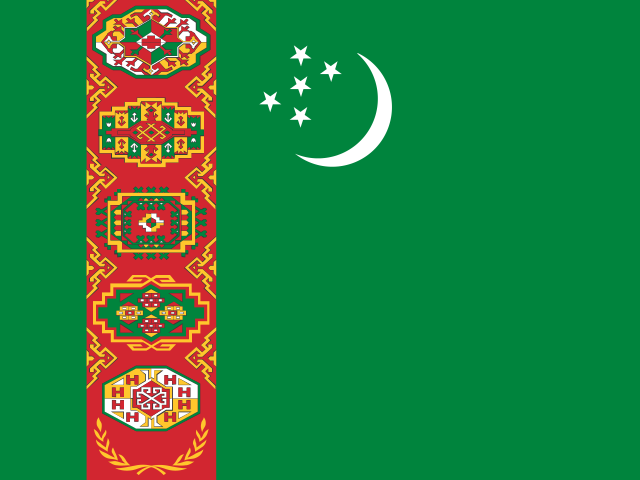
A green field with a vertical crimson carpet stripe near the hoist bearing five guls above two crossed olive branches, and a white crescent with five white stars on the green. The constitution leaves the description of the state symbols to law, and the Law on the State Flag names the five guls for the Ahal Teke, Yomut, Salyr, Chowdur and Arsary and calls them symbols of the friendship and solidarity of the Turkmen people. That law also makes the flag as a whole a symbol of the unity and Independence of the people of Turkmenistan and of the Neutrality of the state, while giving the green, the crescent, the five stars and the olive branches no meaning at all. Reading the five stars for the provinces is convention, and the olive branches, added in 1997, are tied to the neutrality recognised in 1995 by state publications rather than by law.
Source: court.gov.tm · mejlis.gov.tm · bp.gov.tm · ombudsman.gov.tm · docs.un.org · turkmenistan.gov.tm · caa.gov.tm · checked 2026-08-27
Turkmenistan FACTS ◢
| Capital | Ashgabat |
|---|---|
| Continent | Asia |
| Population | 7,618,847 (2025) |
| Area | 491,210 km² |
| Population density | 16/km² |
| Currency | Turkmenistan new manat (TMT) |
| Official language | Turkmen |
| Calling code | +993 |
| Internet TLD | .tm |
| Time zone | UTC+05:00 |
| Drives on the | Right |
| ISO codes | TM / TKM |
DID YOU KNOW? ◢
- Around 80% of the country is covered by the Karakum Desert.
- Its Darvaza gas crater, nicknamed the 'Door to Hell', has been burning continuously since the 1970s.
- The Akhal-Teke horse, famed for its metallic sheen, is a national symbol.
- Its capital, Ashgabat, holds a record for the highest concentration of white-marble buildings in the world.
Turkmenistan QUICK ANSWERS ◢
What is the capital of Turkmenistan?
The capital of Turkmenistan is Ashgabat.
What is the population of Turkmenistan?
Turkmenistan had a population of 7,618,847 in 2025.
What currency does Turkmenistan use?
Turkmenistan uses the Turkmenistan new manat (TMT).
What languages are spoken in Turkmenistan?
The official language of Turkmenistan is Turkmen.
Think you know your flags? Play Flag Daily → · Browse all countries →
MORE ON THE FLAG ◢
Most of the detail on Turkmenistan's flag is packed into one narrow stripe near the hoist. Five carpet medallions run down it, each ringed by its own border, with two olive branches crossing at the bottom.
The unusual part is that the country's flag law names them. Not a vague gesture at tribal motifs but five specific guls, listed in order, and a sentence saying what they stand for. For a national flag, that is rare. The usual answer to what a flag means is that the instrument establishing it assigns nothing, and the readings in circulation belong to whoever is repeating them.
For every other element on Turkmenistan's flag, that is exactly what happens.
Key Takeaways
- Article 2 of the Law on the State Flag names the five guls in order, the ahalteke, yomut, salyr, chowdur and arsary, and calls them symbols of the friendship and solidarity of the Turkmen people.
- Article 2 also specifies the two olive branches down to ten leaves on each and never connects them to anything. Law No 221-1 of 29 January 1997 put them there, and Turkmenistan's state news agency supplies the reason.
- The restatement of 24 January 2001 gave the stars a point count the earlier flag law did not fix, and cut the days on which the flag is lowered from two to one.
- The Turkmen and Russian texts of that restated law, published side by side by the Mejlis, do not carry the same article 7.
- Flag Day was 19 February, the anniversary of the 1992 flag law and the birthday of the first president. It is now 18 May, shared with Constitution Day.
| Instrument | Date | What it did |
|---|---|---|
| Law on the State Flag of Turkmenistan | 19 February 1992 | Established the flag |
| Law No 221-1 | 29 January 1997 | Amended the flag law. The olive branches date from here |
| Law No 14-II | 14 February 2000 | Further amendments to the same law |
| Law No 57-II, restating the flag law | 24 January 2001 | The text in force, since amended six times to 2023 |
| State standard TDS 562-2015 | 20 June 2015 | Approved by presidential resolution No 14304, and amended in 2017 |
What are the five shapes on Turkmenistan's hoist stripe?
They are guls, the medallion motifs of Turkmen carpet weaving, and the flag law lists them by name.
Article 2 of the Law of Turkmenistan on the State Flag of Turkmenistan puts them on the record in one sentence: "Gyzyl-gyrmyzy zolakda ýokardan aşak bäş sany esasy haly gölleri bolan ahalteke, ýomut, salyr, çowdur, ärsary gölleri ýerleşdirilendir, olar türkmen halkynyň dostlugynyň we jebisliginiň nyşanlarydyr." Rendered into English: on the crimson stripe, from top to bottom, are placed five principal carpet guls, the ahalteke, yomut, salyr, chowdur and arsary, which are symbols of the friendship and solidarity of the Turkmen people.
The Russian text of the same law, published on the same page of the parliament's website, carries the same clause: "пять основных ковровых гёлей: ахалтеке, йомут, салыр, човдур, эрсары, которые символизируют дружбу и сплоченность туркменского народа."
The five names are in the statute, in both published language versions, and each of them is a Turkmen tribe. Those are two separate facts and it is worth keeping them apart. The statute never uses a word for tribe, so recognising the names as tribal names is a step taken from outside the text; what the statute supplies on its own account is the gloss. And it has supplied it since well before the current version: the pre-2001 text of the law, published by Turkmenistan's Prosecutor General's Office, carries the identical list and the identical gloss.
The law goes further than naming them. It says each gul is ringed by carpet ornament whose outer edge meets the edges of the stripe, so the stripe reads as a woven band rather than as five badges on a background.
UNESCO's Representative List of the Intangible Cultural Heritage of Humanity, which inscribed traditional Turkmen carpet-making art in 2019, describes the carpets as bearing "characteristic coloured patterns pertaining to one of the five main Turkmen tribes". The flag is doing on cloth what the carpets do on the floor. Turkmenistan keeps the connection in its calendar too: the last Sunday in May is Turkmen Carpet Day, one of the observances the foreign ministry lists, and UNESCO's own citation says that annual celebration is how the craft gets passed on.
What Turkmenistan's flag law says in its opening sentence
Three things, and none of them is a colour.
Article 1 reads: "Türkmenistanyň Döwlet baýdagy Türkmenistanyň halkynyň agzybirliginiň we Garaşsyzlygynyň hem-de döwlet Bitaraplygynyň nyşanydyr." The State Flag of Turkmenistan is the symbol of the unity and Independence of the people of Turkmenistan and of the Neutrality of the state. The Russian text of the same article is built the same way, with unity and independence both belonging to the people and neutrality to the state.
That is a meaning assigned to the object, not to any part of it. It tells you what the flag is for. It does not tell you why the field is green, or why there is a crescent, or why there are five stars rather than four or six.
The wording was not always this. The pre-2001 text made the flag the symbol of the unity and independence of "milletiň", the nation, where the restated law says "Türkmenistanyň halkynyň", the people of Turkmenistan. The older text also has garaşsyzlyk and bitaraplyk in lower case; the restated one capitalises Garaşsyzlyk and Bitaraplyk, Independence and Neutrality, which is how the state now writes the two ideas it builds its self-description on.
Why does a landlocked Central Asian flag carry olive branches?
Because of a diplomatic status the country acquired in December 1995, and an amending law passed just over a year later.
On 12 December 1995 the United Nations General Assembly adopted resolution A/RES/50/80. Section A of it is headed "Permanent neutrality of Turkmenistan", and it resolves that the Assembly "Recognizes and supports the status of permanent neutrality declared by Turkmenistan". The wording is worth reading closely, because it is often reported the other way round: the UN did not confer neutrality on Turkmenistan. It recognised a status Turkmenistan had declared, and its preamble welcomes "the legislative confirmation by Turkmenistan of its status of permanent neutrality".
Turkmenistan's own Law on the Permanent Neutrality of Turkmenistan followed on 27 December 1995, and its opening paragraph cites the General Assembly resolution by name and date. Its article 1 says Turkmenistan voluntarily declares its permanent neutrality and will maintain it and carry it out consistently.
The flag caught up on 29 January 1997, when Law No 221-1 amended the flag law. Turkmenistan's state news agency, in an account published on the eve of Flag Day in February 2015, dates the change and gives the reason: "В целях увековечения в официальной символике страны идей нейтралитета 29 января 1997 года в Закон Туркменистана «О Государственном флаге Туркменистана» были внесены изменения и дополнения. Государственный флаг нашей страны украсили оливковые ветви, символизирующие статус нейтралитета Туркменистана." To perpetuate the ideas of neutrality in the country's official symbolism, the law was amended, and olive branches symbolising Turkmenistan's status of neutrality were added to the flag.
Here is the part that matters for anyone quoting a law rather than a press release. The flag law itself never ties the branches to neutrality. Its description of them is purely geometric: two olive branches crossing at their bases in the lower part of the crimson stripe, directed upward in different directions, each made of ten leaves that shrink towards the tip and sit in pairs except the lowest and the uppermost. Ten leaves each, specified in the statute. Not one word about neutrality.
The neutrality reading of the branches is the state's own, and more than one state body publishes it. Turkmenistan's civil aviation agency describes the flag as carrying "BMG-niň Baş Assambleýasy tarapyndan ykrar edilen Bitaraplyk hukuk ýagdaýymyzyň nyşany hökmünde zeýtun şahalary", olive branches as the emblem of the legal status of Neutrality recognised by the UN General Assembly. So it is an official gloss. It is not a statutory one, and keeping the two apart is what makes the branches datable in the first place.
What the flag law leaves unexplained
The green, the crescent and the five stars.
Article 2 describes all three and interprets none. "Baýdak ýaşyl reňklidir" is the entire treatment of the colour: the flag is green. The crescent and stars get one sentence: "Baýdagyň uly ýaşyl böleginde çep ýokarky burçda ak reňkli ýarymaý we bäş sany bäşburçly ýyldyz şekillendirilendir." On the large green part, in the upper left corner, are depicted a white crescent and five five-pointed stars.
That is a placement, a colour and a count. No Turkmen instrument opened for this article assigns any of the three a meaning: not the flag law, not the constitution, which does not describe the flag at all, and not the 1995 law on permanent neutrality.
The familiar readings still circulate, and they are worth attributing rather than repeating. Green and the crescent are widely read as emblems of Islam, and the five stars as standing for the country's provinces, its welayats. The count works: the foreign ministry's own country page lists five velayats, Ahal, Balkan, Dashoguz, Lebap and Mary. But arithmetic is not attribution. No state publication opened for this article makes the claim, and where the state does gloss the flag it stays at the level article 1 works on: the state news agency's 2021 Flag Day piece calls the banner a symbol of "agzybirligiň we Garaşsyzlygyň, parahatçylyk söýüjilikli daşary syýasat ugrunyň", of unity and Independence and of a peace-loving direction in foreign policy, and stops there.
The crescent is not a Turkmen peculiarity in any case. Turkey's flag belongs to the same family further west, and Uzbekistan's flag, across the border, carries a crescent and stars of its own. What is peculiar to Turkmenistan is the carpet band, and the carpet band is the one part its law explains. If you want to find out whether you could pick it out of a line-up, a daily flag round settles it in three guesses.
What changed when Turkmenistan restated the law in 2001
Three things, all of them visible by putting the published texts side by side. The third is a divergence in the current text rather than a change made in 2001, but it is only visible from the same comparison, so it belongs here.
The stars acquired a point count. The pre-2001 text says "bäş sany ýyldyz", five stars. The restated text says "bäş sany bäşburçly ýyldyz", five five-pointed stars. Before the restatement, the law did not fix how many points a star on the national flag had.
The flag stopped being lowered in January. The older text lowered the flag on two remembrance days, 12 January and 6 October: "Ýatlama günlerinde: 12-ýanwarda we 6-oktýabrda matam tutmak hökmünde Türkmenistanyň Döwlet baýdagy aşak egilýär." The restated article 4 names only 6 October, which is Memorial Day in the foreign ministry's list of public holidays, plus whatever other occasions the Cabinet of Ministers declares.
The Turkmen and Russian texts of the restated law do not carry the same article 7. Both are published by the Mejlis, on the same page, under the same list of six amending laws running to March 2023, and both have eight articles. The difference is not numbering. Both texts carry a clause about further occasions for flying the flag, but the Russian puts it at the end of article 3 and attributes it to the Cabinet of Ministers while the Turkmen puts it at the end of article 3 attributed to Turkmenistan's legislation and then again as a standalone article 7 attributed to the Cabinet. That leaves the Russian article 7 free for something the Turkmen text has nowhere: a prohibition on insulting the flag in speech, in writing, by conduct and in any other form. The pre-2001 Turkmen text carried that prohibition at its own article 7, so what the restatement looks like it did, in Turkmen, was drop the standalone prohibition and fold insult and disrespect into the liability clause at article 8, which the pre-2001 article 8 had not mentioned at all. Both language texts carry that rewritten article 8. Only the Russian also carries the prohibition.
On the face of it the Turkmen text should govern, since Turkmen is the state language under article 21 of the constitution and the two Turkmen copies agree with each other. But that is an inference: no instrument opened for this article states a rule for divergent publications.
Why the flag has a birthday, and when it moved
The flag was established on 19 February 1992, and that date stayed Flag Day into the 2010s. It was also the birthday of the first president.
On 1 October 1993 the Mejlis passed resolution No 857-XII, which is one sentence long: "Saparmyrat Türkmenbaşynyň doglan güni bolan 19-njy fewraly her ýyllyk ählihalk baýramy edip bellemeli hem-de şol güni dynç alyş güni diýip yglan etmeli." 19 February, the birthday of Saparmurat Turkmenbashi, is to be marked as an annual national holiday and declared a rest day.
So for years the country's flag anniversary and its president's birthday were the same public holiday. State coverage from February 2015 still puts Flag Day on 19 February and notes that the first one was held in 1995.
It is now 18 May, and it shares the date with Constitution Day. Turkmenistan's constitution was adopted on 18 May 1992, and the foreign ministry's published list of public holidays gives 18 May as the Day of the Constitution of Turkmenistan and the National Flag of Turkmenistan, one entry rather than two. State bodies describe it in those terms without qualification. The instrument that made the change is not in the Mejlis's own online index of laws or resolutions. That index carries titles of parliamentary acts only, so a presidential resolution or an amendment to the holiday schedule would be missing from it without that meaning anything; what its silence supports is only that this article can date the practice from state publications and cannot cite the act behind it.
How precisely is the flag specified?
Far more exactly than the law itself manages, and the exactness is in documents the law only points at.
Article 5 of the flag law says the flag, its colour, image, size and material must conform to the parameters set by the Regulation on the State Flag of Turkmenistan approved by the President. The law says nothing else about any of them. Alongside that Regulation sits a state standard, TDS 562-2015, on the State Flag of Turkmenistan, approved by presidential resolution No 14304 of 20 June 2015 and amended by a further presidential resolution reported in September 2017.
The 2017 amendments give a sense of the grain. One new clause permits the crescent and star to be applied by appliqué on large flags: "Uly ölçeglerdäki baýdaklarda (ini 5000 mm we şondan ýokary bolanda) Aýyň we ýyldyzyň şekillerini baýdaga dikme (aplikasiýa) usulynda ýerleşdirmäge ýol berilýär." Another widens an edge specification from 3 to 10 mm to 3 to 15 mm, and changes what it applies to at the same time, from the edges of the flag's main part to the edges of the flag. A third requires flags 5000 mm wide and over to have their edges folded and sewn at between 15 and 40 mm. This is a state standard specifying the seam allowance on a national flag.
Neither the standard nor the Regulation is published on any Turkmen state site opened for this article, so the colour values cannot be quoted here. What can be said is what the law does and does not fix. It fixes the ratio, in words rather than numbers, at one and a half times as long as it is wide. It fixes the leaf count on the olive branches at ten each. It never says where the crimson stripe sits or that it is vertical, only that the guls run down it from top to bottom and that the crescent and stars are in the upper left of the green.
Which is a reasonable place to end up. A flag law that is exact about carpet weaving and vague about geometry tells you where its drafters' attention was.
Frequently asked questions
What do the five shapes on the Turkmenistan flag mean?
They are carpet guls, and article 2 of the Law on the State Flag of Turkmenistan names them: the ahalteke, yomut, salyr, chowdur and arsary, which are the names of five Turkmen tribes. The same sentence calls them symbols of the friendship and solidarity of the Turkmen people, so that gloss sits in the statute itself rather than in a government publicity page.
What do the olive branches on Turkmenistan's flag stand for?
Permanent neutrality, according to Turkmenistan's state publications, though not according to the flag law. The branches were added by an amending law of 29 January 1997, after the UN General Assembly recognised Turkmenistan's declared permanent neutrality on 12 December 1995. The flag law describes the branches only geometrically, down to the ten leaves on each.
Why is the flag of Turkmenistan green?
Nothing in Turkmenistan's flag law or its constitution says. Article 2 of the Law on the State Flag states only that the flag is green, and the constitution does not describe the flag at all, so neither of them assigns the colour a meaning. Green is widely read as an emblem of Islam, but that reading belongs to the people making it, not to Turkmenistan's law.
When was the flag of Turkmenistan adopted?
On 19 February 1992, by the Law of Turkmenistan on the State Flag of Turkmenistan. The law was amended on 29 January 1997, when the olive branches were added, and again on 14 February 2000. It was then restated in full on 24 January 2001 by Law No 57-II, which is the text in force today, as amended six times since.
Does Turkmenistan have a flag day?
Yes, on 18 May. The foreign ministry's list of public holidays gives that date as the Day of the Constitution of Turkmenistan and the National Flag of Turkmenistan, one entry covering both. It used to fall on 19 February, the anniversary of the 1992 law and also the birthday of the first president: a Mejlis resolution of 1 October 1993 had already made that date a national holiday and a rest day.
Sources
- Mejlis of Turkmenistan, Law of Turkmenistan on the State Flag of Turkmenistan, restated text of 24 January 2001 - Turkmen and Russian texts, retrieved 27 August 2026.
- Supreme Court of Turkmenistan, Law of Turkmenistan on the State Flag of Turkmenistan, No 57-II - official PDF of the same law, retrieved 27 August 2026.
- Prosecutor General's Office of Turkmenistan, Law of Turkmenistan on the State Flag of Turkmenistan, text as amended to 2000 - the pre-2001 version, retrieved 27 August 2026.
- Ombudsman of Turkmenistan, Constitution of Turkmenistan, 2016 restated edition as amended to 2023 - articles 21 and 22, retrieved 27 August 2026.
- Mejlis of Turkmenistan, Law of Turkmenistan on the Permanent Neutrality of Turkmenistan, 27 December 1995 - retrieved 27 August 2026.
- United Nations General Assembly, resolution A/RES/50/80 of 12 December 1995, section A, Permanent neutrality of Turkmenistan - retrieved 27 August 2026.
- Mejlis of Turkmenistan, resolution No 857-XII of 1 October 1993 - retrieved 27 August 2026.
- Turkmen State News Agency, Altyn asyr, Symbol of pride in the country - 17 February 2015, retrieved 27 August 2026.
- Turkmen State News Agency, Altyn asyr, My flag shines in the world - 18 May 2021, retrieved 27 August 2026.
- Turkmen State News Agency, Altyn asyr, Amendments made to the state standard for the State Flag of Turkmenistan - 3 September 2017, retrieved 27 August 2026.
- Turkmenhowaýollary State Civil Aviation Agency, Turkmenistan will widely mark the Day of the Constitution and the State Flag on 18 May - retrieved 27 August 2026.
- UNESCO, Traditional Turkmen carpet making art in Turkmenistan - Representative List of the Intangible Cultural Heritage of Humanity, inscribed 2019, retrieved 27 August 2026.
- Ministry of Foreign Affairs of Turkmenistan, General information - retrieved 27 August 2026.
PLAY ANOTHER →
One thing that happened today in history. Every day, a new one.
TODAY IN HISTORYDAILYDaily CodeA short message, hidden in a different cipher every day.
ONE CIPHER A DAYDAILYDaily TriviaFive questions a day. Everyone gets the same five.
FIVE QUESTIONSDAILYGuess the CountryThree clues, three guesses. Work out where in the world it is.
THREE CLUES