
Algeria
The largest country in Africa, where a thin strip of Mediterranean coast gives way to a vast Saharan interior that swallows more than four-fifths of the map.
WHAT THE FLAG MEANS ◢
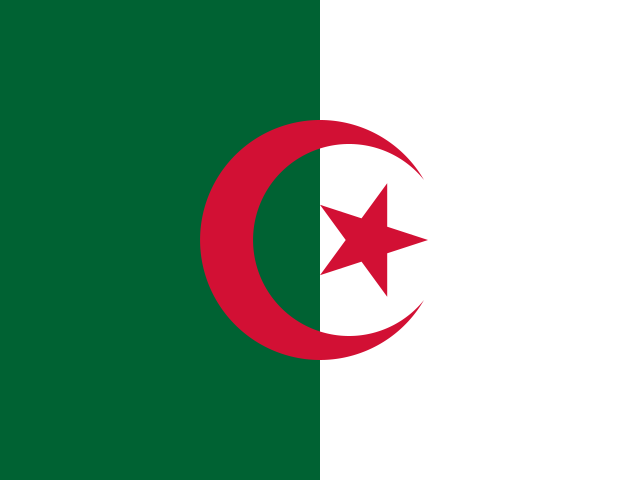
Two equal vertical bands of green at the hoist and white, in a 3:2 rectangle, with a red crescent centred on the rectangle and a red five-pointed star standing clear on the white half. Law 63-145 of 25 April 1963 fixes the geometry and even the wavelengths of the green and the red, but assigns no colour a meaning, and neither does the constitution, which calls the emblem a conquest of the 1 November 1954 Revolution and bars any revision touching it. The readings of green for Islam and red for the blood of the martyrs are popular, not official.
Source: joradp.dz
Algeria FACTS ◢
| Capital | Algiers |
|---|---|
| Continent | Africa |
| Population | 47,435,312 (2025) |
| Area | 2,381,741 km² |
| Population density | 20/km² |
| Currency | Algerian dinar (DZD) |
| Official languages | Arabic, Tamazight |
| Calling code | +213 |
| Internet TLD | .dz |
| Time zone | UTC+01:00 |
| Drives on the | Right |
| ISO codes | DZ / DZA |
DID YOU KNOW? ◢
- It's the largest country in Africa by land area, and the tenth-largest in the world.
- More than 80% of its territory is covered by the Sahara Desert.
- The writer Albert Camus, who won the Nobel Prize in Literature, was born here.
- Its Tassili n'Ajjer plateau holds prehistoric rock art dating back thousands of years.
Algeria QUICK ANSWERS ◢
What is the capital of Algeria?
The capital of Algeria is Algiers.
What is the population of Algeria?
Algeria had a population of 47,435,312 in 2025.
What currency does Algeria use?
Algeria uses the Algerian dinar (DZD).
What languages are spoken in Algeria?
The official languages of Algeria are Arabic and Tamazight.
Think you know your flags? Play Flag Daily → · Browse all countries →
MORE ON THE FLAG ◢
Ask what the colours on the Algerian flag mean and you will get a confident answer almost anywhere you look. Green for Islam, white for peace, red for the blood of the martyrs.
Ask the two texts that actually define the flag and you get geometry.
The law is three short articles and a technical annexe. It fixes the proportions of the rectangle, the radius of the crescent, the circle the star sits inside, and the wavelengths of the green and the red. It assigns no colour a meaning. Neither does the constitution.
Key Takeaways
- Law 63-145 of 25 April 1963 sets the green at a wavelength of 5,411 and the red at 6,562, figures computed from a scale in Ogden Rood's Modern Chromatics of 1879.
- The red sits at position 285 on that scale, which is where Rood's table puts the Fraunhofer C line in the solar spectrum.
- The white is never specified. It is simply the other half of the rectangle.
- Neither the law nor the constitution says what a colour stands for. The familiar readings are popular, not official.
- Article 223 of the constitution puts the emblem beyond amendment, and the law names no designer.
What do the colours on the Algerian flag mean?
Neither of the two texts that define the flag says.
Article 1 of Law 63-145 is a single sentence. The national emblem is "un drapeau aux couleurs verte et blanche, frappé d'une étoile et d'un croissant rouges", green and white struck with a red star and crescent. Article 2 hands the rest to an annexe, and Article 3 orders the law published.
That annexe has a heading for colours and two entries under it. The green must be "d'une composition à égalité de jaune et de bleu pur", equal parts of pure yellow and blue. Its position on "le spectre normal" is 600 and its wavelength is printed "5.411", the point being a thousands separator, so 5,411.
The red must be "pur, de couleur primaire indécomposable, et exempt de bleu et de jaune": pure, an indivisible primary, free of blue and yellow. Its position is 285 and its wavelength "6.562", again 6,562.
There is no third entry. The white half is never specified and never explained.
The constitution is no more forthcoming. Article 6 calls the emblem and the anthem "des conquêtes de la Révolution du 1er novembre 1954", conquests of the November 1954 Revolution, and describes the flag in one line. It says nothing about why.
Nor is the annexe a dead letter. The Algerian embassy in Muscat still reproduces it on its page of state symbols, wavelengths and radii included, and adds no meanings to it.
The readings you find elsewhere have named owners instead. Catalogued from the French-language bibliography rather than read here, they include Malek Chebel's dictionary of Muslim symbols, which gives green for Islam and white for purity, and a 2008 book on Messali Hadj by Khaled Merzouk, which gives green for the country's greenery, white for peace, and the star's five points for the five pillars. They are readings by writers, and they do not agree.
What does the law say the Algerian flag must look like?
Everything, to a degree most flag statutes never attempt.
| Element | What the annexe fixes |
|---|---|
| Rectangle | length one and a half times the height, so 3:2 |
| Division | down the vertical centre line, green half at the staff |
| Green | equal parts pure yellow and blue, wavelength 5,411, position 600 |
| Red | pure and indivisible, wavelength 6,562, position 285 |
| White | nothing at all |
| Crescent | outer radius a quarter of the height, inner radius a fifth, opening one sixth of the circumference |
| Star | five points in a circle of radius one eighth the height, clear of the green |
Two of those rows do the work. The crescent's outer circle is centred on the centre of the rectangle, so the crescent alone straddles the join. The star must stand entirely on the white ground, so the star never crosses that join at all. Two scale drawings run beneath the annexe's text, marking the radii as fractions of the height.
A crescent and star also fly over Tunisia, Turkey and Pakistan, so the vertical split is the faster way to place this one.
Why does a flag law talk about wavelengths?
Because it borrows its scale from a physicist and names him.
Both colour entries are set "selon le diagramme des contrastes de Rood". That is Ogden Rood, professor of physics at Columbia College, whose Modern Chromatics appeared in New York in 1879.
Rood takes the solar spectrum from the Fraunhofer line A to the line H and divides it into 1,000 parts, which he calls the normal spectrum. Page 26 gives the rule for turning a position on it into a wavelength. Multiply the position by 3.653, then subtract the product from 7,603. The answer comes out "expressed in ten-millionths of a millimetre".
Put the law's two positions through that rule. Position 600 gives 5,411. Position 285 gives 6,562. Those are the annexe's own figures, to the unit, so whoever drafted the law worked them out of Rood's book rather than picking a colour that looked right.
Position 285 is more specific still. Rood's table of the principal fixed lines, calculated from Ångström's observations, puts the Fraunhofer C line at 285.05. Algeria's red therefore coincides, to a twentieth of a part in a thousand, with a named dark line in the solar spectrum. Its green, at 600, sits five parts inside the band Rood calls full green, which begins at 595.
Ten-millionths of a millimetre are what we now call angstroms, so the flag's green is 541.1 nanometres and its red 656.2. A definition by wavelength rather than by name or by sample, and far more precise than the meaning nobody wrote down.
Who designed the Algerian flag?
The law declines to say, and the way it declines is its most revealing sentence.
That sentence is in the statement of reasons printed above the articles, not in the law itself. The emblem "existe déjà", it already exists. It is the one "que le peuple algérien a adopté spontanément dans les montagnes comme dans les villes", adopted spontaneously in the mountains as in the towns. It is the one "sous lequel ont accepté de souffrir et de mourir ses martyrs", under which its martyrs accepted to suffer and to die.
That is as close to symbolism as either text comes, and it is worth being exact about what it does. It attaches the martyrs to the flag entire. It does not attach them to the red.
The same passage explains the haste. Finishing the constitution still needs "des études approfondies et d'assez longs délais", deep study and fairly long delays, while Algeria "a déjà ouvert des ambassades et des consulats". Embassies were open and more were being set up, so an emblem with official sanction could not wait. Ahmed Ben Bella signed the law at Algiers on 25 April 1963.
Accounts of where the design came from differ, and each has a proponent rather than a document. Taking the same bibliography at second hand, René Gallissot and Anissa Bouayed put it at labour demonstrations around 1919, Benjamin Stora at a nationalist meeting in 1934, and Achour Cheurfi with the party organisations of the 1940s.
One appearance is documented and dated. The historian Charles-Robert Ageron, writing on the demonstrations of 8 May 1945 at Sétif, records that police were under orders to tear down the banners reading "Vive l'Algérie libre et indépendante!" and the Algerian national flag. An inspector then fired at the flag bearer, setting off the exchange of gunfire. The flag was in the street, and worth shooting at, nearly eighteen years before the law that measured it.
Can Algeria change its flag?
Not by ordinary means, and arguably not at all.
Article 6 says of the emblem and the anthem that "ils sont immuables", they are unalterable. Article 223 makes that operative. It lists ten things no constitutional revision may touch, and the emblem and the anthem are the ninth, named as symbols of the glorious Revolution of November 1954, of the Republic and of the Nation. They sit beside Islam as the religion of the state and the integrity of the national territory.
The revision carrying those articles was itself adopted by referendum on 1 November 2020, the anniversary of the Revolution that Article 6 names.
So the state has legislated the flag to within an angstrom and left its meaning entirely alone, while making it one of the few things Algerian constitutional law forbids anyone to alter. If you want to see how well the shape has stuck in your head, Flag Daily is the place to find out.
Frequently asked questions
Does any Algerian text say the green means Islam?
No. Neither the law that defines the flag nor the constitution assigns any colour a meaning. Law 63-145 of 25 April 1963 specifies the green and the red by wavelength and the design by geometry, and Article 6 of the constitution describes the flag in one line and stops. The closest either comes is the law's statement of reasons, which calls the flag the one under which Algeria's martyrs accepted to suffer and die, and that attaches them to the flag as a whole rather than to a colour. Green for Islam is a reading by writers, among several that disagree.
How wide is the Algerian flag's crescent, in law?
Its outer circle has a radius of a quarter of the flag's height, so it spans half the height, and its inner circle a radius of a fifth. The outer circle is centred on the centre of the rectangle, which is why the crescent alone straddles the join between the green and the white. The star, in a circle of one eighth the height, has to stand entirely on the white.
Is the flag's designer officially recognised?
No. The law names nobody, stating instead that the emblem already existed and had been adopted spontaneously by the Algerian people, in the mountains as in the towns. Ahmed Ben Bella signed it in that form on 25 April 1963. Historians differ on where the design came from, and no Algerian legal text settles it.
Is the Algerian flag protected from being changed?
Yes, by the constitution itself. Article 6 declares the emblem and the anthem unalterable, and Article 223 places them ninth among ten matters that no constitutional revision may touch at all.
Where do the numbers 5,411 and 6,562 in the flag law come from?
From the normal-spectrum scale in Ogden Rood's Modern Chromatics of 1879, which the annexe names. Rood's rule converts a position on his 1,000-part scale into a wavelength, and it returns exactly 5,411 for position 600 and 6,562 for position 285, the two positions the law gives. Rood's own table puts the Fraunhofer C line at 285.05. In modern units the green is 541.1 nanometres and the red 656.2.
Sources
- Journal officiel de la République algérienne, Loi n° 63-145 du 25 avril 1963, caractéristiques de l'emblème national, no. 26, 30 April 1963, p. 394: statement of reasons, Articles 1 to 3 and the annexe - retrieved 12 August 2026.
- Journal officiel de la République algérienne, Constitution, révision adoptée par référendum du 1er novembre 2020, no. 82, 30 December 2020: Articles 2, 3 and 4 at p. 7, Article 6 at p. 7, Article 223 at p. 48 - retrieved 12 August 2026.
- Ogden N. Rood, Modern Chromatics, D. Appleton and Company, New York, 1879: fixed lines and coloured spaces of the normal spectrum at p. 24, the position-to-wavelength rule at p. 26 - retrieved 12 August 2026.
- Charles-Robert Ageron, Mai 1945 en Algérie. Enjeu de mémoire et histoire, Matériaux pour l'histoire de notre temps, vol. 39-40, 1995, p. 52 - retrieved 12 August 2026.
- Ambassade d'Algérie à Mascate, Les Symboles de l'Etat, reproducing the 1963 annexe in full - retrieved 12 August 2026.
- Drapeau de l'Algérie, French Wikipedia. Used only as a bibliographic finding aid, for which published readings exist and who their proponents are: Malek Chebel (2001), Khaled Merzouk (2008), René Gallissot and Anissa Bouayed (2006), Benjamin Stora (1985), Achour Cheurfi (2004). Those books were not opened here, and none is cited for anything the Algerian texts settle - retrieved 12 August 2026.
PLAY ANOTHER →
Five questions a day. Everyone gets the same five.
FIVE QUESTIONSDAILYOn This DayOne thing that happened today in history. Every day, a new one.
TODAY IN HISTORYDAILYDaily CodeA short message, hidden in a different cipher every day.
ONE CIPHER A DAYDAILYDaily CryptogramOne quote, one scrambled alphabet. Crack it before tomorrow.
CRACK THE QUOTE