
Tunisia
The northernmost country in Africa and the point where the continent reaches closest to Europe, Tunisia mixes Mediterranean beaches, Roman ruins and the sands of the Sahara.
WHAT THE FLAG MEANS ◢
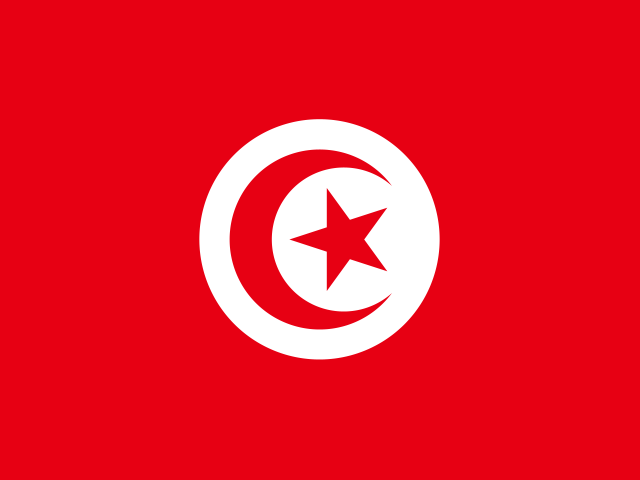
A red field bearing a central white circle in which a red crescent encloses a red five-pointed star. Article 8 of the constitution describes the flag in one sentence and leaves the detail to law, and the flag law fixes the geometry in fractions of the flag's length without assigning any element a meaning. The constitution's preamble says the blood of martyrs drew the two colours of the national banner. Reading the crescent and star as emblems of Islam is conventional rather than official.
Source: lake.jort.tn · iort.gov.tn · amb-tunisie.fr · checked 2026-08-27
Tunisia FACTS ◢
| Capital | Tunis |
|---|---|
| Continent | Africa |
| Population | 12,348,573 (2025) |
| Area | 163,610 km² |
| Population density | 75/km² |
| Currency | Tunisian dinar (TND) |
| Official language | Arabic |
| Calling code | +216 |
| Internet TLD | .tn |
| Time zone | UTC+01:00 |
| Drives on the | Right |
| ISO codes | TN / TUN |
DID YOU KNOW? ◢
- It is the northernmost country on the African continent.
- The ancient city of Carthage, Rome's great rival, stood on its coast near modern Tunis.
- Its Roman amphitheatre at El Jem is among the largest and best preserved anywhere.
- Parts of the original Star Wars were filmed in its southern desert, which lent its name to the planet Tatooine.
Tunisia QUICK ANSWERS ◢
What is the capital of Tunisia?
The capital of Tunisia is Tunis.
What is the population of Tunisia?
Tunisia had a population of 12,348,573 in 2025.
What currency does Tunisia use?
Tunisia uses the Tunisian dinar (TND).
What languages are spoken in Tunisia?
The official language of Tunisia is Arabic.
Think you know your flags? Play Flag Daily → · Browse all countries →
MORE ON THE FLAG ◢
Tunisia's flag is specified in unusual detail and explained almost nowhere. An organic law passed in 1999 fixes the white circle at exactly a third of the flag's length, puts the star's centre a thirtieth of the length off the circle's centre, and builds the crescent out of two named arcs with named diameters.
It says nothing at all about what any of it stands for. Neither does the constitution: article 8 of the 2022 text describes the flag in one sentence and hands the detail to the legislature, and that sentence is a description rather than an explanation.
The readings that circulate everywhere else do have an author, and it is worth knowing who. Most of them trace to one page on the website of Tunisia's embassy in Paris, a page that has not existed for well over a decade.
Key Takeaways
- Loi organique n° 99-56 of 30 June 1999 specifies the flag in fractions of its own length and assigns no element a meaning.
- The star's centre sits a thirtieth of the flag's length from the centre of the white circle, away from the hoist, which is the side the crescent is on.
- The law's colour specification is not printed in the gazette. Article 4 leaves it to an annexed technical dossier that the issue does not reproduce.
- In the 2022 constitution the flag is article 8, not article 4, and the article calls it the flag of the Tunisian State.
- The widely quoted gloss, red for the blood of martyrs and the star's branches for the five pillars of Islam, comes from a Tunisian embassy page archived in 2004.
| What the law fixes | The measurement it gives | Article |
|---|---|---|
| The flag | A red rectangle whose width is two thirds of its length | 1 |
| The white circle | Diameter one third of the rectangle's length, centred where the diagonals cross | 2 |
| The star | Red, five branches, its centre a thirtieth of the flag's length from the circle's centre, away from the hoist | 2 |
| The star's size | Branch tips lie on an imaginary circle fifteen per cent of the flag's length across | 2 |
| The crescent | The space between two arcs, an outer one a quarter of the length across and an inner one a fifth | 2 |
| The colour | Deferred to an annexed technical dossier, which the gazette does not print | 4 |
The crescent is drawn around the star, and Tunisian law says so in fractions
The most useful thing to know about the Tunisian flag is how the crescent sits relative to the star, because that is what separates it at a glance from every other crescent-and-star flag.
The 1999 law is explicit. The star, it says, "est entourée du côté de la hampe d'un croissant rouge", is surrounded on the hoist side by a red crescent. The crescent is not a second charge sitting beside the star. It wraps around it, opening towards the fly.
The law makes that literal in the geometry. The crescent is the space between two arcs, and the inner one is centred on the star itself, with a diameter of a fifth of the flag's length. The star's own branch tips lie on a circle fifteen per cent of the length across. A smaller circle inside a larger one, sharing a centre, so the star sits wholly within the crescent's opening rather than beside it.
That is also why the star is not in the middle of the white circle. The law moves it deliberately: its centre sits "à une distance égale au trentième (1/30) de la longueur du drapeau dans le sens opposé au côté attaché à la hampe", a thirtieth of the flag's length away from the hoist side. The offset leaves room for the thick part of the crescent behind it.
Even the star's rotation is fixed. Its five branches are equidistant, and one branch tip must lie on the horizontal median "à gauche du centre du cercle blanc", to the left of the centre of the white circle. One point of the star aims at the flagpole.
For telling it apart from Turkey's flag, though, you never need any of that. Tunisia's crescent and star sit inside a white circle a third of the flag's length across. Turkey's sit directly on the red field, with no white circle at all. The circle settles it before you look at anything else.
Tunisia's flag law is four articles long and three of them are drawing instructions
The instrument is Loi organique n° 99-56 du 30 juin 1999, published in the Journal Officiel de la République Tunisienne of 6 July 1999, at page 1088 of the French edition and page 1249 of the Arabic. In Arabic it is a قانون أساسي, an organic law, and the French edition's own masthead warns that its text is a "TRADUCTION FRANÇAISE POUR INFORMATION", a French translation for information. The Arabic is the operative version.
Article 1 gives the shape. The flag "a la forme d'un rectangle de couleur rouge et dont la largeur est égale aux deux tiers 2/3 de sa longueur", a red rectangle two units tall for every three long, attached to a staff by the width of its left-hand side. Article 2 is the entire design and runs to four paragraphs, all of them measurements.
Article 3 is the odd one. It describes a second flag, the one reserved for the President of the Republic, and it is the only place in the law where a word appears on the cloth. In gold letters at the top goes the expression للوطن, for the homeland. That flag hangs from a lance with a gilded head engraved with the circle, the star and the crescent.
Article 4 is one sentence about a document, and then the law ends. No preamble, no statement of purpose, no gloss anywhere in it.
The gazette prints one more thing worth having. Under the law's title is a footnote headed Travaux préparatoires, and it records: "Discussion et adoption par la chambre des députés dans sa séance du 29 juin 1999." The Chamber of Deputies discussed and adopted the flag law on 29 June 1999, the day before the President signed it. Both the French and the English Wikipedia articles on the flag give 3 July as the date the Chamber adopted it, and both cite Flags of the World rather than the gazette. The gazette that published the law says 29 June.
The one thing the law does not print is the colour
Article 4 reads: "Est joint à la présente loi un dossier technique comportant un modèle du drapeau, ses différentes mesures, la manière de le tracer ainsi que les spécifications techniques de sa couleur." A technical dossier is attached, holding a model of the flag, its various measurements, the way to draw it, and the technical specifications of its colour.
That dossier is not in the gazette. The issue's own table of contents lists four laws and a run of decrees and orders, with no annex to the flag law, and reading the whole issue turns up no second mention of the dossier anywhere.
So the law that places the star to a thirtieth of the flag's length does not publish the shade of red, and the document that does is referred to rather than reproduced. Any Pantone or hexadecimal value quoted for the Tunisian flag has come from somewhere other than the Journal Officiel, and the gazette gives a reader no way to check it against the law.
You can watch the effect of that. Flags of the World's Tunisia page gathers what published compilations give as the red, and seven compilations give five different answers, once you notice that three of the seven are the same Pantone 186 written three ways.
| The red | Where Flags of the World gets it |
|---|---|
| PMS S 94-1 | Vlaggen Documentatie Centrum Nederland |
| PMS 032 | The Flag Manual, Beijing 2008 |
| PMS 186 | The protocol manual for the London 2012 Olympics |
| Pantone 186c | Album des Pavillons, 2000 and 2023 |
| PMS 186C | Vexilla Mundi |
| Hex #e70013 | Wikipedia |
| Hex #C8102E | Flag Color Codes |
The same page says the red "was also defined by law", which is the one thing the gazette shows it was not.
Withholding the colour is a choice rather than a norm, and the country next door made the other one. When Algeria defined its own flag by Loi n° 63-145 of 25 April 1963, the annexe went into the gazette with the law, and it specifies the green as having "une longueur d'onde de 5.411 et la position 600 sur le spectre normal" and the red "une longueur d'onde de 6.562 et la position 285 sur spectre normal", against the Rood contrast diagram, with construction drawings printed underneath. A reader can check an Algerian flag against the Journal officiel. A reader cannot check a Tunisian one.
The constitution describes the flag and then stops
Tunisia's current constitution was sealed and promulgated by presidential decree n° 2022-691 of 17 August 2022, whose single article directs that it be published in a special issue of the Journal Officiel. That special issue is number 92, dated 18 August 2022, fifty pages of calligraphic Arabic with no printed article headings beyond their numbers. The flag is article 8, at page 8.
The official French translation published by the Imprimerie Officielle reads: "Le drapeau de l’Etat tunisien est rouge, il comporte, dans les conditions fixées par la loi, en son milieu, un cercle blanc où figure une étoile rouge à cinq branches entourée d’un croissant rouge."
Two easily missed things sit in that sentence.
The first is the subject. It is the flag of the Tunisian State, علم الدّولة التّونسيّة, where the 1959 constitution said the flag of the Tunisian Republic and the 1999 law still does. The motto, the seal and the anthem in the three articles that follow are all still the Republic's. Only the flag was reassigned.
The second is the closing clause, حسب ما يضبطه القانون, as regulated by law. The constitution is not trying to be the specification. It sketches the design and points at the statute, and the 1999 law is what the pointer leads to.
The 1959 constitution did the same job in its article 4, and the comparison is instructive. The older text gave the star no colour at all: نجم ذو خمس أشعة, a star with five rays, with only the crescent described as red. The 2022 text makes the star نجم أحمر, red. The flag did not change. The sentence describing it gained a colour word it had not carried before.
The other change is the numbering. The flag was article 4 in 1959, and constituteproject.org's English text of the 2014 constitution has it at article 4 there too. In 2022 it is article 8, because a run of new provisions about the unity of the state, Islam and the Arab world was inserted ahead of it. A citation of article 4 of the Tunisian constitution for the flag now points at an article about the state's unity instead.
Article 8's pronoun is ambiguous and the law it defers to is not
Read the promulgated Arabic closely and the sentence does not fix its own picture.
Article 8 says the crescent يحيط بها, surrounds it, in the feminine. Two feminine things are available in the same clause. One is the circle, دائرة. The other is the rays, أشعّة, which is a non-human plural and so takes feminine singular agreement in Arabic, making the phrase mean the crescent goes around the star's five rays.
Only the second reading is possible on this flag. The crescent's outer arc is a quarter of the flag's length across and the white circle is a third, so the crescent sits inside the circle and cannot enclose it.
The article settles it itself, in its own closing clause. It defers to the law, and the law uses no pronoun at all. Article 2 of the 1999 organic law says ويحيط بالنجم هلال أحمر, a red crescent surrounds the star, naming النجم outright. The constitution points at the statute and the statute says which one it means.
The Imprimerie Officielle's own French translation of article 8 reads it the same way, giving "une étoile rouge à cinq branches entourée d’un croissant rouge", where the feminine ending on "entourée" attaches to the star rather than to the circle.
Article 4 of the 1959 constitution had used a masculine pronoun, يحيط به, whose only possible antecedent in that sentence is the star. So the two ends of the sequence differ: a pronoun with one referent in 1959, a pronoun with two in 2022. Which of the two the intervening 2014 constitution used is not established here, because its Arabic text was not obtained for this article.
And the publisher does not print it consistently. The gazette version is يحيط بها, and so is the Arabic constitution page on the Imprimerie Officielle's own website. Its printed PDF booklet of the same constitution reads يحيط به, the older masculine form. Same publisher, same article, two spellings, and the letter they differ by is the one that decides what the crescent encloses.
The gloss everyone quotes comes from an embassy page that no longer exists
Search for what the Tunisian flag means and you will get a confident, detailed answer: red for the blood of martyrs, recalling the Turkish conquest of 1574, white for peace, the crescent for the unity of all Muslims, and the star's five branches for the five pillars of Islam.
That source is a Tunisian state body, and it is not an instrument. It is the website of the Embassy of Tunisia in France, and the page reads: "Le fond rouge représente le sang des martyrs et rappelle la conquête turque de 1574. Le blanc symbolise la paix alors que le croissant représente l'unité de tous les musulmans et les branches de l'étoile les cinq piliers de l'islam."
The page needs two caveats. It is old, read here from the Internet Archive's capture of 10 April 2004, and the domain it sat on stopped belonging to the embassy years ago: by 2017 the same address was serving articles about online banking, and today it does not resolve at all. So the gloss is a Tunisian state publication, and it is not a current one.
It is also thinner than what gets attributed to it. The embassy page says the red recalls the Turkish conquest of 1574 and does not say who the martyrs were or which side they were on. French Wikipedia states that the martyrs fell during the Ottoman conquest of a territory then held by Spain, and that extra clause is not in the embassy page. The Wikipedia sentence carries a second reference as well, and that one does not resolve. It is a short citation to a collective work of 2006 with no page given, and no work of 2006 appears anywhere in the article, whose only collective works are of 1997 and 2001, the second of them the Alif book the reference is named after. So the added detail cannot be traced to the embassy page and cannot be identified in the other reference either.
The rival readings are worth noticing for the same reason. The same Wikipedia article attributes the white circle to the sun, and the red to resistance against Turkish supremacy, sourcing both to Webster's Concise Encyclopedia of Flags & Coats of Arms of 1985, whose authors are Ludvík Mucha, Stanislav Valášek, William Crampton and Jiří Louda. Resistance against the Turks and the blood of martyrs of the Turkish conquest are not variants of one reading. They are opposite accounts of the same colour, and no Tunisian instrument arbitrates between them, because no Tunisian instrument mentions either.
The constitution's preamble points the same phrase at different martyrs
There is one place a Tunisian constitution does touch the colours, and it is not the flag article.
The 2022 preamble, describing the struggle for freedom, says the people gave legions of martyrs and that their pure blood mingled with this blessed earth and traced on it لوني الرّاية الوطنيّة, the two colours of the national banner.
Three details in it matter.
- It says the two colours, لوني, an Arabic dual. The clause covers the white as well as the red, not the red alone.
- It is a preamble rather than an operative article, so it is doing rhetorical work rather than defining anything.
- It uses الرّاية, banner, where article 8 uses العلم, flag.
The Imprimerie Officielle's own French translation loses the first of those. It renders the clause "leur sang pur et auréolé s'est mêlé à cette terre bénie pour peindre les couleurs de la bannière nationale", the colours, with the dual gone. A reader working from the French would not know the Arabic was counting.
Set that beside the embassy page and the two Tunisian state texts point the same image at different people. The embassy's martyrs are those of a sixteenth-century conquest. The preamble's are the martyrs of Tunisia's own struggle for freedom, named in the same sentence, and they colour the white as well as the red. Neither text is the flag's legal definition, and they do not agree with each other.
Tunisia's 1827 and 1831 dates are repeated far more often than they are documented
The dates you will see everywhere are 20 October 1827, the Battle of Navarino, after which Al-Husayn II Bey is said to have ordered a distinctive flag for the Tunisian fleet, and 1831 for its adoption. No Tunisian instrument opened for this piece establishes either. The 1999 law recites no earlier decree, does not name a predecessor text and does not say it is replacing anything, and no pre-1999 Tunisian instrument on the flag turned up in the searches run for this article. The Imprimerie Officielle offers two ways in: an index of the whole gazette back to 1956, and a full-text search whose own form says it covers issues from the year 2000 onwards. The full-text route cannot reach a 19th-century decree by keyword, and every attempt at the index route timed out without returning.
The embassy page is not much help either, and shows why single sources are risky. It dates the flag from 1831 and credits its adoption to "Hassine 1er, huitième Bey (monarque) de la Dynastie Husseinite". The eighth Husainid bey is Al-Husayn II. Husayn I founded the dynasty and died in 1740. The page has the right man in the right seat and the wrong number after his name.
What can be checked is what foreign navies were told to recognise, because those compilations survive and are readable. They record what other states believed Tunisia flew, not what Tunisia enacted, and they should be read that way.
The United States Navy's Flags of Maritime Nations of 1868 gives Tunis a man-of-war flag on plate XI: a red field, a white disc, a red crescent on the hoist side of it and a red star. Every element of the modern flag is there, forty years after Navarino and more than a century before the law that fixed it. Two of its details are not the modern flag. The white shape is drawn as a flattened oval rather than a circle, and the star has eight points, not five. The 1882 edition, plate XXXI, repeats both.
Go back further and even the elements go. Alphonso Figsbee's compilation of 1856 gives Tunis three flags and not one of them carries a crescent, a star or a disc: they are horizontal striped ensigns. Striped flags of that family were real, and the 1899 US Navy edition shows one: its index lists for Tunis a Bey's Standard and nothing else, no national flag and no ensign, and the plate is a striped flag with stars and a sword. Tunisia had been a French protectorate since 1881.
None of that makes the 1827 story false. It is a reason to give those dates as what is repeated rather than as what is documented, and to notice that a flag routinely called one of the oldest in continuous use was not specified in law until 1999, and that in 1868 a foreign navy drew its star with eight points.
Most flags are like this once you look. The details people are sure of turn out to be the details nobody wrote down. Flag Daily shows one flag a day and gives you three guesses, which is a fast way to find out how much of one you can actually hold in your head.
Frequently asked questions
What does the Tunisian flag mean?
No Tunisian instrument says. Article 8 of the 2022 constitution and all four articles of the 1999 organic law describe the flag and assign no meaning to the red, the white, the circle, the crescent or the star. The familiar gloss, red for the blood of martyrs and the star's five branches for the five pillars of Islam, comes from the website of Tunisia's embassy in France as archived in 2004, which is a state body publishing a reading rather than a text with legal force.
Why do the Tunisian and Turkish flags look so similar?
Both are red flags carrying a crescent and a star, and both belong to the same Ottoman-era visual tradition. The reliable difference is the white circle. Tunisia's crescent and star sit inside a white disc a third of the flag's length across, and Turkey's sit directly on the red field. Tunisia's law also centres the crescent's inner arc on the star itself, so the crescent is drawn around the star rather than beside it.
Is the star on the Tunisian flag red or white?
Red, and so is the crescent. Both sit on a white circle, which is what makes them read as pale at a distance. The 1999 organic law calls for "une étoile rouge de cinq branches" surrounded by a "croissant rouge", and article 8 of the 2022 constitution says the same. The 1959 constitution gave the star no colour at all.
When was the Tunisian flag adopted?
The design is usually dated to 1831, following an order attributed to Al-Husayn II Bey after the Battle of Navarino on 20 October 1827. Those dates are widely repeated rather than established by any instrument opened for this article. What is documented is that the flag was described in the constitution from 1959 and specified in detail only by the organic law of 30 June 1999.
What are the official proportions of the Tunisian flag?
Two to three. Article 1 of the 1999 organic law makes the width equal to two thirds of the length. Within that, the white circle's diameter is a third of the length, the star's branch tips lie on a circle fifteen per cent of the length across, and the crescent is the space between arcs a quarter and a fifth of the length across.
Sources
- Imprimerie Officielle de la République Tunisienne, Journal Officiel de la République Tunisienne n° 54 of 6 July 1999, Arabic edition p. 1249 and French edition p. 1088, carrying Loi organique n° 99-56 du 30 juin 1999 relative au drapeau de la République Tunisienne, downloaded from the publisher's gazette archive at iort.gov.tn - retrieved 27 August 2026.
- Imprimerie Officielle de la République Tunisienne, Journal Officiel de la République Tunisienne, special issue n° 92 of 18 August 2022, the promulgated text of the Constitution of the Tunisian Republic of 2022, article 8 at p. 8 and the preamble at pp. 3 to 6 - retrieved 27 August 2026.
- Imprimerie Officielle de la République Tunisienne, Constitution of the Tunisian Republic of 2022, preamble and articles 8 to 11, Arabic text and official French translation at iort.gov.tn, together with the publisher's printed PDF edition of the same constitution - retrieved 27 August 2026.
- Imprimerie Officielle de la République Tunisienne, Constitution of the Tunisian Republic of 1959, article 4, at iort.gov.tn - retrieved 27 August 2026.
- Imprimerie Officielle de la République Tunisienne, Journal Officiel de la République Tunisienne n° 91 of 18 August 2022, presidential decree n° 2022-691 of 17 August 2022 sealing and promulgating the constitution - retrieved 27 August 2026.
- Ambassade de la République Tunisienne en France, Drapeau de la République Tunisienne, read from the Internet Archive capture of 10 April 2004, the address no longer belonging to the embassy - retrieved 27 August 2026.
- Bureau of Navigation, United States Navy Department, Flags of Maritime Nations, from the Most Authentic Sources, 1868, plate XI - retrieved 27 August 2026.
- Bureau of Navigation, United States Navy Department, Flags of Maritime Nations, from the Most Authentic Sources, 1882, plate XXXI - retrieved 27 August 2026.
- Bureau of Equipment, United States Navy Department, Flags of Maritime Nations, 1899, the index of plates and plate 63 - retrieved 27 August 2026.
- Alphonso Figsbee, The Maritime Flags and Standards of All Nations, Together With a Geographical Sketch, New York, A. Ranney, 1856, the Tunis plate - retrieved 27 August 2026.
- Comparative Constitutions Project, Tunisia's Constitution of 2014, English text, article 4 - retrieved 27 August 2026.
- Secrétariat général du Gouvernement algérien, Journal officiel de la République algérienne n° 26 of 30 April 1963, p. 394, Loi n° 63-145 du 25 avril 1963 and the annexe printed with it - retrieved 27 August 2026.
- Drapeau de la Tunisie, French Wikipedia, and Flag of Tunisia, English Wikipedia. Cited only as carriers, for which readings of the flag circulate, which sources those readings are attributed to, and where the 3 July adoption date comes from. Neither is cited for anything the Tunisian texts settle - retrieved 27 August 2026.
- Tunisia, Flags of the World. Cited only as the carrier of the conflicting published colour values and of the claim that the red was defined by law - retrieved 27 August 2026.
PLAY ANOTHER →
Five questions a day. Everyone gets the same five.
FIVE QUESTIONSDAILYDaily CryptogramOne quote, one scrambled alphabet. Crack it before tomorrow.
CRACK THE QUOTEDAILYDaily CodeA short message, hidden in a different cipher every day.
ONE CIPHER A DAYDAILYGuess the CountryThree clues, three guesses. Work out where in the world it is.
THREE CLUES