
Greece
The birthplace of democracy, the Olympics and Western philosophy, Greece scatters roughly 6,000 islands across the Aegean and Ionian seas - though only a couple of hundred are actually inhabited.
WHAT THE FLAG MEANS ◢
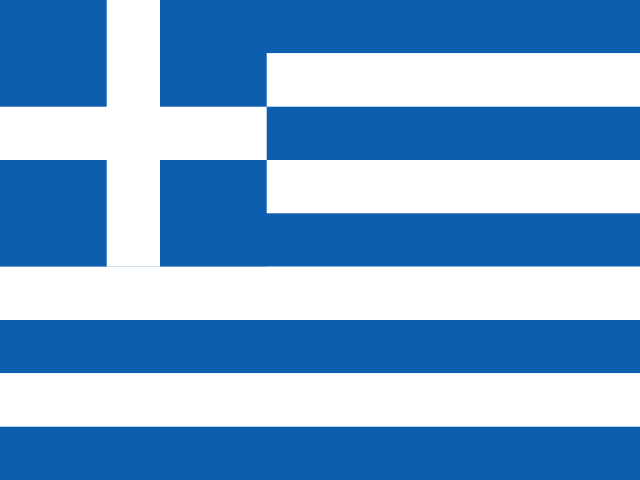
Nine horizontal blue-and-white stripes with a white cross in a blue canton. Greek law describes the design and assigns it no meaning: Law 851/1978 fixes the stripes, the cross and the 2:3 proportions without saying what any of them stand for, and does not even specify a shade of blue. The reading of the cross as Greek Orthodoxy, and of the nine stripes as the syllables of the independence motto, are popular traditions rather than official ones.
Source: lawspot.gr · crwflags.com · hellenicparliament.gr
Greece FACTS ◢
| Capital | Athens |
|---|---|
| Continent | Europe |
| Population | 10,413,962 (2025) |
| Area | 131,957 km² |
| Population density | 79/km² |
| Currency | Euro (EUR) |
| Official language | Greek |
| Calling code | +30 |
| Internet TLD | .gr |
| Time zone | UTC+02:00 |
| Drives on the | Right |
| ISO codes | GR / GRC |
DID YOU KNOW? ◢
- Democracy was born in ancient Athens around 2,500 years ago.
- The first modern Olympic Games were held in Athens in 1896, reviving an ancient Greek tradition.
- Greece has thousands of islands, but only a couple of hundred of them are inhabited.
- No point in the country is more than about 140 kilometres from the sea.
- The Greek philosophers Socrates, Plato and Aristotle laid the foundations of Western thought.
Greece QUICK ANSWERS ◢
What is the capital of Greece?
The capital of Greece is Athens.
What is the population of Greece?
Greece had a population of 10,413,962 in 2025.
What currency does Greece use?
Greece uses the Euro (EUR).
What languages are spoken in Greece?
The official language of Greece is Greek.
Think you know your flags? Play Flag Daily → · Browse all countries →
MORE ON THE FLAG ◢
Greek flag law is unusually precise. It fixes the stripes at nine, the ratio of width to length at two to three, and the width of each arm of the cross at exactly the width of one stripe.
It never says what any of it means.
The nine stripes are almost always explained as the nine syllables of Eleftheria i Thanatos, "Freedom or Death". That reading is popular, old and entirely unofficial. No Greek flag law read for this article assigns a meaning to the stripes, the cross or the colours, and the founding text of 1822 did not assign one either.
Key Takeaways
- Law 851/1978 defines the flag geometrically: nine equal stripes, five blue and four white, top and bottom blue, with a white cross filling a blue square at the hoist.
- It gives the stripes, the cross and the colours no meaning, and fixes no shade of blue.
- The 1822 Provisional Constitution fixed the national colours in one line, "blue and white", and gave no reason for either.
- Greece flew two national flags from 1828 to 1970, the striped one abroad and at sea and the plain cross at home, on Flags of the World's account of the reference work Hellenic Flags.
- From June 1975 to December 1978 the Greek national flag had no stripes: it was a blue field quartered by a white cross.
- Flags of the World records the nine-syllable reading as what the stripes "are said to" stand for, credited to a contributor rather than to any Greek authority.
What do the nine stripes on the Greek flag mean?
Officially, nothing. Article 1 of Law 851/1978 sets out the design in three short paragraphs: nine horizontal stripes of equal width, five blue and four white, arranged so the top and bottom stripes are blue; in the corner nearest the pole an upright white cross reaching all four sides of the blue square that holds it, covering three blue stripes and two white ones. Then it moves on to sizes and flagpoles.
That square is the canton, the slot the Union Jack fills on the flags of Australia and New Zealand, and what sets the design apart from the Nordic crosses, Denmark's among them, which run right across the field.
Folk readings fill the silence. The best known counts the syllables of the revolutionary motto Eleftheria i Thanatos, which lands on nine. Another counts the letters of Eleftheria, "freedom", which also lands on nine. A third reads the alternating bands as the sea and its waves. None has a legal basis. Flags of the World carries the syllable reading as a contributor's note from June 1995, hedged as what the stripes "are said to" stand for.
Does any Greek law say what the Greek flag's colours stand for?
No, and the silence goes all the way back. The Provisional Constitution agreed at Epidaurus and printed at Corinth in 1822 disposes of the national colours in one line, paragraph 104: the colours of the national emblem, and of the flags of the sea and of the land, are fixed as blue and white. The next paragraph hands the design itself to the Executive Body. No reason is offered for either colour, and in the copy digitised by the Hellenic Parliament Library the matter takes two lines of the appendices.
Greece put a cross and the colour blue on its flag in 1822, and no text read for this article explains either. The modern constitution says even less. In the Constitute Project's English text of the 1975 constitution as amended through 2019, the word "flag" appears exactly once, in Article 107, on the registration of ships.
One caution about that silence. Three Greek flag instruments were read for this article: Law 851/1978 in the Greek, Article 1 of Law 48/1975 from the scanned Government Gazette page, and paragraph 104 of the 1822 text. Article 9 of the 1978 Act lists six instruments it repeals, and five of them could not be read in full: a 1967 law on public celebrations, a flag decree of 1969 with amendments in 1971 and 1973, and a presidential decree of 1975 on the form of the national flag. What is reported here is the silence of the three that were opened.
| Element | What Law 851/1978 says | What is popularly said |
|---|---|---|
| Nine stripes | Nine of equal width, five blue and four white, top and bottom blue | The nine syllables of "Eleftheria i Thanatos", or the nine letters of "Eleftheria" |
| The cross | Upright, white, reaching all four sides of the blue square at the hoist | Greek Orthodox Christianity |
| The blue | "Blue and white", on fabric of unfading colour | The sea and the sky |
| The shade of blue | Not specified anywhere in the Act | Pantone 286 C, taken from a French naval flag album |
Why is there no official shade of Greek blue?
Because none of the Greek flag laws read for this article sets one. The 1978 Act calls the flag kyanolefkos, blue and white, requires unfading fabric, and bans the flying of flags that are worn, discoloured or manufactured by impression. For flags bought by state services it delegates the specifications to a decision of the Minister of the Interior. That is the entire treatment of colour in the statute.
So the shade drifts, and there is nothing in the law to appeal to. The Pantone 286 C value usually quoted is not Greek in origin at all. Flags of the World takes it from the Album des Pavillons, the flag album issued at Brest by S.H.O.M., the French navy's hydrographic and oceanographic service, and heads the figure as an approximate specification.
Has the Greek flag always had nine stripes?
No, and the design has been dropped and restored more than once.
Flags of the World records the Provisional Administration's decree of 15 March 1822, old calendar, as prescribing three flags at once: a war flag for use on land, blue with a white cross; a war ensign for use at sea, carrying the nine stripes and the cross in the corner; and a separate ensign for merchant ships. Greece began with a land flag and a sea flag that did not match.
The split between land and sea outlasted the revolution by well over a century, though the separate merchant ensign did not: Flags of the World records it abolished in 1828, when merchant ships were given the navy's flag instead. The same page, citing the reference work Hellenic Flags, records two Greek national flags from 1828 to 1970: the striped flag outside the country and at the coast, the plain cross inside it. Its history of the modern period dates the merger to 18 August 1970, when the cross-and-stripes flag became the national flag and ensign together, in proportions of seven to twelve.
Then it went the other way. Law 48 of 1975, published in the Government Gazette on 7 June 1975, defines the national flag of Greece as a rectangular cloth whose field is blue, divided into four equal rectangles by a white cross reaching its sides. No stripes. For three and a half years the flag of the Hellenic Republic was the plain cross.
Law 851/1978 turned it back. Article 9 repealed Article 1 of the 1975 law and a presidential decree of the same year on the form of the flag, Article 10 gave every flag then in use two years to be replaced, and the striped flag returned as the single national flag on land and at sea, at a ratio of two to three rather than the seven to twelve of 1970. The Act carries the date 22 December 1978, which Flags of the World gives as the adoption date of the flag flying today; the codified text published by Lawspot heads it with a publication date of 21 December.
What does the Greek flag law actually regulate?
Conduct, in detail. Article 1 tabulates eight sizes, from 648 centimetres long down to 27. Article 2 assigns the largest to fortresses and citadels and the smallest to the cars of official persons, on a metal staff 36 centimetres high mounted at the front right of the vehicle. Flying a faded flag is banned. The flag may not be draped over a statue, carry a club or school badge, or be used for advertising. One taken out of service is not thrown away: it is destroyed, preferably by burning.
Timing is prescribed too. The flag flies from eight in the morning until sunset over ministries, embassies, schools during term, army camps and ships, and at half-mast on Good Friday. Breaching any of it carries detention of up to two months, a fine, or both, unless some other provision sets a heavier penalty.
Eleven articles of that, and not one sentence on meaning. Anyone who tells you the ninth stripe stands for something specific is quoting tradition, which is worth quoting as long as it is labelled as tradition. Sort the cross flags in Flag Daily and the family resemblances surface on their own.
Frequently asked questions
Do the nine stripes on the Greek flag stand for "Eleftheria i Thanatos"?
Not officially. Law 851/1978 fixes the number of stripes at nine and assigns them no meaning, and neither does Article 1 of Law 48/1975 nor the 1822 text that first fixed the national colours. Flags of the World presents the nine-syllable reading as what the stripes "are said to" stand for.
What does the cross on the Greek flag mean?
No Greek statute read for this article says. Article 1 of the 1978 Act describes the cross purely as a shape: upright, white, reaching all four sides of the blue square at the hoist. Reading it as a symbol of Greek Orthodoxy is near universal and fits the revolution that produced the flag, but it is an interpretation rather than a legal definition.
What is the official shade of blue on the Greek flag?
There is no official shade. The Act says only that the flag is blue and white and that the fabric must not fade, and it leaves specifications for state-purchased flags to the Minister of the Interior. The Pantone 286 C value often quoted comes from the Album des Pavillons, the flag album of the French navy's hydrographic service, and Flags of the World, which relays it, marks the figure approximate.
When was the current Greek flag adopted?
The Act carries the date 22 December 1978, which Flags of the World gives as the adoption date of the flag in use today. Article 11 makes the law take effect on publication in the Government Gazette, and the codified text published by Lawspot heads it with a publication date of 21 December 1978. Either way the nine-striped flag became the single national flag for land and sea at the end of that month.
Was the Greek national flag ever flown without stripes?
Yes, and within living memory. From the publication of Law 48/1975 on 7 June 1975 until Law 851/1978 replaced it, the national flag of Greece was a blue rectangle divided into four equal parts by a white cross. That was a reversal rather than a survival: Flags of the World dates the merger of Greece's separate land and sea flags to 18 August 1970, so the striped flag had already served nearly five years as the single national flag before the 1975 law dropped it.
Sources
Flags of the World is cited throughout as a recorder of somebody else's statement, with the contributor and date named at each use, rather than as an authority in its own right.
- Hellenic Parliament Library, Provisional Constitution of Greece, Epidaurus 1822, first edition - retrieved 14 August 2026.
- Government Gazette, Law 48/1975, Issue A, No. 108 - retrieved 14 August 2026.
- Lawspot, Law 851/1978 on the National Flag, codified text - retrieved 14 August 2026.
- Flags of the World, Greece: the law on the national flag - retrieved 14 August 2026.
- Flags of the World, Greece - retrieved 14 August 2026.
- Flags of the World, Greece: flag history, 1822 to 1828 - retrieved 14 August 2026.
- Flags of the World, Greece: flag history, 1828 to 1970 - retrieved 14 August 2026.
- Flags of the World, Greece: flag history, 1970 to today - retrieved 14 August 2026.
- Flags of the World, Album des Pavillons, bibliography entry - retrieved 14 August 2026.
- Constitute Project, Constitution of Greece, 1975 with amendments through 2019 - retrieved 14 August 2026.
PLAY ANOTHER →
A short message, hidden in a different cipher every day.
ONE CIPHER A DAYDAILYDaily TriviaFive questions a day. Everyone gets the same five.
FIVE QUESTIONSDAILYGuess the CountryThree clues, three guesses. Work out where in the world it is.
THREE CLUESDAILYOn This DayOne thing that happened today in history. Every day, a new one.
TODAY IN HISTORY