
Denmark
The smallest and southernmost of the Nordic countries, Denmark is a low, tidy sprawl of one peninsula and some 400-odd islands where nearly everyone seems to be on a bike and 'hygge' passes for a national pastime.
WHAT THE FLAG MEANS ◢
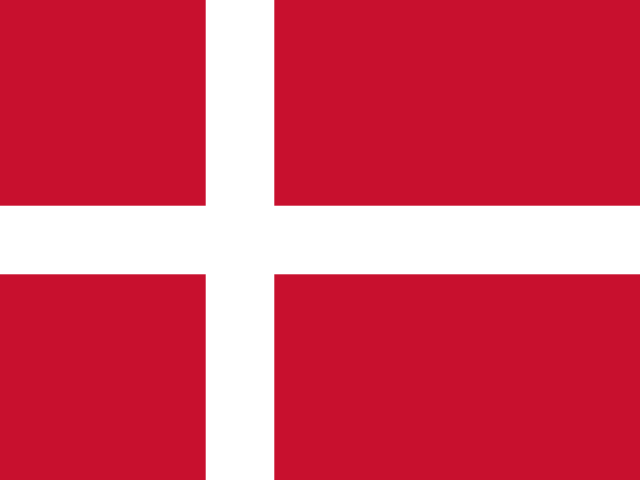
A red field with a white off-centre Scandinavian cross, the 'Dannebrog', widely regarded as the oldest national flag still in use. Legend has it falling from the sky over a battlefield on 15 June 1219, but no surviving text tells that story for three centuries; the earliest reliable evidence of the flag is a Dutch armorial of about 1380.
Denmark FACTS ◢
| Capital | Copenhagen |
|---|---|
| Continent | Europe |
| Population | 6,009,169 (2025) |
| Area | 42,925 km² |
| Population density | 140/km² |
| Currency | Danish krone (DKK) |
| Main language | Danish |
| Calling code | +45 |
| Internet TLD | .dk |
| Time zone | UTC+01:00 |
| Drives on the | Right |
| ISO codes | DK / DNK |
DID YOU KNOW? ◢
- Its flag, the Dannebrog, is generally recognised as the oldest continuously used national flag in the world.
- LEGO was founded in the Danish town of Billund in 1932; the name comes from the Danish 'leg godt', meaning 'play well'.
- Copenhagen is one of the most cycle-friendly cities on Earth, with more bicycles than cars.
- Denmark is made up of the Jutland peninsula and several hundred islands, of which fewer than 80 are inhabited.
- It consistently ranks among the happiest countries in the world in the annual World Happiness Report.
Denmark QUICK ANSWERS ◢
What is the capital of Denmark?
The capital of Denmark is Copenhagen.
What is the population of Denmark?
Denmark had a population of 6,009,169 in 2025.
What currency does Denmark use?
Denmark uses the Danish krone (DKK).
What languages are spoken in Denmark?
Denmark designates no official language. The language of government and education is Danish.
Think you know your flags? Play Flag Daily → · Browse all countries →
MORE ON THE FLAG ◢
Denmark's flag has two ages, and almost every account of it quietly merges them. The legend says the Dannebrog, the "cloth of the Danes", fell out of the sky over a battlefield on 15 June 1219. The documentary record says something far more modest: the flag can first be reliably placed in the late 1300s, in a Dutch roll of arms.
That is a gap of about 160 years, and Denmark's own foreign ministry is blunt about which side of it is history. Its account of the sky-fall ends with the sentence: "the story of the falling flag obviously has no basis in reality."
Key Takeaways
- The legend places the flag's arrival at a battle in Estonia on 15 June 1219, under King Valdemar II.
- No surviving text tells that story for three centuries. The oldest we still have dates from 1520 to 1523.
- The two earliest writers could not agree on which battle it was, and one of them changed his mind.
- The earliest secure depiction is in the Armorial Gelre of about 1380.
- In 1834 the king banned ordinary Danes from using the flag at all.
| The claim | Date | Where it comes from | What it actually establishes |
|---|---|---|---|
| The flag fell from the sky | 15 June 1219 | Chronicles of the 1520s onward | That the story existed by the 16th century |
| First surviving telling | 1520 to 1523 | Christiern Pedersen's Danske Krønike | That the legend was already circulating, battle unresolved |
| Corrected to Lyndanise | around 1527 | Petrus Olai | That the 1219 date is a later correction, not a record |
| First secure depiction | about 1380 | Armorial Gelre | That the flag was in use as a royal banner |
| First rules for flying it | 8 May 1625 | Christian IV's War Articles | That the state had begun regulating it |
What is the legend of Denmark's flag?
A banner fell out of the sky and turned a losing battle.
Denmark's Ministry of Foreign Affairs tells it plainly: King Valdemar II, remembered as Valdemar Sejr, "Valdemar the Victorious", led a crusading army into what is now Estonia. "During a battle on June 15, 1219, the Danes were on the defensive when suddenly a red banner with a white cross fell from the sky." The Danes rallied and won. Danmarkshistorien names the battle: Lyndanise, in Estonia.
The fuller version, set out by Danmarkshistorien, the Danish history reference published by Aarhus University, has a second character in it. Archbishop Anders Sunesen held his arms raised in prayer over the battlefield, and whenever his arms tired the Danish line faltered, until the flag descended and Valdemar held it up to his troops.
The crusade is real. Valdemar did campaign in Estonia in 1219. The banner is not, and the ministry says so in one sentence: "Although King Valdemar's crusade did take place, the story of the falling flag obviously has no basis in reality." Since 1913 the legend has had its own date in the calendar: Denmark marks 15 June as Valdemarsdag, named after the king.
When was the legend first written down?
Three hundred years after the events it describes, by a man who was not sure which battle he meant.
This is the part that gets left out. No surviving chronicle written anywhere near 1219 mentions a flag falling from the sky. The Danish foreign ministry dates the first mention to "the early 16th century". Danmarkshistorien is more precise: the story makes its first written appearance in Christiern Pedersen's Danske Krønike, written between 1520 and 1523 as a continuation of Saxo Grammaticus's history of the Danes.
Pedersen hedged. He wrote that the flag was said to have fallen from heaven during one of Valdemar's eastern campaigns in the early 1200s, and could not settle whether that meant the battle at Fellin in 1208 or somewhere else.
The second writer is the Franciscan friar Petrus Olai, or Peder Olsen, who lived from about 1490 to about 1570 and was working on this around 1527. He began by endorsing the 1208 version, citing an older 15th-century source for it, then changed his mind, decided there had been a misunderstanding, and placed the miracle at Lyndanise in 1219 instead. It is Olai's corrected version that became the tradition everybody now repeats.
So the date every Danish schoolchild knows entered the record as a friar's revision of a story he had already told a different way.
What is the oldest real evidence of the flag?
A herald's book of coats of arms, compiled in the Low Countries around 1380.
The Armorial Gelre is a roll of arms generally attributed to the herald Claes Heinenszoon. Danmarkshistorien identifies its page for Valdemar Atterdag's royal arms, which includes a square Dannebrog flag, as the earliest secure depiction. It then draws the conclusion directly: use of the Dannebrog as the realm's banner can first be reliably established in the late 1300s.
Denmark's foreign ministry, on the pages of its embassy in Estonia, agrees on the century while differing on the king. It states that "the first factual proof that Dannebrog was used to represent the King of the Danes can be traced back to 14th century, as it was incorporated in the coat of arms of King Valdemar III". Danmarkshistorien attaches the Gelre page to Valdemar Atterdag, who is Valdemar IV. Where published accounts differ on the regnal number, the claim they share is the useful one: the 14th century, in a royal coat of arms, and not on a battlefield.
Guinness World Records, which awards Denmark the relevant title, dates the flag's appearance in the same armorial to the 1370s. It then carries the trail forward to Christian IV's War Articles of 8 May 1625, the first known rules for flying the flag.
Why does Denmark hold the record and not Scotland?
Because "oldest" here means oldest continuous and unchanged, which is a stricter test than oldest idea.
Scotland's Saltire, one of the flags flown across the United Kingdom, has a serious claim on age, and the Guinness record addresses it rather than ignoring it. Its reasoning, credited to vexillologists at the Flag Institute, is that "the balance of evidence points to Denmark as being older".
The Guinness record sets out why. St Andrew became Scotland's patron in the 14th century, but there is no direct evidence that the saltire was always carried on a blue field from that point. Captured Scottish flags from 1513 and from 1649 to 1650 show saltires in more than one colour, and colours that were not yet fixed cannot count as continuous use of the modern flag.
The claim is therefore narrower than the headline suggests. Not that Denmark invented flags, but that this particular red field with an off-centre white cross has been in unbroken use longer than any other national design. Worth keeping the halves apart: the dating of the flag is what the Armorial Gelre establishes, while the continuity is the Flag Institute's adjudication, not something the documents by themselves settle.
The shape is easier to spot than the age. Denmark's off-centre cross shares its geometry with Sweden, Norway, Finland, Iceland and the Faroes, which is why the group is described as Nordic cross flags at all.
Who in Denmark was allowed to fly it?
For at least fourteen years, and by some accounts twenty, no ordinary Dane was.
The Dannebrog began as a royal and military emblem rather than a household one, and Denmark's foreign ministry records the moment the state made that explicit: "In 1834, the king even prohibited ordinary citizens from using it."
The reversal came with a war. The ministry dates the change to the mid-19th century and ties it to the First Schleswig War of 1848 to 1850, when national feeling ran high; its embassy in Estonia dates public use of the flag from 1854. The habit that took hold afterwards has never let go. Small paper Dannebrogs on birthday cakes and buns are now among the flag's most common uses, and hanging them on the Christmas tree is a custom the ministry traces to that same war.
A strange arc for the world's oldest continuously used flag: an emblem documented since the 1300s, which ordinary citizens were forbidden to fly until the middle of the 1800s, and which now comes in a packet of cake decorations.
If you want to know whether you could actually pick the Dannebrog out of a line-up of Nordic crosses, a daily flag round settles it in three guesses, and working a country out from three clues instead is the version with no flag to lean on.
Frequently asked questions
How old is the Danish flag?
That depends which claim is meant. The legend dates it to a battle on 15 June 1219, but the story was not written down until between 1520 and 1523. The earliest secure depiction of the flag in use is in the Armorial Gelre of about 1380, which is why Danmarkshistorien says its use as the realm's banner can first be reliably established in the late 1300s.
Is the Dannebrog really the oldest national flag?
Guinness World Records lists it as the oldest continuously used national flag. The qualifier carries the weight: the test is unbroken use of one settled design, not the age of the underlying idea, which is why Scotland's Saltire does not take the title despite a strong claim on age.
Did the Danish flag fall from the sky?
No. Denmark's foreign ministry states that Valdemar II's crusade in Estonia happened but that "the story of the falling flag obviously has no basis in reality". The two earliest writers to record the miracle disagreed about which battle it belonged to, and the second of them changed his answer.
What is Valdemarsdag?
Denmark's flag day, on 15 June, named after King Valdemar II. It has marked the anniversary of the legendary sky-fall since 1913.
When were the first rules for flying the Dannebrog written?
Guinness World Records gives Christian IV's War Articles of 8 May 1625 as the first known rules for flying the flag. Restrictions on ordinary citizens came much later: Denmark's foreign ministry records a royal prohibition on private use in 1834, reversed around the First Schleswig War, with its embassy in Estonia dating public use from 1854.
Sources
- Ministry of Foreign Affairs of Denmark, 800 years of Dannebrog - retrieved 10 August 2026.
- Danmarkshistorien (Aarhus University), Dannebrog - retrieved 10 August 2026.
- Guinness World Records, Oldest continuously used national flag - retrieved 10 August 2026.
- Ministry of Foreign Affairs of Denmark, Embassy in Estonia, Danish national flag - retrieved 10 August 2026.
PLAY ANOTHER →
A short message, hidden in a different cipher every day.
ONE CIPHER A DAYDAILYDaily CryptogramOne quote, one scrambled alphabet. Crack it before tomorrow.
CRACK THE QUOTEDAILYGuess the CountryThree clues, three guesses. Work out where in the world it is.
THREE CLUESDAILYDaily TriviaFive questions a day. Everyone gets the same five.
FIVE QUESTIONS