
Sweden
A long, lake-dotted Nordic country where design, meatballs and Nobel Prizes are all serious business. Sweden has some 267,000 islands, more than almost any nation on Earth.
WHAT THE FLAG MEANS ◢
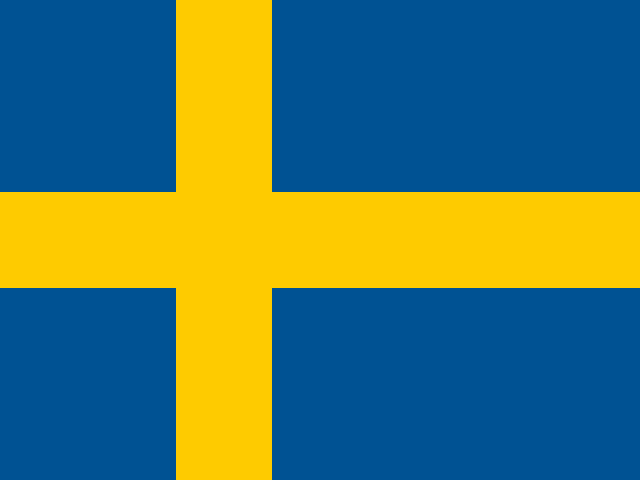
A yellow cross on a blue field, the cross set off-centre toward the hoist. The flag act prescribes the design, the proportions and the colours, and assigns the colours no meaning. Blue and gold are the colours of the national arms: the greater arms is a blue shield quartered by a gold cross, with three gold crowns in each of two of its quarters. Sweden's cross form is conventionally traced to the Danish flag.
Sweden FACTS ◢
| Capital | Stockholm |
|---|---|
| Continent | Europe |
| Population | 10,596,620 (2025) |
| Area | 447,425 km² |
| Population density | 24/km² |
| Currency | Swedish krona (SEK) |
| Official language | Swedish |
| Calling code | +46 |
| Internet TLD | .se |
| Time zone | UTC+01:00 |
| Drives on the | Right |
| ISO codes | SE / SWE |
DID YOU KNOW? ◢
- It has around 267,000 islands, one of the highest counts of any country in the world.
- The Nobel Prizes are awarded in Stockholm each year, funded by the will of Swedish inventor Alfred Nobel.
- The furniture giant IKEA, the music of ABBA, and the seatbelt's three-point design all came from Sweden.
- 'Allemansrätten', the right to roam, lets anyone camp and hike freely across most of the countryside.
- In the far north the summer sun never fully sets, giving weeks of midnight sun.
Sweden QUICK ANSWERS ◢
What is the capital of Sweden?
The capital of Sweden is Stockholm.
What is the population of Sweden?
Sweden had a population of 10,596,620 in 2025.
What currency does Sweden use?
Sweden uses the Swedish krona (SEK).
What languages are spoken in Sweden?
The official language of Sweden is Swedish.
Think you know your flags? Play Flag Daily → · Browse all countries →
MORE ON THE FLAG ◢
Sweden's flag is a yellow cross on a blue field, with the cross set nearer the hoist than the fly. The law gets that said in one sentence and then turns to measurements.
What the colours stand for is not in any of it. Sweden has had two flag acts, in 1906 and again in 1982, and issued a separate government regulation in 1983 that pins the blue and the yellow to numbered coordinates on an international colour chart, with tolerances. Across all three instruments, and across the government bill that produced the second of them, there is no statement of what the blue means or what the yellow means.
The precision is worth the detour, because of why it exists. By about 1980 Sweden could no longer say for certain which shades its own 1906 flag law had intended. The physical colour standards issued in 1908 had partly been lost and the survivors had apparently changed colour. The figures in force today were measured rather than recovered.
Key Takeaways
- The Swedish flag act says the colour is "ljust mellanblå" on the fields and "guldgul" on the cross, and assigns neither colour a meaning.
- A 1983 government regulation gives the blue and the yellow as NCS notations with a stated tolerance, and as CIE chromaticity coordinates with approximate ones.
- The 1982 government bill says the colour prescriptions should not be absolutely binding but should serve as guidelines in the matter.
- The same bill records that some of the 1908 physical colour standards had been lost and the rest had apparently changed colour, and that the shades meant in 1906 could no longer be established with certainty.
- The National Archives, which holds the state's heraldic function, says the model for the flag was taken from Denmark and that the colours come from the national arms.
| Date | Instrument or event | What it settled |
|---|---|---|
| 1448 | Karl Knutsson Bonde's greater coat of arms | A blue shield quartered by a gold cross, regarded in the memorandum annexed to the 1982 bill as a model for the flag |
| 1557 | Gustav Vasa's armorial letter for Duke Johan | Probably the oldest known document concerning the national flag, per the memorandum annexed to the 1982 bill |
| 1663 | Royal placard of 6 November | A yellow cross on a blue field, square-cut, for private Swedish ships |
| 1906 | Lag angående rikets flagga | Flag act: "ljust mellanblå" and "guldgul", proportions 16 to 10, and the union mark dropped |
| 1982 | Lag (1982:269) om Sveriges flagga | The act in force from 1 January 1983, with the same colour words and the same proportions |
| 1983 | Förordning (1983:826) | NCS and CIE values for both colours, with tolerances |
Swedish law calls the colours light medium blue and golden yellow
Section 3 of the 1982 flag act, Lag (1982:269), does not settle for plain blue and yellow: "Flaggans färg är ljust mellanblå på fälten och guldgul på korset." That translates as light medium blue on the fields and golden yellow on the cross. The statute is picking a shade, not just a colour.
The wording is inherited. Section 3 of the 1906 act had said "Färgen å flaggans sidofält skall vara ljust mellanblå och å korset guldgul", in the older spelling, which is the same two colour words in the same two places.
Neither section goes on to say what the colours are for. Nor does section 1 of the 1982 flag act, which describes the design, nor its section 4, which restricts what may be added to the flag. The 1983 colour regulation is purely numerical. The 1982 act on the national arms describes the arms in heraldic terms and stops there.
Nor is the flag anywhere in Sweden's constitution. Sweden has four fundamental laws, and reading the current text of all four returns no occurrence of "flagga" or "riksvapen" in any of them. The flag is the subject of an ordinary act of parliament, not of constitutional text, which is one reason there is no place in Swedish law where a symbolic reading would naturally be written down.
Popular readings of the blue and gold circulate widely, as they do for Denmark and every other Nordic cross. What can be said with a source behind it is narrower: no Swedish instrument consulted for this article assigns the colours a meaning, and the state's own heraldic authority does not either.
Why the exact figures had to be measured at all
Sweden's colour precision is not an old tradition. It is a repair.
The 1906 act was itself a response to an event. It was given on 22 June 1906, the year after the dissolution of the union with Norway, and the memorandum annexed to the 1982 bill records two things it did beyond putting the flag into statute. It removed the union mark that the union had required on the naval and merchant flags, and it changed the shades: "Då gavs även åt flaggans färger ljusare nyanser än som tidigare hade varit i bruk." The flag's colours were then given lighter shades than had previously been in use.
The 1906 act put no colour figures in the statute. It said the shades and then delegated the physical definition to objects: "Likare å mönsterfärger skall tillhandahållas å de ställen, Konungen bestämmer." A likare is a reference standard, and the 1982 bill's summary of the 1908 proclamation on them, at page 11, says such standards in wool and in cotton were to be kept at named authorities, the county administrative boards among them.
Fading was foreseen: the same summary records that a standard altered or damaged by bleaching or otherwise was to be replaced on the holding authority's application.
Seventy years later the objects had failed anyway. The 1982 bill puts it flatly, at page 13: "Av de likare som gavs ut år 1908 har en del förkommit, och de återstående exemplaren har av allt att döma undergått förändringar i färgen sedan sin tillkomst." Some of the 1908 standards had been lost, and the surviving copies had to all appearances changed colour since they were made. The 1908 proclamation's own description of the dyeing procedure no longer gave sufficient guidance either.
The bill states the consequence at page 15: "Som framgår av promemorian är det dock numera inte möjligt att med säkerhet konstatera vilka nyanser som avsågs i 1906 års flagglag." It was no longer possible to establish with certainty which shades the 1906 flag act had meant.
Because certainty was out of reach, the exact values were to be settled "med hjälp av en objektiv färgbestämningsmetod", by an objective colour determination method.
The starting point was still to be whatever could be established about the shades intended when the flag law was made, with aesthetic judgement weighed in before the colours were finally settled. What the memorandum ruled out was going backwards: no return to the shades used during the 1800s, when the fields had been "en närmast svartblå nyans", a shade close to black-blue.
The memorandum recommended the job go to the national testing institute, Statens provningsanstalt, in consultation with the state heraldic board and the academy of arts. The institute said it should not, as a matter of principle, be both the testing institution and the prescribing authority in the same type of case. Its proposal was that the government set the colours directly in a regulation, on the institute's recommendation. That is what happened in 1983.
The specification is precise, and it is a guideline
The 1983 regulation gives each colour twice. In the NCS notations used by the Swedish standard SS 19100, the blue is 4055-R95B and the yellow is 0580-Y10R, and the tolerance is stated: "Toleranserna i NCS-enheter ska för svarthet, för kulörthet och för kulörton vara mindre än ± 5 enheter." That is less than plus or minus five NCS units for blackness, chromaticness and hue.
It then gives both colours as CIE chromaticity coordinates with luminance factors, per SS 19104. The blue is x = 0,189, y = 0,192, Y = 8,3. The yellow is x = 0,472, y = 0,465, Y = 64,4. What it then calls approximate tolerances are not single figures but four-cornered regions of the CIE diagram, listed corner by corner, plus a luminance range: 6,2 to 10,4 for the blue and 55 to 75 for the yellow.
The title of the regulation is the qualification. It is a regulation "med riktlinjer för färgnyanserna", with guidelines for the colour shades, and the 1982 bill had said the same thing in advance: the prescriptions to be issued "inte bör få en absolut bindande karaktär utan mera tjäna som riktlinjer i ämnet". They should not have an absolutely binding character but should rather serve as guidelines in the matter.
The bill's reason for adding exact figures is to serve those who need them, and the example it names is makers of flags. The National Archives publishes PMS and four-colour print equivalents alongside the legal values.
Where the state says the blue and the yellow come from
Sweden does publish an account of the flag's origin, in one place, and it is about heraldry rather than symbolism.
Riksarkivet, the National Archives, holds the state's heraldic function. Its account of the flag begins in the mid-1500s and is candid about the borrowing: "Modellen hämtades säkerligen från Danmark, som sedan länge haft den röda och vita korsflaggan Dannebrogen som symbol." The model was taken from Denmark, which had long had the red and white cross flag as its symbol. The adverb is "säkerligen", surely, which asserts confidence rather than pointing at a document.
On the colours it names two sources rather than one: "Färgerna kommer från riksvapnets tre gyllene kronor i blått fält liksom från korset som kvadrerar (fyrdelar) stora riksvapnet i fyra blåa fält." The colours come from the arms' three gold crowns on a blue field, and from the cross that quarters the greater arms into four blue fields.
The cross clause is the one that explains the design rather than just the palette. Section 2 of the 1982 act on the national arms, Lag (1982:268), blazons the greater arms as "en blå huvudsköld, kvadrerad genom ett kors av guld med utböjda armar", a blue main shield quartered by a gold cross with flared arms. A gold cross on blue is already in the arms. Riksarkivet dates that composition to 1448 and to King Karl Knutsson Bonde.
The memorandum annexed to the 1982 bill reaches the same place from the research literature. Its historical section says that Karl Knutsson's arms composition, "med huvudsköldens fyra blå fält åtskilda av ett gyllene kors", is regarded as a model for the flag.
One symbolic reading does surface in the National Archives' account of the arms, and it is one the National Archives then sets aside. Shields with three crowns were widespread in late medieval Europe and are often taken there to stand for the Holy Trinity or the three Magi. In Sweden, Riksarkivet writes, the device was accepted "som ett tecken för kungariket Sverige och ingenting annat", as a sign for the Kingdom of Sweden and nothing else.
How the flag is actually built
Section 2 of the 1982 flag act, Lag (1982:269), does not print a construction diagram. It gives ratios, and the construction falls out of them.
The square-cut flag stands in height to length as 10 to 16. The inner fields, the two next to the hoist, stand in height to length as 4 to 5. The outer fields stand as 4 to 9. The cross arms are half the height of each field.
Work that through with a height of 10 and a length of 16 and the cross is fixed. Down the flag it goes 4, then 2, then 4. Across it goes 5, then 2, then 9. The cross sits off centre toward the hoist because 5 is not 9, and no Swedish instrument gives a reason for the difference.
The overall 16 to 10 is 8 to 5, or 1.6. The 1982 bill calls these "enligt det s. k. gyllene snittet bestämda proportioner", proportions determined according to the so-called golden section, which 1.6 approximates without reaching the golden ratio's 1.618.
The bill also records why nobody changed them. Objections had been raised on practical and aesthetic grounds, but the shape had stood for at least seventy-five years and "det torde finnas flera miljoner flaggor med de nu föreskrivna proportionerna i bruk", there being several million flags in use with the prescribed proportions. Those flags would have to be accepted after any change, so a change would leave Sweden with two lawful flags for the foreseeable future. The proportions stayed.
Proportions at this level of detail are what make a flag easy to redraw from a specification and hard to recognise at a glance, which is roughly the problem Flag Daily sets: one flag, three guesses at the country.
Sweden has two flag shapes, and most people may fly only one
Section 2 of the 1982 flag act says the flag is either square-cut or three-tailed. Its section 4 decides who gets which.
The head of state, and with the head of state's permission other members of the royal house, may use the three-tailed flag, with or without the greater or lesser national arms on a white field at the centre of the cross. The three-tailed flag is also the naval ensign of the Swedish Armed Forces, and is used by other authorities conducting military activity under government rules. Everyone else uses the square-cut flag.
The split between the two shapes is older than the modern allocation. The annexed memorandum's historical section traces it to a royal placard of 6 November 1663, which forbade merchant ships the Crown's flags and any of their own made with three points, and ordered private ships of Swedish subjects flags with a yellow cross, "Fyrekantige och jämnt avskurne", four-cornered and evenly cut off. The memorandum's judgement on that instrument is firm: through it, "blev också huvuddragen av vår nuvarande flaggas utseende, ett gult kors på blått fält, slutgiltigt tecknade", the main features of the present flag were finally drawn.
What 1663 did not settle was the detail. Because the detailed appearance was not given, the memorandum says, the cross's width, the fields' proportions and the colours' values varied over the centuries.
Section 4 of the 1982 flag act closes with that act's only express prohibition. The flag may not be given marks, letters or other signs beyond what that section itself allows. It is the provision Riksarkivet cites when it says the flag may not carry lettering, and separately that using it in a trade mark needs permission, from Patent- och registreringsverket.
The 1906 act had gone further. Its section 6 made it punishable to fly the three-tailed flag where it was not allowed, to use a flag improperly bearing a mark, letter or other sign, or to offer for sale a flag whose colour obviously differed from the prescribed shades or which did not keep the prescribed measurements, the penalty being a fine "från och med 10 till och med 100 kronor". The 1982 bill proposed no penalty provisions at all, and the act in force has none.
The pennant the flag act does not mention
Swedish flagpoles often carry a long tapering pennant when no flag is flown, split lengthwise into blue and yellow. None of the four sections of the flag act mentions it. Riksarkivet notes the gap plainly: "Lagen saknar föreskrifter om vimpelns färger", the law lacks provisions on the pennant's colours, and it treats as obvious that they should match the flag's, with the blue uppermost when hoisted.
Recommendations fill the rest of the space: no shorter than a third and no longer than half the height of the pole, so four to six metres on a twelve-metre pole. Riksarkivet dates the Swedish pennant to naval regulation early in the 1700s.
Then there is the cross pennant, a newer article with the flag's design in a pennant's shape. Riksarkivet is blunt about it: "Korsvimpeln är en modern företeelse som saknar tradition och historisk förankring." It is a modern phenomenon lacking tradition and historical anchoring. Riksarkivet's objection is not only about taste. A cross pennant has the flag's colours without the flag's regulated proportions, so in practice, it writes, it appears as a flag whose proportions conflict with the legal provisions. Riksarkivet recommends avoiding it.
Why Sweden flies the flag on 6 June
Sweden's flag day and its national day are the same day, and the flag day came first.
Riksarkivet dates flag celebrations at Skansen in Stockholm to the 1890s and the nationwide observance of Svenska flaggans dag on 6 June to 1916. The date is the anniversary of Gustav Vasa's election as king in 1523, and it coincides with the adoption of the 1809 instrument of government.
The two names were joined in law by the 1982 reform. Regulation (1982:270) lists the general flag days and gives 6 June as "Sveriges nationaldag och svenska flaggans dag", Sweden's national day and Swedish flag day. The bill records that this would be the first time the day's status as national day was given expression in legislation. The day became a public holiday later and separately: the Public Holidays Act passed in 1989 did not list it, and Lag (2004:1320) added nationaldagen to that list.
The list of flag days is deliberately easy to change. The bill's reason for putting it in a regulation rather than in the act was that the list could then be altered without going back to parliament when circumstances around the royal flag days change. It has grown since: the bill counted fifteen on the unofficial almanac list in 1982, and the regulation as it stands lists nineteen, including a veterans' day on 29 May. It was last amended in 2023.
One more thing the state does not regulate is when to raise and lower the flag. The 1982 bill declined to make binding rules outside the armed forces, after Stiftelsen Svenska Flaggan pressed the wish that private flag-flying not be hampered by unnecessary formalism. The morning and evening times widely quoted in Sweden are recommendations, which Riksarkivet reproduces from Stiftelsen Sveriges nationaldag rather than from any statute.
Frequently asked questions
What do the colours of the Swedish flag mean?
No Swedish flag legislation says. The 1906 flag act, the 1982 flag act that replaced it, the 1983 colour regulation and the 1982 act on the national arms all describe the colours and none assigns them a meaning, and the National Archives, which holds the state's heraldic function, gives an origin for them rather than a symbolism. Readings such as sky and sun circulate widely, and none of the Swedish state sources consulted for this article states one.
What are the official colours of the Swedish flag?
Regulation (1983:826) gives the blue as NCS 4055-R95B and the yellow as NCS 0580-Y10R, with a tolerance of less than plus or minus five NCS units for blackness, chromaticness and hue. It also gives CIE chromaticity coordinates: x = 0,189, y = 0,192, Y = 8,3 for the blue and x = 0,472, y = 0,465, Y = 64,4 for the yellow, each with a tolerance region. The regulation is titled as guidelines, and the government bill behind it says the colour prescriptions should not be absolutely binding but should serve as guidelines in the matter.
Why is the cross on the Swedish flag off centre?
Because of the proportions in section 2 of the 1982 flag act. Reading across the flag, the inner fields are 5 units wide, the cross arm 2 and the outer fields 9, on a total length of 16; reading down, it is 4, 2 and 4 on a height of 10. The act states these as ratios rather than as a series and gives no reason for the difference between 5 and 9. The 1906 act prescribed the same figures.
How old is the Swedish flag?
The memorandum annexed to the 1982 government bill names Gustav Vasa's armorial letter for Duke Johan of 1557 as probably the oldest known document concerning the national flag, and Erik XIV's voyage to England in 1562 as the oldest evidence of its use. It treats a royal placard of 6 November 1663 as the point at which the main features of the present flag were finally settled. The oldest flag law the bill reprints is the act given on 22 June 1906, which stayed in force until 1983.
Is the Swedish flag based on the Danish flag?
The National Archives says the model was taken from Denmark, which it says had long had the red and white cross flag Dannebrogen, and it makes that statement with the adverb "säkerligen", surely, rather than by citing a document. It pairs the borrowed shape with a domestic source for the colours: the three gold crowns on blue in the national arms, and the gold cross that quarters the greater arms into four blue fields, a composition it dates to 1448.
Sources
- Sveriges riksdag, Lag (1982:269) om Sveriges flagga - retrieved 26 August 2026.
- Sveriges riksdag, Förordning (1983:826) med riktlinjer för färgnyanserna i Sveriges flagga - retrieved 26 August 2026.
- Sveriges riksdag, Lag (1982:268) om Sveriges riksvapen - retrieved 26 August 2026.
- Sveriges riksdag, Förordning (1982:270) om allmänna flaggdagar - retrieved 26 August 2026.
- Sveriges riksdag, Proposition 1981/82:109, med förslag till ny lagstiftning om Sveriges riksvapen och Sveriges flagga - retrieved 26 August 2026. Quotations are transcribed from the scanned page images of the bill, at pages 11, 12, 13, 15, 34 and 54, because the PDF has no text layer.
- Lag (1906:55 s. 1) angående rikets flagga, reprinted in full as Bilaga 1:2 at page 54 of Proposition 1981/82:109 - retrieved 26 August 2026.
- Sveriges riksdag, Lag (1989:253) om allmänna helgdagar - retrieved 26 August 2026.
- Riksarkivet, Sveriges flagga - retrieved 26 August 2026.
- Riksarkivet, Stora riksvapnet - retrieved 26 August 2026.
- Riksarkivet, Lilla riksvapnet - retrieved 26 August 2026.
PLAY ANOTHER →
One thing that happened today in history. Every day, a new one.
TODAY IN HISTORYDAILYDaily CodeA short message, hidden in a different cipher every day.
ONE CIPHER A DAYDAILYGuess the CountryThree clues, three guesses. Work out where in the world it is.
THREE CLUESDAILYDaily CryptogramOne quote, one scrambled alphabet. Crack it before tomorrow.
CRACK THE QUOTE