
Mauritius
A volcanic island east of Madagascar, Mauritius was the only home of the dodo - a flightless bird that vanished within a century of humans arriving.
WHAT THE FLAG MEANS ◢
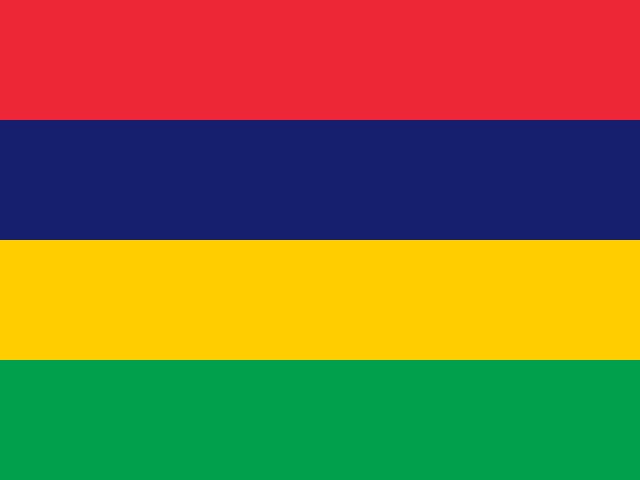
Four equal horizontal bands of red, blue, yellow and green, one of the few national flags of four stripes. The constitution has no flag provision at all. The bands are conventionally read as red for the struggle for independence, blue for the Indian Ocean around the island, yellow for the light of independence and green for the vegetation of an island that stays green all year.
Mauritius FACTS ◢
| Capital | Port Louis |
|---|---|
| Continent | Africa |
| Population | 1,243,741 (2025) |
| Area | 2,040 km² |
| Population density | 610/km² |
| Currency | Mauritian rupee (MUR) |
| Main languages | English, French |
| Calling code | +230 |
| Internet TLD | .mu |
| Time zone | UTC+04:00 |
| Drives on the | Left |
| ISO codes | MU / MUS |
DID YOU KNOW? ◢
- The dodo, now the world's most famous extinct bird, lived only on Mauritius.
- It's one of the few countries in the region with no native land mammals other than bats.
- Author Mark Twain quoted a saying that Mauritius was made first, and heaven was copied from it.
- It has a stretch of coast where a play of light and sediment creates the illusion of an 'underwater waterfall'.
Mauritius QUICK ANSWERS ◢
What is the capital of Mauritius?
The capital of Mauritius is Port Louis.
What is the population of Mauritius?
Mauritius had a population of 1,243,741 in 2025.
What currency does Mauritius use?
Mauritius uses the Mauritian rupee (MUR).
What languages are spoken in Mauritius?
Mauritius designates no official language. The languages of government and education are English and French.
Think you know your flags? Play Flag Daily → · Browse all countries →
MORE ON THE FLAG ◢
Ask what a flag's colours mean and the answer usually has to be attributed to somebody: a ministry page, a designer, a tradition. In Mauritius it can be attributed to Parliament.
The meaning of each of the four stripes sits in a schedule to an Act, first enacted in 2015 and re-enacted in substance in 2022 when the country consolidated all its national symbols into one statute.
The 2022 schedule goes further, and sets out the flag's Pantone references, the height of each band in millimetres for a mast flag, a desk flag and a car flag, and the fibre composition and mass per square metre of the cloth a mast flag is to be made from.
Key Takeaways
- The meaning of each colour is set out in a schedule to an Act of Parliament.
- The 2015 Act's four readings were re-enacted in the 2022 consolidating Act with their substance unchanged.
- The statute gives the flag's colours as Pantone Fashion Home Cotton references.
- It also fixes three standard sizes, a two per cent tolerance on the coloured sections and the mast flag's fabric.
- Vertical bunting in the national colours is not the national flag, and the exemption for national events does not excuse the proportion.
| Colour | Meaning, 2015 First Schedule and 2022 Second Schedule | Pantone, 2022 Second Schedule |
|---|---|---|
| Red | The struggle for freedom and independence | 18-1664TCX |
| Blue | The Indian Ocean in the middle of which Mauritius is situated | 19-3939TCX |
| Yellow | The new light of independence | 14-0957TCX |
| Green | The agriculture of Mauritius and its colour throughout the 12 months of the year | 17-6030TCX |
Parliament wrote the Mauritius flag meanings into a schedule
The National Flag Act 2015, Act No. 26 of 2015, was assented to on 6 November 2015 and published in the Legal Supplement to the Government Gazette. Its long title is one line: "To provide for the better protection of the national flag of Mauritius".
The Act came into force on 15 April 2016, as the Prime Minister's Office recorded the following year. Its section 4(1) is the description, in four limbs. The flag is to "consist of 4 horizontal stripes of equal width", to be as set out in Part I of the Schedule, to "bear the national colours red, blue, yellow and green in that order starting from the top and having the symbolic meaning set out in Part II of the Schedule", and to "be in the proportion of 3 horizontally to 2 vertically".
The third of those limbs is where the symbolism enters the law. It does not merely permit a reading of the colours; it makes the reading part of the statutory definition of the flag, and then prints it. Part II of the First Schedule, headed SYMBOLIC MEANING OF NATIONAL COLOURS, reads in four numbered paragraphs:
"Red represents the struggle for freedom and independence." "Blue represents the Indian Ocean in the middle of which Mauritius is situated." "Yellow represents the new light of independence." "Green represents the agriculture of Mauritius and its colour throughout the 12 months of the year."
Section 18 of the National Flag, Arms of Mauritius, National Anthem and Other National Symbols of Mauritius Act 2022 clears the ground: its subsection (1) repeals the National Flag Act and its subsection (2) revokes the 2016 Regulations made under it. That Act's own long title opens "To consolidate and update the laws with regard to the national symbols of Mauritius", and goes on to add better protection and use of those symbols and matters related to them, and its section 5(2) provides that the flag, "including its national colours with their corresponding symbolic meaning", is as set out in Part I of the Second Schedule.
Its commencement was left to Proclamation, so the Act itself does not date its own entry into force. The nearest date any of these documents gives is in the amending Act of 2024, which is "deemed to have come into operation on 1 June 2022" and amends sections 4 and 7. Section 21(2) of the 2022 Act allows different dates for different sections, so that tells you when the 2024 amendments bite and not when the Act as a whole commenced. No Proclamation was among the documents opened for this article.
That schedule keeps all four readings. Only the grammar changes: "red, representing the struggle for freedom and independence", and so on down the list. Seven years apart, two Parliaments and two statutes, and the substance of the four sentences did not move.
The constitution of Mauritius has no flag provision
Mauritius has a written constitution, published by the Attorney General's Office as Government Notice 54 of 1968. Read it end to end and there is no flag provision in it: no description, no colours, no symbolism, no protection clause.
That absence is easy to misread as silence about the flag altogether, which it is not. In Mauritius the constitution leaves the flag alone and an ordinary statute does the whole job, down to the fabric. Constitutional silence and legal silence are different things, and on this subject the second one is what a reader is usually being told about.
The division of labour shows in the wording. Section 3 of the 2015 Act said simply that the Act "shall bind the State", and section 3 of the Act now in force repeats it word for word, a clause a statute needs if it is to reach the government that flies the flag.
Mauritius specifies the cloth, not just the colours
Part II of the Second Schedule to the 2022 Act carries on past the design and into the making of the object.
There are three standard sizes, given in millimetres: a mast flag at 1,800 by 1,200 with each colour band 300 high, a desk or handheld flag at 150 by 100 with 25-millimetre bands, and a car flag at 300 by 200 with 50-millimetre bands. A tolerance of plus or minus two per cent is allowed on the coloured sections, and the tolerance for overlap between two different colours is one millimetre.
Then the colour codes, given in Pantone Fashion Home Cotton: red 18-1664TCX, blue 19-3939TCX, yellow 14-0957TCX and green 17-6030TCX.
Then the cloth. A mast flag is to be 100 per cent polyester, of plain weave to ISO 3572, with a mass per unit area of 150 plus or minus 5 grams per square metre to ISO 3801. The schedule even footnotes how to identify the fibre, and prints the footnote with the solvent inside a parenthesis and the last word cut off: "Polyester fibres dissolve at room temperature (or on slight warming in o-chlorophenol) and in hot m-creso". The 2016 regulations, from which the footnote came, print it with a comma and with m-cresol whole.
Those numbers first appeared in the National Flag (Standard Size and Dimension, Colour Codes and Materials) Regulations 2016, made under section 6 of the 2015 Act. The copy the government portal serves is an unsigned one, with a blank Government Notice number and a blank date of making; the Prime Minister's Office communiqué of 28 February 2017 supplies both, as Government Notice 174 of 2016, operational from 1 November 2016. The 2022 Act lifted them out of the regulations and into the statute itself, and revoked the regulations in the same section that repealed the parent Act. One detail changed on the way: the regulations wrote the Pantone references as TC, and the Act writes them as TCX.
Vertical bunting is not the flag
A definition this precise has consequences for what gets strung across a street, and the Prime Minister's Office set them out in a communiqué on 28 February 2017, ahead of the national day celebrations.
Its point was blunt. Vertical bunting in the national colours "do not comply with Section 4(1) of the National Flag Act", which requires four horizontal stripes, "and therefore cannot be used". Horizontal bunting had to meet section 4(1)(d), the three-to-two proportion. Flags not in accordance with the legislation "must not be used", flags that complied but were defective "should be replaced", and failure to comply "shall constitute an offence".
Parliament then made room. The National Flag (Amendment) Act 2017 inserted a new section 5A allowing a person, on the occasion of a national event, to exhibit a flag that does not comply with the three-to-two proportion, provided it is "displayed horizontally and bearing the colours red, blue, yellow and green in that order". A national event meant Independence Day and Republic Day, or another event prescribed by regulation.
The requirement itself survived the consolidation. Part I of the Second Schedule to the 2022 Act re-enacts that the flag shall "consist of 4 horizontal stripes of equal width" and be in the proportion of three horizontally to two vertically, section 13(1) prohibits exhibiting as the National Flag anything not as described there, and section 13(5) makes that an offence. So the communiqué's reasoning still holds, on different provisions.
The derogation came forward too, as section 13(3), and it moved rather than shrank. The 2017 version relieved the three-to-two proportion and nothing else. The 2022 version relieves the size and dimension specified in Part II of the Second Schedule and nothing else, and the proportion now sits in Part I, outside the exemption. Both conditions are unchanged: horizontal, and in that colour order.
What it costs to insult the flag
Part III of the 2022 Act is headed PROTECTION OF NATIONAL SYMBOLS, and it is stricter than the Act it replaced.
Section 11(1) prohibits anyone from bringing "into hatred, ridicule or dishonour, a national symbol or the national symbol of any other State". Section 11(2) prohibits burning, mutilating or otherwise destroying or damaging the Arms, the flag or the Seal without lawful authority. Breaching either carries a fine of up to one million rupees and penal servitude.
Those two subsections reach different distances, and the difference is easy to miss. Subsection (1), on hatred, ridicule and dishonour, covers a national symbol "or the national symbol of any other State". Subsection (2), on burning, mutilating and damaging, names only the Arms of Mauritius, the National Flag and the Seal of Mauritius.
The penalty also moved. The 2015 Act set 100,000 rupees and up to two years for its own hatred-and-ridicule offence, where the 2022 Act sets a million rupees and penal servitude.
Lesser offences kept the older ceiling. Altering the flag by placing a letter, emblem or representation on it, and exhibiting as the flag something that is not the flag, both carry up to 100,000 rupees and up to two years. A minor who represents the flag inaccurately in good faith during educational or social activities commits no offence, and it is a defence to show that a variance on an item is "the consequence of the ordinary use of the item or article".
The 2015 Act also reached into three other statutes. It added the national flag to the definition of an artistic, literary or scientific work in the Copyright Act, repealed section 181A of the Criminal Code, and rewrote section 24 of the Merchant Shipping Act, which now requires a Mauritius ship to hoist the national flag on a signal being made to it by any ship in the service of the Government, on entering or leaving a foreign port, and on entering or leaving a port. Section 19 of the 2022 Act then went back over the first and the third, replacing the Copyright Act subparagraph and the Merchant Shipping Act definition of national flag, and leaving the rewritten section 24 standing. It did not revisit the Criminal Code repeal: it touches that code at sections 76A and 100(1)(a) and never at the section 181A the 2015 Act had repealed.
One government page gives colour numbers the statute does not
The Government of Mauritius portal publishes a National Flag page giving the four meanings, and it is worth comparing with the schedule because it does not match it exactly.
On yellow, the schedule says the new light of independence. The portal says it "represents the new light of independence shining over the island", which is four words more than the statute has.
It also writes the green band's meaning as "throughout the twelve months of the year" where both schedules write "the 12 months". The proportion it gives, six to four, is the ratio the Acts express as three horizontally to two vertically. And its colour references are given in a British Standard rather than in Pantone: red 0.005, blue 7.086, yellow 0.001, green 0.010. The statutory codes are the Pantone ones, and the same page links to the 2016 regulations, where a Pantone reference first appeared.
Where those British Standard numbers come from is not something the documents settle. They appear on the portal, and in no Act and no regulation. The colour chain in the instruments runs from no codes at all in 2015, to Pantone TC in the 2016 regulations, to Pantone TCX in the 2022 schedule. What can be said is that the page and the statute do not agree, and that the statute is the one with legal force behind it.
If you want to test whether you could pick a four-stripe flag out at speed, a daily flag round gives you three guesses at one flag, and three written clues and no flag at all is the version where the stripes cannot help you.
Frequently asked questions
What do the colours of the Mauritius flag mean?
The meanings are set by statute, in a schedule. Red represents the struggle for freedom and independence, blue represents the Indian Ocean in the middle of which Mauritius is situated, yellow represents the new light of independence, and green represents the agriculture of Mauritius and its colour throughout the 12 months of the year.
Those four sentences appeared in Part II of the First Schedule to the National Flag Act 2015 and were re-enacted, in the same substance, in Part I of the Second Schedule to the 2022 consolidating Act.
What are the official colours of the Mauritian flag?
The Second Schedule to the National Flag, Arms of Mauritius, National Anthem and Other National Symbols of Mauritius Act 2022 gives them as Pantone Fashion Home Cotton references: red 18-1664TCX, blue 19-3939TCX, yellow 14-0957TCX and green 17-6030TCX. It allows a tolerance of one millimetre for overlap between two colours.
What is the correct size of the Mauritius flag?
The statute gives three, in millimetres: 1,800 by 1,200 for a mast flag with 300-millimetre colour bands, 150 by 100 for a desk or handheld flag with 25-millimetre bands, and 300 by 200 for a car flag with 50-millimetre bands. A tolerance of plus or minus two per cent applies to the coloured sections. The general proportion is three horizontally to two vertically.
Is vertical Mauritius flag bunting allowed?
No. The Prime Minister's Office stated in 2017 that vertical bunting does not comply with the requirement of four horizontal stripes and cannot be used. The law does allow a flag that departs from the standard size and dimension on a national event, but only if it is displayed horizontally and carries red, blue, yellow and green in that order.
Does Mauritius protect its flag by law?
Yes, and it protects other countries' flags in the same section. Bringing a national symbol, or the national symbol of any other State, into hatred, ridicule or dishonour is an offence under section 11 of the 2022 Act, as is burning, mutilating or damaging Mauritius's own Arms, flag or Seal without lawful authority. The maximum is a fine of up to one million rupees and penal servitude, a custodial penalty the Act names without defining or capping it.
Sources
- National Assembly of Mauritius, The National Flag Act 2015, Act No. 26 of 2015 - sections 3 to 7 and the First Schedule. Retrieved 26 August 2026.
- National Assembly of Mauritius, The National Flag (Amendment) Act 2017, Act No. 21 of 2017 - the new section 5A. Retrieved 26 August 2026.
- National Assembly of Mauritius, The National Flag, Arms of Mauritius, National Anthem and Other National Symbols of Mauritius Act 2022, Act No. 5 of 2022 - sections 5, 11, 12, 13, 18, 19 and 21, and the Second Schedule. Retrieved 26 August 2026.
- National Assembly of Mauritius, The National Flag, Arms of Mauritius, National Anthem and Other National Symbols of Mauritius (Amendment) Act 2024, Act No. 14 of 2024 - section 5, commencement. Retrieved 26 August 2026.
- Government of Mauritius, The National Flag (Standard Size and Dimension, Colour Codes and Materials) Regulations 2016 - the Schedule. Retrieved 26 August 2026.
- Prime Minister's Office of Mauritius, Communiqué on the Regulations and on buntings, 28 February 2017. Retrieved 26 August 2026.
- Government of Mauritius, National Flag - the portal's own summary and its British Standard colour references. Retrieved 26 August 2026.
- Attorney General's Office of Mauritius, The Constitution, GN 54 of 1968 - checked and found to contain no flag provision. Retrieved 26 August 2026.
PLAY ANOTHER →
Three clues, three guesses. Work out where in the world it is.
THREE CLUESDAILYDaily CryptogramOne quote, one scrambled alphabet. Crack it before tomorrow.
CRACK THE QUOTEDAILYDaily CodeA short message, hidden in a different cipher every day.
ONE CIPHER A DAYDAILYDaily TriviaFive questions a day. Everyone gets the same five.
FIVE QUESTIONS