
Mexico
Home to over 130 million people and the ancient pyramids of the Aztecs and Maya, Mexico gave the world chocolate, chillies and the tomato - reshaping kitchens everywhere.
WHAT THE FLAG MEANS ◢
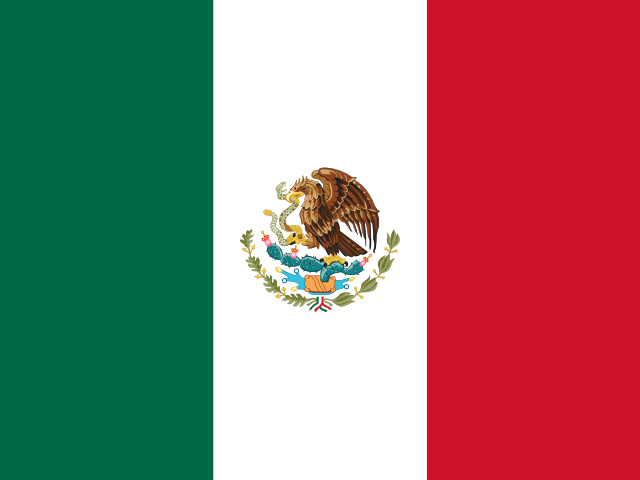
Three vertical bands of green, white and red from the hoist, in the proportion 4:7, height to length, with the national coat of arms centred on the white stripe at a diameter of three quarters of its width. The arms are a Mexican eagle perched by its left talon on a flowering nopal that grows from a rock rising out of a lake, seizing a curved serpent with its right talon and its beak, closed below by oak and laurel branches joined by a ribbon in the flag's colours. The law that defines the flag assigns the colours no meaning; they are conventionally read as hope, purity and the blood of the country's heroes.
Mexico FACTS ◢
| Capital | Mexico City |
|---|---|
| Continent | North America |
| Population | 131,946,900 (2025) |
| Area | 1,964,375 km² |
| Population density | 67/km² |
| Currency | Peso (MXN) |
| National language | Spanish |
| Calling code | +52 |
| Internet TLD | .mx |
| Time zones | UTC-08:00, UTC-07:00, UTC-06:00, UTC-05:00 |
| Drives on the | Right |
| ISO codes | MX / MEX |
DID YOU KNOW? ◢
- Chocolate, chillies, tomatoes, corn and vanilla were all first cultivated in ancient Mexico.
- Mexico City is built on the site of the Aztec capital Tenochtitlan, once a city on an island in a lake.
- Millions of monarch butterflies migrate here each year to overwinter in its mountain forests.
- It has more UNESCO World Heritage Sites than any other country in the Americas.
- The Chichen Itza pyramid is engineered so that a serpent of shadow slithers down its steps at the equinox.
Mexico QUICK ANSWERS ◢
What is the capital of Mexico?
The capital of Mexico is Mexico City.
What is the population of Mexico?
Mexico had a population of 131,946,900 in 2025.
What currency does Mexico use?
Mexico uses the Peso (MXN).
What languages are spoken in Mexico?
Mexico designates no official language. The national language of Mexico is Spanish.
Think you know your flags? Play Flag Daily → · Browse all countries →
MORE ON THE FLAG ◢
Mexico's flag law describes the angle of the eagle's wings, which foot the bird stands on, the fan of its tail feathers, the rock the cactus grows out of and the ribbon tying the two branches underneath. It sets the flag four units high to seven long, and the coat of arms at a diameter of three quarters of the white stripe's width.
On what green, white and red mean, it says nothing.
That silence is the real answer to the question people type, because the meaning everyone recites is nowhere in the law that defines the flag, and it is not even the first meaning the three colours carried. An older one came first, and only one word of it survives in the version taught today.
Key Takeaways
- Article 3 of Mexico's flag law fixes the stripe order, the proportions and the size of the arms, and assigns the colours no symbolism whatsoever.
- The 1821 reading was white for the purity of religion, red for the Spanish nation and green for independence.
- The reading taught today, hope and purity and the blood of heroes, comes from government prose rather than from the statute.
- The snake is not in the 1821 arms. The republic put it there by decree on 14 April 1823, and took the eagle's crown off in the same decree.
- The arms are mirrored on the back of the flag, so the eagle faces the staff whichever side you are standing on.
| What people ask | What the instrument says | Where that comes from |
|---|---|---|
| What do the colours mean? | Nothing. The article is silent. | Article 3, Ley sobre el Escudo, la Bandera y el Himno Nacionales, 1984 |
| Green, white, red in what order? | From the flagpole outward | Article 3 |
| How big is the coat of arms? | A diameter of three quarters of the white stripe's width | Article 3 |
| What shape is the flag? | Four units of height to seven of length | Article 3 |
| What is the eagle eating? | A curved serpent, held in the right claw and the beak | Article 2 |
| Which foot does it stand on? | The left, on the front of the flag | Article 2 |
What Mexico's flag law actually specifies
The governing text is the Ley sobre el Escudo, la Bandera y el Himno Nacionales, published in the Diario Oficial de la Federación on 8 February 1984 and in force since 24 February 1984. It replaced a 1967 law, which the same statute repeals by name in its first transitional article.
Article 3 gives the flag in four sentences: a rectangle divided into three vertical stripes "de medidas idénticas", of identical measure, in the order "verde, blanco y rojo" starting from the staff. The arms sit centred in the white stripe at a diameter of three quarters of that stripe's width. The proportion of the flag's height to its length is four to seven, fixed by statute rather than left to convention, and the flag may carry a tie in the same colours at the foot of the spearhead.
Article 2 is where the detail lives. It gives a Mexican eagle in left profile, wings raised above the crest and slightly spread "en actitud de combate", perched by its left talon on a flowering nopal that grows from a rock rising out of a lake, holding a curved serpent with the right talon and the beak "en actitud de devorar". Two branches close the design below, one of oak in front of the bird and one of laurel on the opposite side, joined by a ribbon whose three stripes match the flag's colours when the arms are shown in natural colours.
Read the two articles end to end and the pattern is clear. Every element is prescribed and no element is explained. Article 5 goes further and requires every reproduction to correspond faithfully to that model, which it says may not be varied or altered "bajo ninguna circunstancia".
What do the colours on Mexico's flag mean?
The answer people are usually given is that green stands for hope, white for purity and red for the blood of the country's heroes. It is a real answer and a government one. The Secretaría de Salud published it plainly in 2018: "El verde simboliza la esperanza; mientras que el blanco significa la pureza de los ideales de los mexicanos y, el color rojo representa la sangre derramada por nuestros héroes patrios."
What it is not is law. No article of the 1984 statute assigns a meaning to any colour, and the department publishing that gloss is a health ministry writing about a flag-raising ceremony, not the authority that defines the symbol.
The statute is not shy about symbolism as such, which makes the omission sharper. Article 25 sets out the words spoken when a flag is handed to a school or an institution, and they commit the whole flag to something: "esta Bandera que simboliza su independencia, su honor, sus instituciones y la integridad de su territorio". Independence, honour, institutions, the integrity of the territory. That is the one place the law says what the flag stands for, and it attaches to the flag entire. Not one of the four is given to a stripe.
The gap matters because the colours have carried a different meaning before, and the earlier one is documented. The historian Lucas Alamán, writing about the Plan de Iguala of 1821, recorded the original scheme in a passage Mexico's national archive reprints: "significándose por el blanco la pureza de la religión, por el encarnado la nación española" and "el verde se aplicaba a la independencia".
White was the purity of religion. Red was Spain, and specifically the Spaniards who were now to be counted as Mexicans. Green was independence. Those are the three guarantees of the Plan de Iguala, and the flag of the Ejército Trigarante wore them in that order.
Not one of those readings survives in the modern gloss, though one word does: white is still read as purity, and only what that purity attaches to has changed. Why the rest were dropped is the obvious question and no source opened here answers it, so the answer is left where it belongs. What the record shows is the narrower thing: the colours were reassigned rather than retired.
The wording drifts inside government too. In 1971, at a ceremony in Mexico's national archive marking the flag's 150th anniversary, the historian J. Ignacio Rubio Mañé gave the three as hope in the colour of the freshness of the fields, freedom of feeling in the clean colour of the lilies, and heroism in the colour of the blood of the martyrs. Same structure, different nouns, no statute behind either version.
The honest answer to the question, then, is that the colours mean what Mexico has agreed they mean, and Mexico has changed its mind once already.
Why the eagle on Mexico's flag is eating a snake
Here the law is specific and the history is stranger than the law.
The arms adopted in 1821 had no snake. The Soberana Junta Provisional Gubernativa published its resolution on 2 November 1821, and it ordered that the arms of the empire, for seals of every kind, be "solamente el nopal nacido de una peña que sale de la laguna, y sobre él parada, en el pie izquierdo, una águila con corona imperial". A cactus, a rock, a lake, and an eagle wearing an imperial crown. Nothing in its beak.
The drafting committee had wanted something more dramatic. Its proposal put the eagle in the act of throwing itself upon a tiger, and Dr Guridi y Alcocer moved that the scene be dropped and a crowned eagle used instead. The record of that session notes the outcome of the motions around it and not of this one, so what happened to it has to be read off the result: the arms published on 2 November have no tiger on them.
The snake arrives with the republic. Iturbide abdicated in March 1823, and on 14 April 1823 the Constituent Congress settled the arms and the flag together:
"Que el escudo sea el águila mexicana, parada en el pie izquierdo, sobre un nopal que nazca de una peña entre las aguas de la laguna, y agarrando con el derecho una culebra en actitud de despedazarla con el pico".
The second article of the same decree kept the flag as it was "con la única diferencia de colocar el águila sin corona". One decree removes the crown and adds the snake. Both changes say the same thing about who was now in charge.
So the snake is about seventeen months younger than the 1821 arms it was added to, and it is a republican addition to an imperial design.
Folio 2r of the Codex Mendoza has no serpent in it
The usual explanation is that the emblem shows the Mexica founding of Tenochtitlan, where a wandering people were told to build their city where they found an eagle on a cactus.
You can check one of the earliest illustrated versions of that scene yourself. It is folio 2r of the Codex Mendoza, held at the Bodleian Library in Oxford as MS. Arch. Selden. A. 1, and the library publishes a high-resolution image of the page. The founding of Tenochtitlan occupies the centre of it.
The eagle is there, wings up, perched on a flowering nopal that grows from a stone in the middle of the lake, with the ten founders named around it and the city's name glyph below. Its beak is open and empty. There is no serpent in the founding scene.
That is not proof the snake was invented. Colonial chronicles are reported to describe versions of the founding that have one, and those texts could not be reached to check them here. What the manuscript does establish is that an image of the founding made about twenty years after the conquest does not carry the detail that later became the flag's most famous feature. The serpent is documented entering the state's own description of itself in April 1823, and it is absent from both the 1821 arms and the Mendoza scene.
Worth knowing too: the statute names no species. It says "un águila mexicana" and "una serpiente curvada" and stops. The golden eagle and the rattlesnake that descriptions commonly supply, the health ministry's among them, are additions to the legal text rather than readings of it. If you enjoy the gap between what a flag is said to show and what its law prescribes, Flag Daily gives you one flag a day and three guesses at the country, which is a fast way to learn how few of them you actually picture correctly.
The arms are mirrored so the eagle faces the staff from either side
Mexico legislated the back of its flag.
A paragraph added to Article 2 in 1995 provides that when the arms are reproduced on the reverse of the flag, the eagle appears perched on its right talon and holds the serpent with its left talon and the beak. Set that against the front, where the bird stands on its left talon and grips with the right, and the reverse is the mirror of the obverse rather than a second, unrelated drawing.
The effect of the rule is which way the eagle looks. Green sits at the staff, and the front of a flag is the face you see with the staff on your left, so the bird's left profile turns it toward the staff. Seen from the back the staff is on your right, so the mirrored drawing turns it toward the staff again. Without the mirroring the same drawing would face the free edge on the reverse.
The 1995 decree also said what to do about every flag already flying. Its second transitional article let existing replicas whose arms did not follow Article 2 go on being honoured until they had to be destroyed, and required that from the day the reform took effect, replicas be made faithfully to the Law.
Where the vertical stripes came from, and why 24 February
The flag is older than every law that has described it.
Vertical stripes date from the Soberana Junta's resolution of 2 November 1821, with the consequent decree issued on 7 January 1822. The arrangement was a practical decision, not a symbolic one. In the session of 20 October 1821 Sánchez de Tagle proposed turning the stripes so that "la faja blanca dé más campo en que dibujar el águila", giving the white stripe more room for the eagle. Alamán records the Ejército Trigarante's own stripes as running horizontally, and Rubio Mañé, reprinting him, concludes the same.
There is a small correction buried in that sequence, and it comes from the national archive's own journal. Alamán wrote that the stripes were turned by decree of the first Congress. They were not. They were turned by the Soberana Junta, nearly four months before the first Constituent Congress was installed.
The date the country keeps is the earlier one. Rubio Mañé puts the flag's birth at Iguala on 24 February 1821, the day the Plan was being drafted, and dates the installation of the first Constituent Congress, on 24 February 1822, to the tricolour's first anniversary. So 24 February belongs to the flag first. The Congress sat on the flag's anniversary, not the other way round.
Article 10 of the current law makes it official: "El 24 de febrero se establece solemnemente como Día de la Bandera." The 1984 law was itself timed to enter into force on 24 February, which is the sort of detail a legislature enjoys arranging.
Telling it apart from Italy's
Green, white and red in three vertical stripes is not unique to Mexico. Italy's flag takes the same three colours in the same arrangement, which is why the two get mistaken for each other.
The test that always works is the middle stripe. Mexico's law requires the national arms to be there, at a diameter of three quarters of the stripe's width, and Italy's flag carries no emblem at all, so a plain white centre is never Mexican. Mexico's proportions are fixed by statute too, at four units of height to seven of length.
If you would rather work it out from clues than from a picture, Guess the Country gives you three written clues and three guesses, and the full country list has the factsheet for every flag on it.
Frequently asked questions
What do the colours of the Mexican flag mean?
Legally, nothing. Article 3 of the Ley sobre el Escudo, la Bandera y el Himno Nacionales specifies the order, size and proportions of the stripes and assigns them no symbolism. The familiar gloss of green as hope, white as the purity of Mexicans' ideals and red as the blood shed by national heroes is published by government departments, the Secretaría de Salud among them, but it appears in their prose rather than in the statute.
The original 1821 scheme was different again: white for the purity of religion, red for the Spanish nation and green for independence, matching the three guarantees of the Plan de Iguala.
Why is there a snake in the eagle's beak?
Because a decree of 14 April 1823 put it there. The arms adopted under the empire in November 1821 showed a crowned eagle on the nopal with nothing in its beak, and an earlier committee idea of an eagle attacking a tiger did not survive into them either.
When the republic replaced the empire, the Constituent Congress ordered the eagle drawn without its crown and grasping "una culebra" with its right foot, tearing at it with the beak. The 1984 law keeps that arrangement and describes the serpent as curved.
Is the Mexican flag the same on both sides?
No. A paragraph added to Article 2 in 1995 requires the arms on the reverse of the flag to be the mirror of the front, with the eagle perched on its right talon and holding the serpent with its left talon and the beak.
The front has it standing on the left talon and gripping with the right, so the two faces are mirror images of one another rather than the same drawing repeated. The effect is that the eagle turns toward the staff whichever side of the flag you are standing on.
What kind of eagle and snake are on the Mexican flag?
The law does not say. Article 2 specifies "un águila mexicana" and "una serpiente curvada" and describes their posture in detail without naming a species for either.
Descriptions that identify the bird as a golden eagle and the snake as a rattlesnake, including some published by Mexican government departments, are adding information the statute does not carry.
How do you tell the Mexican and Italian flags apart?
By the middle stripe. Mexico's law places the national coat of arms in the centre of the white stripe at a diameter of three quarters of its width, so a green-white-red vertical tricolour with a plain white centre is not Mexico's.
Article 3 also fixes the flag's proportion of height to length at four to seven.
Sources
- Ley sobre el Escudo, la Bandera y el Himno Nacionales, published in the Diario Oficial de la Federación on 8 February 1984, text as last reformed 10 June 2013. Copy published by the Secretaría de Educación Pública of the Cámara de Diputados text. Articles 2, 3, 5 and 10 and the transitional articles were read in full. normatecainterna.sep.gob.mx - retrieved 13 August 2026.
- The same law in the Orden Jurídico Nacional's compilation, text as last reformed 21 January 2008, used to confirm the wording of Articles 2 and 3 against a second government copy. Orden Jurídico Nacional, Secretaría de Gobernación. ordenjuridico.gob.mx - retrieved 13 August 2026.
- J. Ignacio Rubio Mañé, "Creación de la Bandera Nacional Mexicana 1821-1971", lecture given at the Archivo General de la Nación on 24 February 1971, published in the Boletín del Archivo General de la Nación. Source of the Soberana Junta's resolution of 2 November 1821, the decree of 14 April 1823, the Sánchez de Tagle proposal, the rejected eagle-and-tiger design and the Alamán passage. Archivo General de la Nación. bagn.archivos.gob.mx - retrieved 13 August 2026.
- "Símbolo de unidad para los mexicanos: nuestra bandera", Secretaría de Salud, 14 May 2018, the source of the hope, purity and blood gloss and of the golden eagle and rattlesnake identifications. Read through an Internet Archive capture, since gob.mx does not serve the page directly to a plain request. gob.mx - retrieved 13 August 2026.
- Codex Mendoza, Bodleian Library MS. Arch. Selden. A. 1, folio 2r, the founding of Tenochtitlan. The page image was opened and examined directly. Bodleian Libraries, University of Oxford. digital.bodleian.ox.ac.uk - retrieved 13 August 2026.
PLAY ANOTHER →
A short message, hidden in a different cipher every day.
ONE CIPHER A DAYDAILYGuess the CountryThree clues, three guesses. Work out where in the world it is.
THREE CLUESDAILYDaily CryptogramOne quote, one scrambled alphabet. Crack it before tomorrow.
CRACK THE QUOTEDAILYOn This DayOne thing that happened today in history. Every day, a new one.
TODAY IN HISTORY