
Monaco
The second-smallest country in the world, Monaco crams a glittering harbour, a Grand Prix and a casino into an area smaller than many city parks - with barely any of it flat.
WHAT THE FLAG MEANS ◢
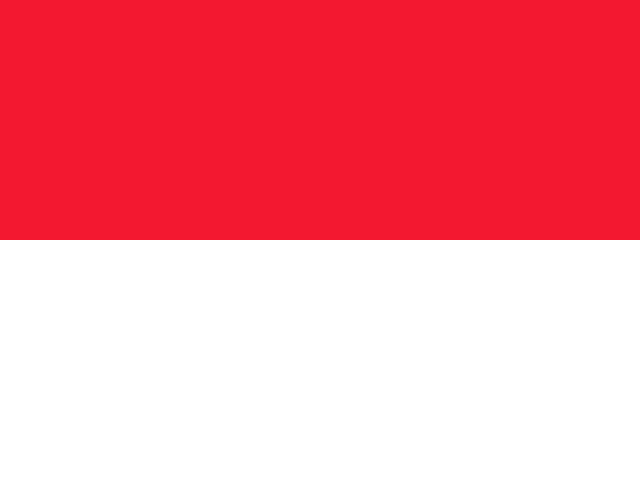
Two equal horizontal bands of red over white. Article 7 of the constitution prescribes exactly that, red above and white below, in the same article that makes the Grimaldi arms on a white ground the separate princely flag, and it refers the use of both to a sovereign ordinance of 4 April 1881. Neither instrument assigns the colours a meaning. Outside the law they are conventionally read as the heraldic colours of the House of Grimaldi.
Monaco FACTS ◢
| Capital | Monaco |
|---|---|
| Continent | Europe |
| Population | 38,341 (2025) |
| Area | 2 km² |
| Population density | 19,171/km² |
| Currency | Euro (EUR) |
| Official language | French |
| Calling code | +377 |
| Internet TLD | .mc |
| Time zone | UTC+01:00 |
| Drives on the | Right |
| ISO codes | MC / MCO |
DID YOU KNOW? ◢
- It's the second-smallest country in the world, after Vatican City.
- The Monaco Grand Prix winds through the streets of the city itself, one of motorsport's most famous races.
- It's the most densely populated country on Earth.
- It has no army but has been ruled by the Grimaldi family for more than 700 years.
Monaco QUICK ANSWERS ◢
What is the capital of Monaco?
The capital of Monaco is Monaco.
What is the population of Monaco?
Monaco had a population of 38,341 in 2025.
What currency does Monaco use?
Monaco uses the Euro (EUR).
What languages are spoken in Monaco?
The official language of Monaco is French.
Think you know your flags? Play Flag Daily → · Browse all countries →
MORE ON THE FLAG ◢
Ask what Monaco's flag means and you will usually be told it carries the colours of the Grimaldi. That reading is real, and the Monegasque Government publishes it. What the instruments add to it is that Monaco has two flags, that both are described in the same article of the constitution, and that neither that article nor the ordinance it points to says a word about what the colours stand for.
Article 7 of the Constitution of 17 December 1962 opens with the princely flag, not the red-and-white one. Its first line is: "Le pavillon princier se compose des armes de la Maison des Grimaldi sur fond blanc." The Grimaldi arms on a white ground. The national flag is the second paragraph, not the first.
Those flags are still separate in law today, and the older instrument behind both, a sovereign ordinance of 4 April 1881, gives each a different job.
Key Takeaways
- Article 7 of Monaco's constitution describes two flags: a princely flag bearing the Grimaldi arms on white, and the red-over-white national flag.
- Article 7 refers the use of both flags to the Ordonnance Souveraine du 4 avril 1881, which has not been abrogated.
- The 1881 ordinance assigns the national flag to merchant and fishing vessels, while the princely flag belongs on the Palace, on public buildings and on vessels of the State. Britannica describes the modern national flag as the one for private citizens and the flag flown at the United Nations.
- Neither article 7 nor the 1881 ordinance says what the red and the white stand for.
- The Government's own account of the national symbols reads the colours as those of the Grimaldi arms, and links the arms to the red and white of Genoa. It publishes that on a history page, not in law.
Monaco has two flags, and the constitution names them separately
Article 7 of the constitution runs to three short paragraphs. The first is the princely flag, the Grimaldi arms on a white ground. The second is the one people mean when they say the flag of Monaco: "Le pavillon national se compose de deux bandes horizontales égales de couleur rouge et blanc, la rouge à la partie supérieure, la blanche à la partie inférieure." Horizontal bands of red and white, equal in size, the red on top and the white below.
The third paragraph is the operative one. "L'utilisation desdits pavillons demeure régie par les dispositions de l'Ordonnance Souveraine du 4 avril 1881." The use of the said flags, plural, remains governed by the 1881 ordinance. The constitution refers both flags to it, not just the national one.
Nothing in those three paragraphs interprets anything. The article describes two objects and points at an earlier text for how they are to be used, and then moves on to article 8, which makes French the official language of the State.
The two-flag distinction is not a museum piece. Monaco's current Code de la mer still treats the two as different categories: article L. 610-2 sets nationality requirements for the crew of any ship flying the Monegasque flag, then exempts, among others, "navires battant pavillon du Prince".
The flag is also a late arrival in Monaco's constitutional law. The Principality's first constitution was granted by Prince Albert I on 5 January 1911, the Government setting aside an 1848 charter that was never applied, and that 1911 text has no flag article at all. Article 7 appears in the 1962 text, and its wording is identical in the original of 17 December 1962 and in the version revised by the law of 2 April 2002.
The 1881 ordinance gives the two flags different jobs
The Ordonnance Souveraine du 4 avril 1881 sur le pavillon princier et le pavillon national is six articles long. It is still on the Principality's legal database as a text in force.
Article 1 gives the princely flag as "Nos armes en couleur sur fond blanc", in the reigning prince's own voice: Our arms, in colour, on a white ground. Article 2 gives the national flag as "deux bandes égales de couleur rouge et blanc, disposées horizontalement", red above and white below, "et tenant toutes deux à la hampe", both attached to the staff.
Then it stops describing and starts allocating.
| Provision | Princely flag | National flag |
|---|---|---|
| The design (art. 1 and 2) | The prince's arms in colour on white | Bands of red over white, equal in size |
| Where it flies (art. 4 and 5) | The Palace, the prince's other residences, public buildings, State ships | Merchant and fishing vessels |
| Private houses (art. 6) | Allowed at ceremonies and public festivities | Allowed at ceremonies and public festivities |
Article 4 puts the princely flag on "Notre Palais de Monaco et sur les autres résidences occupées par Nous, ainsi que sur les édifices publics et sur les navires de l'État". Article 5 is one line: "Le pavillon national est spécialement affecté aux navires de commerce et de pêche." The national flag is specially assigned to merchant and fishing vessels. Article 6 lets either be flown at private houses during ceremonies and public festivities.
So in the instrument that fixes them, the plain red-and-white flag is the ensign of merchant and fishing vessels, and the flag with the arms on it is the one for the Palace and the public buildings.
The 1881 allocation is not the whole of what the red-and-white flag does now. Britannica's flag article describes it as "The national flag for use by private citizens, also flown at the United Nations to represent Monaco".
One thing the ordinance requires cannot be read in it. Article 3 says both flags "devront être exécutés conformément aux modèles ci-annexés", must be made in accordance with the annexed models. The consolidated text published today carries the six articles and no annexes, so the shape and the proportions the ordinance actually prescribes are not in the published instrument.
Neither article 7 nor the 1881 ordinance gives the red and the white a meaning
Article 7 assigns no meaning, the 1881 ordinance assigns no meaning, and neither uses a word like symbol. Between them the two instruments run to three constitutional paragraphs and six articles about these flags, and not one of them interprets a colour.
The reading that circulates comes from outside both instruments, and Monaco publishes it under its own name. The Government portal's page on the national symbols says: "Fixé par le prince Charles III en 1881, le pavillon national reprend les couleurs des armes des Grimaldi, qui elles-même rappellent les couleurs rouge et blanche du blason de la république de Gênes, berceau de la Famille Princière." Fixed by Prince Charles III in 1881, the national flag takes up the colours of the Grimaldi arms, which themselves recall the red and white of the arms of the Republic of Genoa, the cradle of the princely family.
So the derivation runs two steps, not one. The flag takes its colours from the family arms; the family arms are linked to Genoa, where a second Government page, the one on the occupation of the Rock, puts the Grimaldi among the republic's consuls, naming Otto Canella in 1133 and his son Grimaldo from 1162. Anyone who stops at the heraldic colours of the Grimaldi is quoting half of what the Government says.
The same Government page then does something careful. It records a second reading and labels it: "Une vision poétique a pu faire du drapeau une évocation du sang de Sainte-Devote", a poetic vision has been able to make of the flag an evocation of the blood of Saint Devota, the fourth-century martyr who is the Principality's patron saint.
A state that separates its own history-page derivation from an evocation it calls poetic has already sorted its sources for you. What it never does is put either reading into article 7 or into the 1881 ordinance.
Red and white were in a Monegasque ordinance eighteen years before the flag ordinance
The arms on the princely flag are not a picture. They are a heraldic field, and the Prince's Palace gives the blazon: "L'écu, fuselé d'argent et de gueules et entouré du Collier de l'Ordre de Saint-Charles, est placé sur un manteau rouge doublé d'hermine, sommé de la Couronne princière." The shield is fusily argent and gules, which is a diagonal lattice of red and white lozenges, and it sits inside the collar of the Order of Saint Charles on an ermine-lined red mantle under the princely crown.
Those two tinctures are old enough to have been written into Monegasque law well before the flag was. Article 4 of a sovereign ordinance of 16 January 1863 on the Order of Saint Charles puts on the reverse of the decoration "l'écusson de Nos armes en émail rouge et blanc", the shield of Our arms in red and white enamel, and adds that "Le ruban de l'ordre est rouge et blanc." That article is read from Legimonaco's consolidated version of the ordinance, in which articles 5 and 8 are headed with later amending ordinances and article 4 is not, so the wording is the 1863 wording. Red and white as the prince's colours are in a Monegasque ordinance eighteen years before the flag ordinance.
Britannica puts the colours themselves further back than either date. It calls the red-over-white bicolour "a traditional use of heraldic colours" and says that use of the colours "can be dated back at least to 1339, although early Monegasque flags displayed many graphic variations". So 1881 is the year the design was fixed in law, not the year the colours first appear.
What none of the Monegasque sources read here explains is why the field is lozenges at all. The Britannica article on the flag, written by the vexillologist Whitney Smith, says of the shield that "As is the case with many heraldic devices, the original meaning of the lozenges is not clear." Keep that in view when a flag guide offers a confident story about them.
Why do two monks with swords hold up the Grimaldi arms?
The full achievement has supporters, and they are the part of it that needs explaining. The Palace describes them as "deux Frères Mineurs chevelus, barbus et chaussés, portant chacun une épée levée": two Friars Minor, long-haired, bearded and shod, each carrying a raised sword.
The Government explains them by the founding episode: "Les moines portant chacun une épée font allusion à l'épisode fondateur de l'identité monégasque qu'est la prise de la forteresse par François Grimaldi, déguisé en frère franciscain." The monks each bearing a sword allude to the taking of the fortress by François Grimaldi, in the habit of a Franciscan friar.
That legend has a datable written source, and the Government prints it. Its page on 8 January 1297 quotes the spice merchant Guillaume Ventura, whom it dates 1250 to 1327, from the Chronique d'Asti in Claude Passet's French translation: "déguisé sous l’habit des frères mineurs, entra dans la cité de Monaco, tua les gardes de ladite cité", disguised in the habit of the Friars Minor, he entered the city of Monaco and killed the guards of the said city.
And then the Government hedges its own founding story. The same page adds the possibility that "le chroniqueur de cet épisode a utilisé le nom de Monaco (moine, en italien) pour imaginer le mode opératoire de la ruse", that the chronicler may have used the name Monaco, which is monk in Italian, to imagine how the trick was done. It still concludes that the episode "justifie la présence du moine armé comme tenant des armoiries princières", justifies the armed monk as a supporter of the princely arms.
That is a state saying, on its own history page, that the detail behind its own supporters may be a pun the chronicler made on the country's name.
The hold that followed was short. The Government's timeline runs François Grimaldi at Monaco from 1297 to 1301, then a treaty of 10 April 1301 with Charles II of Anjou under which the Grimaldi give the place up. A passing reconciliation, it says, lets them "reprendre possession du Rocher en 1331", retake possession of the Rock in 1331. Charles I acquired the lordship of Menton in 1346 and Roquebrune in 1355. Counting Grimaldi rule continuously from 1297 skips the thirty years between.
Deo juvante is not a relic of 1297, and its official capitalisations disagree
Below the supporters runs the motto. The Palace gives it as "DEO JUVANTE (avec l'aide de Dieu)", with God's help.
The Government attributes it to Lambert Grimaldi, and ties it to a plot laid in 1458 by his wife's mother Pomeline Fregose, after which the inhabitants of the lordships of Monaco, Menton and Roquebrune swore an oath of loyalty to him. Its timeline puts the oath of the people of Monaco on 16 March 1458.
The capitalisation is worth a note for anyone quoting it. The Palace sets it in full capitals, DEO JUVANTE. The Government's symbols pages set it as Deo Juvante. The 1863 ordinance on the Order of Saint Charles, which is the oldest of the three and the only one that is law, sets it as "Deo juvante". That is one motto, three official Monegasque renderings, and no reason to treat any of them as the wrong one.
Why Charles III fixed a flag in 1881
The date is not arbitrary. The flag ordinance belongs to a programme, and the Government describes that programme in one sentence on its page about the reign.
Charles III, it says, worked to make the Principality a modern State "doté de tous les attributs de la souveraineté", equipped with all the attributes of sovereignty: he reformed justice and the administration, developed diplomatic relations and concluded treaties, instituted a Sovereign's Feast in 1857 and a national decoration, the Order of Saint Charles, in 1858, resumed a coinage abandoned since 1838, gave the Principality postage stamps in 1885, and obtained the creation of a bishopric in 1887. In the middle of that list sits the clause that matters here: he "dote le pays, en 1881, d'un drapeau national", endows the country, in 1881, with a national flag.
A flag, a decoration, a coinage, stamps, a bishopric. Read as a set, the 1881 ordinance is less a design decision than a piece of statecraft, which is also why three of its six articles are about who may fly what and where.
Monaco and Indonesia, and the proportion no published Monegasque text gives
Monaco's national flag and Indonesia's are the same two bands in the same order. Britannica's flag article states plainly that "The similarity of the flag of Monaco to that of Indonesia is purely coincidental", and gives Monaco's flag a width-to-length ratio of 4 to 5.
That ratio is not in article 7 of the constitution and it is not in the 1881 ordinance, whose only word on the matter is the reference in its article 3 to models that the published text does not reproduce. So the proportion is reported by a reference work rather than fixed by any Monegasque provision you can open.
That still leaves anyone looking at the two flags having to tell them apart at a glance. If you want to find out how well you actually do that, Flag Daily shows one flag a day and gives you three guesses.
Frequently asked questions
What do the colours of Monaco's flag mean?
Neither Monegasque instrument that fixes the flag assigns the colours a meaning. Article 7 of the constitution describes the national flag as two equal horizontal bands, red above and white below, the sovereign ordinance of 4 April 1881 describes it the same way, and neither interprets the colours. The Government's own page on the national symbols reads them as the colours of the Grimaldi arms, and links those to the red and white of Genoa.
Why do Monaco and Indonesia have almost the same flag?
Monaco's flag and Indonesia's are both a horizontal bicolour of red over white. Britannica's flag article says the similarity is purely coincidental, and gives Monaco's flag a width-to-length ratio of 4 to 5. Monaco's own instruments fix no proportion: article 3 of the 1881 ordinance refers to annexed models, and the published consolidated text does not reproduce them.
What is the difference between Monaco's national flag and the princely flag?
Monaco's national flag and its princely flag are two different flags described in the same article of the constitution. The princely flag is the Grimaldi arms on a white ground. The national flag is the plain red-over-white bicolour. Under the 1881 ordinance the princely flag flies on the Palace, the prince's residences, public buildings and State ships, while the national flag is the one that ordinance assigns to merchant and fishing vessels. Britannica describes the national flag as the one for use by private citizens, and as the flag flown at the United Nations to represent Monaco.
When was Monaco's flag adopted?
The sovereign ordinance that fixes both flags is dated 4 April 1881, in the reign of Prince Charles III. It has not been abrogated, and the constitution of 17 December 1962 still refers the use of both flags to it. Monaco's first constitution, of 1911, contained no flag article.
What does Deo juvante mean and where does it come from?
Deo juvante is Latin for with God's help, and the Prince's Palace prints the French gloss "avec l'aide de Dieu" beside the motto on the coat of arms. The Government attributes it to Lambert Grimaldi, in connection with the oath of loyalty sworn to him by the inhabitants of Monaco, Menton and Roquebrune in 1458 after a failed plot. It appears on the arms and on Monegasque coins.
Sources
- Legimonaco (Government of Monaco legal database), Constitution du 17 décembre 1962 de la Principauté, article 7, and the original text as enacted at Constitution du 17 decembre 1962, version of 17 December 1962 - retrieved 27 August 2026.
- Legimonaco, Ordonnance Souveraine du 4 avril 1881 sur le pavillon princier et le pavillon national, articles 1 to 6 - retrieved 27 August 2026.
- Legimonaco, Ordonnance Souveraine du 16 janvier 1863 sur l'ordre de Saint-Charles, article 4 - retrieved 27 August 2026.
- Legimonaco, Code de la mer, article L. 610-2 - retrieved 27 August 2026.
- Legimonaco, Constitution du 5 janvier 1911 (PDF) - retrieved 27 August 2026.
- Gouvernement Princier de la Principauté de Monaco, La Constitution de la Principauté - retrieved 27 August 2026.
- Gouvernement Princier de la Principauté de Monaco, Drapeau monégasque - retrieved 27 August 2026.
- Gouvernement Princier, Armoiries de la Famille Princière and Devise "Deo Juvante" - retrieved 27 August 2026.
- Gouvernement Princier, Occupation du Rocher par François Grimaldi, Charles Ier : la constitution du territoire and Union avec la population - retrieved 27 August 2026.
- Gouvernement Princier, Affirmation de la souveraineté - retrieved 27 August 2026.
- Palais Princier de Monaco, Armoiries de la Maison Grimaldi and Le Palais des Princes de Monaco - retrieved 27 August 2026.
- Whitney Smith, flag of Monaco, Encyclopaedia Britannica - read from the Internet Archive capture of 7 March 2026, the live site being unreachable from here - retrieved 27 August 2026.
PLAY ANOTHER →
A short message, hidden in a different cipher every day.
ONE CIPHER A DAYDAILYGuess the CountryThree clues, three guesses. Work out where in the world it is.
THREE CLUESDAILYDaily TriviaFive questions a day. Everyone gets the same five.
FIVE QUESTIONSDAILYOn This DayOne thing that happened today in history. Every day, a new one.
TODAY IN HISTORY