
Myanmar
A Southeast Asian nation where thousands of golden stupas rise from the plains of Bagan and the Irrawaddy River threads the whole country together. Myanmar keeps its own clock, literally.
WHAT THE FLAG MEANS ◢
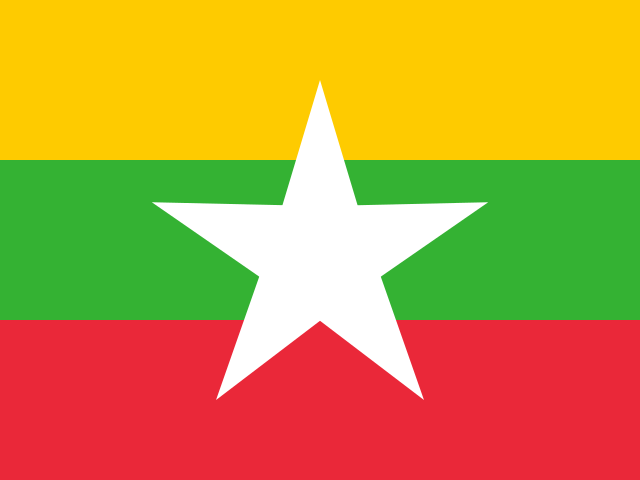
Three horizontal bands of yellow, green and red with a large white five-pointed star in the centre. The constitution carries the State Flag in a chapter of its own and prescribes the design without interpreting it. The law it calls for does the interpreting: the Union Flag Law of 2010 gives the yellow unity, conformity, huge wisdom, happiness and the amicable unity of all national races, the green fertility, conformity, fairness and being a peaceful, pleasant and greening nation, the red bravery and decisiveness, and the white of the star purity, honesty, fullness of compassion and power. The flag replaced the previous one on 21 October 2010, the day that law was made, and was first hoisted that afternoon at a ceremony attended by the prime minister.
Myanmar FACTS ◢
| Capital | Naypyidaw |
|---|---|
| Continent | Asia |
| Population | 54,850,648 (2025) |
| Area | 676,577 km² |
| Population density | 81/km² |
| Currency | Kyat (MMK) |
| Official language | Burmese |
| Calling code | +95 |
| Internet TLD | .mm |
| Time zone | UTC+06:30 |
| Drives on the | Right |
| ISO codes | MM / MMR |
DID YOU KNOW? ◢
- The plain of Bagan is dotted with thousands of Buddhist temples and pagodas built between the 11th and 13th centuries.
- Its clocks run half an hour off the neighbours, sitting 6.5 hours ahead of GMT.
- The gold-covered Shwedagon Pagoda in Yangon is said to be topped with thousands of diamonds.
- Fishermen on Inle Lake are known for a distinctive leg-rowing technique that leaves their hands free to fish.
Myanmar QUICK ANSWERS ◢
What is the capital of Myanmar?
The capital of Myanmar is Naypyidaw.
What is the population of Myanmar?
Myanmar had a population of 54,850,648 in 2025.
What currency does Myanmar use?
Myanmar uses the Kyat (MMK).
What languages are spoken in Myanmar?
The official language of Myanmar is Burmese.
Think you know your flags? Play Flag Daily → · Browse all countries →
MORE ON THE FLAG ◢
Myanmar's constitution really does put the State Flag in a chapter of its own and then decline to explain it. Section 437 prints a picture and adds one line of instruction: "Law shall be promulgated concerning the State Flag."
That instruction was carried out on 21 October 2010, and the law that answered it does something none of Myanmar's earlier flag instruments had done. It measures the flag and it prohibits misuse, as they did, and then it spends a whole section saying what the colours are for.
So the readings you find attached to Myanmar's flag are not folklore that grew up around it. They are section 5 of the Union Flag Law, in the statute book. A short version circulates that keeps a fraction of it.
Key Takeaways
- Section 437 of the 2008 constitution shows the flag as an image and directs that a law be made about it. It interprets nothing.
- The Union Flag Law, State Peace and Development Council Law No. 8/2010, was made on 21 October 2010 and assigns a meaning to yellow, green, red and the white of the star.
- Section 5 of that law gives yellow five ideas: unity, conformity, huge wisdom, happiness, and the amicable unity of all national races.
- Section 5 gives the white of the star purity, honesty, fullness of compassion and power. The unity of all national races is given to the yellow, not to the star.
- None of the ten earlier Myanmar flag instruments that can be read assigns any colour a meaning, the 1973 declaration included, and that one fixed the previous flag down to the bend of each rice leaf.
| Instrument | Date | What it does with the flag | Does it assign a meaning? |
|---|---|---|---|
| Constitution of 1947, section 215 | 1947 | Describes the red flag with its blue canton and six stars in words, with dimensions | No |
| State Flag Act, Act No. 68 of 1948 | 13 November 1948 | Defines "flag" and punishes misuse | No |
| State Flag Rules, Notification No. 114 | 18 February 1953 | Protocol for the flag's dignity and its use | No |
| State Flag (Amendment) Act, Act No. 15 of 1955 | 1955 | Lets the president attach penalties to the rules | No |
| Revolutionary Council Declaration No. 109 | 26 December 1973 | Fixes size, colour and every proportion of the incoming flag | No |
| Constitution of 1974, section 190 | 1974 | Shows the flag as an image | No |
| State Flag Law, Pyithu Hluttaw Law No. 1 of 1974 | 30 March 1974 | Sets flag days, prohibitions and penalties | No |
| State Flag Rules, Pyithu Hluttaw Rules No. 1 of 1974 | 30 March 1974 | Size, colour, protocol and prohibitions | No |
| State Flag Rules amendment, SLORC Rules No. 2/89 | 27 April 1989 | Replaces rule 4(c) on where the flag may be flown | No |
| Constitution of 2008, section 437 | 2008 | Shows the flag as an image and orders a law | No |
| Union Flag Law, SPDC Law No. 8/2010 | 21 October 2010 | Measures the flag, assigns meanings, prohibits misuse | Yes, section 5 |
| State Flag Rules, SPDC Rules No. 1/2010 | 21 October 2010 | Hoisting, protocol and saluting | No |
Section 5 of Myanmar's flag law, colour by colour
Section 5 opens by naming its own subject: the meanings of the colours of the flag and of the white of the star. Then it takes them one at a time.
Yellow. The official English translation reads: "the yellow colour indicates the meaning of unity, conformity, huge wisdom, happiness and unity of all national races amicably". The Burmese opens with စည်းလုံးခြင်း၊ ညီညွတ်ခြင်း, two different words for togetherness, before the wisdom and the happiness arrive.
Green. "the green colour indicates the meaning of fertility, conformity, fairness and being a peaceful, pleasant, and greening nation". The Burmese for the first of those is မြေဆီသြဇာကြွယ်ဝခြင်း, richness of soil, which is a good deal more specific than the greenery that usually replaces it.
Red. "the red colour indicates the meaning of bravery and decisiveness", in Burmese ရဲရင့်ခြင်းနှင့် ပြတ်သားခြင်း. This is the one clause the short version reproduces intact.
White. "the white colour of the star indicates the meaning of purity, honesty, fullness of compassion and power". The Burmese begins သန့်ရှင်းစင်ကြယ်ခြင်း, purity in the sense of cleanness.
Read together, the section is more generous than its reputation. Yellow alone carries five ideas where a one-word summary carries one, and green carries fertility and fairness before it gets anywhere near being green.
It is also worth noticing what is not in section 5. The white star is not given the union of the country. Union belongs to the yellow, in the phrase "unity of all national races amicably".
Why yellow, green and red, and the flag the law will not name
Section 4 sits immediately before the meanings and does a different job. It explains where the three colours came from rather than what they stand for.
The three colours are in the flag, it says, as a mark of respect towards an earlier three-coloured flag, one "applied magnificently in the period of struggle for the independence of Myanmar". The Burmese calls that earlier design a သုံးရောင်ခြယ်အလံ and says their presence honours it, အလေးအမြတ်ပြု, a phrase of reverence that the official English translation drops.
That is the whole of it, and it is deliberately unspecific: the section does not name a year, a regime or a design, and it never says whose flag it was, when it flew, or what it looked like beyond having three colours.
The identification everyone reaches for is the yellow-green-red tricolour of the wartime years. The late vexillologist Whitney Smith made it explicitly in his account of the flag for Encyclopaedia Britannica, writing that the 2010 design "harkened back to the 1943 yellow-green-red tricolour, but, instead of the peacock used on the earlier standard, a white star was set in the centre of the flag." That is a scholar's reading, and a reasonable one. It is not the state's, because the state declined to say.
Section 437 shows the flag, and section 443 is what the law cites
The constitutional provision is two lines long. Sub-section (a) reads "The State Flag shall be as shown below:" and is followed by the image. Sub-section (b) reads "Law shall be promulgated concerning the State Flag."
The chapter around it is headed "Chapter XIII. State Flag, State Seal, National Anthem and the Capital", and the State Seal gets the identical treatment one section later: a picture, then an order to legislate. The anthem is handled the same way again, except that instead of an image section 439(a) simply prescribes the anthem already in use.
The Union Flag Law takes that structure seriously, because its own definition section does not redescribe the flag at all. It points back: "The Union Flag means the flag provided in sub-section (a) of section 437 of the Constitution."
The law's stated authority is a different provision again, and it repays reading. The preamble enacts the law "in accord with section 443 of the Constitution of the Republic of the Union of Myanmar", and the state newspaper's account of the six instruments issued that day cited 443 as well.
Section 443 is not a grant of power. It reads: "The preparatory work done by the State Peace and Development Council, before this Constitution comes into operation, to bring the Constitution into operation, shall be deemed to have been carried out in accord with this Constitution." It presupposes the work and validates it afterwards.
The preamble restates that as an instruction, saying it is provided in section 443 that the council "shall carry out necessary preparatory works", and the newspaper follows suit. A deeming clause had become a mandate by the time it reached the front page.
So the constitution and the law divide the work between them. The constitution settles which flag, by showing it. The law settles what it measures, what it means, and what happens to you if you misuse it.
The earlier instruments never interpret anything
The 2010 law's willingness to explain itself is the exception in this country's flag legislation, not the rule. The instruments that can be read are the constitutions of 1947, 1974 and 2008, the State Flag Act of 1948 and its 1955 amendment, the flag rules of 1953, 1974 and 1989, the Revolutionary Council declaration of 1973 and the flag law of 1974. Not one of them attaches a meaning to anything.
The 1947 constitution described its flag at length in section 215: a rectangle with a red field, a dark blue canton, one large white five-rayed star with five smaller five-rayed stars set between its arms, nine feet by five, canton four feet by two feet six inches. It gives measurements for the circles the stars are drawn in. It assigns nothing a meaning.
The State Flag Act of 1948, Act No. 68, signed on 13 November 1948 by the acting president Sao Shwe Thaik, never describes the flag at all. It defines what counts as one and then lists the ways you may not treat it.
The 1973 declaration is the sharpest case. Revolutionary Council Declaration No. 109 of 26 December 1973 fixed the incoming flag in obsessive detail: a fourteen-toothed cogwheel, which the declaration calls a pinion, with each tooth 1.8 inches wide at the base and 1.4 inches high, two ears of rice bearing thirty-four grains between them, fourteen white five-pointed stars, and one paragraph tracing where the tip of each individual rice leaf must fall relative to which tooth. It assigns nothing any meaning whatsoever.
The flag law that followed it, Pyithu Hluttaw Law No. 1 of 1974, is about which days the flag is flown and what happens if you deface it. Its rules, made the same day, cover size, colour, protocol and prohibitions. Neither contains a word about symbolism.
The familiar readings of that older flag, the cogwheel for industrial workers and the rice for the peasantry, are in the same position as the ones the 2010 law later put on the record: widely repeated, sourced to writers rather than to the state. Smith's Britannica entry gives exactly that pairing. Myanmar's earlier constitution and declaration, which had every opportunity, simply did not.
Nine feet by six, and three Pantone numbers
Section 3 of the Union Flag Law carries the geometry, and it is exact.
The standard flag is "rectangular, with 9 feet in length and 6 feet in width". The three bands each take a third of the six-foot width, so "each colour shall be 2 feet". On that ground goes "a large white star with five vertices". Its upper point sits on the vertical centre line at four feet six inches and must point straight up. The top of the star and the tips of its two lower points each stand one foot clear of the yellow and red edges respectively, and the points are two feet 7.2 inches apart.
The colours are pinned to a commercial standard rather than described: pantone 116 PC for the yellow, pantone 361 PC for the green, pantone 1788 PC for the red. Section 6 then extends the whole scheme to flags of other sizes, which must keep "the proportions and colours contained in the provision of section 3".
Anyone drawing the flag from the text should know about two snags in the printed copies. The statute fixes 6 feet of width to 9 of length, a width-to-length ratio of 2 to 3. Britannica's entry on the flag states that it "has a width-to-length ratio of 1 to 2", which does not match the law. And the annexure diagram in the copy of the official English translation published by the Myanmar Information Management Unit prints the red as "PAN TONE 178 PC" in its colour key, while section 3 of the same document gives 1788 PC. Section 3 of the Burmese original gives ၁၇၈၈, 1788. It cannot settle the annexure, because the Burmese copy served by the Myanmar Law Information System reproduces no annexure at all, only a placeholder line where one should be. Where a printed copy disagrees with itself, the operative section is the one to trust.
Getting a flag's proportions right from memory is harder than it looks, which is roughly the whole premise of Flag Daily, where you see one flag and get three guesses at the country.
The prohibitions, and a maximum of three years
Chapter IV of the Union Flag Law is long and specific. Nothing may be written, painted, fixed, printed or marked on the flag, the statute giving word, number, picture and symbol as examples rather than as the whole list. Its colour, size, shape or proportion may not be destroyed, it may not be used in places, regions or for purposes that have not been allowed, and it may not be applied disrespectfully. No flag of a local organisation may be flown above it or level with it.
It may not be hoisted at half-mast without a government order, used to cover a stone sculpture, pillar or statue at an opening ceremony, or used to cover a body except at a state or military funeral. At such a funeral it may not be buried with the body, and it may not touch the ground of the cemetery. It may not touch the ground, the water or the floor beneath it while it is being raised, lowered or used, and it may not be torn or destroyed, or intentionally treated in a way that affects its glory.
Section 15 adds three more. The flag may not be used to pack or tie anything, used "as a flooring", or used as a trademark of any goods, painted on clothes or used as decoration, except when performing on behalf of the Union or the entire nation.
One line in the hoisting chapter, just before all of that, is of a different register. Section 11: "The State flag shall always be held upright and proudly."
Breaching any of the three prohibition sections carries, on conviction, "imprisonment for a term not exceeding three years", a fine of up to three lakh kyats, or both. That is a considerable escalation on the six months and one thousand kyats of the 1974 law it replaced.
What Myanmar did on 21 October 2010
The change of flag is often described as abrupt, and in one sense it was. The state's own newspaper, The New Light of Myanmar, ran the announcement on 22 October 2010 under a headline that lists six instruments at once: "State Flag Law, State Seal Law, National Anthem Law, State Flag Rules, State Seal Rules and National Anthem Rules issued". Flag, seal and anthem were all legislated on the same day, along with the rules under each.
It was not, however, done quietly. The same front page reports that the hoisting of the flag "took place in front of the State Peace and Development Council Office here at 3 pm today, with attendance by Prime Minister U Thein Sein". It adds that "the Prime Minister and staff members saluted the State Flag, and the Guard of Honour played the National Anthem at the same time", and that "Similar ceremonies were held simultaneously in military commands, ministries and central offices in Nay Pyi Taw, and offices of State and Region Peace and Development Councils".
Section 19 of the Union Flag Law did the tidying: "The State Flag Law (The Pyithu Hluttaw Law No. 1 of 1974) is hereby repealed." The flag that had flown since 1974 stopped being the flag that afternoon.
One curiosity survives in the paperwork. The English name of the 2010 statute is not settled. The translation published through the Myanmar Law Information System calls it the Union Flag Law and calls the flag the Union flag throughout, and then writes "The State flag shall always be held upright and proudly" in section 11. The New Light of Myanmar called it the State Flag Law on the day, which is also the name the repealing section gives the 1974 act. The Burmese, နိုင်ငံတော်အလံဥပဒေ, never changes.
The white star, and the meaning that was never its own
The white star is often given the union of the country, a reading that belongs to the five small stars of the 1948 flag. Smith attaches it to those, where it stands for the union of five named ethnic groups, and the 2010 law never transfers it to the single star that replaced them. What section 5 of the Union Flag Law gives the star is purity, honesty, fullness of compassion and power. Union does appear in that section, in the first of its four clauses, attached to the yellow.
That is a different failure from the usual one with flag descriptions. The familiar failure is a popular reading presented as official. Here it runs the other way: an official reading gets flattened into a popular one, and loses most of itself on the way.
Compare Cuba, whose flag law also assigns a meaning to every element, and which gets compressed in exactly the same fashion. The pattern is not the invention of a meaning. It is the truncation of one.
Frequently asked questions
What do the colours of the Myanmar flag mean?
Section 5 of the Union Flag Law of 2010 assigns them. In the official English translation, yellow "indicates the meaning of unity, conformity, huge wisdom, happiness and unity of all national races amicably", green means "fertility, conformity, fairness and being a peaceful, pleasant, and greening nation", and red means "bravery and decisiveness".
The law is the source here. Myanmar's constitution declines to interpret the flag, and none of the ten earlier flag instruments that can be read assigns any colour a meaning.
What does the white star on the Myanmar flag mean?
The Union Flag Law gives the white of the star "purity, honesty, fullness of compassion and power". It does not give the star the union of the country, although that reading is often repeated. The section attaches the unity of all national races to the yellow band instead.
Why is Myanmar's flag yellow, green and red?
Section 4 of the Union Flag Law says the three colours are there in tribute to a three-coloured flag "applied magnificently in the period of struggle for the independence of Myanmar", without naming a date, a regime or a design, so the state never says which flag it means. The wartime yellow-green-red tricolour is the usual identification, made by writers rather than by the statute.
What are the official colours of the Myanmar flag?
The Union Flag Law fixes them by commercial standard rather than by name: pantone 116 PC for the yellow, pantone 361 PC for the green and pantone 1788 PC for the red. The standard flag is nine feet by six, each band two feet deep, with the star's upper point on the centre line at four feet six inches.
When did Myanmar change its flag?
On 21 October 2010, the day the Union Flag Law was made. The New Light of Myanmar reported the first hoisting at 3 pm that afternoon outside the State Peace and Development Council office in Nay Pyi Taw, with the prime minister present and matching ceremonies at ministries and military commands. The same law repealed the 1974 flag statute.
Sources
- State Peace and Development Council, The Union Flag Law (Law No. 8/2010 of 21 October 2010), Burmese original and official English translation served from the Myanmar Law Information System via WIPO Lex - retrieved 26 August 2026. The Burmese text layer is unusable, so sections 3 to 5 were read from page images of the PDF rather than from its text layer.
- State Peace and Development Council, The Union Flag Law, English translation, copy published by the Myanmar Information Management Unit, including the annexure diagram - retrieved 26 August 2026.
- Constitution of the Republic of the Union of Myanmar (2008, with amendments through 2015), chapter XIII, section 437, English text via constituteproject.org - retrieved 26 August 2026.
- The New Light of Myanmar, Volume XVIII, Number 184, 22 October 2010, page 1, read from the Internet Archive capture of the Online Burma/Myanmar Library scan at burmalibrary.org (capture of 4 November 2010) - retrieved 26 August 2026.
- Burmese texts of the earlier flag instruments, transcribed from the Government Gazette on Myanmar Wikisource and read there: the State Flag Act, Act No. 68 of 1948, its 1955 amendment, the flag rules of 1953, 1974 and 1989, Revolutionary Council Declaration No. 109 of 26 December 1973, and the State Flag Law (Pyithu Hluttaw Law No. 1 of 1974) - retrieved 26 August 2026. These are transcriptions rather than gazette scans, and are cited as such.
- Constitution of the Union of Burma (1947), section 215 and Constitution of the Socialist Republic of the Union of Burma (1974), section 190, Burmese texts on Myanmar Wikisource - retrieved 26 August 2026.
- Whitney Smith, "flag of Myanmar", Encyclopaedia Britannica, read from the Internet Archive capture of britannica.com dated 22 August 2026 - retrieved 26 August 2026.
PLAY ANOTHER →
Three clues, three guesses. Work out where in the world it is.
THREE CLUESDAILYDaily CryptogramOne quote, one scrambled alphabet. Crack it before tomorrow.
CRACK THE QUOTEDAILYOn This DayOne thing that happened today in history. Every day, a new one.
TODAY IN HISTORYDAILYDaily TriviaFive questions a day. Everyone gets the same five.
FIVE QUESTIONS