
Cuba
The largest island in the Caribbean, Cuba runs on vintage American cars, hand-rolled cigars and son-cubano rhythms that helped birth salsa.
WHAT THE FLAG MEANS ◢
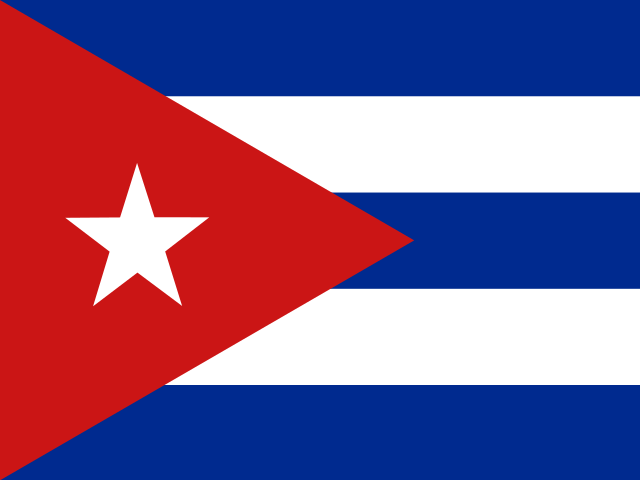
Three blue and two white horizontal stripes with a red equilateral triangle at the hoist bearing a single white five-pointed star. The law of national symbols gives the blue stripes the high aspirations of the country's patriots and the island's colonial-era administrative divisions, the white stripes the purity of its ideals and the virtue of Cubans, the triangle the historical ideals of liberty, equality and fraternity, the red inside it the blood shed in the struggle, and the lone star a free, independent and sovereign republic together with the unity of Cubans.
Cuba FACTS ◢
| Capital | Havana |
|---|---|
| Continent | North America |
| Population | 10,937,203 (2025) |
| Area | 109,884 km² |
| Population density | 100/km² |
| Currency | Cuban peso (CUP) |
| Official language | Spanish |
| Calling code | +53 |
| Internet TLD | .cu |
| Time zone | UTC-05:00 |
| Drives on the | Right |
| ISO codes | CU / CUB |
DID YOU KNOW? ◢
- It's the largest island in the Caribbean by area.
- Its capital, Havana, is famous for classic 1950s American cars still cruising the streets.
- Cuban music styles like son and rumba are among the roots of modern salsa.
- It's known worldwide for hand-rolled cigars made from its tobacco.
Cuba QUICK ANSWERS ◢
What is the capital of Cuba?
The capital of Cuba is Havana.
What is the population of Cuba?
Cuba had a population of 10,937,203 in 2025.
What currency does Cuba use?
Cuba uses the Cuban peso (CUP).
What languages are spoken in Cuba?
The official language of Cuba is Spanish.
Think you know your flags? Play Flag Daily → · Browse all countries →
MORE ON THE FLAG ◢
Cuba's national symbols statute does not stop at measuring the flag. It goes element by element and says what each one stands for, beginning with the lone star, which it gives a free, independent and sovereign republic and the unity of Cubans.
The rest follows the same pattern. The triangle carries the historical ideals of liberty, equality and fraternity, the red inside it the blood shed in the struggle, the white stripes the purity of those ideals and the virtue of Cubans, and the blue stripes the high aspirations of Cuba's patriots together with the island's colonial administrative divisions. So the answer to what the colours mean can be quoted from the statute book rather than inferred from it.
That statute is Ley No. 128, "Ley de los Símbolos Nacionales", the law of national symbols of the Republic of Cuba, passed by the National Assembly of People's Power on 13 July 2019 and published in Gaceta Oficial No. 71 Ordinaria of 19 September 2019. Its Article 6 is the answer to the question people actually type. The Constitution, by contrast, assigns the flag no meaning at all.
So the gloss is real rather than invented. What is easy to miss is that each of Article 6's four clauses carries two ideas rather than one, which means a one-line version of the flag's meaning has to drop half of them. The sections below set every clause out in full.
Key Takeaways
- Cuba's flag meanings are set by statute: Ley No. 128 of 2019, Article 6, assigns a meaning to the star, the triangle, the red inside it, the white stripes and the blue stripes.
- The lone star stands for a free, independent and sovereign republic and for the unity of Cubans. Independence alone is half the clause.
- The statute gives the triangle the ideals of liberty, equality and fraternity. It never uses the word Masonic.
- The law dates the flag's adoption to the Guáimaro Assembly of 11 April 1869, not to 1902, and names no designer.
- Puerto Rico's flag is the same design with the red and blue exchanged, and Puerto Rican law describes it without interpreting it.
| Element | What Ley No. 128 of 2019, art. 6 assigns it | What Villaverde's account assigned it |
|---|---|---|
| The five-pointed lone star | A free, independent and sovereign republic, and the unity of Cubans | A silver star lighting the destiny of the nascent nation |
| The equilateral triangle | The historical ideals of liberty, equality and fraternity | Strength and solidity of the Cuban people's principles |
| The red inside the triangle | The blood shed in the struggle | The union of the Cuban people |
| The two white stripes | The purity of the ideals and the virtue of Cubans | Purity, or republican virtue |
| The three blue stripes | The high aspirations of Cuba's patriots, and the island's colonial-era administrative divisions | The three departments the island was then divided into, and the patriots' high aspirations |
What do the colours on the Cuban flag mean?
The statute answers in four lettered clauses. Article 6 of Ley No. 128 opens "Los elementos que conforman la Bandera Nacional son", the elements that make up the National Flag are, and then works through them.
The star first: "La estrella solitaria de cinco puntas que representa la república libre, independiente y soberana, así como la unidad de los cubanos" - the five-pointed lone star, which represents the free, independent and sovereign republic, as well as the unity of Cubans. Two things, not one. A version that stops at independence has dropped both the sovereignty and the unity of Cubans.
Then the triangle and the red, which the law deliberately separates: "el triángulo equilátero que representa los ideales históricos de libertad, igualdad y fraternidad, el color rojo ubicado dentro del mismo, alude a la sangre derramada en la lucha" - the equilateral triangle, which represents the historical ideals of liberty, equality and fraternity; the red colour located within it alludes to the blood shed in the struggle. The shape carries the ideals. The colour carries the blood. A summary that gives the red triangle a single blended meaning has merged two assignments the statute keeps apart, both of them inside clause (b).
The white next: "las franjas blancas que indican la pureza de los ideales y la virtud de los cubanos" - the white stripes, which indicate the purity of the ideals and the virtue of Cubans.
And the blue, the longest of the four clauses: "las franjas azules que revelan las elevadas y gloriosas aspiraciones de nuestros patriotas y representan la división administrativa de Cuba en el momento en que se diseñó la Bandera Nacional, durante la época colonial" - the blue stripes, which reveal the high and glorious aspirations of our patriots and represent the administrative division of Cuba at the time the National Flag was designed, during the colonial era. The old divisions are there, but they come second. The aspirations come first, so a version that gives only the divisions has dropped the half the statute leads with.
The same four clauses are reproduced word for word in the booklet Los Símbolos Nacionales, published in 2020 by the Sello Editorial Fiscalía de Cuba, the publishing imprint of Cuba's Attorney General's Office, which is a useful independent check that the Gaceta text is being read correctly.
What does the Constitution say about the flag?
Very little, and that is worth knowing before anyone cites it for a colour meaning. The National Assembly's own account of the process records that it approved the text on 22 December 2018 and put it to a popular referendum, held on 24 February 2019, in which 7,848,343 of 8,705,723 registered electors voted, a turnout of 90.15%. The Constitution was proclaimed on 10 April 2019 and published in Gaceta Oficial No. 5 Extraordinaria of that date.
Its Article 2 names the symbols and then hands the subject to ordinary legislation: "Los símbolos nacionales son la bandera de la estrella solitaria, el Himno de Bayamo y el escudo de la palma real", followed by "La ley define las características que los identifican, su uso y conservación" - the law defines the characteristics that identify them, their use and conservation. No colour, no star, no reading of either. The only other constitutional mention is a duty in Article 90(c), on citizens, to "respetar y proteger los símbolos patrios".
That Constitution is still in force. The Gaceta Oficial's own record for it lists a single amending norm, a 2025 law of the National Assembly, and that reform struck the second paragraph of Article 127, the clause reading "Se exige además tener hasta sesenta años de edad para ser elegido en este cargo en un primer período", which set a maximum age of sixty for a first-term candidate for President. Mondelo Tamayo and Mustelier Giro, writing in the Revista de Estudios Jurídicos y Criminológicos, record it as the first reform to the 2019 text, announced on 19 July 2025. Article 2 is untouched. The Gaceta's record for Ley No. 128 lists no amending or repealing norm at all.
Where does the Masonic reading come from?
Not from the statute. Ley No. 128 runs to 82 articles plus two annexes, including a glossary of the terms it uses, and the word Freemasonry appears nowhere in it. The glossary is the telling part: it explains the Phrygian cap on the coat of arms by saying "Se adoptó como símbolo de libertad durante la Revolución francesa" - it was adopted as a symbol of liberty during the French Revolution. Where the law wants to name a provenance, it names one, and the one it names is revolutionary France.
The Masonic claim is real, but it belongs to historians rather than to the state, and it is a claim about the geometry rather than about the three ideals. Avelino Víctor Couceiro Rodríguez set out the chain in a paper to the 24th International Congress of Vexillology in Washington in 2011, working mainly from Emilio Roig de Leuchsenring's Banderas oficiales y revolucionarias de Cuba of 1950. It goes back to Cirilo Villaverde, a fellow exile who wrote the fullest surviving account of the meeting at Teurbe Tolón's house, and who says that as a Freemason López rejected the square and the rectangle for the equilateral triangle. Since flags are usually rectangular, the argument runs, "López, as a Freemason, naturally chose the equilateral triangle, a significantly stronger and meaningful geometric figure". Couceiro adds that Roig recorded the Eighth National Congress of History as holding that the triangle, the lone star and the five stripes together show "an obvious Masonic composition".
So the honest attribution is: the fullest surviving account of the meeting, and a Cuban historical congress, relayed by Havana's first city historian and restated by a vexillologist. That is a respectable pedigree and it is not the law. The version in which the statute's liberty, equality and fraternity is the Masonic content splices two separate arguments together: the shapes are what the Masonic reading is about, and the triad in Cuban law is given no source at all beyond the words "ideales históricos", the historical ideals.
Who designed the Cuban flag, and when?
The design is credited to Narciso López, a general born in Venezuela who had served in the Spanish army before turning against Spain, working with the Cuban writer Miguel Teurbe Tolón, who drew it. Emilia Teurbe Tolón, Miguel's cousin and wife, sewed the first one. Couceiro's account puts all of that in New York in early June 1849, and calls Emilia "the Cuban Betsy Ross".
One detail in that account cuts against the story as it is usually told. The flag first raised on Cuban soil, at Cárdenas on 19 May 1850, was not Emilia's original but a second flag sewn by women in New Orleans. Both survive in Havana, one in the Museum of the Revolution and one in the Capitol. The flag had already been shown publicly on 11 May 1850, at newspaper offices in New York and New Orleans.
The authorship was disputed in its own century. The newspaper La Revolución de Cuba credited Gaspar Betancourt Cisneros on 8 February 1873, and Villaverde answered four days later, by letter from New York, that "the creation of our glorious flag was exclusively the work of the illustrious Narciso López". Villaverde also records where the star came from: someone at the meeting proposed an eye of Providence in the middle of the triangle, and López reached instead for the star on the original flag of Texas.
The earliest recorded gloss is not the statute's, and it is Villaverde's too. He set the design down in a handwritten notebook in 1873, more than twenty years after the event, and it reaches us through Gay-Calbó and Roig. Describing Teurbe Tolón's intention, he has the white standing for "purity or republican virtue", the three blue zones for "the three departments into which the island was then divided", the blue for "the high or heavenly aspirations of the patriots", and then the reading that has since been reversed: "The red triangle by its color represents the union of the Cuban people and by its equilateral shape indicates the strength and solidity of their principles". The star is in that account too, and not as a white one: "In the center of the triangle is a silver star that illuminates with its light the destiny of the nascent nation under republican colors".
Compare that with Article 6 and the two limbs have swapped places. In Villaverde's telling the colour red meant union and the equilateral shape meant strength. In 2019 the shape means liberty, equality and fraternity and the colour means blood. The blood limb is old, though. José Martí printed a version of López's own explanation in his newspaper Patria on 14 July 1894: "From the triangle of red, strength and blood, will come the radiant star: the three blue stripes are the three departments".
Why does Cuban law date the flag to 1869 rather than 1902?
Because Cuba's statute anchors the flag to the war for independence, not to the founding of the republic. Article 5 of Ley No. 128 says "Fue adoptada en la Asamblea de Guáimaro el 11 de abril de 1869", it was adopted at the Guáimaro Assembly on 11 April 1869, and calls it "un emblema de lealtad, honor e inspiración en las luchas por la independencia de Cuba", an emblem of loyalty, honour and inspiration in the struggles for Cuban independence. At Guáimaro the constituent assembly of the republic in arms chose López's flag over the one Carlos Manuel de Céspedes had raised at La Demajagua in 1868. Céspedes's flag is not forgotten: the same statute makes it a symbol of historic importance and keeps it flying beside the national flag at Bayamo and La Demajagua.
The 1902 date belongs to a different instrument. Article 5 of Cuba's 1940 Constitution defined the flag by its maker and by that year: "La Bandera de la República es la de Narciso López, que se izó en la fortaleza del Morro de La Habana el día veinte de mayo de mil novecientos dos, al transmitirse los Poderes públicos al pueblo de Cuba" - the Flag of the Republic is that of Narciso López, which was raised at the fortress of El Morro in Havana on the twentieth of May nineteen hundred and two, when public powers were transferred to the people of Cuba.
Two Cuban instruments, two anchors. Neither is wrong. Guáimaro is when the flag was adopted by a Cuban body; 20 May 1902 is when it first flew over an independent Cuban state. Saying the flag was adopted in 1902 collapses them.
Why does Puerto Rico's flag look like Cuba's in reverse?
Because it was designed that way, by people working in the same movement, and Puerto Rico's own government publishes the minute that records it. The founding meeting of the Sección de Puerto Rico del Partido Revolucionario Cubano was held on 22 December 1895, in the party José Martí had built to fight for Cuban independence and to support Puerto Rico's. The Government of Puerto Rico's flags page dates it and puts the attendance at 59, then quotes the minutes: Juan de Mata Terreforte, a survivor of the Grito de Lares, presented a flag of the same form as Cuba's, "con la diferencia de haber sido invertidos los colores: franjas blancas y triángulo azul en vez de rojo, con la misma estrella blanca solitaria en el centro" - with the difference that the colours had been inverted, white stripes and a blue triangle instead of red, with the same lone white star at the centre.
The Academia Puertorriqueña de Jurisprudencia y Legislación places the meeting at the Chimney Corner Hall on Sixth Avenue at 25th Street and describes what was unveiled as "la misma de Cuba con los colores transpuestos", the same as Cuba's with the colours transposed, under the name Cuba uses for its own: La Bandera de la Estrella Solitaria. The Puerto Rican poet Lola Rodríguez de Tió, who died in Havana, gave the relationship its lasting phrase: two wings of one bird.
The legal texts make the symmetry easy to see. Puerto Rico's flag law, Ley Núm. 1 of 24 July 1952, describes in Section 1 "cinco franjas horizontales alternadas, tres rojas y dos blancas y junto al asta un triángulo equilátero azul con una estrella blanca de cinco puntas" - five alternating horizontal stripes, three red and two white, and beside the staff a blue equilateral triangle with a white five-pointed star. Set that against Cuba's three blue stripes, two white, and red triangle, and the two flags are the same construction with the red and the blue exchanged.
The contrast is in what the two laws do next. Cuba's goes on to Article 6 and interprets every element. Puerto Rico's does not interpret anything: it defines the flag as the one "que tradicionalmente se ha conocido hasta ahora como la bandera puertorriqueña", the one traditionally known until now as the Puerto Rican flag, and never assigns the colours a meaning. It does not even fix their shades, which is why the argument over a pale or a dark blue triangle has never had a legal answer.
What Puerto Rico's government does instead is fill the gap in prose, and the provenance it names is the French Revolution, which is what Cuba's statutory glossary reaches for on a different emblem. Its flags page says that "En ausencia de una explicación de los delegados puertorriqueños reunidos en asamblea el siglo pasado, los tres colores de la bandera y las tres puntas del triángulo representan al igual que en la bandera cubana, los ideales republicanos de libertad, igualdad y fraternidad proclamados en la Revolución Francesa" - in the absence of an explanation from the Puerto Rican delegates who met in assembly in the last century, the flag's three colours and the triangle's three points represent, as on the Cuban flag, the republican ideals of liberty, equality and fraternity proclaimed in the French Revolution. Two governments, the same triad, and neither of them says Freemasonry.
What Cuban law leaves open
Two things, and both are easy to miss because the statute is otherwise precise. The blue is named only by a word. Article 7 calls it "azul turquí", and Annex II repeats "El azul de tres de sus franjas es azul turquí". No shade value appears anywhere in the law, in a text that is willing to specify the coat of arms by golden-rectangle construction.
And the law credits nobody. López, Miguel Teurbe Tolón, Emilia Teurbe Tolón, 1849 and Cárdenas are all absent from Ley No. 128, which reaches back only as far as Guáimaro. The 1940 Constitution did name López. The current statute does not, so the designer's name reaches you from historians, and the meaning of the colours reaches you from the Gaceta Oficial. Worth remembering which is which the next time a flag comes up in Flag Daily.
One sourcing limit is worth declaring. Ley No. 128 repealed the previous statute, Ley No. 42 of 27 December 1983, and its 1988 regulation. The Gaceta Oficial's own site indexes its holdings under the headings "GACETAS OFICIALES (1990-1995)" and "GACETAS DESDE 1996", so the 1983 original cannot be read from its publisher. In the transcription available from the Cuban legal compilation Juriscuba, whose text carries visible scanning errors, the 1983 statute describes the flag geometrically and contains no clause assigning the colours a meaning. That would make Article 6 the newer thing on the page, but the claim rests on a transcription rather than on the Gaceta, and it is offered as such.
Frequently asked questions
Does Cuban law say what the flag's colours mean?
Cuban law answers directly. Under Article 6 of Ley No. 128 of 2019, the white stripes indicate the purity of the ideals and the virtue of Cubans; the blue stripes reveal the high and glorious aspirations of Cuba's patriots and represent the island's administrative divisions at the time the flag was designed, in the colonial period; and the red inside the triangle alludes to the blood shed in the struggle.
Each of those clauses carries two ideas rather than one, and in the blue clause the aspirations come first, ahead of the administrative divisions.
What does the star on the Cuban flag represent?
More than independence. Article 6(a) of Ley No. 128 gives the five-pointed lone star two meanings at once: the free, independent and sovereign republic, and the unity of Cubans. A summary that stops at independence has dropped the sovereignty and the unity.
The number of points is fixed by law as well: Article 6(a) calls it a five-pointed star, and Article 7 repeats the count in the description of the triangle.
Is the triangle on the Cuban flag a Masonic symbol?
Not in Cuban law, which never mentions Freemasonry, though historians do argue the case for the geometry. Ley No. 128 gives the equilateral triangle "los ideales históricos de libertad, igualdad y fraternidad", the historical ideals of liberty, equality and fraternity, and names no source for them; where the statute does trace an emblem, in the glossary entry for the Phrygian cap on the coat of arms, it points to the French Revolution.
The Masonic reading is an argument about the shapes rather than about the three ideals. It goes back to Cirilo Villaverde's account of the meeting at which the design was settled, and to a Cuban historical congress recorded by Emilio Roig de Leuchsenring in 1950.
Was Narciso López the designer of the Cuban flag?
He is the figure the design is credited to, with Miguel Teurbe Tolón drawing it and Emilia Teurbe Tolón sewing the first one, in New York in 1849 by the fullest published account. The claim was contested in 1873, when a New York newspaper credited Gaspar Betancourt Cisneros and Cirilo Villaverde replied that the flag was exclusively López's work.
None of those names appears in the statute that governs the flag today. Cuba's 1940 Constitution did name López; Ley No. 128 of 2019 credits nobody.
Which flag came first, Cuba's or Puerto Rico's?
Cuba's, by 46 years. The Cuban design is dated to 1849 and first flew at Cárdenas in 1850, while the Government of Puerto Rico's own flags page dates the Puerto Rican design to the founding meeting of the Puerto Rican Section of the Cuban Revolutionary Party in New York on 22 December 1895, whose minutes record a flag of the same form as Cuba's with the colours inverted, white stripes and a blue triangle in place of red.
Puerto Rico's Ley Núm. 1 of 1952 describes the result: three red stripes, two white, and a blue equilateral triangle carrying a white five-pointed star. The laws diverge where the designs agree, because that statute defines the flag by tradition, assigns the colours no meaning and fixes no shades, where Cuba's interprets every element.
Sources
- Asamblea Nacional del Poder Popular, Ley No. 128 "Ley de los Símbolos Nacionales", Gaceta Oficial No. 71 Ordinaria of 19 September 2019 - copy published by Cuba's Ministry of Foreign Affairs, retrieved 13 August 2026.
- Gaceta Oficial de la República de Cuba, norma record for Ley 128 de 2019 - retrieved 13 August 2026.
- Asamblea Nacional del Poder Popular, Constitución de 2019 - the National Assembly's own account, carrying the 22 December 2018 approval, the 24 February 2019 referendum and its turnout - retrieved 13 August 2026.
- Asamblea Nacional del Poder Popular, Constitución de la República de Cuba, proclaimed 10 April 2019 - retrieved 13 August 2026.
- Gaceta Oficial de la República de Cuba, norma record for the Constitución de 2019 - retrieved 13 August 2026.
- Fiscalía General de la República de Cuba, Los Símbolos Nacionales, Sello Editorial Fiscalía de Cuba, 2020 - retrieved 13 August 2026.
- Political Database of the Americas, Georgetown University, Cuba: Constitución de 1940, art. 5 - retrieved 13 August 2026.
- Avelino Víctor Couceiro Rodríguez, That Cuban Flag... The Original, Proceedings of the 24th International Congress of Vexillology, Washington DC, 2011, published by the North American Vexillological Association - retrieved 13 August 2026.
- Oficina de Gerencia y Presupuesto de Puerto Rico, Ley de la Bandera del Estado Libre Asociado de Puerto Rico, Ley Núm. 1 de 24 de julio de 1952 - retrieved 13 August 2026.
- Gobierno de Puerto Rico, Banderas y Escudo - quotes the minutes of the 22 December 1895 meeting and gives the government's own reading of the colours - retrieved 13 August 2026.
- Academia Puertorriqueña de Jurisprudencia y Legislación, Los orígenes políticos de nuestra bandera - retrieved 13 August 2026.
- J. O. Mondelo Tamayo and A. Mustelier Giro, Primera reforma a la Constitución cubana de 2019: eliminación del requisito de edad máxima para la Presidencia de la República, Revista de Estudios Jurídicos y Criminológicos, no. 13 (2026), 445-468 - retrieved 13 August 2026.
- Juriscuba, Ley No. 42 "De los Símbolos Nacionales" of 27 December 1983 - transcription with visible scanning errors, retrieved 13 August 2026.
PLAY ANOTHER →
Three clues, three guesses. Work out where in the world it is.
THREE CLUESDAILYDaily CodeA short message, hidden in a different cipher every day.
ONE CIPHER A DAYDAILYDaily TriviaFive questions a day. Everyone gets the same five.
FIVE QUESTIONSDAILYOn This DayOne thing that happened today in history. Every day, a new one.
TODAY IN HISTORY