
Venezuela
A South American country of Caribbean coastline and Amazon rainforest, Venezuela is home to Angel Falls, the highest uninterrupted waterfall on the planet.
WHAT THE FLAG MEANS ◢
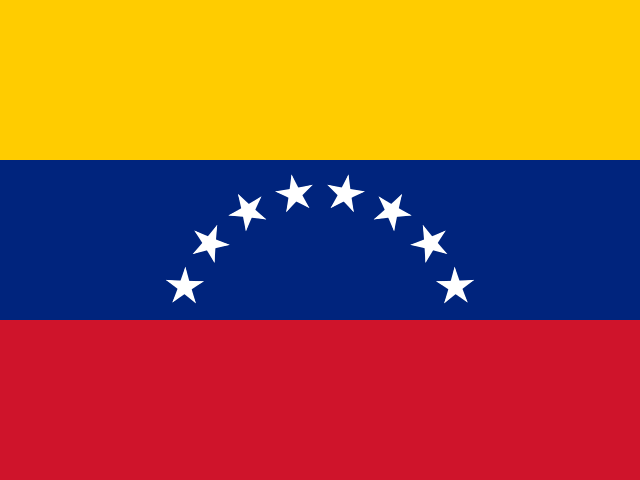
Three equal horizontal bands of yellow, blue and red, with an arc of eight white stars on the blue band. Article 8 of the constitution names the flag by its three colours and then does something unusual: it reserves the characteristics, the meaning and the use of the national symbols to ordinary law. The law that answers it, passed in 2006, describes the flag without interpreting any part of it. The colours are conventionally read as yellow for the wealth of the land, blue for the sea that separated it from Spain and red for the blood of independence. The eighth star was decreed for Guayana in 1817 and restored to the flag in 2006.
Source: oas.org · checked 2026-08-21
Venezuela FACTS ◢
| Capital | Caracas |
|---|---|
| Continent | South America |
| Population | 28,516,896 (2025) |
| Area | 912,050 km² |
| Population density | 31/km² |
| Currency | Sovereign bolivar (VES) |
| Official language | Spanish |
| Calling code | +58 |
| Internet TLD | .ve |
| Time zone | UTC-04:00 |
| Drives on the | Right |
| ISO codes | VE / VEN |
DID YOU KNOW? ◢
- Angel Falls, plunging around 979 metres, is the world's tallest uninterrupted waterfall.
- Its flat-topped 'tepui' mountains helped inspire Arthur Conan Doyle's 'The Lost World'.
- Lake Maracaibo hosts Catatumbo lightning, a spot with some of the most frequent lightning on Earth.
- It sits on some of the largest proven oil reserves of any country in the world.
Venezuela QUICK ANSWERS ◢
What is the capital of Venezuela?
The capital of Venezuela is Caracas.
What is the population of Venezuela?
Venezuela had a population of 28,516,896 in 2025.
What currency does Venezuela use?
Venezuela uses the Sovereign bolivar (VES).
What languages are spoken in Venezuela?
The official language of Venezuela is Spanish.
Think you know your flags? Play Flag Daily → · Browse all countries →
MORE ON THE FLAG ◢
The law that article 8 of Venezuela's constitution promises arrived in 2006. It is still the instrument in force, and it assigns a meaning to a sheaf of grain, to a sword and a lance, to a white horse and to two cornucopias. It assigns none to yellow, to blue, to red, or to the eight stars.
Those four coat-of-arms meanings are not new. Three of them are word for word what the law of 1954 already said, forty-five years before the constitution that asked for meanings at all. So the asymmetry is older than the instruction, and the 2006 legislature had the article open, edited it, and carried the asymmetry through unchanged. Only one element of the flag is explained by any of the instruments cited on this page, and the explanation is two centuries old.
Key Takeaways
- Article 8 of the 1999 constitution names the flag's three colours and then delegates: "La ley regulará sus características, significados y usos." Meaning is expressly the legislature's job, not the constitution's.
- The law that answers article 8 is the Ley de Bandera Nacional, Himno Nacional y Escudo de Armas, Gaceta Oficial N. 38.394 of 9 March 2006. Its article 3 defines the flag in terms of colour, order, stripe count and star geometry, and assigns no meaning to any of it.
- Article 8 of the Ley de Bandera Nacional interprets the coat of arms four times over: the sheaf is a symbol of union and wealth, the weapons an emblem of triumph, the white horse an emblem of independence and liberty, the cornucopias a symbol of abundance. Three of the four are inherited word for word from the 1954 law it repealed.
- The one element of the flag any Venezuelan instrument has been found to explain is the eighth star, and the explanation is an 1817 decree of Bolívar: it is added "como emblema de la Provincia de Guayana".
- The 2006 law's fourth transitional provision ordered a regulation of the flag's form and dimensions within six months. Two Supreme Tribunal decisions in 2010 record an applicant's assertion that it had not been made, and neither court contradicted it; a reform of the law has sat between its first and second readings since October 2024.
| Instrument | Date | What it does about the flag | Meaning it assigns to a flag element |
|---|---|---|---|
| Bolívar's decree at Angostura | Decreed 20 November 1817 | Adds an eighth star to the seven | The eighth star, for the Province of Guayana |
| Ley Fundamental de la República de Colombia, art. 10 | Decreed 17 December 1819 | Defers the new republic's own arms and flag to a future congress, adopting Venezuela's meanwhile | None |
| Ley de Bandera, Escudo e Himno Nacionales | Published 17 February 1954 | Three stripes; seven stars on the state and merchant flags only | None |
| Constitution of the Bolivarian Republic of Venezuela, art. 8 | Published 30 December 1999 | Names the three colours, delegates meaning to ordinary law | None |
| Ley de Bandera Nacional, Himno Nacional y Escudo de Armas, art. 3 | Published 9 March 2006 | Three stripes and eight stars in the base definition; coat of arms on the state flag, stars alone on the merchant flag | None |
Article 8 of the 1999 constitution hands the question to the legislature
Article 8 of the Constitution of the Bolivarian Republic of Venezuela, published in Gaceta Oficial Extraordinaria N. 36.860 on 30 December 1999, is two sentences long. The first is an inventory: "La bandera nacional con los colores amarillo, azul y rojo; el himno nacional Gloria al bravo pueblo y el escudo de armas de la República son los símbolos de la patria." The national flag with the colours yellow, blue and red, the national anthem Gloria al bravo pueblo and the coat of arms of the Republic are the symbols of the homeland.
The second sentence is the interesting one, and it is eight words: "La ley regulará sus características, significados y usos." The law shall regulate their characteristics, meanings and uses.
Read that against almost any other constitution and the difference is sharp. A constitution that describes a flag and stops has left meaning unaddressed. A constitution that names meaning as one of three things a statute must regulate has decided an official meaning is something the state should have, and has said where to look for it. The question of what Venezuela's flag means is not open in the way it is open for most countries. It has an address.
What Venezuela's 2006 flag law says, and what it leaves alone
The law that address points to is the Ley de Bandera Nacional, Himno Nacional y Escudo de Armas de la República Bolivariana de Venezuela, published in Gaceta Oficial N. 38.394 on 9 March 2006. Seventeen articles, seven transitional provisions, one repeal, one final provision.
Its article 3 is the flag. It opens by pointing backwards, saying the flag "se inspira en la que adoptó el Congreso de la República en 1811", it looks to the one the Congress of the Republic adopted in 1811. Then it becomes a specification: the colours yellow, blue and red in joined, equal, horizontal bands in the order stated from top to bottom, and, in the middle of the blue, "ocho estrellas blancas de cinco puntas, colocadas en arco de círculo con la convexidad hacia arriba". Eight white five-pointed stars set in an arc of a circle with the convexity upwards.
Colour, order, count, points, curve, and which way the curve bends. Nothing in the article says what any of it stands for.
Now read article 8 of the same 2006 law, on the coat of arms, and the contrast is not subtle. The sheaf of grain carries as many ears as the Republic has states, "como símbolo de la unión y de la riqueza de la Nación". The sword, lance, bow, arrow, quiver, machete and two national flags entwined by a laurel wreath appear "como emblema del triunfo". The untamed white horse gallops to the observer's left and looks ahead, "emblema de la independencia y de la libertad". The two cornucopias are there "como símbolo de la abundancia".
Four interpretive clauses in one article, and five articles earlier the flag with none.
The 2006 legislature did not write those four clauses, and that makes the asymmetry older and harder than it looks. Article 9 of the 1954 law already carried all of them, forty-five years before the constitution that asked for meanings. Three survive word for word: "como emblema del triunfo", "emblema de la independencia y de la libertad", "como símbolo de la abundancia".
The fourth was not trimmed so much as relocated, and where it went is the interesting part. In 1954 the sheaf stood "como símbolo de la unión de los Estados de la República y de la riqueza de la Nación". In 2006 the States come out of the meaning and reappear a few words earlier as a counting rule, the sheaf carrying "tantas espigas como estados tenga la República Bolivariana de Venezuela" and standing only "como símbolo de la unión y de la riqueza de la Nación". The States stopped being part of what the sheaf meant and became something you could count, which is the posture article 3 keeps for the whole flag.
The 2006 drafters were plainly working on article 8 of their own law. They enumerated weapons the 1954 text had left as "armas", turned the cornucopias horizontal and filled them with tropical fruit and flowers, described the quarters from the observer's side rather than the shield's, and specified the horse by reference to the Federation coat of arms of 29 July 1863. So they had it open, they changed it, and they left three of the four interpretive clauses untouched. Then they left article 3 bare, under a constitution that had since told them to regulate the meanings of the national symbols.
The eighth star, and the 1817 decree that explains it
There is one exception among the instruments cited on this page, and it is nearly two centuries older than the law.
On 20 November 1817, at the government palace in Angostura, Simón Bolívar decreed that the flag would gain a star. The operative article is one sentence: "A las siete estrellas que lleva la Bandera nacional de Venezuela se añadirá una, como emblema de la Provincia de Guayana, de modo que el número de las estrellas será en adelante el de ocho." To the seven stars the national flag of Venezuela carries, one will be added, as an emblem of the Province of Guayana, so that the number of stars will from then on be eight.
The reason given in the preamble is administrative rather than symbolic: the number of provinces making up the Republic had increased by the incorporation of Guayana, decreed on 15 October.
The document is held in the Venezuelan state's own Archivo del Libertador, and the archive's note on it is worth reading beside it. The entry is a copybook copy at volume 23, folios 214v and 215, written in the hand of Pedro Briceño Méndez, and its note ends "No consta la firma y rúbrica de Bolívar", Bolívar's signature and rubric do not appear on it. A marginal note in the same hand gives the subject: "Sobre el Pabellón Nacional". The Ministry of Culture's page on the anniversary says Bolívar signed the order. The archive that holds it says the copy in its custody is unsigned.
The archive also identifies the seven stars the decree was adding to. They are the seven provinces that sent representatives to the Congress of 1811 and swore independence: Caracas, Cumaná, Barcelona, Margarita, Barinas, Trujillo and Mérida.
That is the entire symbolism these instruments document. One star, one province, one decree, 1817.
How 2006 restructured the flag, and restored a star lost in 1821
The eighth star lasted four years. The Ministry of Culture and the finance ministry both date its repeal to 4 October 1821 at the Congress of Cúcuta, the constituent congress of Gran Colombia, the union that came to include what are now Colombia and Ecuador. Venezuela's flag returned to seven stars after that union broke up.
So the 2006 law restored the eighth. What is easier to miss is the second change in the same article 3 sentence that restored it, which is structural rather than numerical.
Under the 1954 law, published in Gaceta Oficial N. 24.371 on 17 February 1954, the National Flag as defined had no stars at all. Its article 2 opens: the National Flag is the one the Congress of the Republic adopted in 1811, "formada por los colores amarillo, azul y rojo, en franjas unidas, iguales y horizontales, en el orden que queda expresado, de superior a inferior". Stars appear nowhere in that sentence. They arrive only in the next paragraph, and only on two other flags: the one flown by the Presidency, the armed forces and public buildings, which carries the coat of arms near the hoist and seven stars on the blue, and the merchant marine's, which "sólo llevará las siete estrellas", carries only the seven stars.
The 2006 article 3 moves the stars into the base definition. Every Venezuelan flag now has eight of them by law, and the state version is distinguished by the coat of arms alone. The merchant marine sentence survives almost word for word, with "ocho" where the 1954 text had "siete".
No regulation of Venezuela's flag proportions was found in any instrument traced here
The 2006 law knew it was incomplete. Its fourth transitional provision authorises the executive, through the Ministry of Interior and Justice, "para reglamentar la forma, dimensiones y usos de todos los Símbolos Patrios, Bandera Nacional, Escudo de Armas e Himno Nacional", and sets a deadline: the regulation "deberá ser dictado dentro de los seis meses siguientes a la publicación de esta Ley".
That was a real expansion. The 1954 law's equivalent, its article 3, only ever authorised the executive to regulate the form and dimensions of "los estandartes, emblemas e insignias que lleven los colores de la Bandera Nacional", the standards, emblems and insignia carrying the flag's colours. Not the flag. The 2006 drafters added the flag itself to the list of things somebody was supposed to specify.
Six months came and went. In 2010 two chambers of the Supreme Tribunal of Justice heard an application to interpret the law, brought by a body that had been told its use of the flag and coat of arms was improper. Both decisions record the applicant's position in near-identical terms, the Sala Constitucional putting it as the law leaving the conditions of use to the regulation, "Reglamento que aún no ha sido dictado", a regulation that has still not been made. Neither court contradicted it. Neither, in its own voice, said the regulation existed.
Nor is one printed in the place you would expect to find it. The Biblioteca Nacional de Venezuela's edition of the 1954 law reprints every instrument the national library thought worth binding with it: Decreto N. 1.048 of 1963, making 12 March the national flag day, a 1963 resolution requiring every new building in the country to carry a flagpole "no menor de tres metros de longitud y diez centímetros de diámetro en su pie", a 1975 decree putting a flag over every primary and secondary school, and a 1975 resolution setting out the school ceremonial minute by minute. Between them they regulate when the flag flies, where the pole goes and what the children sing. None of them says how wide the flag is or what shade of blue it is.
The foreign ministry's page on the flag says as much outright: "Las proporciones totales, la forma del arco de estrellas y los colores exactos de la bandera venezolana no han sido exactamente definidos de manera oficial y varían mucho popularmente." Treat that page as an echo rather than as testimony. Two of its passages sit in older revisions of the Spanish Wikipedia article on the flag, the proportions sentence differing from a 2024 revision by one word and a long 1819 speech appearing in a 2020 one, while the ministry page itself carries a byline date of 12 February 2026. The page is good evidence that the claim circulates unchallenged on a Venezuelan government domain, and no more than that. The instruments are what make it true.
The reform that might have settled some of this is stalled. On 15 October 2024 the National Assembly approved, in first discussion, a reform of the 2006 law, which its sponsor described as having fourteen articles where the text in the Gaceta has seventeen. He proposed four further articles of punitive scope, plus two more: one on the procedure for imposing sanctions, making the law its own regulation as he put it, and one guaranteeing a right of defence. Whether that was aimed at the gap left by the missing regulation is an inference, and not something the report says. A week later, on 22 October, the second discussion was deferred at a deputy's request, and it has not been taken since.
Where the yellow, blue and red reading comes from
Yellow for the country's gold and fertile land, blue for the Caribbean that separates it from Spain, red for the blood spilled in the war of independence. That reading is everywhere, and it is not in the constitution, not in the 2006 law, not in the 1954 law it repealed, and not in Bolívar's decree.
The version cited on this page that reaches furthest back is a speech attributed to Francisco Antonio Zea and dated 17 December 1819, in which the first band is yellow for the peoples who want federation, the second blue for the ocean that divides them from Spain's yoke, and the third red for a promise to drown slavery in their own blood before accepting it. The Venezuelan foreign ministry's flag page prints it. So does the Spanish Wikipedia article on the flag, which carried the same passage in 2020 with citations to three twentieth-century Colombian heraldic histories, none of them opened here. One of those citations heads the passage as Zea partially describing the flag that was still to be adopted, which is a different thing from an account of the flag Venezuela already had.
The contemporary record of that date says nothing about colours, and it says why the flag was an open question. On 17 December 1819 the Sovereign Congress of Venezuela at Angostura enacted the Ley Fundamental de la República de Colombia, creating Gran Colombia. Zea signed it as President of the Congress and Bolívar put the ejecútese on it the same day. Its article 10 leaves the new republic's arms and flag to a congress that had not yet met: "Las Armas y el Pabellón de Colombia se decretarán por el Congreso General, sirviéndose entretanto de las Armas y Pabellón de Venezuela por ser más conocido". Colombia's arms and flag will be decreed by the General Congress, using Venezuela's in the meantime because it is better known. Recognisability, and nothing about meaning.
Article 8 of the Ley Fundamental names the congress that article 10 was deferring to: one that would meet on 1 January 1821 at the Villa del Rosario de Cúcuta. That is the congress which, on 4 October 1821, repealed the eighth star.
The speech is not in the government's own newspaper as the run has been searched here. The Correo del Orinoco printed the Ley Fundamental in full in its issue of 18 December 1819, the day after the sitting, and none of the paper's run from 1818 to 1822 carries the speech's distinctive phrases. That is a bounded negative rather than a verdict, since the run was searched as scanned text and its optical character recognition is imperfect, but it is what a search of the obvious place returns.
Frequently asked questions
Does Venezuelan law say what the colours of the flag mean?
No. The Ley de Bandera Nacional, Himno Nacional y Escudo de Armas of 2006, which is the law in force, describes the flag in its article 3 as a specification: three joined equal horizontal bands of yellow, blue and red from top to bottom, with eight white five-pointed stars in an upward-convex arc on the blue. It assigns no meaning to any colour. Neither did the 1954 law it repealed, which was not interpretively silent in general: its article 9 gave the coat of arms four meanings that the 2006 law carried forward.
Why does Venezuela's flag have eight stars?
Because the seven stars the flag then carried stood, per the Archivo del Libertador's note on the decree, for the seven provinces that sent representatives to the Congress of 1811, and Bolívar added an eighth. His decree of 20 November 1817 orders that a star be added to the seven "como emblema de la Provincia de Guayana", as an emblem of the Province of Guayana, making the number eight thereafter. The eighth was dropped in 1821, when the Congress of Cúcuta repealed the decree, and restored by the 2006 law.
When did Venezuela change from seven stars to eight?
The current eight-star flag dates from the law published in the Gaceta Oficial on 9 March 2006, which repealed the 1954 law, under which the National Flag as defined carried no stars at all and seven appeared only on the state and merchant flags. That was a restoration rather than an invention: the eighth star had been decreed in 1817 and lost in 1821.
What are the official colours of Venezuela's flag?
Yellow, blue and red, in joined equal horizontal bands from top to bottom. Article 8 of the 1999 constitution names them and article 3 of the 2006 law arranges them. What no Venezuelan instrument cited on this page gives is a shade, a colour standard reference or a set of proportions. The 2006 law's own fourth transitional provision ordered a Reglamento covering the flag's form, dimensions and uses. Two 2010 Supreme Tribunal decisions record an applicant saying that Reglamento had not been made, and neither court contradicted it.
Is the Venezuelan state flag different from the one civilians fly?
Yes, in one respect. Under article 3 of the 2006 law, the flag used by the Presidency and the armed forces, and flown on national, state and municipal public buildings, carries the coat of arms at the end of the yellow band nearest the staff. There are two designs, not three: the merchant marine's flag and the one everyone else flies are the same plain eight-star tricolour, which is all the law means when it says the merchant flag carries only the eight stars. Under the 1954 law that sentence did real work, because the flag as then defined carried no stars at all.
Sources
- Constitución de la República Bolivariana de Venezuela, Gaceta Oficial Extraordinaria N. 36.860 of 30 December 1999, article 8. Spanish text hosted by the Organization of American States. Retrieved 21 August 2026.
- Ley de Bandera Nacional, Himno Nacional y Escudo de Armas de la República Bolivariana de Venezuela, Gaceta Oficial N. 38.394 of 9 March 2006, articles 3 and 8 and the fourth transitional provision. Justia Venezuela. Cross-checked against five further independent transcriptions and against the passages quoted in the Supreme Tribunal decisions cited here. Retrieved 21 August 2026.
- Ley de Bandera, Escudo e Himno Nacionales, Gaceta Oficial N. 24.371 of 17 February 1954, with Decreto N. 1.048 of 1963, Resolución N. 23 of 1963, Decreto N. 743 of 1975 and Resolución N. 37 of 1975. Biblioteca Nacional de Venezuela, Publicaciones Oficiales. Articles 2 to 4 were transcribed by eye from the page images; article 9 was cross-checked against an independent transcription of the same instrument. Retrieved 21 August 2026.
- Documento 2409, Archivo del Libertador, the decree of 20 November 1817 adding an eighth star, with the archive's note on the copybook entry at volume 23, folios 214v and 215. Retrieved 21 August 2026.
- Documento 3970, Archivo del Libertador, the Ley Fundamental de la República de Colombia of 17 December 1819 with Bolívar's ejecútese, articles 8 and 10. Cross-checked against the Biblioteca Virtual Miguel de Cervantes transcription of the same instrument. Retrieved 21 August 2026.
- Sala Político-Administrativa, Tribunal Supremo de Justicia, decision N. 00393 of 12 May 2010, and Sala Constitucional decision N. 19 of 5 March 2010, both on an application to interpret the 2006 law. Retrieved 21 August 2026.
- La Bandera Nacional de la República Bolivariana de Venezuela, Ministerio del Poder Popular para Relaciones Exteriores, byline date 12 February 2026. Retrieved 21 August 2026.
- 20 de noviembre de 1817: Simón Bolívar decreta la octava estrella en la bandera, Ministerio del Poder Popular para la Cultura, and the equivalent notice from the Ministerio del Poder Popular de Economía y Finanzas, 20 November 2022. Retrieved 21 August 2026.
- Asamblea Nacional aprueba reformar ley sobre los símbolos patrios, 15 October 2024; Comisión de Política Interior prepara consulta pública para reformar Ley de Símbolos Patrios, 16 October 2024; and AN difiere segunda discusión de reforma de la ley sobre símbolos patrios, 22 October 2024. Asamblea Nacional de la República Bolivariana de Venezuela. Retrieved 21 August 2026.
- Spanish Wikipedia, "Bandera de Venezuela", cited as documentary evidence of what that page carried on a date rather than as an authority on the flag: the revision of 5 January 2020, which carries the Zea passage with its three book citations, and the revision of 6 January 2024, which carries the proportions sentence. Retrieved 21 August 2026.
- Correo del Orinoco, 1818 to 1822, the collected run of the Angostura government newspaper, the whole run searched as scanned text. Internet Archive. Retrieved 21 August 2026.
PLAY ANOTHER →
One thing that happened today in history. Every day, a new one.
TODAY IN HISTORYDAILYDaily TriviaFive questions a day. Everyone gets the same five.
FIVE QUESTIONSDAILYGuess the CountryThree clues, three guesses. Work out where in the world it is.
THREE CLUESDAILYDaily CodeA short message, hidden in a different cipher every day.
ONE CIPHER A DAY