
Colombia
Perched at South America's northwest corner with coasts on two oceans, Colombia grows some of the world's most prized coffee and is one of the most biodiverse nations on the planet.
WHAT THE FLAG MEANS ◢
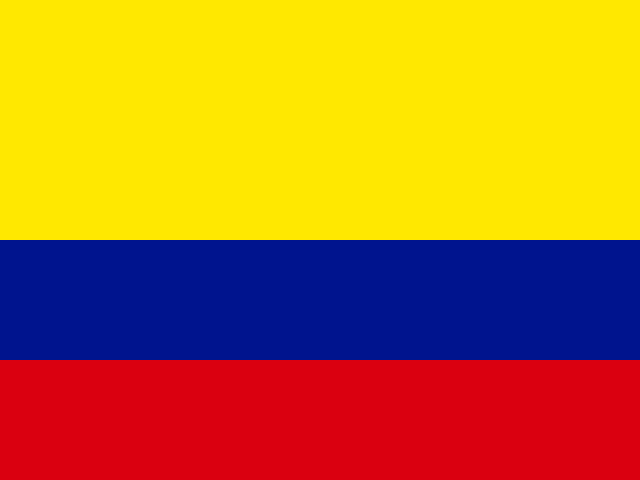
Three horizontal bands with yellow on top taking up half the flag, then blue and red each a quarter. No Colombian law gives the colours a meaning; by popular tradition yellow stands for the riches of the land, blue for the two oceans the country borders, and red for the struggle for independence.
Colombia FACTS ◢
| Capital | Bogotá |
|---|---|
| Continent | South America |
| Population | 53,425,635 (2025) |
| Area | 1,141,748 km² |
| Population density | 47/km² |
| Currency | Colombian peso (COP) |
| Official language | Spanish |
| Calling code | +57 |
| Internet TLD | .co |
| Time zone | UTC-05:00 |
| Drives on the | Right |
| ISO codes | CO / COL |
DID YOU KNOW? ◢
- It's one of the most biodiverse countries on Earth and home to more bird species than any other nation.
- It's the only South American country with coastlines on two oceans, the Pacific and the Atlantic.
- The Amazon rainforest covers a large part of its south.
- Author Gabriel García Márquez, a Nobel laureate and pioneer of magical realism, was Colombian.
Colombia QUICK ANSWERS ◢
What is the capital of Colombia?
The capital of Colombia is Bogotá.
What is the population of Colombia?
Colombia had a population of 53,425,635 in 2025.
What currency does Colombia use?
Colombia uses the Colombian peso (COP).
What languages are spoken in Colombia?
The official language of Colombia is Spanish.
Think you know your flags? Play Flag Daily → · Browse all countries →
MORE ON THE FLAG ◢
Colombia's flag is the easiest tricolour in South America to recognise and the hardest to explain. The yellow band is not a third of it. It is a half, with blue and red splitting what is left, and that ratio has been fixed in Colombian law since 1861.
What has never been fixed in Colombian law is what any of the three colours stands for. Not in the Constitution of 1991, which does not mention the flag at all. Not in Ley 12 de 1984, the only act of Congress in force that adopts it. Not in the decree or the law that governs how it is flown.
The meanings taught in every Colombian classroom are real and worth knowing. They are simply not law, and the bodies publishing them are more candid about that than you would expect.
Key Takeaways
- Ley 12 de 1984 is the only act of Congress in force that adopts the flag. It gives the bands and their widths and assigns no colour a meaning.
- The Constitution of 1991 never mentions the flag, the coat of arms or the anthem.
- The half-width yellow band comes from a decree of 26 November 1861 and has survived every rewrite since.
- The statute Ley 12 replaced, from 1834, prescribed a vertical tricolour with red against the flagpole.
- Only the President and the armed forces may fly the version carrying the coat of arms, and since 1995 the plain flag must fly permanently at every public building and school.
| The instrument | Date | What it says about the flag |
|---|---|---|
| Ley of 9 May 1834 | 9 May 1834 | A vertical tricolour, equal thirds, red at the hoist |
| Decree on the arms and the national flag | 26 November 1861 | Horizontal, yellow taking half, then blue, then red |
| Decreto 861 | 17 May 1924, per two records; 1934 per a third | The same ratio, plus the war and merchant flags |
| Ley 28 de 1925 | 16 February 1925 | Flag Day on 7 August, and nothing on the design |
| Decreto 62, articles 209 and 210 | 11 January 1934 | Flags on public buildings carry no coat of arms |
| Ley 12 de 1984 | 29 February 1984 | The bands and widths, and no colour meanings |
| Decreto 1967 de 1991 | 15 August 1991 | Twenty articles on flying it, none on meaning |
| Ley 198 de 1995 | 17 July 1995 | Permanent hoisting at public buildings and schools |
Who says what the Colombian flag's colours mean?
No Colombian law does. Two state bodies do, in much the same terms, and on the red they do not agree with each other.
Marca País, Colombia's national branding platform, gives the classroom version in a single line: yellow is "la abundancia y riqueza natural del país", the abundance and natural riches of the country; blue the oceans that join Colombia to the rest of the world; red the struggle of the heroes of independence.
Señal Colombia, the state public broadcaster, is unusually frank about the status of all that. Meanings are attached to national symbols, it says, "con el fin de crear un discurso unificador", to create a unifying discourse, and the nation's historians and narrative-makers "han hecho consensos sobre la interpretación de los colores". A consensus arrived at, not a rule handed down.
Its own version then corrects the most-repeated reading of the lot. Red stands for blood, the broadcaster writes, "pero no la sangre que derrama el odio sino la que alimenta el corazón": not the blood spilled by hatred but the blood that feeds the heart, meaning love, power, strength and progress. Two state publishers, two different reds, and nothing adjudicating between them.
Does Colombian law give the colours a meaning?
No, and the search is short, because there are few places to look.
The Constitución Política of 1991 is the fastest. In the official text published by the Presidency and by the Departamento Administrativo de la Función Pública, the words bandera, pabellón, escudo, himno and emblema do not appear once. Colombia's founding document is silent on its own flag.
Ley 12 de 1984 is the act of Congress that adopts the three national symbols, and its second article is the whole of what it says about the design: the colours run "en tres fajas horizontales de las cuales el amarillo, colocado en la parte superior, tendrá un ancho igual a la mitad de la Bandera", with the other two taking a quarter each and blue in the centre. Widths, order, nothing else.
Article 3 is the tell. Describing the coat of arms, the drafters did state a symbolic reading: the lower band is "representativa de la privilegiada situación geográfica del país". They were willing to write a meaning down where they had one, and they wrote exactly one. It was not about a colour.
Decreto 1967 de 1991, the regulation in force, then spends twenty articles on how the flag must be treated and none of them on what it means. The parágrafo to its first article specifies the mourning ribbon: black crepe, its hanging ends half the width of the flag.
Why is the yellow band half of Colombia's flag?
Because a provisional president settled the proportion in 1861 and nobody has moved it since.
Tomás Cipriano de Mosquera issued the decree on 26 November 1861, the day the flags of the country's predecessor states were abolished. Bogotá's city archive quotes its second article: the colours are "distribuidos en fajas horizontales y ocupando el amarillo la mitad del pabellón nacional, en su parte superior", with the remaining half split equally, blue in the centre and red at the bottom.
What it replaced is the surprising part. The exposición de motivos published with Ley 198 de 1995 quotes the sixth article of the Ley of 9 May 1834, which gave the national colours of the Nueva Granada as "rojo, azul y amarillo", arranged "en tres divisiones verticales de igual magnitud, la más inmediata al asta, roja": equal vertical divisions, red nearest the flagpole. In other words a vertical flag, in the reverse order, in equal thirds.
That statute stayed on the books for another one hundred and twenty-three years after the flag stopped matching it, and the same legislative record is blunt about the gap. Congress "ha sido parco, por no decir mezquino, en legislar sobre este tema", sparing to the point of meanness in legislating on the subject, and "el pabellón que nos distingue no ha sido decretada [sic] por el Congreso, sino por el Gobierno": the flag was decreed not by Congress but by the government, resting on "una sana tradición patriótica" rather than on pure legal foundations. Ley 12 de 1984 substituted the 1834 statute at last, in its seventh article.
Where did Colombia's yellow, blue and red come from?
Nobody knows, and Colombia's own broadcaster says so.
The tricolour is older than the country. Bogotá's city archive records that Francisco de Miranda first flew it from his brigantine, which it names the Leandro, on 12 March 1806, as he prepared to attack the Venezuelan town of Coro. Bolívar then carried it into the war: the legislative record behind Ley 12 de 1984 notes that by his own order to the Governor of Margarita Island, dated 28 October 1813, he "adoptó el tricolor de Colombia, Ecuador y Venezuela". That shared adoption is why Venezuela and Ecuador still fly the same three colours in the same order.
Why those three is unanswered. Señal Colombia states flatly that "no se sabe a ciencia cierta el motivo por el que Francisco de Miranda los eligió". Bogotá's archive repeats one romantic answer, that Miranda took yellow for Catherine the Great's hair, blue for her eyes and red for her lips, and introduces it with "Hay quienes afirman", there are those who claim. The historian Roberto Velandia Rodríguez, quoted by the broadcaster from his work for the Banco de la República, refused the genre outright: stop "fantaseando con anécdotas de alcoba", he wrote, when the three are ordinary heraldic colours to begin with.
The earliest recorded meaning is stranger than the modern one. Señal Colombia quotes Francisco Antonio Zea at the Congress of Angostura in 1819: yellow "para significar a los pueblos que queremos y amamos la federación", to signify that we want and love federation; blue as "color de los mares", to show Spain's despots that the ocean divides Colombia from their yoke; and red so the tyrants would grasp that rather than accept slavery "queremos ahogarlos en nuestra propia sangre". Yellow for federalism, red as a threat rather than a memorial. Neither survives in what is taught now.
Colombia has three flags, and most people only ever fly one
The difference between them is the coat of arms, and who may put it there.
Decreto 1967 de 1991 is unambiguous in its eighth article: the flag with the arms incorporated "solamente podrá ser usada por el Presidente de la República y los cuerpos armados de la Nación", and in their hands it is named the Bandera de Guerra, the war flag.
The rule is much older. Decreto 62 of 11 January 1934 says at article 209 that "La bandera con escudo sólo podrá ser usada por los cuerpos armados de la Nación", and at article 210 that flags hoisted on barracks, public buildings, merchant ships and bastions may be larger or smaller "y no llevarán escudo", and shall carry no arms. The plain tricolour is the civil flag by exclusion.
Article 12 of the 1991 decree draws the boundary tighter still. The coat of arms "sólo se usará en la bandera nacional del Presidente de la República, en las banderas de guerra, en los membretes de papel, sobres, etc., mediante los cuales se ventilen asuntos estrictamente oficiales": the President's flag, war flags, and stationery used for strictly official business.
The merchant ensign is the third flag, and it is not an exception to that rule. Decreto 861 sets out all three. Its first article repeats the half-and-two-quarters ratio, its third gives the army's war flag its dimensions and puts the coat of arms at the centre, and its second describes an ensign carrying a device of its own instead: an oval shield on a blue field, ringed by five centimetres of red velvet, with a single white eight-rayed star at the centre.
That transcription comes with a puzzle attached. The Presidency heads it "Decreto Nº 861 de 1934", while two other government records date the same decree to 17 May 1924: the exposición de motivos published with Ley 198 de 1995, which cites "el 861 del 17 de mayo de 1924", and Bogotá's city archive, which pairs "los decretos 861 del 17 de mayo de 1924 y 62 del 11 de enero de 1934".
What Colombian law does protect
Colombian law is far more exacting about respect than about symbolism.
Decreto 1967 de 1991 makes flying the flag compulsory nationwide, in official and private buildings alike, on five dates:
- 20 July, independence day
- 7 August, the anniversary of Boyacá
- 12 October
- 11 November
- the national feast of the Sacred Heart of Jesus
The decree lists them without saying what each one marks.
The same decree allows the flag to be displayed only in daylight or comparable light, requires that it never touch the ground, and forbids working it into ornaments that alter what it represents.
Ley 198 de 1995, of 17 July, adds a standing duty on top of those five days. Its first article orders the flag hoisted and the coat of arms placed "de manera permanente y en todo el territorio nacional" at the main entrance of national, departmental, district and municipal government buildings, at military and police installations, at educational establishments, and at Colombia's diplomatic and consular missions abroad. The arms go up beside the flag as a separate emblem, not on it, so the rule sits alongside the restriction above rather than against it.
Article 19 hands mayors the power to fine, at five to ten daily minimum wages, for failing to hoist it on the appointed days and for flying one "en mal estado, desteñidos los colores o alterada la composición de ellos": in poor condition, with the colours faded or their arrangement altered. A faded flag is a finable offence in Colombia. What the colours mean when they are not faded goes unmentioned.
One of those five dates has a statute of its own. Ley 28 de 1925, of 16 February, created the fiesta nacional de la Bandera and fixed it on 7 August, legislating the holiday and a budget for it while saying nothing at all about the design.
If you want to find out whether you can pick Colombia's tricolour out of a line-up, a daily flag round will settle it in three guesses, and three clues and no flag at all is the harder version of the same test.
Frequently asked questions
What do the three colours of the Colombian flag mean?
No Colombian law assigns them a meaning. The reading taught in schools and published by Marca País holds that yellow is the abundance and natural riches of the country, blue the oceans that join Colombia to the rest of the world, and red the struggle of the heroes of independence. Señal Colombia calls that a consensus reached to unify the national narrative, and offers a different red of its own: the blood that feeds the heart rather than blood shed in war.
Why is the yellow stripe on the Colombian flag twice as wide as either of the others?
Because the decree of 26 November 1861 made it so, and every instrument since has copied the ratio unchanged. Ley 12 de 1984 still gives yellow a width equal to half the flag, leaving blue and red a quarter each with blue in the centre. The law states the proportion and offers no reason for it.
Did Catherine the Great inspire the colours of Colombia's flag?
There is no evidence that she did. Bogotá's city archive repeats the story that Francisco de Miranda picked yellow for the Russian empress's hair, blue for her eyes and red for her lips, and marks it as a claim rather than a fact. The historian Roberto Velandia Rodríguez dismissed that class of anecdote, and Colombia's public broadcaster says Miranda's reason is not known for certain.
Who may fly the Colombian flag with the coat of arms on it?
Only the President of the Republic and the armed forces, under article 8 of Decreto 1967 de 1991, which names that version the Bandera de Guerra. Article 12 confines the arms to the President's flag, war flags and strictly official stationery. Flags on public buildings, barracks and merchant ships carry no arms at all, a restriction already written into Decreto 62 of 1934.
When is it compulsory to fly the flag in Colombia?
Decreto 1967 de 1991 requires it on five dates a year, in official and private buildings across the country: 20 July, 7 August, 12 October, 11 November and the national feast of the Sacred Heart of Jesus. Ley 198 de 1995 goes further, ordering it flown permanently at the main entrance of public buildings, schools, military and police installations, and Colombian missions abroad.
Sources
- Congreso de Colombia, Ley 12 de 1984, por la cual se adoptan los símbolos patrios, Función Pública - retrieved 12 August 2026.
- Presidencia de la República, Decreto 1967 de 1991, Función Pública - retrieved 12 August 2026.
- Congreso de Colombia, Ley 198 de 1995, with the exposición de motivos of Ley 12 de 1984 appended, Función Pública - retrieved 12 August 2026.
- Congreso de Colombia, Ley 28 de 1925, Función Pública - retrieved 12 August 2026.
- Constitución Política de Colombia 1991, official text, Presidencia de la República - retrieved 12 August 2026.
- Presidencia de la República, Historia de la bandera, transcribing Decreto 861 and Decreto 62 de 1934 - retrieved 12 August 2026.
- Archivo de Bogotá, El tricolor nacional - retrieved 12 August 2026.
- Señal Colombia, La bandera de Colombia y su verdadero significado - retrieved 12 August 2026.
- Marca País Colombia, Entre todos construimos el significado de la bandera - retrieved 12 August 2026.
PLAY ANOTHER →
One thing that happened today in history. Every day, a new one.
TODAY IN HISTORYDAILYGuess the CountryThree clues, three guesses. Work out where in the world it is.
THREE CLUESDAILYDaily CodeA short message, hidden in a different cipher every day.
ONE CIPHER A DAYDAILYDaily TriviaFive questions a day. Everyone gets the same five.
FIVE QUESTIONS