
Ecuador
A compact South American country that packs Andean volcanoes, Amazon rainforest and the Galápagos Islands into one national passport. Ecuador is literally named after the equator that runs straight through it.
WHAT THE FLAG MEANS ◢
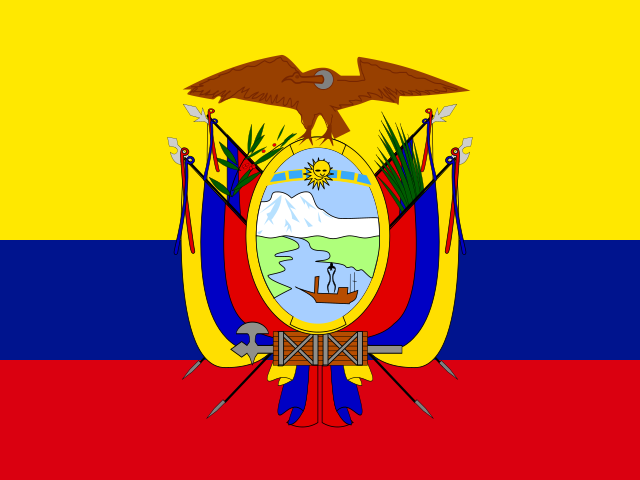
Three horizontal bands, yellow on top at half the flag's depth, then blue and red. Official flags flown on national buildings, warships and diplomatic missions carry the national coat of arms at the centre; merchant ships and private citizens fly the plain tricolour, and municipal buildings fly a version with a circle of white stars in the blue band, one for each province. The legislative decree of 31 October 1900 that fixes the flag describes the stripes, their order and their widths and assigns the colours no meaning, and Article 2 of the 2008 constitution simply leaves the symbols to ordinary law. The familiar reading of yellow for the country's fertile and mineral-bearing soil, blue for the Ecuadorian sky and sea and red for the blood of its heroes comes from Ecuadorian government communications rather than from either text.
Source: es.wikisource.org · constituteproject.org · presidencia.gob.ec · fae.mil.ec · exteriores.gob.es
Ecuador FACTS ◢
| Capital | Quito |
|---|---|
| Continent | South America |
| Population | 18,289,896 (2025) |
| Area | 257,204 km² |
| Population density | 71/km² |
| Currency | United States dollar (USD) |
| Official language | Spanish |
| Calling code | +593 |
| Internet TLD | .ec |
| Time zones | UTC-06:00, UTC-05:00 |
| Drives on the | Right |
| ISO codes | EC / ECU |
DID YOU KNOW? ◢
- The Galápagos Islands, which belong to Ecuador, inspired Charles Darwin's theory of evolution.
- Thanks to Earth's bulge at the equator, the summit of Mount Chimborazo is the point on the surface farthest from the planet's centre.
- It was the first country in the world to grant constitutional rights to nature itself.
- The Panama hat was actually invented in Ecuador, not Panama.
Ecuador QUICK ANSWERS ◢
What is the capital of Ecuador?
The capital of Ecuador is Quito.
What is the population of Ecuador?
Ecuador had a population of 18,289,896 in 2025.
What currency does Ecuador use?
Ecuador uses the United States dollar (USD).
What languages are spoken in Ecuador?
The official language of Ecuador is Spanish.
Think you know your flags? Play Flag Daily → · Browse all countries →
MORE ON THE FLAG ◢
Yellow on top, blue in the middle, red at the bottom, and the yellow band as deep as the other two put together. Page after page will tell you the same thing about the Ecuadorian flag: yellow for fertile land, blue for sea and sky, red for the blood of the heroes of independence.
Ecuador's own government says much the same. Ecuador's flag law says none of it.
The text that fixes the flag is a legislative decree passed on 31 October 1900, signed into effect by President Eloy Alfaro a week later. It sets out the stripes, their order and their widths, and assigns the colours nothing.
Key Takeaways
- Article 2 of the 2008 constitution makes the flag, coat of arms and anthem the symbols of the nation as provided for by law, and says nothing about colour.
- The 1900 decree describes the three horizontal stripes and the double-width yellow band, then stops. No colour is given a meaning.
- That decree does hand out meanings twice, both on the coat of arms: the caduceus for navigation and commerce, the bundle of fasces for republican dignity.
- The oldest first-hand account of the colours comes from an officer on Francisco de Miranda's 1806 expedition, who called the new ensign the three primary colours that predominate in the rainbow.
- The Ecuadorian Air Force page that gives the familiar land, sea and blood reading credits it at the foot to a commercial tourism website.
- Colombia's 1924 decree, Venezuela's 2006 law and Peru's constitution describe their flags just as flatly, and gloss elements of the arms while leaving the stripes alone.
What do the colours on the Ecuadorian flag mean?
Officially nothing, and unofficially quite a lot, depending on which arm of the Ecuadorian state you ask. Translations from the Spanish are given here alongside each quotation.
The Presidency of the Republic, in its notice for National Flag Day, says the yellow band "representa la abundancia de nuestro suelo minero y fértil", represents the abundance of our mineral-bearing and fertile soil; that blue "simboliza el cielo y el mar ecuatoriano", symbolises the Ecuadorian sky and sea; and that red "recuerda la sangre de nuestros héroes", recalls the blood of our heroes.
The Ecuadorian Air Force publishes a version that overlaps without matching. Yellow there stands for gold, wealth and the natural resources the country holds, blue for the ocean and the Ecuadorian sky, and red for the blood shed by heroes in the wars of liberation.
Two arms of the same state, two different glosses on the same yellow stripe. That is the signature of a reading which circulates rather than one which is prescribed, and the Air Force page settles the question itself: a line at the foot of the article credits it to Goraymi, a commercial Ecuadorian tourism site.
It travels outward as readily. The Spanish foreign ministry's country file on Ecuador, dated January 2026, reproduces the Presidency's wording almost clause for clause, down to the mineral-bearing and fertile soil. That file opens by saying its contents were drawn from various media and that neither the ministry nor the Spanish government defends any position on the country it covers, which is a fair description of what happens to this reading everywhere it lands.
Does Ecuadorian law say what yellow, blue and red stand for?
No, and it declines to twice over.
Article 2 of the 2008 constitution reads, in the Constitute Project's English text, that the flag, coat of arms and national anthem, as provided for by law, are the symbols of the nation. That is the whole of what it says about the symbols; the rest of the article deals with official languages. Nothing about colour.
The legislation it points at is the 1900 decree. Its Article 2 declares that the national flag shall be, without any alteration, the one Ecuador adopted when it proclaimed its independence, its colours "amarillo, azul y rojo, en listas horizontales", yellow, blue and red in horizontal stripes, in that order from top to bottom, with the yellow band twice the width of the others. Design, order, proportion, and nothing else. It fixes no overall shape for the flag at all, and the contributors who went looking found no later Ecuadorian law setting one for the national flag either. Flags of the World records Zachary Harden, working with the Office of the President of Ecuador in 2010, being told by a government official that the 1:2 ratio was never confirmed into law. The same account puts the 2:3 now in use in a guide to the national symbols issued by Ecuador's national communications secretariat in November 2009, and notes that the one ratio which is codified belongs to a square ceremonial banner.
Here is what makes the silence look deliberate. One article earlier, the same decree is perfectly willing to explain a symbol when it wants to. Describing the coat of arms, it specifies a steamship whose mast is a caduceus, "como símbolo de la navegación y del comercio", as a symbol of navigation and commerce, and says the shield rests on a bundle of consular fasces, "como insignia de la dignidad republicana", as an insignia of republican dignity. The drafters knew how to write a gloss. They wrote two, and none for the stripes.
The decree is spare elsewhere too. Describing the arms, it names the Chimborazo and a river born from it, but names neither that river nor the steamship it puts on the water.
No later Ecuadorian statute redefining the flag turned up in any source reachable for this article, and the Presidency still dates the official regulation of the colours to 1900.
Where do the Ecuadorian flag's colours come from?
From a ship in the Caribbean, twenty-four years before Ecuador existed as a republic.
Francisco de Miranda sailed from New York in 1806 with a force meant to spark a revolution in Spanish America. An officer who went with him kept a running set of letters home, published in Boston and generally attributed to James Biggs. The entry for 12 March 1806 records the moment: "This day the Colombian colours were displayed on board for the first time. This Ensign is formed of the three primary colours which predominate in the rainbow." A gun was fired, and toasts were drunk to a standard the letter says was expected to wave to the triumph of freedom and humanity in a country long oppressed.
That is the earliest surviving eyewitness explanation of the yellow, blue and red, and it is a colour-theory explanation rather than a patriotic one. No land, no sea, no blood.
Flags of the World's contributors trace the design of all three modern tricolours to Miranda, and one of them calls it the "Mirandinian-Venezuelan tricolor" outright. What Venezuela's flag law itself records is the congress rather than the man: Article 3 says the national flag "se inspira en la que adoptó el Congreso de la República en 1811", takes its inspiration from the one the congress adopted in 1811. On the same contributors' account the design passed from there into Gran Colombia, and Ecuador's own first constitution shows how close that union still was at the moment of separation. Its Article 1 joins the departments of Azuay, Guayas and Quito into one independent body called the State of Ecuador; Article 2 then unites and confederates that state with the other states of Colombia "para formar una sola Nación con el nombre República de Colombia", to form a single nation under the name Republic of Colombia.
The colours did not survive the decades that followed unbroken. Flags of the World reproduces a historical synthesis it credits to a statement on Ecuador's foreign ministry website, which counts eight periods in the flag's history. The revolution of March 1845 is the fifth: a white, blue and white vertical tricolour with stars in the blue stripe, three of them at first. The sixth is the Cuenca convention of 6 November that year, which raised the three stars to seven, one for each province of the republic. The Air Force's own account also counts eight, though it puts the current flag after them rather than among them.
That marcista flag lasted fifteen years. On 26 September 1860 Gabriel García Moreno decreed it out of existence and ordered the return of what the Presidency's account calls the Colombian iris, and a national convention ratified the decision the following year. Congress made 26 September National Flag Day in 1955, so the date the country commemorates is the restoration rather than the original.
Why do Colombia, Venezuela and Ecuador share the same flag colours?
All three kept Miranda's ensign when Gran Colombia broke up, and Colombia's decree still carries the wider state on its arms: its shield is banded in three, and the lower band shows the Isthmus of Panama in blue between two seas. What is striking is how alike the three laws are in what they leave out.
| Country | Governing text | How it describes the stripes | Colour meanings given |
|---|---|---|---|
| Ecuador | Legislative decree of 31 October 1900 | Yellow, blue and red, horizontal, the yellow twice the width of the others | None |
| Colombia | Decreto 861 of 17 May 1924 | Yellow on top at half the flag's depth, then blue and red at a quarter each, blue in the centre | None |
| Venezuela | Law of 9 March 2006 | Yellow, blue and red in equal joined bands, eight white stars arced in the blue | None |
| Peru | Constitution of 1993, Article 49 | Three vertical stripes, red, white and red | None |
Venezuela's law is the useful control case. Article 3 describes the flag and gives no colour a meaning. Five articles later, Article 8 explains the coat of arms at length, from a sheaf of corn standing "como símbolo de la unión y de la riqueza de la Nación", as a symbol of the union and the wealth of the nation, to a white horse as the emblem of independence and liberty.
Colombia does the same thing inside a single article. Article 5 of the 1924 decree sets out the arms and stops to explain one element, the Phrygian cap on a lance, "como símbolo de la libertad", as a symbol of liberty. The stripes in Article 1 get nothing. Three neighbouring texts, three glossed emblems, and not one glossed stripe between them.
Peru was never part of the union and arrives at the same place from a higher instrument. Article 49 of its constitution names the symbols of the nation as the flag with three vertical stripes in red, white and red, the coat of arms and the anthem, as established by law. Colour, order, and no meaning.
Telling the three tricolours apart is easier than the shared palette suggests, and stripe width is the fastest check: the yellow band on Ecuador's and Colombia's is twice the others, while Venezuela's three are equal. The family stops abruptly at Ecuador's southern border, where Peru flies red and white in vertical bands. Width first, then the device in the middle, is a habit worth carrying into a round of flag questions.
Which Ecuadorian flag carries the coat of arms?
Not the plain tricolour of Article 2, and not only the one most people expect. The 1900 decree sets out four uses across four articles, and two of them take the arms.
Article 3 puts the arms at the centre of the flag, across the yellow and blue bands, on national buildings, warships and fortresses, and on the flags raised by Ecuador's diplomatic and consular agents abroad. Article 5 sends the army to that same Article 3 flag and adds a mark of its own: each battalion or regiment carries its number in the yellow band, as the Ministry of War directs.
Article 6 sends merchant shipping and private citizens to the plain tricolour of Article 2, with nothing in the middle. That is the flag the decree assigns to private use, and Flags of the World's contributors have disagreed for years about whether it counts as a civil flag in its own right or as the state flag with the difficult part left off. One of them, writing after a visit, reported that almost every flag on display carried the arms anyway.
Article 4 is the one almost nobody knows. Flags on municipal buildings carry no arms at all, but a circle of white stars set in the blue band, equal in number to the provinces of the republic. That is a flag which changes when the map does, and the device was not new: on the foreign-ministry synthesis reproduced by Flags of the World, the marcista flag of 1845 carried three stars, then seven, one for each province of the day.
Frequently asked questions
Do the colours of Ecuador's flag have an official meaning?
No Ecuadorian legal text opened for this article gives them one. The 2008 constitution leaves the flag to ordinary legislation, and the legislative decree of 31 October 1900 that fixes it describes the stripes and their proportions without assigning any colour a meaning. The familiar reading of fertile land, sea and sky, and the blood of heroes appears in Ecuadorian government communications, including the Presidency's flag day notice and an Air Force page that credits the reading to a tourism website, but not in the 1900 decree itself.
Why is the yellow stripe on Ecuador's flag twice as wide?
Because the 1900 decree says so, and it gives no reason. Article 2 requires the yellow band to be twice the width of the blue and red, which makes it half the depth of the flag. Colombia's Decreto 861 of 1924 reaches the same proportion from the other direction, giving yellow half the flag and the other two a quarter each.
When is Ecuador's Flag Day?
26 September. It marks the day in 1860 when Gabriel García Moreno decreed the end of the flag adopted after the 1845 revolution and ordered the yellow, blue and red back. Congress fixed the date as National Flag Day in 1955.
Did Ecuador always have a yellow, blue and red flag?
No. Flags of the World, reproducing a synthesis it credits to a statement on Ecuador's foreign ministry website, records a white, blue and white flag with stars in use from 1845 until 1860, so the tricolour is a restoration rather than a continuous national design. The 1900 decree calls it the flag adopted at independence without acknowledging the fifteen-year gap.
Is the Ecuadorian flag the same as Colombia's and Venezuela's?
No, though the colours and their order are shared. Ecuador's state flag carries the national coat of arms at the centre while its merchant and private flag carries nothing. Colombia's public buildings fly a plain tricolour, and its merchant flag carries an oval blue shield with a white eight-rayed star. Venezuela's carries eight white stars arced across the blue. Venezuela's three bands are also equal in width, while the yellow band on Ecuador's and Colombia's takes up half the flag.
Sources
- Constitute Project, Ecuador's Constitution of 2008 with Amendments through 2021 - retrieved 12 August 2026.
- Congreso de la República del Ecuador, Decreto Legislativo relativo a las Armas de la República y Pabellón Nacional, 31 October 1900, Registro Oficial 1272 - transcribed from Decretos y leyes sancionados en el año 1900, Imprenta Nacional, Quito, 1901, pages 112 to 113; retrieved 12 August 2026.
- Constitución del Estado del Ecuador, Riobamba, 1830, Título I, Articles 1 and 2 - retrieved 14 August 2026.
- Presidencia de la República del Ecuador, Presidencia de la República conmemorará el Día de la Bandera Nacional - retrieved 12 August 2026.
- Fuerza Aérea Ecuatoriana, Día de la Bandera Nacional - retrieved 14 August 2026.
- James Biggs (published anonymously), The History of Don Francisco de Miranda's Attempt to Effect a Revolution in South America, in a Series of Letters, Boston, E. Oliver, Letter V, entry for 12 March 1806 - retrieved 12 August 2026.
- República Bolivariana de Venezuela, Ley de Bandera Nacional, Himno Nacional y Escudo de Armas, Gaceta Oficial 38394 of 9 March 2006, Articles 3 and 8 - retrieved 12 August 2026.
- República de Colombia, Decreto 861 de 1924 (17 de mayo), Articles 1, 2, 4 and 5 - retrieved 12 August 2026.
- Constitute Project, Peru's Constitution of 1993 with Amendments through 2021, Article 49 - retrieved 14 August 2026.
- Flags of the World, Ecuador and Ecuador - Historical Flags, the latter reproducing a historical synthesis credited to a statement on Ecuador's foreign ministry website - retrieved 14 August 2026.
- Ministerio de Asuntos Exteriores, Unión Europea y Cooperación (Spain), Ficha País: Ecuador, January 2026 - retrieved 12 August 2026.
PLAY ANOTHER →
Five questions a day. Everyone gets the same five.
FIVE QUESTIONSDAILYOn This DayOne thing that happened today in history. Every day, a new one.
TODAY IN HISTORYDAILYGuess the CountryThree clues, three guesses. Work out where in the world it is.
THREE CLUESDAILYDaily CodeA short message, hidden in a different cipher every day.
ONE CIPHER A DAY