
Panama
Panama is the slender S-shaped bridge between North and South America, and the country that cut a canal clean through it - reshaping global trade and, curiously, letting ships sail through mountains.
WHAT THE FLAG MEANS ◢
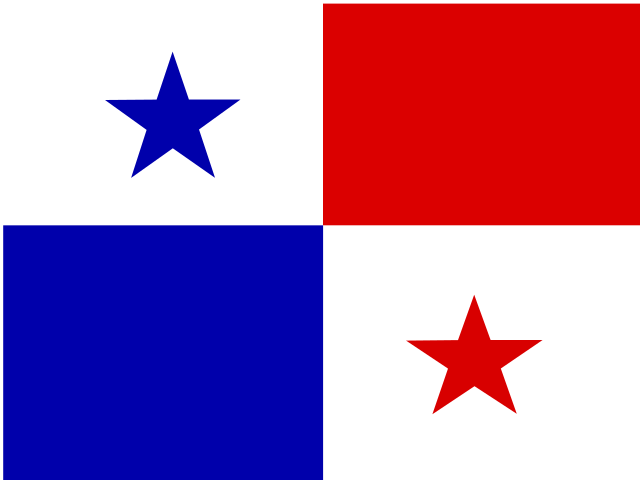
Divided into four quarters: a white one bearing a blue star at the upper hoist, a plain red quarter at the upper fly, a plain blue quarter at the lower hoist, and a white one bearing a red star at the lower fly. The constitution names the flag among the symbols of the Nation and adopts it by reference to Law 34 of 1949, saying nothing itself about what any of it means. That law does: since a 2012 amendment it gives the blue to the Conservative Party, the red to the Liberal Party and the white to the field of peace in which to make a homeland in the new Nation, the blue star to the purity and honesty that are to govern civic life, and the red star to the authority and the law that are to impose those virtues.
Panama FACTS ◢
| Capital | Panama City |
|---|---|
| Continent | North America |
| Population | 4,571,189 (2025) |
| Area | 74,177 km² |
| Population density | 62/km² |
| Legal tender | United States dollar (USD) and Panamanian balboa (PAB) |
| Official language | Spanish |
| Calling code | +507 |
| Internet TLD | .pa |
| Time zone | UTC-05:00 |
| Drives on the | Right |
| ISO codes | PA / PAN |
DID YOU KNOW? ◢
- The Panama Canal connects the Atlantic and Pacific Oceans, saving ships a long voyage around South America.
- It's one of the few places on Earth where you can watch the sun rise over the Pacific and set over the Atlantic.
- Panama uses the US dollar as everyday cash, calling it the 'balboa' alongside its own coins.
- The Darién Gap, a roadless stretch of dense jungle, is the only break in the Pan-American Highway.
- Its rainforests host more bird species than the United States and Canada combined.
Panama QUICK ANSWERS ◢
What is the capital of Panama?
The capital of Panama is Panama City.
What is the population of Panama?
Panama had a population of 4,571,189 in 2025.
What currency does Panama use?
Panama uses the United States dollar (USD) and Panamanian balboa (PAB).
What languages are spoken in Panama?
The official language of Panama is Spanish.
Think you know your flags? Play Flag Daily → · Browse all countries →
MORE ON THE FLAG ◢
The party reading is not folklore in Panama. It is article 6 of the flag law, which is Law 34 of 1949 as it stands after the 2012 amendment, and it is printed in the Gaceta Oficial like any other statute.
What almost nobody says out loud is how new that sentence is. The flag was made in November 1903. It was legally adopted, and legally described, three times before anyone wrote down what it meant.
Twelve Panamanian instruments adopt, describe or regulate the flag between 1904 and that amendment, and every one of them can be read today. Three adopt it and set out its quarters, the earliest of the three provisionally and alongside a competition to replace it. Two are executive decrees, one on who may carry the flag on an official car and one on reproducing the symbols faithfully. The other seven fix hoisting hours, parade rules, fines and commemorative days. None of the twelve says what the flag means. The first instrument that does is dated 23 January 2012, and it arrived as a brand new article inserted into a law from 1949.
Key Takeaways
- Panama's flag law assigns a meaning to every element: blue, red, white, and each of the two stars.
- The meaning provision is new. Law 2 of 23 January 2012 added it to the 1949 flag law as article 2-A, renumbered article 6 in the consolidated text.
- Twelve earlier instruments, 1904 to 1999, adopt, describe or regulate the flag and assign it nothing. The 1904, 1941 and 1949 acts all gloss the coat of arms instead, charge by charge.
- Panama adopted this flag provisionally in 1904 and opened an anonymous competition, prizes in gold, to replace it. Nothing ever replaced it.
- The state fixes the exact colours: blue #072357 or Pantone 295C, red #DA121A or Pantone 187C, and pure white.
| Instrument | Date | What it does with the flag |
|---|---|---|
| Law 64 | 4 June 1904 | Adopts it provisionally, describes it, calls a competition to replace it |
| Law 28 | 28 March 1941 | Adopts it, describes it, glosses the coat of arms, assigns the flag nothing |
| Law 30 | 7 April 1941 | Hoisting, parades, foreign flags, penalties |
| Law 34 | 15 December 1949 | Adopts it definitively, describes it, assigns it no meaning |
| Decrees 268 and 379 | 1953 | Who may carry the flag on an official car; faithful reproduction of the symbols |
| Laws 71/1955, 36/1956, 28/1967, 35/1979, 49/1998, 52/1999 | 1955 to 1999 | Commemorative days, and amendments to the use rules |
| Law 2 | 23 January 2012 | Adds the article that assigns the colours and stars their meanings |
| Executive Decree 337 | 22 December 2017 | Approves the Manual: exact colours, proportions, handling |
The provision that reads the flag, and the year it was written
Law 2 of 23 January 2012 reformed the flag law extensively. Its schedule of amendments, article 63, records that it modified seventeen articles of the 1949 law, added thirty-two, repealed five of the old ones, and repealed six later acts on the symbols entirely. Article 6 of that amending act adds a new article 2-A, and those two sentences are the whole of Panama's official symbolism for its flag:
"Los colores y elementos de la Bandera Nacional tienen el siguiente significado: el azul representa el Partido Conservador, el rojo representa el Partido Liberal y el blanco representa el campo de la paz para hacer patria en la nueva Nación. La estrella azul simboliza la pureza y la honestidad que habrán de normar la vida cívica de la patria y la estrella roja simboliza la autoridad y la ley que habrán de imponer el imperio de estas virtudes."
Rendered into English: the colours and elements of the National Flag have the following meaning: blue represents the Conservative Party, red represents the Liberal Party, and white represents the field of peace in which to make a homeland in the new Nation. The blue star symbolises the purity and honesty that are to govern the country's civic life, and the red star the authority and the law that are to impose the rule of those virtues.
The second sentence is the part that gets flattened in retelling, usually down to one word per star. Each star carries a pair.
Note the tense. Both star clauses use habrán de, a future obligation: these are qualities the flag is asking for rather than qualities it claims. The two parties the provision names had been fighting each other, which is the point the state's own account of the design makes as well.
When the National Assembly published the consolidated text a month later, in the Gaceta Oficial of 27 February 2012, the new provision was renumbered as article 6 of the flag law. That is the number to cite today.
The flag acts explain the coat of arms, and not the flag
Law 34 of 15 December 1949 is the act the constitution points at. Panama's constitution disposes of the question in one line, its article 6: the symbols of the Nation are the anthem, the flag and the coat of arms, adopted by Law 34 of 1949. The constitution itself interprets nothing.
Neither did Law 34, for sixty-two years. Its article 1 sets out the flag as a rectangle quartered white with a five-pointed blue star, red, blue, and white with a five-pointed red star. Article 2 sets a schedule of sizes, from three metres by two on public buildings and ships down to forty-seven by thirty-two centimetres at the bottom of the list. Then it moves on to hoisting hours, parades, embassies, foreign flags and a fine of five to fifty balboas, and across its twenty-two articles it never returns to what any of it means.
The coat of arms gets the opposite treatment. Article 4 of the same 1949 law reads the arms charge by charge: the shield "descansa sobre campo verde, símbolo de vegetación", rests on a green field, symbol of vegetation; the sabre and rifle are there "para significar actitud de alerta en defensa de nuestra soberanía", to signify an attitude of alertness in defence of our sovereignty; there is "un pico y una pala como símbolo de trabajo", a pick and shovel as a symbol of work; "una cornucopia, emblema de riqueza", a cornucopia, emblem of wealth; and "la rueda alada, símbolo de Progreso", the winged wheel, symbol of Progress.
That is not a habit of one drafting committee. Law 28 of 28 March 1941, the act Law 34 replaced, is five articles long and does the same thing: the flag described and left bare, the arms read symbol by symbol in almost the same words. Law 64 of 1904 had already done the same.
So Panamanian legislators have been perfectly willing to legislate symbolism for a century. They simply did not do it for the flag.
They have also been willing to change their minds about it. The 1941 act put a different motto on the arms, "Honor, Justicia y Libertad", where 1904 had "Pro Mundi Beneficio" and where 1949 put it back. And the 2012 rewrite left the arms fully glossed while altering the readings: the crossed sabre and rifle that signified alertness in both 1941 and 1949 became weapons hung "en posición de abandono, para significar el adiós para siempre a las guerras civiles", in a position of abandonment, to signify farewell forever to the civil wars, and the eagle's leftward-turned head, described in 1904, 1941 and 1949 without any meaning attached, acquired one: "símbolo de autonomía".
Panama adopted this flag provisionally, and called a competition to replace it
The flag existed before any law did, which is ordinary enough. What is not ordinary is that the law said so, and went on saying so for forty-five years.
The instrument is Law 64 of 4 June 1904, passed by the National Convention. Its title says what it is doing: "por la cual se adopta provisionalmente el escudo de armas y la bandera de la República de Panamá, y se llama á un concurso" - by which the coat of arms and the flag of the Republic of Panama are provisionally adopted, and a competition is called.
Article 5 of Law 64 keeps in official use "la Bandera que hasta hoy se ha izado en los edificios públicos de la Nación después del 3 de Noviembre de 1903", the flag that has been hoisted on the Nation's public buildings since 3 November 1903. Article 6 of the same law then describes it, and the description is already today's flag: white with a blue five-pointed star at the hoist above, red beside it, blue below the hoist, white with a red five-pointed star at the fly below. The 1904 text calls the points rayos, rays, where 1949 and 2012 say puntas.
Article 3 of Law 64 is the strange one. It opened a public competition for a replacement flag and a replacement coat of arms, on eight numbered conditions. Entries were anonymous: "No se recibirá proyecto alguno en que el autor revele su nombre" - no design would be accepted in which the author revealed their name. A pseudonym was required, and only the Assembly could uncover who was behind it, once a model had been adopted. Foreigners could enter on equal terms. Designers were free in their choice of colours and elements, "sin otra limitación que la ocurrencia del autor y el buen gusto", with no limitation but the author's own invention and good taste. The prize was two hundred pesos in gold for the arms and the same again for the flag, split proportionally if the Assembly put together a hybrid from several entries.
It was supposed to be settled by 1906. Conditions 4 and 7 made that year's ordinary Assembly both the floor and the judge: the competition could not close before it met, and it would then pick the entry that satisfied it best after hearing whatever experts it thought qualified.
Article 4 of Law 64 left the door open anyway. If the Assembly liked nothing, the competition would "continuará abierto el concurso indefinidamente hasta que se elija alguno", stay open indefinitely until one was chosen.
None ever was. The provisional flag of 1904 flew for forty-five years as the provisional flag, and Law 34 of 1949 finally adopted it outright. That law, incidentally, had to be printed in the Gaceta Oficial twice: the copy of 25 February 1950 carries a note under the signatures saying it was being republished "por haber salido antes con errores", for having come out earlier with errors.
Who made the first Panamanian flag
The law names the designer, and that too is a 2012 addition. Where the 1949 text began flatly with "La Bandera de la República consiste en", the description in force today opens "La Bandera Nacional, diseñada por don Manuel E. Amador T." - the National Flag, designed by Manuel E. Amador T. It arrived as article 1-C in the 2012 act and sits as article 4 of the consolidated text.
He was Manuel Encarnación Amador Torrero, born in Santiago de Veraguas on 25 March 1869, son of Manuel Amador Guerrero, who became Panama's first president. The National Commission on the Symbols of the Nation, which sits in the Ministerio de Gobierno, dates the design to the night of 1 November 1903 and says he set blue and red for the Conservative and Liberal parties, "hasta entonces en guerra", at war until then, with the double portion of white for the peace and unity that ought to exist.
Then the commission's account continues, and this is the sentence that connects 1903 to 2012: "Las estrellas vinieron a consolidar la idea de la pureza de ideas y fines y la fuerza de la Ley que ayudará que éstas imperen." The stars came to consolidate the idea of purity of ideas and ends, and the force of the Law that will help those prevail.
Set that beside the statute passed 108 years later. The designer has purity of ideas and the force of the Law that makes them prevail; the act gives the blue star "la pureza y la honestidad" and the red star "la autoridad y la ley que habrán de imponer el imperio de estas virtudes". The overlap is close enough that the 2012 provision reads as the designer's own account of his own drawing, promoted into statute, though the act itself never says where its wording came from.
Amador himself went on to paint in New York under Robert Henri and to invent a constructed language, "ideado como lengua universal para promover la paz mundial", conceived as a universal language to promote world peace. He died in Panama City on 12 November 1952.
The flag itself was sewn by María Ossa de Amador, wife of Manuel Amador Guerrero. By her own account, recorded by the same commission, the light woollen cloth was bought at three shops in the city, La Dalia, A la Ville de París and the Bazar Francés. She and her sister-in-law Angélica B. de Ossa went into an abandoned house on the night of 2 November 1903 and made the first two flags there by kerosene lamp on a portable sewing machine, each 2.25 by 1.50 metres. The flag was shown at dusk on the 3rd and carried through the streets for the first time on 4 November.
Those first flags were made the night before Panama separated from Colombia, and the arms still carry that moment. The 1949 description sets the sun going down behind the mountain and the moon beginning to rise over the waves, "marcando así la hora solemne de nuestra separación de Colombia", marking in this way the solemn hour of our separation from Colombia. The verb for the moon is faint on the 1949 gazette scan. The 1941 act and the 2012 re-description both print elevarse, to rise, which settles it.
The exact blue, from the Gaceta Oficial
Panama publishes exact colour values for its flag, and the specification is law rather than a style guide. Executive Decree 337 of 22 December 2017 approved the Manual on the Procedure, Design and Use of the Symbols of the Nation, printed in the Gaceta Oficial of 26 December 2017.
For the flag the Manual gives:
| Colour | Hex | RGB | Pantone | CMYK |
|---|---|---|---|---|
| Blue | #072357 | 7, 35, 87 | 295C coated, 296U uncoated | 100, 46, 0, 70 |
| White | #FFFFFF | 255, 255, 255 | - | 0, 0, 0, 0 |
| Red | #DA121A | 218, 18, 26 | 187C coated, 186U uncoated | 0, 100, 79, 20 |
Some of the geometry is the law's own. Article 5 of the flag law fixes the 1 to 1.5 proportion and puts each star at a quarter of the height or a sixth of the length. The Manual then works it out: the flag divides into sixteen identical parts, four to each of red and blue and double that to white; the stars are heraldic in style, always with one point upward when the flag hangs horizontally; and reproduced without colour, for coins and medals, blue becomes horizontal hatching and red vertical hatching, stars included.
The Manual also names the corner: the white quarter with the blue star is the cantón de honor, the canton of honour, and it always goes to the top left as the viewer sees it, hanging vertically as well as horizontally. Get that wrong and the flag is upside down, and here that is a published rule rather than a point of etiquette.
If you want to see how fast a quartered flag becomes recognisable once you know which corner is the honour canton, Flag Daily puts up one flag a day and gives you three guesses at the country.
Why 4 November is not Flag Day any more
It was, for fifty-six years. Law 36 of 16 February 1956 gave 4 November a name: "El día 4 de Noviembre se denominará Día de la Bandera y del Soldado de la Independencia", the Day of the Flag and of the Soldier of Independence. The date is the day after the separation from Colombia, and the day María Ossa de Amador's flag was first paraded.
Law 2 of 2012 repealed the 1956 act and replaced the name. Its article 51 adds an article 20-N declaring 4 November of each year the Día de los Símbolos de la Nación, the Day of the Symbols of the Nation, covering flag, anthem and arms together, and instructing the executive to promote school and public celebrations honouring the symbols and their authors. The act came into force the day after its promulgation on 26 January 2012, so the first 4 November to fall under the new name was that same year.
The flag oath survives from an older act still. The 2017 Manual reproduces it and credits Law 24 of 31 January 1959 with adopting the words, said right hand raised to ninety degrees with the palm forward, immediately after the flag has been hoisted: "Bandera panameña: Juro a Dios y a la Patria, amarte, respetarte y defenderte, como símbolo sagrado de nuestra Nación." Panamanian flag: I swear to God and to the Fatherland to love you, respect you and defend you, as the sacred symbol of our Nation.
Frequently asked questions
What do the colours of the Panama flag mean?
Article 6 of Panama's flag law, which is Law 34 of 1949 as amended in 2012, states that blue represents the Conservative Party, red represents the Liberal Party, and white represents the field of peace in which to make a homeland in the new Nation. The blue star stands for the purity and honesty that are to govern civic life, and the red star for the authority and the law that are to impose those virtues. That is the statute's own wording, and it is recent: the provision was added by Law 2 of 23 January 2012. It overlaps closely with the reading the flag's designer gave on the night of 1 November 1903, though the act never says where its wording came from.
Who designed the flag of Panama?
Manuel Encarnación Amador Torrero, son of Panama's first president, designed it on the night of 1 November 1903. Law 34 of 1949, as amended in 2012, names him in article 4, the article that describes the flag. The first two flags were sewn by María Ossa de Amador with her sister-in-law Angélica B. de Ossa on the night of 2 November 1903, each measuring 2.25 by 1.50 metres.
How many points do the stars on Panama's flag have?
Five each. Every Panamanian act that has described the flag says so: Law 64 of 1904 calls the points rayos, rays, while Law 28 of 1941, Law 34 of 1949 and the text in force since 2012 call them puntas, points. The current text adds that each star must be oriented point upward, and sets their size at one quarter of the flag's height or one sixth of its length.
What are the official colours of the Panamanian flag?
The 2017 Manual on the Symbols of the Nation, published in the Gaceta Oficial, gives blue as #072357 or Pantone 295C, red as #DA121A or Pantone 187C, and white as pure white in both matte and gloss. It also gives RGB and CMYK values for each, and specifies black hatching patterns for reproducing the flag without colour.
Which corner of the Panama flag goes on top?
The white quarter with the blue star. The Manual calls it the canton of honour and requires it to sit at the top, to the viewer's left, whether the flag is displayed horizontally or vertically. The white quarter with the red star sits diagonally opposite, at the bottom of the fly.
Sources
- Asamblea Nacional de Panamá, Ley 2 de 23 de enero de 2012, que reforma la Ley 34 de 1949 - Gaceta Oficial 26959, 26 January 2012 - retrieved 21 August 2026.
- Asamblea Nacional de Panamá, Texto Único de la Ley 34 de 1949, que comprende las reformas de la Ley 2 de 2012 - Gaceta Oficial 26981-A, 27 February 2012 - retrieved 21 August 2026.
- Asamblea Nacional de Panamá, Ley 28 de 28 de marzo de 1941, que adopta la Bandera, el Himno y el Escudo de Armas - Gaceta Oficial 8483, 2 April 1941, digitised by the Asamblea Nacional's Legispan service - retrieved 21 August 2026.
- Asamblea Nacional de Panamá, Ley 30 de 7 de abril de 1941, sobre el uso de la Bandera, el Escudo y el Himno Nacionales - Gaceta Oficial 8499, 25 April 1941 - retrieved 21 August 2026.
- Ministerio de Gobierno y Justicia, Decreto 268 de 18 de junio de 1953 - Gaceta Oficial 12145, 8 August 1953 - retrieved 21 August 2026.
- Ministerio de Gobierno y Justicia, Decreto 379 de 7 de diciembre de 1953 - Gaceta Oficial 12404, 26 June 1954 - retrieved 21 August 2026.
- Asamblea Nacional de Panamá, Ley 34 de 15 de diciembre de 1949 - Gaceta Oficial 11128, 25 February 1950 - retrieved 21 August 2026.
- Convención Nacional de Panamá, Ley 64 de 4 de junio de 1904 - Gaceta Oficial 29, 15 June 1904, digitised by the Asamblea Nacional's Legispan service - retrieved 21 August 2026.
- Ministerio de Gobierno de Panamá, Manual sobre el Procedimiento, Diseño y Uso de los Símbolos de la Nación, approved by Decreto Ejecutivo 337 de 22 de diciembre de 2017 - Gaceta Oficial 28432-A, 26 December 2017 - retrieved 21 August 2026.
- Comisión Nacional de los Símbolos de la Nación, Bandera Nacional - retrieved 21 August 2026.
- Comisión Nacional de los Símbolos de la Nación, Manuel Encarnación Amador - retrieved 21 August 2026.
- Comisión Nacional de los Símbolos de la Nación, María Ossa de Amador - retrieved 21 August 2026.
- Tribunal Electoral de Panamá, Constitución Política de la República de Panamá, texto vigente - retrieved 21 August 2026.
- Asamblea Nacional de Panamá, Ley 36 de 16 de febrero de 1956 - Gaceta Oficial 12967, 28 May 1956 - retrieved 21 August 2026.
- Biblioteca Nacional de Panamá, Los Símbolos Patrios - retrieved 21 August 2026.
PLAY ANOTHER →
One thing that happened today in history. Every day, a new one.
TODAY IN HISTORYDAILYGuess the CountryThree clues, three guesses. Work out where in the world it is.
THREE CLUESDAILYDaily TriviaFive questions a day. Everyone gets the same five.
FIVE QUESTIONSDAILYDaily CodeA short message, hidden in a different cipher every day.
ONE CIPHER A DAY