
Peru
Peru drops from Pacific desert coast up over the Andes and down into Amazon rainforest, and holds Machu Picchu - the mountaintop city the Inca built and the outside world only rediscovered in 1911.
WHAT THE FLAG MEANS ◢
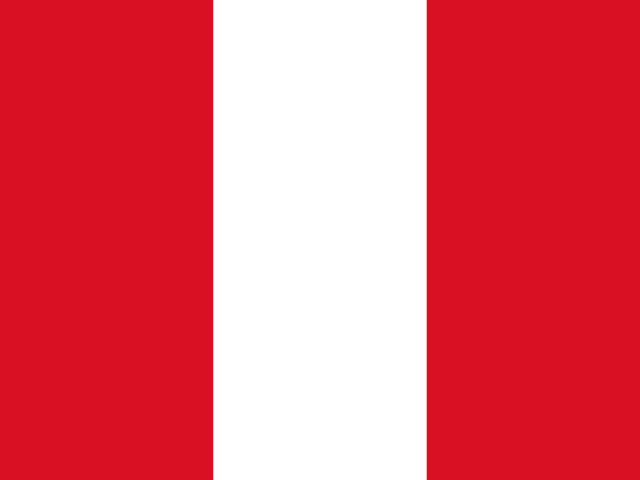
Three vertical bands of red, white and red. Article 49 of the constitution names the flag by its form and colours and says nothing about what they mean. The arms are carried on the state flag but not on the plain civil flag: a shield of three fields holding a vicuna, a cinchona tree and a cornucopia, which the law that created them reads as the country's animal, plant and mineral wealth.
Peru FACTS ◢
| Capital | Lima |
|---|---|
| Continent | South America |
| Population | 34,576,665 (2025) |
| Area | 1,285,216 km² |
| Population density | 27/km² |
| Currency | Sol (PEN) |
| Official language | Spanish |
| Calling code | +51 |
| Internet TLD | .pe |
| Time zone | UTC-05:00 |
| Drives on the | Right |
| ISO codes | PE / PER |
DID YOU KNOW? ◢
- Machu Picchu, the 15th-century Inca citadel high in the Andes, is one of the New Seven Wonders of the World.
- The potato was first domesticated here, and Peru still grows thousands of native varieties.
- The Nazca Lines are enormous ancient drawings etched into the desert, best seen from the air.
- Part of the Amazon rainforest lies within its borders, packed with extraordinary wildlife.
- Lake Titicaca, on its border with Bolivia, is the highest large navigable lake in the world.
Peru QUICK ANSWERS ◢
What is the capital of Peru?
The capital of Peru is Lima.
What is the population of Peru?
Peru had a population of 34,576,665 in 2025.
What currency does Peru use?
Peru uses the Sol (PEN).
What languages are spoken in Peru?
The official language of Peru is Spanish.
Think you know your flags? Play Flag Daily → · Browse all countries →
MORE ON THE FLAG ◢
Peru's constitution names the flag by its colours and says nothing about what they mean. Every statute and decree beneath it does the same thing. That silence has held since 1820, and what has changed is that somebody in Lima has finally written a meaning down.
On 11 July 2025 the Ministry of Defence published a draft regulation for public comment. Buried in it, for the first time in any instrument that creates or describes the flag, is a sentence saying what red and white stand for. It is not the story about flamingos. And the draft gives white one meaning in its articles and a different meaning in its annex.
Six instruments have fixed the flag or its ensigns since José de San Martín created one at Pisco in 1820, and the constitution of 1993 sits above them. The most recent, Ley 32251, was published in January 2025 and repealed the decree-law that had governed Peru's symbols for nearly seventy-five years. Those seven documents are what is quoted below, and where the sections that follow say the instruments, the six flag-specific ones are what is meant.
Key Takeaways
- Article 49 of the 1993 constitution names the flag by its form and colours and assigns it no meaning.
- Ley 32251, published on 19 January 2025, repealed Decreto Ley 11323 of 1950. It calls the flag the principal ensign symbolising Peru's sovereignty and national identity, states that its creation is of anonymous authorship, and says nothing about what the colours mean.
- The 1820 decree that created the first flag says what only one colour represents, and it is the blue of the emblem's sky, not the red or white of the field.
- The stripes are vertical for a documented reason: the 1822 decree that made the naval ensigns vertical says they must not be confused at long distance with Spanish ones, and the law of 1825 carried that form to the national flag.
- The draft regulation of July 2025 proposes a meaning for the colours, and contradicts itself about white. It had not been approved by supreme decree when this was written.
| Instrument | Date | What it did about the flag | Meaning assigned to red or white |
|---|---|---|---|
| Decree of José de San Martín, Pisco | 21 October 1820 | Created a flag of four diagonal fields with a sun emblem | None |
| Decree of the Ministry of State | 15 March 1822 | Replaced it with three horizontal bands and a red sun | None |
| Decree of the Ministry of War | 31 May 1822 | Made the stripes vertical on warships, maritime places and state vessels | None |
| Law of the Constituent Congress | 24 and 25 February 1825 | Fixed the shield, ensign, flag, standard and cockade | None |
| Decreto Ley 11323 | 31 March 1950 | Set proportions and an official vocabulary. Repealed 2025 | None |
| Ley 32251 | 19 January 2025 | Reclassified every symbol and repealed the 1950 decree-law | None |
The statute that governs Peru's flag was replaced in January 2025
Peru's symbols were governed for nearly seventy-five years by a decree-law of 1950, and that instrument is gone. Ley 32251, "Ley que unifica y armoniza la regulación de los símbolos de la patria, símbolos del Estado y emblemas nacionales", appeared in the official gazette on 19 January 2025, and its single repealing provision lists Decreto Ley 11323 among the norms it abolishes.
The new law sorts the country's emblems into three tiers. The símbolos de la patria are the three the constitution names: flag, shield, anthem. The símbolos del Estado are the six that belong to institutions, the national ensign and the war flag among them. The emblemas nacionales are four more, including the cockade and the map.
Article 4 does read the flag as a whole. It calls it "la enseña principal que simboliza la soberanía y la identidad nacional del Perú", the principal ensign symbolising Peru's sovereignty and national identity. Then it describes the object and stops: rectangular, "tres franjas verticales, con los colores rojo, blanco y rojo, sin escudo", three vertical bands in red, white and red, without the shield, in a proportion of three long to two high. About the colours themselves it says nothing at all.
Two more things in that article are worth pausing on. The first is that the law dates the flag's creation to the law of 25 February 1825, not to San Martín's decree of 1820. The second is a five-word sentence: "Su creación es de autor anónimo." Its creation is of anonymous authorship. The state's own current statute declines to name a designer for the flag, while in the very next article naming José Gregorio Paredes y Ayala as the author of the shield.
Why the stripes run vertically: keeping the flag apart from Spain's
San Martín's flag of October 1820 was not a triband at all. The decree describes silk or cloth eight feet long and six wide, divided by diagonal lines into four fields, white at top and bottom, red at the sides, with an oval laurel crown and inside it a sun rising behind steep sierras above a calm sea.
It lasted not quite seventeen months. On 15 March 1822 a decree of the Ministry of State replaced it with a white horizontal band between two red ones, carrying a red sun. The reason is stated in the decree's own opening words: "Consultando la mayor comodidad y economia", consulting the greater convenience and economy, after the inconveniences of making the existing flag. The first redesign was a manufacturing decision.
Eleven weeks later the flag changed again, and this time the recital is a military one. The decree of 31 May 1822, issued by the Ministry of War, opens by naming the mistaken reading given to the March decree, the need to classify the ensigns of state vessels, and one more thing: "que no se confundan á larga distancia con las banderas ó insignias de que usan los españoles", that they not be confused at long distance with the flags or insignia used by the Spanish. Its article 1, speaking of the flag of warships, maritime places and their castles, then prescribes "tres listas verticales ó perpendiculares", three vertical or perpendicular stripes, white in the centre and red at the ends. Its article 5 gives merchant ships whatever the national flag is, minus the red sun, in substantially the same words the March decree had already used.
Read strictly, that decree never prescribes a form for the national flag as such. It legislates ensigns, and where it mentions the national flag, in that article 5, it presupposes one. The instrument that fixes the national flag itself as three vertical bands is the law of 25 February 1825, and that law carries the form over without restating a reason for it.
Spain's flag is red at the edges and yellow in the middle, in horizontal bands. A Peruvian flag of red, white and red, also horizontal, is the same object at any distance where a faded yellow reads as white. The historian Mariano Felipe Paz Soldán, writing in 1868, gives the incident that made the point: a patriot column marching to join its battalion saw a flag it took for Peruvian, and understood its error only when it was very close, "por tener el color amarillo muy descolorido, era Española; y esa tropa cayó prisionera", the yellow colour being very faded, it was Spanish, and that troop was taken prisoner. He credits the account to Martín Guerrero, a Colombian commander who had come with San Martín and later served as Bolívar's chief of staff.
So the single most distinctive thing about this flag, the thing that separates it from a horizontal triband, has a plain documented cause, and the cause is Spain's flag.
What San Martín's decree explains, and what it does not
The 1820 decree is short, and it is unusually candid about why it exists. It opens: "Por cuanto es incompatible con la independencia del Perú la conservacion de los símbolos que recuerdan el dilatado tiempo de su opresion." Because the preservation of the symbols that recall the long time of its oppression is incompatible with the independence of Peru. The flag is introduced as a replacement for Spanish emblems, and the decree gives no other rationale.
It does explain colours, but only the emblem's. Its article 1 sets out how the escudo may be painted or embroidered while each object keeps its colours: the laurel crown green, tied below with a gold-coloured ribbon, the sun and its rays yellow, the mountains a dark brown, the sea between blue and green, and one clause that is different in kind from the rest, "azul la parte superior que representa el firmamento", blue the upper part, which represents the firmament.
That is the only representational statement in the founding document. Blue represents the sky. The red and the white of the fields are prescribed and never explained.
The decree also knows it is provisional. Its article 3 limits both preceding articles to force and vigour "hasta que se establezca en el Perú un Gobierno general por la voluntad libre de sus habitantes", until a general government is established in Peru by the free will of its inhabitants. San Martín was declaring the flag of a country that did not yet exist, and said so.
The 1825 law assigns a meaning, and it is the shield's, not the flag's
The Constituent Congress settled the symbols on 24 February 1825, and Bolívar ordered the law executed the following day. This is the instrument Ley 32251 credits with creating the flag, and apart from the 1820 decree's one clause about the firmament it is the only one of the six that reads any element symbolically at the moment it creates it. Ley 32251 carries the same clause forward two hundred years later.
Its article 1 divides the shield into three fields: sky blue on the right carrying a vicuña, white on the left holding the cinchona tree, and a lower red field, "y mas pequeño", and smaller, showing a cornucopia spilling coins. Then the clause that does the work: "significándose, con estos símbolos, las preciosidades del Perú en los tres reinos naturales", signifying, by these symbols, the treasures of Peru in the three natural kingdoms. Animal, vegetable and mineral. That reading is two hundred years old and it is in the statute book, which is why the vicuna, the cinchona tree and the cornucopia are read that way on this page and everywhere else.
The flag gets no such clause. Article 3 composes it of three vertical bands, "las dos extremas encarnadas, y la intermedia blanca", the two outer ones crimson and the middle one white, and then goes straight to where the shield sits and how the palm and laurel branches embrace it.
The word matters. The 1825 law does not call the flag's bands rojo. Of the flag it says encarnadas, keeping rojo for the shield's lower field, and the 1820 decree says encarnados of its own red fields and never uses rojo at all. The cockade in both is blanco y encarnado. Modern Peruvian law switched to rojo, and the 2025 statute and the draft regulation both use it. Anybody arguing about the exact shade from the founding texts is arguing about a nineteenth-century word for crimson, not about a modern red.
One line of article 3 explains where the two-flags distinction came from. "El pabellon de los buques mercantes será sencillo, sin escudo ni otra insignia." The ensign of merchant ships shall be plain, without shield or other insignia. The plain flag, the one private buildings fly, began life as the merchant marine's version, and the distinction between the plain flag and the one with the shield started as a maritime rule rather than a civic one.
A draft regulation proposes a meaning for Peru's colours, and gives white two of them
Ley 32251 requires a regulation, and it is specific about what that regulation must contain. Among other things it must include "los códigos de los colores nacionales en heráldica (metal o esmaltado), PMS (pantone), CMYK (cian, magenta, amarillo y negro), RGB / RVA (rojo, verde y azul) y HEX (colores web)". Peru is legislating its way to a hex code.
On 11 July 2025 the Ministry of Defence published the draft, together with its explanatory memorandum, for fifteen days of public comment, under Resolución Ministerial 00836-2025-DE. The draft had been approved unanimously by the intersectoral committee at its third ordinary session, on 4 July 2025.
Its Annex VIII carries the colour table the law demanded. Red is proposed as heraldic gules, Pantone 1795C, CMYK 0/100/100/0, RGB 227/6/19, hex #e30613. White is Pantone textile 11-4101 TCX and hex #FFFFFF. Four further colours are proposed as complementary national colours, with a sky blue, a gold, a brown and a green standing for sea and sky, coast, highlands and jungle. Three more rows sit in the table with no gloss anywhere: a duplicate of the same celeste, a dark blue and black.
And above the table, two sentences that no Peruvian instrument has ever contained: "Los colores nacionales del Perú son el rojo y el blanco. El rojo representa la sangre derramada por los peruanos que lucharon por la independencia y los que defendieron la soberanía de la nación." The national colours of Peru are red and white. Red represents the blood shed by the Peruvians who fought for independence and those who defended the sovereignty of the nation.
The annex then explains white as the light of the sun of the Incas and the majesty of the Peruvian Andes. Article 3.1 of the same draft explains it differently. There the colours "poseen una profunda significación patriótica", possess a deep patriotic significance, red carries the same reading about blood shed, and "el color blanco simboliza la paz, justicia y libertad", the colour white symbolises peace, justice and liberty.
Peace and justice and liberty, or Inca sunlight and the Andes. One draft, two answers. Public comment exists for exactly this, and a draft is not a law: when this article was written, a search of the official gazette's index found the July 2025 pre-publication and no supreme decree approving the regulation. Until one appears, the honest answer to what the colours of the Peruvian flag mean is still that no instrument in force says.
The dream of San Martín is a short story, and it reprints the decree that undercuts it
The best-known account of where the colours came from is in none of these documents. It has San Martín landing at Paracas, sleeping under a palm, waking to a flock of red-winged, white-breasted flamingos, and taking his flag from the sky. El Comercio describes it as a fiction made official by its circulation in school textbooks.
The source is a short story by the poet Abraham Valdelomar, printed in the magazine Mundial and reproduced in full by the state newspaper El Peruano, which dates it 28 July 1921, nearly two years after Valdelomar's death and a century after the events. El Comercio dates the story to 1917 instead, so its publication date is not settled here. Peru's own official daily labels the piece rescate bibliográfico, a bibliographical recovery, and prints it as literature.
Read it and three things become obvious. The first is that Valdelomar is writing fiction and not concealing it. His closing sentence attributes the colours to what the Liberator had "en un sueño romántico", in a romantic dream.
The second is that the story's own dates do not hold. "Era el 8 de octubre de 1820", it says of the landing, and it has San Martín issue the flag decree that same afternoon, after taking the port of Pisco. The decree it then prints is dated 21 October, thirteen days later.
The third is the birds. Valdelomar writes "una banda de aves de alas rojas y pechos blancos de armiño", a flock of birds with red wings and breasts of ermine white, and has San Martín tell Cochrane and Las Heras: "Son una bandera. La bandera de la Libertad que acabamos de sembrar." They are a flag. The flag of the Liberty we have just planted. The word parihuana, the Andean name for the flamingo that the retellings use, appears nowhere in his text. He mentions flamencos once, in a line about which birds favour Paracas.
Then the story does the thing that settles it. Valdelomar ends by printing San Martín's decree of 21 October 1820 in full, and that decree describes a flag of four diagonal fields with a sun in a laurel crown. A red-winged, white-breasted bird looks like the flag Peru has flown since 1822. It does not look like the flag the story is about. Daniel Guzmán, a historian at Peru's national archaeology, anthropology and history museum, put the same point to El Comercio: the birds' colour scheme resembles the current flag more than the one San Martín created.
There is an older explanation, and it is also not a document. It sends you to Chile and Argentina. Paz Soldán wrote in 1868 that in choosing the colours San Martín wished to unite those of the two nations helping to free a third, and "tomó el color rojo de la bandera de Chile y el blanco de la Argentina", took the red from Chile's flag and the white from Argentina's. That is a historian's inference nearly fifty years after the fact, offered without a citation to anything San Martín wrote, and it should be read as one.
Bandera, pabellón, bandera de guerra: which Peruvian flag is which
Peru does not have one flag, it has a vocabulary, and the 1950 decree-law wrote it down as léxico oficial. Its article 8 defined the "Bandera Nacional para izar" as the plain rectangle in the national colours without the coat of arms, for private buildings, and the "Pabellón Nacional para izar" as the same rectangle with the shield in the centre, for the state's.
Ley 32251 keeps the split and moves the pieces. The bandera nacional is a símbolo de la patria and carries no shield. The pabellón nacional is a símbolo del Estado, "es la enseña que simboliza a la República del Perú", the ensign that symbolises the Republic of Peru, made of the national flag with the escudo nacional at its centre and reserved to state institutions.
The 2025 law also separates two shields the 1950 one had blurred. The escudo nacional is the blasón plus its civic crown of oak, flanked by standards. The escudo de armas is that shield with a palm branch on one side and a laurel branch on the other, and under the new law it belongs on the war flag rather than on the ensign. The 1950 decree-law had put the palm and the laurel on the pabellón and abolished them everywhere else.
Both the 1825 law and article 5 of Ley 32251 divide the shield into three fields, and the 2025 text adds a detail the 1825 one leaves open, giving the cornucopia veinticinco monedas, twenty-five coins. The 1825 law calls the lower red field smaller than the others. Since 1950 it has been half the shield.
If you want to test how much of this you could pick out of a line-up, Flag Daily shows one flag a day and gives you three guesses at the country.
Frequently asked questions
What does the Peruvian flag mean?
None of the instruments in force that create or describe the flag assigns its colours a meaning. Article 49 of the 1993 constitution names "la bandera de tres franjas verticales con los colores rojo, blanco y rojo" and says nothing more about it; Ley 32251 of January 2025 calls the flag the principal ensign symbolising Peru's sovereignty and national identity, describes it in two sentences and stops there; the 1950 decree-law it repealed said nothing either. The only clause in any of these documents that reads an element of the design symbolically belongs to the shield, where the law of 25 February 1825 reads the vicuña, the cinchona tree and the cornucopia as the treasures of Peru in the three natural kingdoms. A draft regulation published for comment in July 2025 would assign the flag's colours a meaning for the first time, and it had not been approved when this was written.
Why is the Peruvian flag red and white?
The founding decree does not say. San Martín's decree of 21 October 1820 prescribes white and crimson fields and explains only the emblem's blue, which it says represents the firmament. The best known explanation came later and from a historian rather than from San Martín: Mariano Felipe Paz Soldán wrote in 1868 that the colours joined those of the two nations whose armies were helping to liberate Peru, red from Chile and white from Argentina. Peru's current statute, Ley 32251, states that the flag's creation is of anonymous authorship, so the state does not attribute the choice to anybody at all.
Why does the Peruvian flag have vertical stripes?
Because the decree that made them vertical says so: the ensigns must not be confused at long distance with those used by the Spanish. Peru's second flag, decreed on 15 March 1822, was a white band between two red ones, laid out horizontally like the Spanish flag, whose yellow centre reads as white at a distance or when faded. The decree of 31 May 1822 carries that recital, and speaks of the flag of warships and maritime places; the national flag itself was fixed as three vertical bands by the law of 25 February 1825. That confusion had actually occurred is the account of the historian Mariano Felipe Paz Soldán, who in 1868 recorded a patriot column captured after approaching a Spanish flag it took for its own.
Did San Martín really dream of flamingos?
There is no document supporting it. The story comes from a piece of fiction by Abraham Valdelomar, printed in the magazine Mundial on a date the state newspaper El Peruano gives as 28 July 1921 and El Comercio gives as 1917, and it identifies itself as a dream. Its details do not survive checking: it dates the landing to 8 October 1820 and has the flag decree issued that same afternoon, when the decree it goes on to print is dated 21 October; it never uses the word parihuana; and the flag it describes in the sky is a red and white banner rather than the diagonal four-field flag that San Martín's decree, quoted at the end of the story itself, actually created.
What is the difference between the bandera nacional and the pabellón nacional?
The shield. Under Ley 32251 the bandera nacional is the plain red, white and red triband with no emblem, and it is one of the three símbolos de la patria the constitution names. The pabellón nacional is the same triband with the escudo nacional at its centre, it is classified as a símbolo del Estado, and its use is reserved to state institutions. The distinction is old: the law of 25 February 1825 already provided that the ensign of merchant ships would be plain, without shield or other insignia.
Sources
- Congreso Constituyente del Perú, Ley de 24 de febrero de 1825, executed by Simón Bolívar 25 February 1825, detailing the national coat of arms, flag, standard and cockade, page scan of a nineteenth-century legislative collection - the PDF carries no text layer, so the quotations here were transcribed from the page image. Retrieved 18 August 2026.
- José de San Martín, Decreto de 21 de octubre de 1820, Pisco, creating the national flag and cockade, page scan of the same collection - no text layer; quotations transcribed from the page image. Retrieved 18 August 2026.
- Ministerio de Estado, Decreto de 15 de marzo de 1822, page scan - no text layer; quotations transcribed from the page image. Retrieved 18 August 2026.
- Ministerio de Guerra, Decreto de 31 de mayo de 1822, the decree that made the stripes vertical, page scan - the file name mis-dates it to March; the document is dated 31 de Mayo de 1822. Quotations transcribed from the page image. Retrieved 18 August 2026.
- Junta Militar de Gobierno, Decreto Ley 11323 of 31 March 1950 - gazette scan without a text layer; quotations transcribed from the page images. Repealed by Ley 32251. Retrieved 18 August 2026.
- Congreso de la República, Ley 32251, published in El Peruano, Normas Legales, 19 January 2025, pp. 6-11, PDF of the gazette pages - text layer read directly. Retrieved 18 August 2026.
- Ministerio de Defensa, Resolución Ministerial 00836-2025-DE of 10 July 2025, publishing the draft supreme decree, the draft regulation of Ley 32251 and its explanatory memorandum for comment, El Peruano, 11 July 2025 - retrieved 18 August 2026.
- Draft regulation of Ley 32251, the text pre-published under that resolution, 20 pages, article 3.1 and Annex VIII - retrieved 18 August 2026. A draft, not in force.
- Constitución Política del Perú of 1993, articles 48 and 49, consolidated text published by the Jurado Nacional de Elecciones - the Congress's own copy was returning 502 errors on the day of retrieval. Retrieved 18 August 2026.
- Mariano Felipe Paz Soldán, Historia del Perú Independiente. Primer período, 1819-1822 (1868), p. 75 - Google-digitised copy at the Internet Archive. The archive's OCR of this page is unusable, so the quotations here were transcribed from the page image. Retrieved 18 August 2026.
- Abraham Valdelomar, "El sueño de San Martín", Mundial, given as 28 July 1921, reproduced complete by El Peruano, 9 August 2020 - the newspaper notes that it prints the text in the spelling of the period. Retrieved 18 August 2026.
- Jorge Paredes Laos, "La primera bandera del Perú, entre la historia y el relato de ficción", El Comercio, El Dominical, 18 October 2020 - source for Daniel Guzmán's remark about the birds. It dates the Valdelomar story to 1917, where El Peruano dates its publication to 1921. Retrieved 18 August 2026.
PLAY ANOTHER →
Five questions a day. Everyone gets the same five.
FIVE QUESTIONSDAILYDaily CryptogramOne quote, one scrambled alphabet. Crack it before tomorrow.
CRACK THE QUOTEDAILYOn This DayOne thing that happened today in history. Every day, a new one.
TODAY IN HISTORYDAILYGuess the CountryThree clues, three guesses. Work out where in the world it is.
THREE CLUES