
Chile
A ribbon of a country over 4,000 kilometres long but rarely more than 200 wide, Chile runs from the driest non-polar desert on Earth down toward the icy edge of Antarctica.
WHAT THE FLAG MEANS ◢
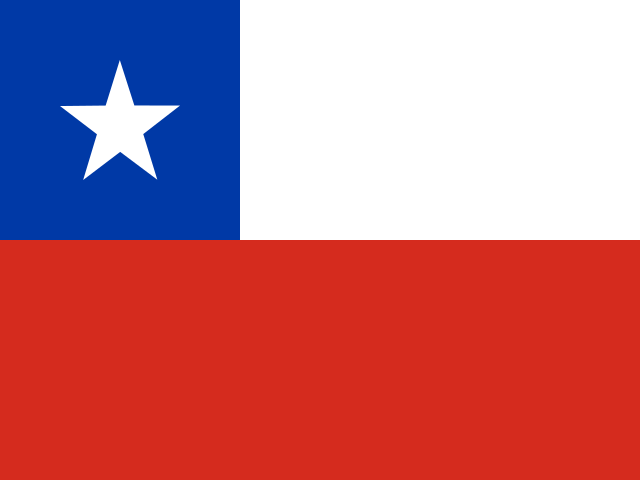
Two horizontal bands, white over red, with a blue square in the upper hoist bearing a single white five-pointed star. By popular tradition white recalls the snow of the Andes, blue the sky and red the blood shed for independence, though no Chilean statute assigns the colours or the star any meaning.
Chile FACTS ◢
| Capital | Santiago |
|---|---|
| Continent | South America |
| Population | 19,859,921 (2025) |
| Area | 756,102 km² |
| Population density | 26/km² |
| Currency | Chilean peso (CLP) |
| Main language | Spanish |
| Calling code | +56 |
| Internet TLD | .cl |
| Time zones | UTC-06:00, UTC-04:00, UTC-03:00 |
| Drives on the | Right |
| ISO codes | CL / CHL |
DID YOU KNOW? ◢
- It's one of the longest and narrowest countries in the world, spanning a huge range of climates.
- Its Atacama Desert is the driest non-polar desert on Earth, with places that may have never recorded rainfall.
- It governs Easter Island, home to the famous moai stone statues, thousands of kilometres out in the Pacific.
- The clear Atacama skies host some of the world's most powerful astronomical observatories.
Chile QUICK ANSWERS ◢
What is the capital of Chile?
The capital of Chile is Santiago.
What is the population of Chile?
Chile had a population of 19,859,921 in 2025.
What currency does Chile use?
Chile uses the Chilean peso (CLP).
What languages are spoken in Chile?
Chile designates no official language. The language of government and education is Spanish.
Think you know your flags? Play Flag Daily → · Browse all countries →
MORE ON THE FLAG ◢
Chile's flag is called La Estrella Solitaria, the Lone Star, and the usual account of it is quick and confident: white for the snow of the Andes, blue for the sky, red for the blood of independence.
Chilean law says none of that. It has been exact about this flag since 1912, fixing the width of each band, the shape of the blue field and the diameter of the star. None of the texts that define or regulate the flag assigns a colour a meaning.
The reading is not invented. It comes from Chile's own heritage bodies rather than from its statute book, and two arms of the same heritage service do not quite agree about it.
Key Takeaways
- The flag was adopted by a decree of 18 October 1817, signed by war minister José Ignacio Zenteno. The original of that decree is lost.
- Who drew it is genuinely disputed. Chile's foreign ministry names Antonio Arcos as most likely and records that some historians say Gregorio de Andía y Varela instead.
- Neither the 1912 colours law, the 1967 decree nor the Constitution assigns the colours or the star any meaning.
- The snow, sky and blood reading is supplied by Chilean heritage agencies, which attach it to the flag's short-lived 1817 predecessor and treat the current design as inheriting it.
- Until 2011, Chileans needed official permission to fly their own flag on any day other than three fixed dates.
| Instrument | Promulgated | What it does | Meaning it assigns the colours |
|---|---|---|---|
| Decree of the Ministry of War | 18 October 1817 | Adopts the current design | Original text lost |
| Law 2.597 | 11 January 1912 | Fixes the colours, band widths, star diameter and proportions | None |
| Supreme Decree 1.534 | 18 October 1967 | Restates that geometry and adds protocol | None |
| Supreme Decree 1.100 | July 1974 | Sets 9 July as the flag's own day | Not a design instrument |
| Constitution, article 2 (2005 consolidated text) | 17 September 2005 | Names the flag a national emblem | None |
| Law 20.537 | 16 September 2011 | Ends the permission requirement | None |
What do the colours of the Chilean flag mean?
The answer depends on who you ask, and the legal texts are the ones that decline to answer.
Chile's Servicio Nacional del Patrimonio Cultural, the national heritage service, does answer. Its Centro de Documentación de Bienes Patrimoniales gives the reading for the transitional flag adopted in 1817 after the patriot victory at Chacabuco: "azul por el cielo, blanco por la cordillera y rojo, que representa la sangre derramada por los héroes de la Independencia", blue for the sky, white for the mountain range, red for the blood spilled by the heroes of Independence. It then says the present design, dated to 18 October that same year, "conserva el simbolismo de la bandera de transición en lo que respecta a sus colores", keeps the transitional flag's colour symbolism.
So on that account the meanings are inherited rather than assigned to the flag Chile actually flies. The flag they were inherited from lasted months and was never given legal force. BiblioRedes, the heritage service's public library network, records that it was dropped in part because people kept confusing it with the flag of the Netherlands.
BiblioRedes also puts the colours differently: red for the blood of the heroes, white for "la nieve de la cordillera de los Andes", the snow of the Andes, and blue for "el limpio cielo chileno", the clear Chilean sky. Snow rather than mountain, from the same service. That page credits its text to a newspaper's schools site, which is worth knowing before treating it as the state speaking.
Chile's foreign ministry, which maintains the official page on the national emblems, explains what the coat of arms' golden naval crowns and its tricolour plume stand for, and offers not one word on what the flag's colours stand for.
The colours were never a regional convention, either. Neighbouring Argentina carries light blue and white with no red on it at all, and Peru red and white with no blue.
What does Chilean law actually say about the flag?
It says exactly how to draw it, and stops there.
The governing text is Supreme Decree 1.534 of the Ministry of the Interior, promulgated on 18 October 1967, the flag's one hundred and fiftieth anniversary, and published that December. Its article 1 sets the flag out in a single sentence of pure geometry. The flag "es igual en la vaina a dos tercios de su vuelo", meaning the hoist is two thirds of the fly. Then: "se divide en dos fajas horizontales de igual ancho, la faja inferior es roja y la superior azul turquí en tercera parte inmediata a la vaina y blanca en los dos tercios restantes de su vuelo, con una estrella blanca de cinco picos en medio del cuadro azul."
Two horizontal bands of equal width. The lower one red. The upper one blue for the third nearest the hoist and white for the remaining two thirds, with a white five-pointed star in the middle of the blue square. Note the colour word: not azul but azul turquí, an older term for a deep indigo. The decree fixes where that colour goes and never says how to mix it.
Then the clause that makes the star the most exactly specified thing on the flag: "El diámetro de esta estrella es igual a la mitad de un costado del cuadro que ocupa." The star's diameter is half the side of the square it sits in. The two-thirds ratio is what makes that field a true square of one third the fly. So the star comes out at a sixth of the flag's length, and ratio and square stand or fall together.
Law 2.597 of 11 January 1912 had already fixed both, and in that order: "El diámetro de la estrella será igual a la mitad de un costado del cuadrado azul. Las proporciones de la bandera son: en la vaina, dos tercios de su vuelo."
One instrument in the sequence is not about the design at all. The heritage service's documentation centre records Supreme Decree 1.100 of July 1974, which gave the flag its own day in the calendar, 9 July, and settles nothing about how it looks.
The Constitution adds an obligation and still no meaning. Article 2 names the emblems and nothing else: "Son emblemas nacionales la bandera nacional, el escudo de armas de la República y el himno nacional." Article 22 requires that "todo habitante de la República debe respeto a Chile y a sus emblemas nacionales", every inhabitant owes respect to Chile and its national emblems. A duty to respect the thing, with nothing said about what the thing represents.
Who designed the Chilean flag, and why is that still argued?
Because the document that would settle it no longer exists.
The design is credited to war minister José Ignacio Zenteno, who conceived it and signed the decree adopting it under Supreme Director Bernardo O'Higgins. Decree 1.534's own opening recital confirms the date and the signature, describing the current flag as established "por decreto del Ministerio de Guerra de 18 de octubre de 1817, siendo Secretario de Estado en esa Cartera el Coronel don José Ignacio Zenteno".
The hand that drew it is another matter. Chile's foreign ministry hedges in print: "Lo más probable es que haya sido diseñada por el militar español Antonio Arcos, aunque algunos historiadores mantienen que fue Gregorio de Andía y Varela quien la diseñó." Most likely the Spanish soldier Antonio Arcos, although some historians hold that Gregorio de Andía y Varela drew it.
There is a reason nobody can close it. BiblioRedes notes of the adopting decree that "sólo se conoce por referencias indirectas, pues el original desapareció", it is known only through indirect references, because the original disappeared. Every later account is working from citations of a text no longer in hand. The flag was first shown in public on 12 February 1818, at the solemn proclamation of independence.
What does the lone star stand for?
More than one thing, and the heritage service says so openly rather than picking a winner.
Its documentation centre lists three readings side by side: national unity; a possible inspiration in Venus, the morning star venerated by peoples including the Inca and the Mapuche; and the iconography of the Logia Lautaro, the independence lodge which the centre describes as counting O'Higgins, José Miguel Carrera and José de San Martín among its members. "En relación a la estrella hay más de una interpretación", it begins, and that hedge is the honest part.
BiblioRedes gives a fourth reading: the star "representa los poderes del Estado que velan por la integridad de la patria", the powers of the State that safeguard the nation's integrity. That one has a traceable ancestor. The same page records that for Camilo Henríquez, the 1812 flag of the Patria Vieja stood for three powers of state named as Majesty, Law and Force.
The version most English-language accounts print is on neither list. The Flag Institute gives the star as standing for Chile's independence, its status as a unitary republic, or a guide to progress, and the widely copied "honour and progress" formula turns up in no Chilean source consulted here.
Chilean law's only remark about the star is a protocol one, and it is oddly touching. Decree 1.534, article 3, provides that when a flag is flown in mourning without a pole, a black crepe is added at the upper corner by the hoist, "en forma que no cubra la estrella", so that it does not cover the star.
Chileans needed permission to fly their own flag until 2011
For most of this flag's modern life, using it was a privilege rather than a right.
Decree 1.534's article 2, in the wording it carried until 2011, allowed three fixed dates and no more: "ninguna persona ni reunión de personas podrá usar en público y enarbolar en los edificios públicos o particulares la Bandera Nacional, sin la correspondiente autorización." No person or gathering of people may display the flag in public or on a building, public or private, without the corresponding authorisation. The three dates were 21 May for the naval glories, and 18 and 19 September for the national holiday and the army. Anything else needed a governor's leave on justified grounds.
By 2010 the government was telling the Senate the rule had fallen into disuse while people flew the flag anyway. Law 20.537, promulgated on 16 September 2011, replaced it: the flag "podrá usarse o izarse sin autorización previa", may be used or hoisted without prior authorisation. Its article 5 repealed the old statutory basis by name, article 80 of decree with force of law 22 of 1959, the statute the 1967 decree had been implementing. Its article 1 defines the flag by pointing straight back at the 1912 colours-and-proportions law, adding no meaning of its own.
To see whether you could place Chile with no flag in front of you at all, Guess the Country gives you three clues and three guesses instead.
Frequently asked questions
What shade of blue is the Chilean flag?
Chilean law names it azul turquí, an older Spanish term for a deep indigo, and leaves it there. Neither Law 2.597 of 1912 nor Supreme Decree 1.534 of 1967 gives a numeric colour standard. Both fix exactly where each colour sits and how large the star is, and say nothing about how the colours are to be mixed.
How large is the star on the Chilean flag?
Its diameter is half the side of the blue square it occupies, which works out at a sixth of the flag's length, because the two-thirds ratio between hoist and fly makes that field a true square. The same decree also governs the pole: white, and no shorter than four thirds of the flag's fly when hoisted to the top.
Why is Chile's flag called La Estrella Solitaria?
Because the design carries exactly one device, a single white five-pointed star in the blue square, which is all Chilean law ever calls it. Chile's national heritage service describes that star as the new element the 1817 design added to the blue, white and red it inherited. The nickname appears in no Chilean statute.
Why does Chile's flag look like the flag of Texas?
Coincidence, and Chile got there first by twenty-two years. Texas adopted its Lone Star Flag on 25 January 1839, described in law as a blue vertical stripe one third of the flag's length bearing a white five-pointed star, with white over red stripes filling the rest. Chile's blue is a square canton, not a full-height stripe. The Texas State Historical Association records that the author of the Texas design is unknown and draws no link to Chile.
When is Chile's flag day, and why that date?
Chile marks its flag on 9 July, set by what the heritage service's documentation centre records as Supreme Decree 1.100 of July 1974. The date commemorates the Battle of La Concepción on 9 and 10 July 1882, where Chile's heritage service records that a detachment of seventy-seven soldiers and two cantineras was destroyed and only the remains of a Chilean flag were found flying over the church bell tower. That is separate from 18 October, the anniversary of the 1817 adoption.
Sources
- Biblioteca del Congreso Nacional de Chile, Ley Chile, Decreto 1534, Ministerio del Interior, "Determina los emblemas nacionales y reglamenta su uso" - retrieved 12 August 2026.
- Biblioteca del Congreso Nacional de Chile, Ley Chile, Ley 20.537, "Sobre el uso e izamiento del Pabellón Patrio" - retrieved 12 August 2026.
- Biblioteca del Congreso Nacional de Chile, Historia de la Ley N 20.537, whose presidential message to the Senate of 25 October 2010 quotes Law 2.597 of 1912 in full - retrieved 12 August 2026.
- Biblioteca del Congreso Nacional de Chile, Ley Chile, Constitución Política de la República de Chile, articles 2 and 22 - retrieved 12 August 2026.
- Ministerio de Relaciones Exteriores de Chile, Emblemas nacionales - retrieved 12 August 2026.
- Servicio Nacional del Patrimonio Cultural, Centro de Documentación de Bienes Patrimoniales, Datos curiosos sobre las banderas y nuestra bandera nacional - retrieved 12 August 2026.
- Servicio Nacional del Patrimonio Cultural, BiblioRedes, Día de la Bandera - retrieved 12 August 2026.
- The Flag Institute, Flag Week: Chile - retrieved 12 August 2026.
- Texas State Historical Association, Flags of Texas - retrieved 12 August 2026.
PLAY ANOTHER →
One quote, one scrambled alphabet. Crack it before tomorrow.
CRACK THE QUOTEDAILYDaily TriviaFive questions a day. Everyone gets the same five.
FIVE QUESTIONSDAILYGuess the CountryThree clues, three guesses. Work out where in the world it is.
THREE CLUESDAILYDaily CodeA short message, hidden in a different cipher every day.
ONE CIPHER A DAY