
Argentina
A long ribbon of a country stretching from subtropical jungle to the icy tip of Patagonia, where tango, steak and football are practically constitutional rights.
WHAT THE FLAG MEANS ◢
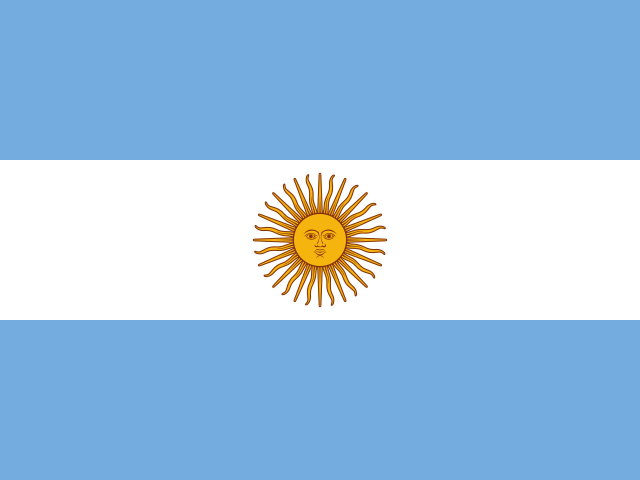
Three horizontal bands of light blue, white and light blue with a golden sun in the centre. Belgrano raised the light blue and white in 1812, taking them from the national cockade adopted that same month; Congress added the sun in 1818. Decree 10.302 of 1944 defines it as the sun engraved on the first Argentine coins of 1813, with thirty-two alternating flaming and straight rays, and assigns it no meaning; Casa Rosada traces the design to the Inca sun, a figure of Inti.
Source: servicios.infoleg.gob.ar
Argentina FACTS ◢
| Capital | Buenos Aires |
|---|---|
| Continent | South America |
| Population | 45,851,378 (2025) |
| Area | 2,780,400 km² |
| Population density | 16/km² |
| Currency | Argentine peso (ARS) |
| Main language | Spanish |
| Calling code | +54 |
| Internet TLD | .ar |
| Time zone | UTC-03:00 |
| Drives on the | Right |
| ISO codes | AR / ARG |
DID YOU KNOW? ◢
- It's home to Aconcagua, the highest mountain in both the Americas and the Southern Hemisphere.
- The country has won the men's football World Cup three times.
- The Iguazú Falls on its border form one of the largest waterfall systems on Earth.
- It shares Patagonia and the vast Pampas grasslands, famed for gauchos and cattle ranching.
- The tango, now danced worldwide, was born in the working-class neighbourhoods of Buenos Aires.
Argentina QUICK ANSWERS ◢
What is the capital of Argentina?
The capital of Argentina is Buenos Aires.
What is the population of Argentina?
Argentina had a population of 45,851,378 in 2025.
What currency does Argentina use?
Argentina uses the Argentine peso (ARS).
What languages are spoken in Argentina?
Argentina designates no official language. The language of government and education is Spanish.
Think you know your flags? Play Flag Daily → · Browse all countries →
MORE ON THE FLAG ◢
Argentina's flag did not begin with a sun on it. Manuel Belgrano raised light blue and white on the banks of the Paraná on 27 February 1812, and the sun arrived six years later, added by a congress sitting in Buenos Aires.
Then it went away again for most people. Between 1944 and 1985, an ordinary Argentine was legally entitled to fly the colours but not the sun.
Key Takeaways
- Belgrano raised the light blue and white at Rosario on 27 February 1812, nine days after the Triumvirate adopted a cockade in those colours.
- The sun was added on 25 February 1818, by the same congress that had approved the plain colours in 1816.
- Argentine law defines the sun by provenance, not meaning: the one engraved on the 1813 coins, thirty-two alternating flaming and straight rays, in gold yellow.
- Casa Rosada attributes the design to the Inca sun, a figure of Inti, chosen by the Peruvian engraver Juan de Dios Rivera.
- Decree 10.302 of 1944 reserved the flag with the sun for governments. Ley 23.208 opened it to everyone in 1985.
What does the sun on Argentina's flag mean?
The law that fixes the flag declines to say. Decree 10.302 of 1944 is still the governing standard, and its article 2 identifies the sun purely by where it came from: the one engraved on the first Argentine coins, the eight-escudo gold and eight-real silver pieces authorised on 13 April 1813, to be reproduced "con los treinta y dos rayos flamígeros y rectos colocados alternativamente".
Thirty-two rays, sixteen flaming and sixteen straight, alternating, positioned exactly as on those coins, in gold yellow. That is the whole legal specification, and no symbolism is assigned to it anywhere in the decree.
The face is not in the decree either, though it is on the flag. Casa Rosada describes the emblem as "un sol con rostro humano de color amarillo oro, rodeado por treinta y dos rayos": a sun with a human face, ringed by those rays. The decree tells you to reproduce the coin's sun, and the face is part of that figure.
The meaning people repeat comes from a different sort of state source. Casa Rosada, the presidential palace, says the Río de la Plata design departed from its French model in one way: "el orfebre peruano Juan de Dios Rivera utilizó el Sol Incaico. Esta figura era la representación de Inti, dios del sol inca, dios principal y creador".
That is a claim about where the picture came from, and about a deliberate choice by the patriots to build an American identity "en abierta oposición a la española". It is not a meaning the state prescribes, and the two get quoted as one.
The name adds a third layer. "Sol de Mayo" ties the emblem to the May Revolution of 1810, and Casa Rosada treats "el sol incaico o Sol de Mayo" as interchangeable labels, but no Argentine legal text makes that reading official.
The sun did not stay in Argentina, either. Casa Rosada notes it appeared on one of the early flags of Peru and is still on the flag of Uruguay, which is why those three are a standing trap in flag quizzes.
Who created Argentina's flag, and when did the sun arrive?
Five separate events, and merging them is where most accounts go wrong.
- 13 February 1812. Belgrano asks the Triumvirate to settle on a national cockade, so the revolutionary army can be told apart from its enemies.
- 18 February 1812. The Triumvirate decrees white and light blue, in the words of the Presidency's own account "quedando abolida la roja con que antiguamente se distinguían". The red one, abolished.
- 27 February 1812. Belgrano raises a flag in those colours at the Capilla del Rosario, now the city of Rosario. The 1944 decree records that he created it "conforme a los colores de la escarapela nacional".
- 20 July 1816. The Congress of Tucumán consecrates the same "celeste y blanco", on a motion by the deputy Juan José Paso.
- 25 February 1818. The same body, by then sitting in Buenos Aires, ratifies the flag and, as the Presidency puts it, incorporates "el sol incaico en la franja blanca central". Casa Rosada adds that Congress took only the sun, not the whole national shield it sits inside.
What do the light blue and white stand for?
Nothing that Argentine law states, which is the honest answer and an unsatisfying one.
The 1944 decree spends most of its preamble on the shade rather than the meaning, because that was the live dispute. It settles on light blue and glosses it: "este matiz del azul (el celeste), que quiere decir azul claro como el del cielo". Sky blue as a description of the colour, not an explanation of it.
The layout is settled the same way, by evidence rather than symbolism. The decree reaches for secret instructions issued from the Fortress of Buenos Aires on 21 September 1815 to the privateers Brown and Bouchard, describing the flag as "blanco en su Centro, y celeste en sus extremos al largo". White in the centre, light blue along the long edges, and the decree calls that document decisive.
So the provenance is documented and the symbolism is not. Sky and clouds, the Bourbon livery, the mantle of the Virgin: all popular readings, none of them in the statute that defines the flag.
Why was the sun off limits to ordinary Argentines until 1985?
Because article 3 of that same 1944 decree said so, in a single sentence: "Los particulares usarán solamente los colores nacionales en forma de bandera, sin sol, de escarapela o de estandarte". Private individuals, the colours only, without the sun.
The Bandera Oficial de la Nación, the version with the sun, belonged to the federal government, the provinces and the governorships. For forty-one years the country effectively flew two flags: an official one, and a plainer one for everybody else.
Ley 23.208 ended that. Sanctioned on 25 July 1985 and promulgated on 16 August, it runs to three articles. Article 1 grants the right to use the official flag to the federal government, the provincial governments and the southern territories, "así como también los particulares". Article 2 repeals the offending article 3, along with two earlier restrictions from 1884 and 1943.
So a sunless Argentine flag in an old photograph is usually not an error. Before 1985 it was what a private citizen was supposed to be flying.
Argentina has a second national flag
Ley 27.134 of 2015 recognises the Bandera Nacional de la Libertad Civil as a historic national symbol: white satin bearing the Seal of the Assembly of the Year XIII, blessed by Belgrano and handed to the Cabildo of Jujuy on 25 May 1813, in thanks for what that province had given to the war of emancipation. It carries no sun.
It is a working flag rather than a relic. Article 4 requires it to be shown alongside the official flag, and article 5 ranks it below that flag and above those of the provinces. Both sit in the country pages with every other national design. So Argentina has two national flags in law, and only one of them has a sun on it.
Frequently asked questions
What does the Sun of May on the Argentine flag represent?
Argentine law assigns it no meaning. Decree 10.302 of 1944, which defines the flag, identifies the sun only as the one engraved on the first Argentine coins of 1813 and specifies its thirty-two rays and gold colour, without saying what it stands for.
Casa Rosada, separately, attributes the design to the Inca sun used by the Peruvian engraver Juan de Dios Rivera, a figure of Inti. That is an account of the design's origin rather than an official symbolism.
How many rays does the sun on the Argentine flag have?
Thirty-two. Sixteen are flaming and sixteen are straight, placed alternately and in the same position as on the eight-escudo gold and eight-real silver coins of 1813, the source of the design. The specified colour is gold yellow.
Who created the Argentine flag, and when?
General Manuel Belgrano, on 27 February 1812, at the Capilla del Rosario on the Paraná, now the city of Rosario. He used the colours of the national cockade that the Triumvirate had adopted nine days earlier, at his own request.
When was the sun added to the Argentine flag?
On 25 February 1818, by the Congress of Tucumán sitting in Buenos Aires. The same congress had consecrated the plain light blue and white on 20 July 1816, so the flag existed for six years before it carried a sun.
Can anyone fly the Argentine flag with the sun on it?
Yes, since 1985. Ley 23.208 granted the right to use the Bandera Oficial de la Nación to the federal government, the provincial governments and private individuals alike, subject to the flag always being shown due respect and honour.
Before that law, article 3 of Decree 10.302 of 1944 left private citizens the colours without the sun.
Sources
- InfoLeg, Ministry of Justice, Decreto 10.302/1944, texto actualizado - article 2 and preamble. Retrieved 12 August 2026.
- Argentina.gob.ar, Decreto 10.302/1944, texto original - article 3 as enacted, before its repeal. Retrieved 12 August 2026.
- InfoLeg, Ministry of Justice, Ley 23.208 - articles 1 and 2. Retrieved 12 August 2026.
- Casa Rosada, Presidency of the Nation, Estación del Sol de Mayo - retrieved 12 August 2026.
- Argentina.gob.ar, Presidency of the Nation, Bandera Nacional and Escarapela Nacional - retrieved 12 August 2026.
- InfoLeg, Ministry of Justice, Ley 27.134 - articles 1, 4 and 5. Retrieved 12 August 2026.
PLAY ANOTHER →
One thing that happened today in history. Every day, a new one.
TODAY IN HISTORYDAILYDaily CodeA short message, hidden in a different cipher every day.
ONE CIPHER A DAYDAILYDaily TriviaFive questions a day. Everyone gets the same five.
FIVE QUESTIONSDAILYDaily CryptogramOne quote, one scrambled alphabet. Crack it before tomorrow.
CRACK THE QUOTE