
Uruguay
A small, easygoing country wedged between Brazil and Argentina, Uruguay won the very first football World Cup on home soil and has been punching above its weight ever since.
WHAT THE FLAG MEANS ◢
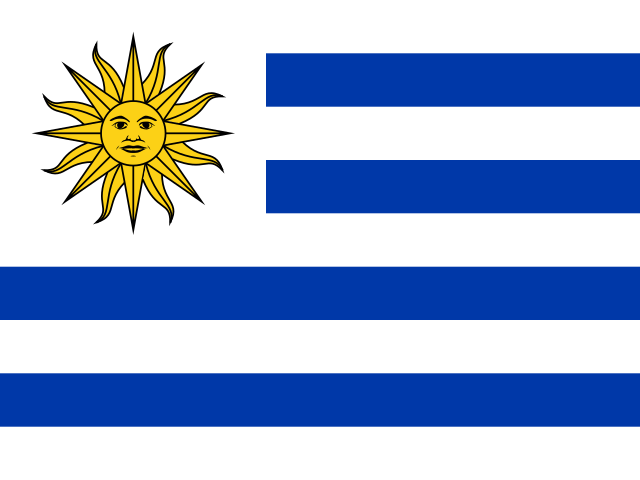
Nine horizontal stripes, five white and four blue, with a white canton bearing the golden Sun of May, a radiant disc with a face bordered by sixteen rays. The constitution says nothing about the flag. The law of 16 December 1828 gave it nine sky-blue stripes on white and the reform of 12 July 1830 cut those to four, which with white at the top and bottom is the nine flown today; neither law explains any of it. The nine stripes are conventionally read as the nine departments the country had at the time.
Source: impo.com.uy · archive.org · checked 2026-08-21
Uruguay FACTS ◢
| Capital | Montevideo |
|---|---|
| Continent | South America |
| Population | 3,384,688 (2025) |
| Area | 176,215 km² |
| Population density | 19/km² |
| Currency | Uruguayan peso (UYU) |
| Main language | Spanish |
| Calling code | +598 |
| Internet TLD | .uy |
| Time zone | UTC-03:00 |
| Drives on the | Right |
| ISO codes | UY / URY |
DID YOU KNOW? ◢
- It hosted and won the first-ever FIFA World Cup in 1930.
- Montevideo, its capital, is home to roughly a third of the entire national population.
- It became the first country in the world to give every primary-school child a laptop, under Plan Ceibal.
- Cattle comfortably outnumber people, making beef a cornerstone of its economy and its asado barbecues.
Uruguay QUICK ANSWERS ◢
What is the capital of Uruguay?
The capital of Uruguay is Montevideo.
What is the population of Uruguay?
Uruguay had a population of 3,384,688 in 2025.
What currency does Uruguay use?
Uruguay uses the Uruguayan peso (UYU).
What languages are spoken in Uruguay?
Uruguay designates no official language. The language of government and education is Spanish.
Think you know your flags? Play Flag Daily → · Browse all countries →
MORE ON THE FLAG ◢
The note on this page headed WHAT THE FLAG MEANS says that neither of the two laws it names explains any of it. That is exact, and it is worth seeing how completely they say nothing. Three instruments make this flag, passed in 1825, 1828 and 1830, and each of them is a single article. Between them they name four colours, three stripe counts and a sun, and stop there.
The news is what happened instead. There is an official Uruguayan text that states in terms what the flag symbolises, and it is not a statute about the flag at all. It is the oath sworn to it, and what it puts behind the cloth is the constitution and the laws of the Republic, the honour and integrity of the Nation, and its democratic institutions.
The oath names "la Constitución y las leyes de la República" without dating either, so the constitution it points at is whichever one is in force. Two Uruguayan constitutions were read for this article, the founding text of 1830 and the text in force today, and neither has a flag provision.
Key Takeaways
- The three flag instruments are one article each. The law of 25 August 1825 fixes "tres fajas horizontales, celeste, blanca y punzon" provisionally; the law of 16 December 1828 makes the flag white with nine sky-blue stripes and a white square carrying a sun; the reform sanctioned 11 July 1830 and in force from the 12th cuts it to four blue stripes on a white field. Not one adjective of meaning in any of them.
- The 1828 assembly that left the flag unexplained gave the coat of arms four meanings three months later. The law of 14 March 1829 assigns "símbolo de la igualdad, y la justicia", "símbolo de fuerza", "símbolo de la libertad" and "símbolo de la abundancia" to four charges, and assigns nothing to the sun that crowns them.
- No flag instrument states a stripe total at all. The 1828 law counts nine blue stripes and gives no total; the 1830 reform counts four blue stripes and gives none either. The nine stripes flown today follow from the 1830 count read with the 1952 decree's rule that the first stripe and the last are white.
- The nine departments are in a different document. Article 1 of the constitution of 1830 defines the State as the citizens of "los nueve Departamentos actuales de su territorio", and its article 20 names them. That constitution was set by law to be sworn on 18 July 1830, a week after the flag was reformed, and it says nothing about the flag.
- The sixteen rays are real and the alternation of straight and flaming rays belongs to a different sun. The decree of 18 February 1952 gives the flag's sun "un círculo radiante, con cara, orlado de diez y seis rayos" and says nothing about their kinds. The seven lance-point rays and eight flame rays are the 1908 rules for the sun on the coat of arms.
| Instrument | Date | What it fixes | Meaning it assigns |
|---|---|---|---|
| Ley, Pabellón Nacional, fijación provisoria | 25 August 1825, receipt acknowledged 26 August | Three horizontal bands, celeste, blanca and punzon, expressly provisional | None |
| Ley, Pabellón Nacional, su creación | 16 December 1828 | White with nine sky-blue horizontal alternating stripes; a white square at the upper hoist carrying a Sun | None |
| Ley, Escarapela Nacional | 20 December 1828, circulated 22 December | The national cockade shall be sky blue | None |
| Ley, Escudo de Armas del Estado | 14 March 1829, receipt acknowledged 19 March | A quartered oval crowned with a sun | Four, one for each quarter; none for the sun |
| Ley, Pabellón Nacional, su reforma | 11 July 1830, cúmplase 12 July | Four blue horizontal stripes on a white field, equally distributed | None |
| Decreto del Poder Ejecutivo | 18 February 1952 | Colours, 3:2 proportions, the canton's extent, sixteen rays, the sun's diameter | None |
The word nine is in the 1828 law, and it is not the number of stripes
Open the law of 16 December 1828 and the number is in the first clause of it. The Honourable General Constituent and Legislative Assembly, sitting at Canelones, resolved a single article:
"El pabellón del Estado será blanco con nueve listas de color azul celeste horizontales y alternadas, dejando en el ángulo superior del lado del asta un cuadro blanco en el cual se colocará un Sol".
The flag of the State shall be white with nine sky-blue horizontal alternating stripes, leaving in the upper angle on the staff side a white square in which a Sun shall be placed.
Nine stripes, then. Except that they are the nine blue ones, and the law gives no total.
That gap is wider than it looks. Nine blue stripes alternating on a white field can be drawn two ways, and the law does not choose between them. Put white at the top and the bottom edge and you get ten white bands and nineteen stripes. Put blue at both edges and you get eight white bands and seventeen. Seventeen is the second of those, and it is the count that circulates. The law supports it no better than it supports the first. It says the flag is white, that nine of its stripes are sky blue, and that they alternate, and it leaves the edges to whoever cuts the cloth.
The instruments that follow do lean one way. The reform of 1830 changes the stripe count and leaves everything else "conforme al que establece la ley de 16 de Diciembre de 1828", in conformity with what the 1828 law establishes, so whichever edge convention that law carried, the 1830 flag inherits it.
Article 6 of the 1952 decree then says of the flag in force that "La primera franja y la última serán de color blanco", the first stripe and the last shall be white, and that the sun's square reaches the sixth stripe, which is blue. That is a nine-stripe flag with white edges. Run the blue-edged convention through the same reform instead and four blue stripes give seven, blue at the top and the bottom, which is not the flag the 1952 decree goes on to describe. So the chain corroborates white edges, and seventeen is the reading it does not corroborate.
That holds on one assumption, which is that the 1952 decree was writing down a convention it had inherited rather than choosing one. Its own preamble leaves room for the second, since the commission behind it was asked to remedy the absence of precise rules. What it does not leave room for is seventeen, which has no instrument behind it at all.
Now the reform. On 11 July 1830 the same assembly sanctioned another single article, and the Executive ordered it into effect the following day:
"El Pabellón Nacional constará de cuatro listas azules horizontales en campo blanco distribuidas con igualdad en su extensión, quedando en lo demás conforme al que establece la ley de 16 de Diciembre de 1828".
The National Flag shall consist of four blue horizontal stripes on a white field, equally distributed across its extent, remaining in all else in conformity with what the law of 16 December 1828 establishes.
Four blue stripes on white, evenly spaced, gives five white bands and nine stripes in all. The reform does not say nine either. It says four.
So the number nine survives the reform, and survives it having changed what it counts. Before 1830 nine was the count of blue stripes, on a flag whose total the law never gave. After 1830 nine is the total, on a flag whose blue stripes the law counts as four. Neither instrument writes the word about the thing a reader counts, so a claim resting on the nine stripes as a legal figure rests on arithmetic rather than on either text.
Uruguay's three flag instruments, and not one adjective of meaning
The 1828 law was not the first. The Honourable Chamber of Representatives of the Provincia Oriental, sitting at San Fernando de la Florida on 25 August 1825, had already fixed a flag, and had fixed it as a stopgap. Its reasoning is worth reading because it is the only one of the three that reasons at all:
"Siendo una consecuencia necesaria del rango de Independencia y Libertad que ha recobrado de hecho y de derecho la Provincia Oriental, fijar el pabellón que debe señalar su Ejército y flamear en los pueblos de su territorio, se declara por tal, el que tiene admitido, compuesto de tres fajas horizontales, celeste, blanca y punzon, por ahora, y hasta tanto que incorporados los Diputados de esta Provincia, a la Soberanía Nacional, se enorbole el reconocido por el de las unidades del Río de la Plata, a que pertenece".
Being a necessary consequence of the rank of Independence and Liberty that the Provincia Oriental has recovered in fact and in law, to fix the flag that shall mark its Army and fly in the towns of its territory, it is declared to be the one already in use, composed of three horizontal bands, sky blue, white and crimson, for now, and until such time as, the Deputies of this Province having been incorporated into the National Sovereignty, the one recognised by that of the United Provinces of the Río de la Plata, to which it belongs, is raised. The compilation prints "las unidades" there; its own index writes the Provincias Unidas out in full, in the entry printed immediately above this law.
Three bands, named by colour, adopted "por ahora", for now. The law explains why the province needs a flag. It never explains why those colours.
Jump forward to Canelones in December 1828 and the habit is unchanged. Four days after the flag law, the same assembly created the national cockade in one line, "La Escarapela nacional será color azul celeste", the national cockade shall be sky blue, and left that unexplained too. All three flag instruments and the cockade do the same thing. They are specifications, and specifications only.
The 1828 assembly explained the coat of arms, four times over, three months later
This is the part that makes the flag's silence look deliberate rather than accidental. On 14 March 1829, at the Aguada, the same General Constituent and Legislative Assembly created the coat of arms, and it wrote the meanings straight into the operative article:
"El escudo de armas del Estado, será un óvalo coronado con un sol y cuarteado: con una balanza por símbolo de la igualdad, y la justicia, colocada sobre esmalte azul, en el cuadro superior de la derecha: en el de la izquierda, el Cerro de Montevideo, como símbolo de fuerza, en campo de plata; en el cuadro inferior de la derecha, un caballo suelto, como símbolo de la libertad, en campo de plata, y en el de la izquierda, sobre esmalte azul, un buey, como símbolo de la abundancia", and the article runs on to the trophies and emblems that decorate the shield.
A pair of scales as the symbol of equality and justice. The Cerro de Montevideo as the symbol of strength. A loose horse as the symbol of liberty. An ox as the symbol of abundance. Four interpretive clauses in one article, from the assembly that had described the flag three months earlier without a single one.
And the arms article opens by crowning the oval "con un sol", with a sun, and says nothing at all about what the sun means. The one element the arms share with the flag is the one element the arms law also declines to explain.
That is a much harder fact than a general silence. A legislature that does not think in symbolic terms leaves everything bare. This one plainly did think in those terms, produced four readings in a single sentence when it wanted to, and produced none for the flag or for the sun on either.
Two dates for one instrument, and no settled rule about which the state cites
Most of these laws carry two dates, the day the assembly's text is dated and the day the Executive acted on it, and the state has never settled which of the two it cites. For the 1830 reform it is the second, and that one has stuck: the reform is dated 11 July and its cúmplase 12 July, and article 6 of the decree of 18 February 1952 names the flag as the one adopted by the laws of 16 December 1828 and 12 July 1830. Decreto 557/976 reaches for the same pair and mistypes it, printing "12 de julio de 1930" for a law of 1830.
For the others the volume goes the other way. Its chronological index files the law of 25 August 1825 at 26 August, the day its receipt was acknowledged, and the cockade of 20 December 1828 at the 22nd, the day it was circulated. This article names each law by the date printed on the instrument itself, which is why it says 25 August 1825 and 20 December 1828 where the volume's index says 26 August and 22 December.
Two state publications carry these instruments. One is the Compilación de leyes y decretos 1825-1930, the state's own chronological compilation, whose page images the official publisher IMPO serves; unless this page says otherwise, every quotation from the laws of 1825, 1828, 1829 and 1830 comes from it. The other is the Ministry of the Interior's annotated edition of the 1952 decree, which reprints those same flag laws as footnotes to the articles that cite them, and which is the source here for the 1952 and 1908 decrees.
They do not agree, and neither agrees entirely with itself. The compilation's chronological index calls the law of 16 December 1828 "Modificando el pabellón nacional", modifying the national flag, while the heading printed over the law itself calls it "Su creación", its creation. The annotated edition's reprint of the same law writes "en el cual se colocará el sol", the sun, where the compilation prints "un Sol", a Sun; its reprint of the 1830 reform drops the word "horizontales" the compilation carries. The compilation has its own spellings: at the 1825 law it prints "se enorbole" where modern Spanish would have enarbole.
The arms law shows the same thing at its sharpest. On a single page the annotated edition heads Ley 3.060 of 1906 as a "Modificación de la ley de 19 de Marzo de 1829" and then prints, on the next lines, that law's article 1, which calls the arms "creado por ley de 14 de Marzo de mil ochocientos veinte y nueve", created by the law of 14 March 1829. Lower down the same page, the decree of 1908 that adopted the official model says the model was ordered "al ponerse el cúmplase a la ley respectiva el 19 de Marzo de 1829". Two dates for one instrument, a heading and an article apart.
The 1908 decree also describes the act of 19 March as a cúmplase, an order to execute. The compilation prints the act itself, and it is not one. Running across pages 101 and 102 it reads "Acúsese recibo, comuníquese a los Ministerios de Guerra, y Hacienda, circúlese, insértese en el Registro Oficial y mándese gravar el escudo": acknowledge receipt, notify the ministries of War and Finance, circulate it, insert it in the Official Register, and order the shield engraved.
The volume prints a cúmplase when there is one. Lower down page 102, past an unrelated decree of 4 April 1829 on the public accounts, that decree's own executive act of 7 April reads "Acúsese recibo, cúmplase y publíquese". One page, both formulas, and the arms law got the one without it.
The sixteen rays are Uruguayan law. The straight-and-flaming alternation is a different sun
For a hundred and twenty-four years after 1828 the sun on the flag was, as a matter of text, just "un Sol". The gap was closed by the decree of the Executive Power of 18 February 1952, which is still the operative regulation of the national symbols and whose own preamble says why it was needed: the commission that studied the matter advised rules "conducentes a paliar la ausencia de normas precisas en la materia", tending to remedy the absence of precise rules on the subject. The state, in 1952, describing its own symbol law as imprecise.
Its article 6 is the whole of the flag's specification. It opens by pointing backwards, naming the flag as the one adopted by the laws of 16 December 1828 and 12 July 1830, and then specifies:
"Sus colores serán el blanco y el azul, teniendo el sol, que ocupa el cuadro, color oro."
Its colours shall be white and blue, the sun which occupies the square being gold. The proportions come next, borrowed from the 1884 military code: "el largo y el ancho estarán en relación de 3 a 2 (artículo 77 del Código Militar)", the length and the width shall be in a relation of three to two. Then the geometry, in one run:
"y el espacio que contiene el sol consistirá en un cuadro en la parte superior, junto al asta, que llegará hasta la sexta franja, exclusive, de color azul. La primera franja y la última serán de color blanco. El dibujo del sol consistirá en un círculo radiante, con cara, orlado de diez y seis rayos. El sol tendrá un diámetro de 11/15 del cuadro blanco".
The space containing the sun shall consist of a square at the top, beside the staff, reaching to the sixth stripe, exclusive, which is blue. The first stripe and the last shall be white. The drawing of the sun shall consist of a radiant circle, with a face, bordered by sixteen rays. The sun shall have a diameter of eleven fifteenths of the white square.
That counting rule is worth pausing on, because it is the closest any instrument comes to fixing the total. A canton that stops at the sixth stripe, and a sixth stripe that is blue, only works on a flag whose stripes alternate starting with white. Put that beside the first and the last being white and the four blue stripes of 1830, and nine falls out. The decree still never writes it.
Two things follow. The first is that sixteen rays is a real legal figure, not folklore. The second is that the decree stops there. It does not divide the sixteen into kinds, does not call any of them straight, and does not call any of them flames.
The rays that alternate straight with flaming belong to the other sun. The decree of 26 October 1908, which adopted the official model of the coat of arms, draws it in detail: the sun crowning the oval shows three quarters of its disc, the face shows only the eyes and the nose, and "de dicho disco saldrán siete rayos en forma de punta de lanza; de entre estos saldrán otros ocho rayos dibujados en forma tal que aparezcan llamas de fuego". Seven rays in the form of a lance point, and eight more between them drawn to appear as flames of fire. Seven and eight, fifteen in total, on the arms.
So a description of the flag's sun as sixteen rays alternating eight straight with eight flaming is two suns spliced together. It takes the count from the 1952 flag article and the alternation from the 1908 arms decree, where the counts are seven and eight rather than eight and eight. Argentine law does define its sun that way. Article 2 of Argentina's Decreto 10.302 of 1944 specifies the sun of the 1813 coin "con los treinta y dos rayos flamígeros y rectos colocados alternativamente", with the thirty-two flaming and straight rays placed alternately. Uruguay's instruments say nothing of the kind about the flag, which is one reason the sun on Argentina's flag is worth reading beside this one.
The Museo Histórico Nacional holds the pattern every reproduction must respect
Article 4 of the 1952 decree does something a specification cannot do on its own. It puts the authority in an object:
"El Museo Histórico Nacional conservará un patrón de cada uno de los símbolos indicados, y su reproducción no podrá hacerse sin respetar aquéllos en su dibujo, colores, texto y proporciones", and the article goes on to give the museum the historic flags too worn to fly.
The Museo Histórico Nacional shall keep a pattern of each of the symbols indicated, and their reproduction may not be made without respecting those patterns in their drawing, colours, text and proportions.
That is the answer to every question the text leaves open. Which blue. What the face on the sun looks like. How the rays are shaped. The decree gives numbers where it can and then points at a physical standard for the rest, which is a candid way of admitting that a flag is a drawing before it is a sentence.
The oath sworn to the flag says what it symbolises, and names four things
Article 13 of the same decree sends the Jura de la Bandera, the swearing to the flag, to articles 28 and 29 of law 9.943 of 20 July 1940 and to the decrees of 1943 that carry them out. The state's own annotated edition of the symbol rules prints that formula in full, and it is the only place in that volume where anything is said to symbolise anything about the flag. The obvious other candidate is silent too: the Manual de Ceremonial Público approved by decree 435/007 in 2007 governs where the flag stands, who may raise it and how it is carried, and never says what it stands for.
The senior authority administering it is directed first to explain "el significado del concepto de Patria, la razón de ser de los símbolos materiales que la representan: la Bandera y el Escudo Nacional", and then the purpose of the ceremony. Then comes the question:
"Juráis honrar vuestra Patria, con la práctica constante de una vida digna, consagrada al ejercicio del bien para vosotros y vuestros semejantes; defender con sacrificio de vuestra vida, si fuere preciso, la Constitución y las leyes de la República, el honor y la integridad de la Nación y sus instituciones democráticas, todo lo cual simboliza esta Bandera?".
Do you swear to honour your Fatherland, by the constant practice of a worthy life, devoted to the exercise of good for yourselves and your fellows; to defend with the sacrifice of your life, if need be, the Constitution and the laws of the Republic, the honour and integrity of the Nation and its democratic institutions, all of which this Flag symbolises?
The clause that carries it is "todo lo cual simboliza esta Bandera", all of which this Flag symbolises. It is the assignment the flag laws never made, and it is not doing what a colour gloss does. It attaches no meaning to blue, or to white, or to the sun, or to a stripe. It attaches the whole flag to four things at once: the constitution, the laws, the nation's honour and integrity, and its democratic institutions.
Compare that with what Cuban law does. Article 6 of Cuba's Ley No. 128 of 2019, the Ley de los Símbolos Nacionales, takes the star, the triangle, the red inside it and the white and blue stripes one at a time and says what each of them stands for. Uruguay never took the flag apart. It made the flag stand for the whole arrangement.
The nine departments are in the constitution of 1830, which never mentions the flag
The reading that the nine stripes stand for nine departments has a real historical anchor, and it is worth being exact about where the anchor is, because it is not in any flag instrument.
Article 1 of the constitution of 1830 reads:
"El Estado Oriental del Uruguay es la asociación política de todos los ciudadanos comprendidos en los nueve Departamentos actuales de su territorio".
The Eastern State of Uruguay is the political association of all the citizens comprised in the nine present Departments of its territory.
Nine, in the first article, as a definition of the country. Its article 20 then names them while apportioning the first two legislatures: Montevideo five representatives, Maldonado four, Canelones four, San José three, Colonia three, Soriano three, Paysandú three, Durazno two, Cerro Largo two.
The dates sit very close together. The flag reform was sanctioned on 11 July 1830 and ordered into effect on the 12th. The law of 26 June 1830 setting the formalities for the oath to the constitution required that it "será publicada y solemnemente jurada la Constitución en el día 18 de Julio del presente año", that the Constitution be published and solemnly sworn on 18 July of that year. Seven days after the reform was sanctioned, six after it was ordered into effect.
So in the same month, the country's stripes fell to nine and the country's own founding text said it had nine departments. That is a strong reason for the reading to have arisen and a weak reason to call it official, because the constitution that supplies the number is also the document that never mentions the flag. Its 159 articles run from the section on the Nation to the section on the observance of the old laws, and the pabellón appears in none of them.
Nor does it in the constitution in force. The text served by IMPO, the state's official legal publisher, runs to 332 articles, and a search of the whole of it for pabellón, bandera, escarapela, escudo, himno, símbolo and emblema returns nothing. In neither text read for this article are the national symbols constitutional matter. The 1952 decree declares six of them, and the flag, the cockade and the arms rest on five one-article laws passed between 1825 and 1830 and on that decree, which is exactly the arrangement the 1952 commission was appointed to tidy up. Uruguay has had constitutions in 1918, 1934, 1942 and 1952 as well; those were not opened here, and IMPO serves them only behind a subscription.
What Uruguay's flag is, stated only from the instruments
Strip out everything the instruments do not carry and this is what is left, all of it sourced.
Nine stripes, five white and four blue, the first and the last white, from the 1830 reform read with article 6 of the 1952 decree. Length to width three to two. A white square at the upper hoist reaching to the sixth stripe, which is blue. A gold sun in that square, drawn as a radiant circle with a face and bordered by sixteen rays, its diameter eleven fifteenths of the square. A pattern held at the Museo Histórico Nacional that any reproduction must respect.
And an oath which says that what all of it symbolises is the constitution, the laws, the nation's honour and integrity, and its democratic institutions.
Everything else you will read about the flag, the departments, the Sun of May as an emblem of independence and liberty, is a reading. Some of those readings are old and widely held. None of them is in the law.
Frequently asked questions
Does Uruguay's constitution say anything about the flag?
No. The constitution in force has 332 articles and none of them mentions the flag, the coat of arms, the anthem, the cockade or the national symbols at all. The flag rests entirely on ordinary law: the acts the state cites as those of 16 December 1828 and 12 July 1830, and the executive decree of 18 February 1952 that regulates the design. The constitution of 1830 was the same, with 159 articles and no flag provision, even though the law set it to be sworn a week after the flag was reformed.
How many rays does the sun on Uruguay's flag have?
Sixteen. Article 6 of the decree of 18 February 1952 specifies "un círculo radiante, con cara, orlado de diez y seis rayos", a radiant circle with a face bordered by sixteen rays, with a diameter of eleven fifteenths of the white square. The decree does not divide those sixteen into straight and flaming rays. That distinction comes from the decree of 26 October 1908 on the coat of arms, whose sun has seven lance-point rays and eight flame-shaped ones, fifteen in all.
Why does Uruguay's flag have nine stripes?
Because the reform of 11 July 1830 cut the blue stripes from nine to four, and four blue stripes evenly spaced on a white field with white at each end, a rule article 6 of the decree of 18 February 1952 supplies, leaves nine stripes in total. The reform states four, not nine, and gives no reason for the change. The common explanation, that the nine stripes stand for Uruguay's nine departments, appears in no flag instrument. Its anchor is article 1 of the constitution of 1830, which defines the State as the citizens of the nine departments then existing and was set by law to be sworn a week after the reform.
Was the Uruguayan flag adopted in 1828 or 1830?
Both dates are correct for different flags, and there is an earlier one still. The law of 25 August 1825 fixed a provisional flag of three bands, sky blue, white and crimson. The law of 16 December 1828 replaced it with a white flag of nine sky-blue stripes and a sun in a white canton, giving no stripe total. Seventeen is the figure that circulates for that flag, nine blue alternating with eight white, which requires blue at both edges; the law does not say so. The law sanctioned on 11 July 1830 and ordered into effect on the 12th reduced the blue stripes to four, producing the flag flown today. Uruguayan instruments usually cite the pair as 16 December 1828 and 12 July 1830.
Does any Uruguayan law say what the flag's colours mean?
No law assigns a meaning to the blue, the white or the sun. The three flag instruments are specifications only, and the 1952 decree that fixed the proportions and the sun's design added no gloss. The one place the state's own consolidation of the symbol rules says what the flag stands for is the oath of the flag, set by law 9.943 of 1940 and the decrees of 1943 that carry it out, and it attaches the whole flag rather than any element of it to the constitution and the laws of the Republic, the honour and integrity of the Nation, and its democratic institutions.
Sources
- Compilación de leyes y decretos 1825-1930, tomo I, published by the Uruguayan state and served as page images by IMPO, the Dirección Nacional de Impresiones y Publicaciones Oficiales. Each page is a separate image: page 10 and page 11, the flag law of 25 August 1825 and its transmission and receipt of 26 August; page 83, the flag law of 16 December 1828; page 84, the cockade law; page 101 and page 102, the coat of arms law of 14 March 1829 and the executive act of 19 March; page 217, the law of 26 June 1830 on the swearing of the constitution; page 222, the flag reform of 11 July 1830; page 243 and page 247, articles 1 and 20 of the constitution of 1830, which runs to page 264; page 417, page 420, page 421 and page 428, the chronological index. Retrieved 21 August 2026.
- Símbolos Nacionales, Decreto del Poder Ejecutivo del 18 de febrero de 1952, annotated edition, Ministerio del Interior, República Oriental del Uruguay. Carries the decree in force, the flag laws of 1828 and 1830 as footnotes, the coat of arms decree of 26 October 1908 and the formula of the oath of the flag. Retrieved 21 August 2026.
- Constitución de la República, official text, IMPO. Retrieved 21 August 2026.
- Decreto N.o 557/976 of 24 August 1976, IMPO, on the flying of the national flags. Its second considerando names the acts that fixed the flag as those "de 16 de diciembre de 1828 y 12 de julio de 1930", the year 1930 being a misprint for 1830 in the text IMPO serves. Retrieved 21 August 2026.
- Decreto N.o 273/995 of 26 July 1995, IMPO, the only later amendment to the 1952 regulation. Retrieved 21 August 2026.
- Repartido N.o 421, October 2025, Cámara de Representantes, a bill on the protection and use of the national symbols which recognises as national symbols only those established by the decree of 18 February 1952. Retrieved 21 August 2026.
- Cuba, Asamblea Nacional del Poder Popular, Ley No. 128, Ley de los Símbolos Nacionales, Gaceta Oficial No. 71 Ordinaria of 19 September 2019, article 6, cited once for the contrast with the Uruguayan instruments. Retrieved 21 August 2026.
- Argentina, Ministerio de Justicia, Decreto 10.302/1944, texto actualizado, article 2, cited once for the contrast with the Uruguayan sun. Retrieved 21 August 2026.
- Decreto N.o 435/007 of 14 November 2007, IMPO, approving the Manual de Ceremonial Público. Read in full for this article and cited as a null result: it regulates the flag's placement, precedence and handling throughout and assigns it no meaning. Retrieved 21 August 2026.
- Digesto Departamental de Montevideo, articles 751 to 753, Intendencia de Montevideo, reproducing articles 1, 2 and 4 of the 1952 decree. Retrieved 21 August 2026.
PLAY ANOTHER →
One thing that happened today in history. Every day, a new one.
TODAY IN HISTORYDAILYDaily CodeA short message, hidden in a different cipher every day.
ONE CIPHER A DAYDAILYGuess the CountryThree clues, three guesses. Work out where in the world it is.
THREE CLUESDAILYDaily CryptogramOne quote, one scrambled alphabet. Crack it before tomorrow.
CRACK THE QUOTE