
North Korea
One of the most closed-off countries on Earth, North Korea keeps its own calendar and its own carefully guarded borders on the northern half of the Korean peninsula.
WHAT THE FLAG MEANS ◢
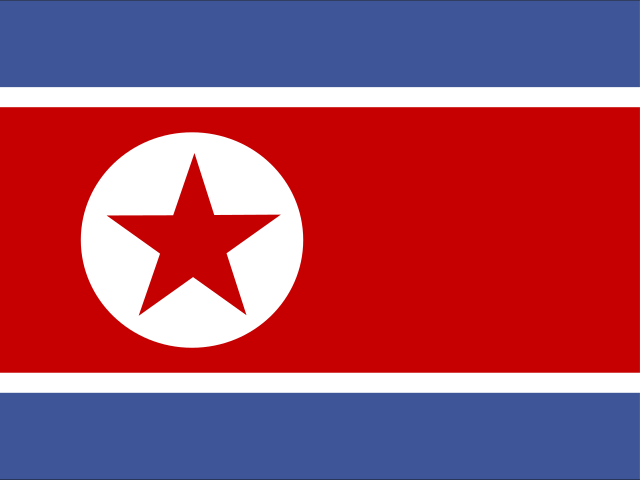
A wide central red panel bordered above and below by a narrow white stripe and a broad blue stripe, with a red five-pointed star in a white circle near the hoist. Article 166 of the constitution prescribes exactly that, sets the flag at 1.65 times as long as it is tall and assigns none of it a meaning; a separate national flag law gives the whole flag a meaning without reading the colours one by one. A state account of the design gives the red to the blood of revolutionaries, the white to a nation of one bloodline and culture, the blue to the people's stamina and to sovereignty, and the star to bravery.
North Korea FACTS ◢
| Capital | Pyongyang |
|---|---|
| Continent | Asia |
| Population | 26,571,036 (2025) |
| Area | 120,540 km² |
| Population density | 220/km² |
| Currency | North Korean won (KPW) |
| Official language | Korean |
| Calling code | +850 |
| Internet TLD | .kp |
| Time zone | UTC+09:00 |
| Drives on the | Right |
| ISO codes | KP / PRK |
DID YOU KNOW? ◢
- The border between it and South Korea, the Korean Demilitarized Zone, is one of the most heavily fortified frontiers in the world.
- Mount Paektu, a volcano on its northern border with China, is the highest peak on the Korean peninsula.
- The Rungrado 1st of May Stadium in Pyongyang is among the largest stadiums in the world by seating capacity.
- The country's official language is Korean, written in the Hangul alphabet.
North Korea QUICK ANSWERS ◢
What is the capital of North Korea?
The capital of North Korea is Pyongyang.
What is the population of North Korea?
North Korea had a population of 26,571,036 in 2025.
What currency does North Korea use?
North Korea uses the North Korean won (KPW).
What languages are spoken in North Korea?
The official language of North Korea is Korean.
Think you know your flags? Play Flag Daily → · Browse all countries →
MORE ON THE FLAG ◢
Ask what the North Korean flag means and the English-language reference works answer in four tidy sentences: red for the revolutionary struggle for socialism, white for purity, blue for peace, the star for the Workers' Party. That reading is the one that has spread. It is not what North Korea says.
North Korea's constitution describes the flag in exact terms and assigns it no meaning at all. A separate statute, the National Flag Law, does assign a meaning, but it gives it to the whole flag at once and never reads the colours one by one. And Pyongyang's own colour-by-colour explanations, published in 1948 and again in the 2010s, do not match each other either.
So there is no one answer to give. There is a constitution that only describes, a statute that dignifies the flag without reading its colours, and two state narratives that interpret. Each is set out here, with the text it comes from.
Key Takeaways
- The constitutional article on the flag is purely descriptive: it fixes the stripes, the star and the proportions, and stops.
- The National Flag Law (1992, as amended to 2012) says the flag holds the blood of patriotic fighters and the revolutionary spirit of the people. It says that of the flag, not of the red stripe.
- The material published in support of the flag in 1948 read white as radiance and as the unity of the whole people. The account North Korea publishes now reads white as a homogeneous nation with a long culture.
- In March 2026 the constitutional article was renumbered and the prescribed proportions changed from 1:2 to 1:1.65, so the constitution no longer makes the flag twice as long as it is tall.
- The design is credited inside North Korea to Kim Il Sung. Pak Il, a Soviet-Korean interpreter, said it was dictated to him in a call from Moscow and that he took it down.
| Where the reading comes from | Red | White | Blue |
|---|---|---|---|
| The constitution, 1948 draft to 2026 text | no meaning given | no meaning given | no meaning given |
| National Flag Law, 1992 as amended to 2012 | not read on its own | not read on its own | not read on its own |
| The explanation published in 1948 | blood boiling up after the martyrs, for a strong state | radiance, and the unity of all the people | the sky after rain, and peace secured with the world's democratic forces |
| Choe Yong Thae, A Grand Birth, 2018 | the blood of revolutionaries of Korea | a homogeneous nation with a long culture | the people's stamina, and the state's sovereignty |
| Smith 1975 and Crampton 1985 | the struggle for socialism | purity, strength and dignity | a commitment to peace |
The constitution has never said what the colours mean
The current text is article 166 of the constitution as revised in March 2026, and it is a specification rather than an interpretation. In the Korean released by South Korea's Ministry of Unification, it fixes the geometry and then closes on one measurement: "국기의 세로와 가로의 비는 1:1.65이다".
That is all. No sentence follows about what any of it stands for.
This is not a recent silence. The previous text, article 170 of the Socialist Constitution, was the same shape. In North Korea's own English edition, printed in Pyongyang by the Foreign Languages Publishing House, the flag "consists of a central red panel, bordered both above and below by a narrow white stripe and a broad blue stripe", with a red star in a white circle near the hoist, and then: "The ratio of the width to the length is 1:2." The width there is the vertical dimension, which the Korean of the current article and of the flag law both put as 세로, height.
Go back to the beginning and it is the same. Choi Chongko, professor of law at Seoul National University, quotes the flag provision of the 1948 constitutional draft in his study of the national symbols of the two Koreas, and it opens "횡으로 가운데가 붉고, 아래 위로 희고 푸른" before running through the circle, the star and the ratio. Descriptive in the first draft, and descriptive in the current text seventy-eight years later.
So the constitution is not where the answer is, and never has been. A second instrument is.
The flag law does assign a meaning, to the whole flag
North Korea has a National Flag Law. It was adopted on 22 October 1992 by decision of the Standing Committee of the Supreme People's Assembly, and has been amended ten times since, most recently on 3 April 2012. It runs to six chapters and forty-nine articles, and it regulates the flag from the cloth it is cut from to the hour it goes up.
Article 2 gives the flag a meaning as an object: it is "국가의 존엄과 자주권, 우리 인민의 행복과 휘황찬란한 전망의 상징이다". In the translation by Daye Gang, a barrister who has published English versions of North Korean statutes, that is "a symbol of the dignity and Sovereignty of the State, the well-being of our people, and our resplendent prospects".
Article 3 goes further and is the closest thing in North Korean law to a statement of what the flag holds. Into the flag, it says, is soaked "애국투사들과 영웅전사들의 붉은 피가 스며있으며", the red blood of the patriotic fighters and heroic warriors who threw themselves into the fight for the country's liberation and the people's freedom and well-being, together with the revolutionary spirit of a people struggling for the country's prosperity.
The blood is in the flag. It is not in the red stripe. Across all forty-nine articles, red, white and blue are never given meanings of their own.
The rest of the law specifies. Article 4 calls the flag a 람홍색기발, a blue-and-red banner, rectangular and longer than it is tall. That is the name the statute uses, and it is not the only name the flag has had. Choi's paper records the flag adopted in 1948 being called the 남홍색 공화국기, the blue-and-red flag of the republic, or the 홍남오각별기, the red-and-blue five-pointed-star flag. Tertitskiy gives the names in use as the Flag of the Republic in the north and the Flag of the People's Republic in the south; Choi, writing in Seoul, calls it the 인공기, the short form of the second.
Article 5 sets the ratio at "국기의 세로와 가로의 비는 1대 2이다" and then defines the colours by physics rather than by pigment: the standard is "each centre part of the red and blue colours of sunshine appearing through a prism".
Its first appendix divides the height into six, gives the top and bottom sixths to the blue, splits the remaining four sixths into twenty-fourths and hands twenty-two of them to the red and one each to the white. It sizes the white circle, puts its centre half-way up the flag and a third of the way along it from the pole, and adds a rule that reads like a draughtsman's note: "The points of the red star shall not touch the circumference of the white circle."
Article 7 requires the cloth itself to be of high quality, made with advanced techniques, and names nanotechnology as one of them. The law's appendices set eight size classes, each written as a minimum rather than an exact measurement, and eight matching flagpole lengths, a sword-shaped pole tip one tenth of the flag's height across, and gold tassels for diplomatic use at one eighth of the height. Hoisting runs from seven to eight in the morning between April and September, an hour later the rest of the year. There is no lowering ceremony, because article 40 of the same law says there is none.
The reading North Korea gave in 1948, and the deputy who objected
When the design went before the People's Assembly of North Korea, replacing the taegeukgi was not a formality. Choi's paper preserves the objection of the deputy Chong Chae-yong, who spoke against abolishing the old flag: "태극기는 우리 인민의 희망의 표징이었습니다", the taegeukgi was the emblem of our people's hope. He argued that Koreans on both sides of the line loved it, and concluded "태극기는 통일의 무기로 되는 것입니다", that the taegeukgi was an instrument of unification.
He was overruled. Kim Tu-bong, the linguist who chaired the constitutional committee, answered with four reasons for abolition: the American military government in the south was promoting the taegeukgi, the Book of Changes underlying it was unscientific, it had no standard, and its drawings varied from one to the next. He published the argument as a book on 20 August 1948.
Alongside the reasons came the meanings, and they are not the ones in circulation today. Kim Tu-bong presented the new flag under three headings, each closing on the same construction. Such a flag is "전도양양한 신흥국가의 상징이다", the symbol of a rising state with a bright road ahead. It is "부강화평한 민주국가의 상징이다", the symbol of a prosperous and peaceful democratic state. It is "광명발전할 행복한 국가의 상징이다", the symbol of a happy state developing in brightness.
The red was prosperity, likened to blood "선열의 뒤를 이어 끓어오르는 피의 빛과 같이", boiling up in the people's breast after the martyrs. The blue was peace, the colour of the sky "비온 뒤 갠 날의 하늘빛과 같이", after rain has cleared. The star was direction, "어두운 밤에 반짝반짝 갈 길을 가리켜 주는 샛별과 같은", a morning star showing the way in the dark. The white was radiance.
The committee also had a physicist put the case in the press. Do Sang-rok, then head of the physics and mathematics faculty at Kim Il Sung University, published an appreciation of the new flag in the newspaper Minju Choson on 17 April 1948. Red has the longest wavelength of the colours a prism separates, he wrote, and on the principle that a longer wavelength means stronger energy, red is the strongest of them. Blue is the colour of calm water and clear sky. White stands for the unity of the whole people, being "모든 색이 종합되어 나타나는 통일적 현상인 만큼", inasmuch as it is the unified phenomenon in which every colour is combined.
Forty-four years later, the flag law would still be defining the colours by a prism.
The reading North Korea gives now
Open a current North Korean account and the 1948 explanation has gone, and so has Kim Tu-bong. The design is Kim Il Sung's.
A Grand Birth, published in English in Pyongyang by the Foreign Languages Publishing House in 2018, narrates it as a series of his instructions. The three colours are his, with "the red symbolizing the blood shed by the genuine revolutionaries of Korea", "the white indicating that Korea is a state of a homogeneous nation with a time-honoured, glorious national culture", and "the blue representing the brave stamina of the Korean people, who are struggling to achieve socialism and communism, and the sovereignty of our Republic".
The star is his too, and it means something specific: "A five-pointed star symbolizes the bravery and heroic spirit of our people who always emerge victorious and advance forward". The book has him rejecting a plough for the white circle at some length: the suggestion is a silly remark, a plough stands for the bygone days, and "it is never tolerable to draw a plough in the flag of our country". It also has him setting the proportions himself, telling the designers that "The ratio of the length to the width should be two to one".
Fyodor Tertitskiy, writing on the flag for Daily NK, quotes a Rodong Sinmun piece of 8 August 2013 that puts a fuller version in Kim Il Sung's mouth, in Tertitskiy's rendering: red for anti-Japanese fervour and the blood of patriots, white for one bloodline and one culture living in purity, blue for the spirit of a people fighting for world peace and progress. Tertitskiy's own verdict on the passage is blunt: "This is, of course, a fabrication and not a very good one".
The attribution to Kim Il Sung is older than either of those accounts. Choi cites North Korean magazine articles from 1974 and 1978 in which artists placed on the constitutional committee are already working from an instruction of his, and quotes that instruction by way of a 1995 South Korean study of North Korean symbols. The flag was to be wholly new and Korean, to carry the patriotic spirit of the Korean communists who took up arms against Japanese imperialism, and to express the patriotic zeal of a people fighting for the country's independence, unification and prosperity, together with the invincible might of revolutionary victory. It reads no colour at all.
Line the two colour readings up and only the red survives roughly intact. In 1948 white was radiance and the unity of the people. Now it is ethnic homogeneity. In 1948 blue was peace secured by uniting the world's democratic forces. Now it is stamina in the struggle for socialism, and sovereignty. The star has moved from a compass to a virtue.
A Grand Birth also says of the design's reception that "People absolutely supported the draft national flag". Chong Chae-yong's speech is not in it, and the taegeukgi does not appear anywhere in the book's text. The flag it replaced has been written out of the story of its own replacement. The same question put to the South Korean flag has an answer of its own.
The account that puts the design in Moscow
There is a competing version, and it comes from someone who was in the room.
Pak Il, a Soviet-Korean then working as an interpreter in the Soviet 25th Army, is the source, and Fyodor Tertitskiy relays his account for Daily NK. One day in the summer of 1947 Major General Lebedev summoned Kim Tu-bong and asked him to explain the taegeukgi and say whether it should be kept. Kim, who at that point favoured keeping it, went into yin, yang and the trigrams of the Book of Changes. Lebedev cut him off with a single word, "Enough". A Soviet colonel in the room remarked, "It sounds like a legend to me".
Months later, Pak Il says, a call came from Moscow dictating the design of a new flag, which he transcribed.
Choi's paper records a version of the same doubt from the other side. Describing how the five-pointed star came to be chosen for the white circle in early February 1948, after Mount Paektu, the sun and a ploughshare had all been tried and rejected, he notes that press reporting current when he wrote held the star was not Kim Il Sung's own idea but an instruction handed down from the Soviet Union.
Kim Tu-bong, who took down the old flag and wrote the book justifying it, was purged in March 1958. Tertitskiy dates the active phase of the rewriting to 1967, nine years after that, when mentions of the old flag were removed and photographs of events where it had flown were edited.
None of the sources reachable here settles which version is true. What can be said flatly is that the state's current account is younger than the flag, and that the explanation published at the time of adoption said different things.
In 2026 the constitution changed the flag's shape
North Korea revised its constitution at the first session of the fifteenth Supreme People's Assembly in March 2026. The Ministry of Unification in Seoul released the Korean text on 6 May and Jaju Sibo printed it in full the next day, noting that the changes begin with the document's own name: "헌법 명칭부터 시작해 구성과 내용 모두 기존 사회주의헌법(2023년 개정)에서 크게 바뀌었다", that from the name onwards, structure and content alike are greatly changed from the Socialist Constitution as it stood after its 2023 revision. The text as released is headed "조선민주주의인민공화국 헌법(2026)", with the word socialist gone: what was the Socialist Constitution is now simply the Constitution. The Committee for Human Rights in North Korea published a full English translation on 18 May, calling it North Korea's latest amended constitution. Jeong Gu-jin, a researcher at the Seoul National University Law Research Institute, gives an independent account of the same March revision and sets out its reach: a new territorial clause and the deletion of unification, a sharp cut in the idolisation of Kim Il Sung and Kim Jong Il, the elevation of 인민대중제일주의, the people-first principle, and much wider powers for the chairman of the State Affairs Commission.
The flag article moved, from 170 to 166, and the proportions changed with it. The 1948 draft gave the ratio of height to length as one to two, and so did article 170 of the Socialist Constitution. Article 166 of the new text says 1:1.65. The English translation renders it "The ratio of the width to the length of the national flag is 1:1.65."
A flag 1.65 times as long as it is tall is noticeably squarer than one twice as long. The constitutional text does not say why the change was made, which is consistent with a chapter that has never explained anything about the flag.
The constitution sets the proportion and describes the stripes without giving their widths, and outside it the change may go further. Flags of the World, which prints the article as it stood and as it now reads, gives the new proportion in its whole-number form, 20 to 33. The same page carries a report of Nozomi Kariyasu finding photographs of the flag in use in which the internal geometry appears to have moved as well: white stripes about a third the width of the blue ones, a stripe ratio the report puts at roughly 3:1:12:1:3, a white circle half the width of the flag, and the star's vertical axis a third of the length from the hoist. No official construction data had been found to confirm any of it, and the flag law's own appendix still divides the height into sixths and twenty-fourths.
It also leaves a gap. Article 5 of the National Flag Law still reads 1 to 2 in the version carried by the South Korean legal database Yeslaw, which records the 2012 amendment as the most recent. That article does allow the ratio to differ from 1 to 2 where the flag is draped at a meeting venue or an event hall, or printed, rendered or used as decoration, and article 6 lets the eight size classes follow it when it does; but the standard the statute sets is still 1 to 2. Whether the law has since been changed to agree with the constitution is not something that record settles, and no such amendment is listed there.
Why English sources say purity when North Korea does not
Red for the revolutionary struggle for socialism, white for purity, blue for peace, the star for the Workers' Party: that reading matches none of the North Korean ones. It has a traceable pedigree, and it is not Korean.
Flags of the World reproduces the entry from Webster's Concise Encyclopedia of Flags and Coats of Arms, credited to Crampton, 1985, which states that "The blue stripes stand for the people's desire for peace", that red is the revolutionary spirit of the struggle for socialism, and that white represents the purity of the ideals of the country and national sovereignty. The same page reproduces the wording it gives as Smith, 1975: "White has been the traditional colour of the Korean nation" and figures in the flag as a symbol of purity, strength and dignity, with blue for a commitment to peace and the star for the leading role of the Workers' Party.
Those are the sentences that reached the general reference works, and from them the flag summaries in circulation now. They were not read out of North Korean law, because North Korean law does not contain them. Purity is the clearest case. The 1948 explanation gave white radiance and unity, and A Grand Birth gives it a homogeneous nation and its culture. Tertitskiy's rendering of the Rodong Sinmun passage does reach for the word, and there it applies to how that nation lived rather than to what the colour stands for; the Korean original of that passage is not among the sources reachable here.
That is worth knowing before you repeat the four tidy sentences. If you would rather test whether you can pick the flag itself out of a line-up, a daily flag round gives you three guesses at the country, and three written clues instead of a flag is the version with nothing to look at.
Frequently asked questions
What does the North Korean flag mean?
There is no one official answer, because North Korea's constitution describes the flag and assigns it no meaning at all. The country's National Flag Law does assign one, but to the whole flag rather than to individual colours: article 3 of that law says the flag holds the blood of the patriotic fighters and heroic warriors who fought for the country's liberation, and the revolutionary spirit of a people struggling for the country's prosperity. Colour-by-colour readings do exist in North Korean publications, and they have changed over time.
Does North Korea's constitution say what the flag's colours mean?
No. The flag provision of the 1948 draft described the flag and stopped; so did article 170 of the Socialist Constitution that followed it; so does article 166 today. The current constitutional article, article 166, fixes the wide red panel, the narrow white stripes, the blue stripes, the red star inside a white circle at the hoist and the ratio of 1:1.65, and says nothing about what any of it stands for. The interpretation sits in a separate statute and in state publications, not in the constitution.
What is the North Korean flag called?
Its formal name is simply the national flag of the Democratic People's Republic of Korea. Article 4 of the National Flag Law calls it a 람홍색기발, a blue-and-red banner. Choi Chongko's study records the flag adopted in 1948 being called the 남홍색 공화국기, the blue-and-red flag of the republic, or the 홍남오각별기, the red-and-blue five-pointed-star flag, and Fyodor Tertitskiy gives the names in use as the Flag of the Republic in the north and the Flag of the People's Republic in the south. Choi Chongko writes of it in South Korea as the 인공기, which shortens the second of those.
Why did North Korea change its flag in 2026?
The constitutional revision adopted at the first session of the fifteenth Supreme People's Assembly in March 2026 renumbered the flag article from 170 to 166 and changed the flag's proportions from 1:2 to 1:1.65, making it squarer. The text does not say why, and the chapter it sits in has never explained anything about the flag. Article 166 changes nothing else in the constitution's description of the flag: the same wide red panel, the narrow white stripes, the blue stripes and the red star in a white circle at the hoist. The stripe proportions are set by the flag law's first appendix rather than by the constitution, and reported observations of the new flag in use suggest those have moved as well.
Who designed the North Korean flag?
North Korean publications credit Kim Il Sung, describing him choosing the three colours, rejecting a plough for the white circle in favour of a five-pointed star and setting the proportions. A different account reaches us through Fyodor Tertitskiy, writing for Daily NK, who relays Pak Il, a Soviet-Korean interpreter with the Soviet 25th Army, who said the design was dictated to him in a call from Moscow, some months after Major General Lebedev had cut short Kim Tu-bong's defence of the taegeukgi in the summer of 1947. Kim Tu-bong, who chaired the constitutional committee and published the case for the new flag in 1948, was purged in 1958.
Sources
- Ministry of Unification of the Republic of Korea, Korean text of the 2026 Constitution of the Democratic People's Republic of Korea, released 6 May 2026, printed in full by Jaju Sibo - retrieved 26 August 2026.
- Committee for Human Rights in North Korea, Constitution of the Democratic People's Republic of Korea (2026), translated by Hyunseung Lee - retrieved 26 August 2026.
- Foreign Languages Publishing House, Pyongyang, Socialist Constitution of the Democratic People's Republic of Korea, Juche 103 (2014) - PDF, read from the Internet Archive capture of 30 October 2015, since naenara.com.kp is unreachable from outside the country.
- National Flag Law of the Democratic People's Republic of Korea (2012), translated by Daye Gang, Law and North Korea - read from the Internet Archive capture of 27 April 2025, the site itself having expired.
- Korean text of the same statute, 조선민주주의인민공화국 국기법, in the North Korean law collection at Yeslaw - retrieved 26 August 2026.
- Choi Chongko, 南北韓의 國家象徵과 法 (National Symbols of South and North Korea and Their Laws), Seoul Law Journal vol. 40 no. 3, Seoul National University, 1999 - PDF, read from the Internet Archive capture of 26 August 2024.
- Choe Yong Thae, A Grand Birth, Foreign Languages Publishing House, Pyongyang, 2018 - full text at the Internet Archive, retrieved 26 August 2026.
- Fyodor Tertitskiy, Kim Tu Bong and the Flag of Great Extremes, Daily NK, 20 June 2014 - read from the Internet Archive capture of 2 July 2016.
- North Korea, Flags of the World, reproducing Crampton (1985) and Smith (1975) - retrieved 26 August 2026.
- 최근 북한 헌법 개정 2026년 3월 동향, The Law Times, 8 June 2026 - a summary of Jeong Gu-jin's presentation to the joint conference of 30 May 2026, and it refers to him in the third person throughout - retrieved 26 August 2026.
PLAY ANOTHER →
One thing that happened today in history. Every day, a new one.
TODAY IN HISTORYDAILYDaily CryptogramOne quote, one scrambled alphabet. Crack it before tomorrow.
CRACK THE QUOTEDAILYGuess the CountryThree clues, three guesses. Work out where in the world it is.
THREE CLUESDAILYDaily TriviaFive questions a day. Everyone gets the same five.
FIVE QUESTIONS