South Korea
A high-speed peninsula where K-pop, semiconductors and 24-hour cities run on near-universal gigabit broadband. South Korea went from post-war poverty to tech powerhouse in a single lifetime.
WHAT THE FLAG MEANS ◢
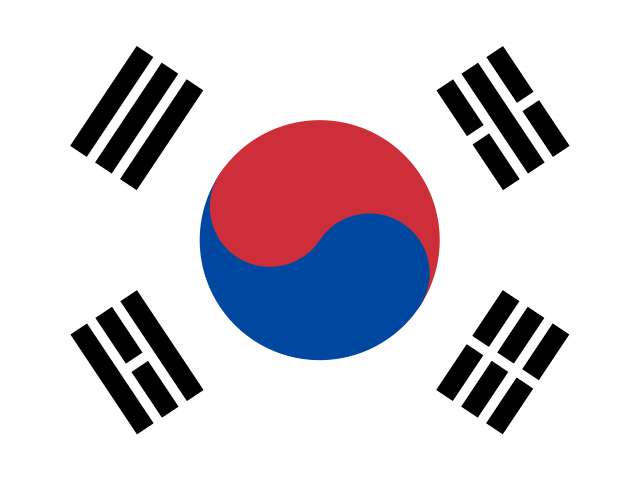
A white field with the red-and-blue taegeuk at its centre and a black trigram in each of the four corners. The taegeuk's upper half is red for yang and its lower half blue for yin, and their harmony is the design's central idea. White is read as brightness and purity and as a peace-loving national character, and the four trigrams are geon for heaven, gon for earth, gam for water and i for fire.
South Korea FACTS ◢
| Capital | Seoul |
|---|---|
| Continent | Asia |
| Population | 51,684,564 (2025) |
| Area | 100,295 km² |
| Population density | 515/km² |
| Currency | Won (KRW) |
| Official languages | Korean, Korean Sign Language |
| Calling code | +82 |
| Internet TLD | .kr |
| Time zone | UTC+09:00 |
| Drives on the | Right |
| ISO codes | KR / KOR |
DID YOU KNOW? ◢
- It consistently ranks among the countries with the fastest average internet speeds in the world.
- Seoul's greater metropolitan area is home to roughly half the nation's entire population.
- The Korean writing system, Hangul, was deliberately invented in the 15th century to be easy to learn.
- Koreans traditionally count a newborn as one year old at birth, a custom distinct from most of the world.
- It is the birthplace of the global K-pop and K-drama entertainment wave.
South Korea QUICK ANSWERS ◢
What is the capital of South Korea?
The capital of South Korea is Seoul.
What is the population of South Korea?
South Korea had a population of 51,684,564 in 2025.
What currency does South Korea use?
South Korea uses the Won (KRW).
What languages are spoken in South Korea?
The official languages of South Korea are Korean and Korean Sign Language.
Think you know your flags? Play Flag Daily → · Browse all countries →
MORE ON THE FLAG ◢
South Korea's flag is one of the few national flags whose design is a diagram rather than an emblem. There is no heraldic device, no crest and no canton. There is a circle split into two teardrops, four groups of black bars, and a great deal of white.
Ask what it means and you will get a confident answer within one sentence: white is purity, the circle is yin and yang, the four corner marks are heaven, earth, water and fire. That answer is broadly right, and it does not come from the law.
The Republic of Korea has a statute devoted to the flag, and a decree that draws it to the fraction. Between them they fix the shape, the colours, the proportions and the position of every element. They assign a meaning to none of them.
Key Takeaways
- The Flag Act's Article 7 fixes a white field, a taegeuk that is red above and blue below, black trigrams and a 3 to 2 ratio, and gives none of them a meaning.
- The familiar reading comes from the Ministry of the Interior and Safety, which is the government explaining its flag rather than the government defining it.
- The ministry reads red as yang and blue as yin, and the law puts red on top. Flipping the two is not a design choice.
- In the ordinary hoist, each trigram has a fixed corner: geon top left, gon bottom right, gam top right, i bottom left. Two articles of the Decree move them.
- Korea flew the design from September 1882, and the Republic of Korea did not publish a construction method until 1949, which is why the Denny Taegeukgi, the oldest of the old taegeukgi now in Korea, has blue trigrams where the modern statute requires black.
The meanings are the ministry's, not the statute's
The familiar meanings come from the Ministry of the Interior and Safety, not from either of the two instruments that define the flag. The one-sentence answer at the top of this article, that white is purity, the circle is yin and yang and the corners are heaven, earth, water and fire, is the ministry's reading, and so is the version in every encyclopaedia entry, quiz answer and infographic made from it. What none of them tends to say is that the ministry is explaining the flag rather than defining it, which turns out to matter as soon as you go looking for the instrument that does the defining.
The ministry's own wording is worth reading in full, because it is more careful than the summaries drawn from it about which claim attaches to which element.
On the field, it writes: "태극기의 흰색 바탕은 밝음과 순수, 그리고 전통적으로 평화를 사랑하는 우리의 민족성을 나타내고 있다." Rendered into English, the white ground stands for brightness and purity, and for a national character that has traditionally loved peace. Note where the peace sits. Summaries routinely compress this into white meaning peace, but in the ministry's sentence peace is a property of the people rather than of the colour.
On the circle: "가운데의 태극 문양은 음(陰 : 파랑)과 양(陽 : 빨강)의 조화를 상징하는 것으로 우주 만물이 음양의 상호 작용에 의해 생성하고 발전한다는 대자연의 진리를 형상화한 것이다." The central taegeuk symbolises the harmony of yin, given as blue, and yang, given as red, and figures the truth that all things are created and develop through their interaction.
On the corners: "그 가운데 건괘(乾卦)는 우주 만물 중에서 하늘을, 곤괘(坤卦)는 땅을, 감괘(坎卦)는 물을, 이괘(離卦)는 불을 상징한다." Geon is heaven, gon is earth, gam is water and i is fire.
The ministry also reads the four as a set rather than as four separate labels. Its preceding sentence has them showing, through combinations of broken and unbroken bars, how yin and yang change into one another and develop, and the sentence after them says the four achieve "태극을 중심으로 통일의 조화", a harmony of unification centred on the taegeuk. The corners are meant to be doing one job between them, not four.
That is where the answer comes from. The rest of this piece is about how much of it the state has actually committed to.
The Flag Act describes the flag and refuses to interpret it
The governing instrument is the 대한민국국기법, the Act on the National Flag of the Republic of Korea, currently Act No. 12342 and in force since 28 January 2014. It runs to twelve articles.
Article 4 is one line: "대한민국의 국기(이하 “국기”라 한다)는 태극기(太極旗)로 한다." The national flag of the Republic of Korea is the taegeukgi.
Article 7 is where the flag is built. Its first clause reads "국기는 가운데의 태극(太極)과 네 모서리의 건곤감리 4괘(卦)로 구성한다.", which puts the taegeuk at the centre and the four trigrams geon, gon, gam and i at the four corners. Note the order the statute names them in, which is also the order the ministry glosses them in: geon, gon, gam, i. Lists that run heaven, earth, fire, water have quietly swapped the last two.
The second clause sets the colours: "국기의 깃면은 그 바탕을 흰색으로 하고, 태극의 윗부분과 아랫부분은 각각 빨간색과 파란색으로 하며, 괘는 검은색으로 한다." White ground, the taegeuk red above and blue below, the trigrams black.
The third begins "국기의 깃면의 길이와 너비는 3대 2의 비례로 한다.", a 3 to 2 ratio of length to width, and then allows exceptions in cases set by decree. Article 5 of the Decree names two: celebratory events, and flags hoisted at a roadside. Article 7's fourth clause requires the finial to be a rounded Rose of Sharon bud with five sepals below it, in gold.
The fifth sets the flagpole's material and colour. The sixth is the hinge of the whole arrangement: it sends the method and specifications for drawing the flag, the standard chromaticity, the making of the finial and the installation of the pole to the Enforcement Decree. That is the clause by which everything precise about the taegeukgi ends up in the other instrument.
Read all twelve articles and nothing tells you what any of it stands for. The same is true of the Enforcement Decree's twenty-four. The state has specified the flag to the forty-eighth of its own width and has declined to say what the white is for.
That absence is not an oversight worth apologising for. It is the ordinary condition of flag law, and it is why the ministry's explanatory page exists at all.
Why the South Korean flag is red on top
If you remember one correction from this page, make it this one. The upper teardrop of the taegeuk is red and the lower is blue, and the ministry identifies red with yang and blue with yin. So the flag puts yang above yin, and the Enforcement Decree restates the instruction in its own drawing method at Article 6: "반원으로 연결된 원의 윗부분은 빨간색으로, 그 아랫부분은 파란색으로 한다."
An inverted taegeukgi is therefore a specific error rather than a general one. It does not merely look wrong. It states the opposite arrangement.
When the South Korean flag is hung vertically or draped on a coffin
Two articles of the Decree take the flag out of the ordinary hoist and redefine the arrangement for it, and both are worth knowing because both look like errors if you do not.
The first is vertical hanging. Article 14 of the Decree requires that "제5조에 따라 국기의 깃면을 늘여서 게양할 때에는 별표 4에 따라 이괘가 왼쪽 위로 오도록 한다." The i trigram, normally bottom left, comes to the top left, so the trigram that leads is fire. The same article then carves out an exception inside the exception: where two flags are hung vertically as a symmetric pair at a roadside, the left one of the pair keeps geon at the top left instead. The two flags of such a pair therefore do not read the same way as each other, by design.
Roadside flags are occasion-based rather than permanent, which is worth knowing before you go looking for a pair to check. Article 9 of the Prime Minister's Directive on the hoisting, care and promotion of the flag puts them out for national holidays, Armed Forces Day and other days or periods the government designates, and separately lets a local authority run a stretch of road year round for flag promotion.
The second case is a coffin. Article 21 of the Decree sets the flag over a bier so that, looked at squarely from above, geon falls to the upper right of the cover and i to the upper left.
The Directive adds a third context without contradicting either. The Directive's Article 11 says that a flag mounted on an indoor staff hangs draped with the taegeuk's red to the right, which is the same quarter turn the Decree's Article 14 describes, stated in terms of the circle instead of the corners.
Where each trigram sits, and how wide its bars are
Article 6 of the Enforcement Decree does the geometry, and it does it in fractions of the flag's width rather than in millimetres, so the construction scales to any size.
The taegeuk is a circle centred where the two diagonals cross, with a diameter of half the flag's width. Along the diagonal that runs from the top left corner to the bottom right, that diameter is halved. A semicircle sits below the diagonal on the left portion and above it on the right, each a quarter of the flag's width across. Those two semicircles are what make the teardrops.
The trigrams are placed by corner, one to each: geon at the top left, gon at the bottom right, gam at the top right and i at the bottom left. Each is a quarter of the flag's width long and a sixth wide, separated from the taegeuk by an eighth of the flag's width, with its long axis at right angles to the diagonal it sits on.
Then the Decree goes one level finer, down to the individual bar: "그 효의 너비는 괘 너비의 4분의 1(깃면 너비의 24분의 1)로 하고, 효와 효 사이 및 끊어진 효의 사이는 효 너비의 2분의 1(깃면 너비의 48분의 1)로 한다." A bar is a twenty-fourth of the flag's width thick, against a quarter of the flag's width long, and every gap, including the break in a divided bar, is a forty-eighth.
| Trigram | Hanja | Position on the flag | Meaning per the ministry |
|---|---|---|---|
| Geon | 乾 | Top left | Heaven |
| Gon | 坤 | Bottom right | Earth |
| Gam | 坎 | Top right | Water |
| I | 離 | Bottom left | Fire |
The positions in that table are the Decree's; the meanings are the ministry's explanatory page, not the Decree's. They are two different kinds of claim sitting in one row, which is the whole point of this article.
None of that resolves at a glance, which is why flags are usually told apart by their broad shapes instead. If you want to find out how well you can do it, Flag Daily shows you one flag and gives you three guesses at the country.
How the taegeukgi was adopted, 1882 to 1883
The ministry dates the impulse to a treaty. The signing of the Korea-United States Treaty of Amity and Commerce on 22 May 1882 is given as the direct occasion for Korea adopting a national flag, and the ministry is candid that the flag flown that day cannot now be identified: "하지만 당시 조인식 때 게양된 국기의 형태에 대해서는 현재 정확한 기록이 남아있지 않다." A document unearthed in 2004, Flags of Maritime Nations, produced by the Bureau of Navigation of the United States Navy Department, carries an ensign that some argue is the prototype, and the ministry presents that as an argument rather than a finding.
What is documented is the voyage. The 사화기략, Park Yeong-hyo's record of his 1882 mission to Japan as minister plenipotentiary and envoy, describes him making a flag aboard ship in September of that year with the taegeuk pattern and, around it, four trigrams in place of eight: geon, gon, gam and i. He flew it from the 25th of that month and reported the fact home on 3 October.
King Gojong proclaimed that taegeuk and four trigram design the national flag by royal command on 6 March 1883. Korea had a flag from that date, and no instructions for drawing one.
Why the old flags do not match each other
The consequence of proclaiming a design without a construction method is exactly what you would expect. The ministry's own history says variant forms circulated for decades afterwards.
The Provisional Government issued a 국기통일양식, a unified pattern, on 29 June 1942, and the ministry records that it never became widely known. Only after the government of the Republic of Korea was established in 1948 did the problem get solved: a 국기시정위원회, a flag rectification committee, was formed in January 1949, and on 15 October that year the government confirmed and announced the 국기제작법 고시, the notice on how to make the flag. Sixty-six years passed between the proclamation and the specification.
The best physical evidence of that gap is the Denny Taegeukgi, designated a Treasure on 25 October 2021 and held by the National Museum of Korea. It belonged to Owen Nickerson Denny, the American who served as Gojong's adviser on foreign and internal affairs from 1886, and who took it home in January 1891; a descendant returned it to Korea in 1981. Scholars put 1890 as the latest possible date of manufacture, that being Denny's last year in Joseon.
Two details in the heritage record matter here. The first is that the flag's four trigrams are blue, not black, applied along with a blue and red taegeuk by cutting the ground fabric away and stitching in two rows so the pattern would read at a distance. The second is that it measures 182.5 cm by 262 cm, which works out at about 1.44 to 1 rather than the 3 to 2 the Decree now requires.
The Korea Heritage Service calls it "현재 우리나라에 있는 옛 태극기 가운데 규모가 가장 클 뿐 아니라 우리나라 국기 제정의 초창기 역사를 보여주는 가장 오래된 태극기", the largest of the old taegeukgi now in Korea and the oldest one showing the early history of the flag's institution. The phrase 현재 우리나라에 있는 scopes both superlatives to old taegeukgi presently in Korea, and each half of it is doing work: 현재 concedes that the set can change, and 우리나라에 있는 concedes that an older or larger one may sit somewhere else. The same record states plainly that no physical flag made at the time of the 1883 proclamation survives.
The Korean peninsula's other flag went a different way entirely after 1948, and we cover the North Korea design separately.
The official colours are coordinates, not a paint chip
Article 8 of the Enforcement Decree sends the standard colours to an attached table, and the ministry publishes that table. It gives two systems and no brand.
| Colour | CIE coordinates | Munsell notation |
|---|---|---|
| Red | x = 0.5640, y = 0.3194, Y = 15.3 | 6.0R 4.5/14 |
| Blue | x = 0.1556, y = 0.1354, Y = 6.5 | 5.0PB 3.0/12 |
| Black | not given | N 0.5 |
| White | not given | N 9.5 |
Black and white carry a Munsell value only. Chromaticity coordinates are perfectly definable for a neutral, so that is the table declining to give them rather than an impossibility.
No Pantone reference appears in that table, so a Pantone number offered as the taegeukgi's official colour is a conversion of these coordinates rather than the published standard. The obvious place for a dye value to live instead is the Prime Minister's Directive on the hoisting, care and promotion of the flag, which the ministry names alongside the Act and the Decree. The Directive's Article 14 governs dyeing and processing, and each of its first four clauses sets a requirement rather than a value:
- The flag must be dyed by a method that stays vivid and lasts, without discolouring or fading.
- The dyeing must show clearly on both faces, with neither an overlap nor a gap where the taegeuk's red meets its blue.
- In processing, the flag must be treated as needed so that it soils less, does not build up static, and repels water well.
- Its edge must be sewn double-stitched so that it does not split easily.
The fifth clause sends the quality and finishing standards behind those four to 별표 7, an attached table that has not been opened here. So the claim is not that the corpus is silent, only that the published colour specification is a pair of coordinate systems and nothing else.
The ministry also publishes a fallback. Where printed matter cannot show the flag in the standard colours, the field and the upper half of the taegeuk take the background colour of the printing, and the lower half of the taegeuk and the four trigrams are printed black. That is the one-colour taegeukgi you see on forms and letterheads, and it is sanctioned rather than improvised.
A separate note directly after it says that where a printed item is for foreign readers, the flag is to be shown in the standard colours unless there is a particular reason not to. The pairing reads as an order of priority: the ministry will accept a one-colour flag wherever the standard colours cannot be printed, and then names the one audience for whom it wants the limitation argued rather than assumed. That is a reading of two adjacent instructions, not something the ministry says about itself.
Frequently asked questions
What do the four trigrams on the South Korean flag mean?
The Ministry of the Interior and Safety assigns them heaven, earth, water and fire, in that order: geon is heaven, gon is earth, gam is water and i is fire. It also reads the four as one unit rather than four labels, achieving a harmony of unification centred on the taegeuk. The Flag Act names the four trigrams but gives them no meanings, so all of this is the government's explanation of the flag rather than a definition written into the statute.
Article 6 of the Enforcement Decree fixes each trigram's corner, so the ministry's meanings map onto fixed positions rather than interchangeable ones.
Why is the top half of the taegeuk red and the bottom half blue?
Because the law says so and because the ministry identifies red with yang and blue with yin, which puts yang above yin. Article 7 of the Flag Act requires the upper part of the taegeuk to be red and the lower part blue, and Article 6 of the Enforcement Decree repeats the same instruction in its drawing method.
An upside down taegeukgi is a real error rather than a stylistic variant, since it reverses the arrangement the flag is describing.
Is the meaning of the South Korean flag written into law?
No. The meanings quoted everywhere come from the Ministry of the Interior and Safety's national symbols pages, which is a government source but not a legislative one. The Act on the National Flag of the Republic of Korea has twelve articles and its Enforcement Decree twenty-four, and between them they set out the design, colours, proportions, finial, hoisting rules and disposal of the flag without assigning a meaning to any element.
That is a normal condition for flag law rather than an omission, and it is why the ministry publishes an explanatory page at all.
What ratio and colours does the South Korean flag officially use?
Three to two, length to width, with exceptions allowed under Article 5 of the Enforcement Decree for celebratory events and roadside display. The standard colours are published as CIE coordinates and Munsell notations, with black and white given in Munsell only: red at 6.0R 4.5/14, blue at 5.0PB 3.0/12, black at N 0.5 and white at N 9.5.
No Pantone value appears in the standard-colour table, so a Pantone number offered as the official colour is a conversion of the published coordinates.
What is the Denny Taegeukgi?
A taegeukgi that the Korea Heritage Service describes as the largest of the old taegeukgi now in Korea and the oldest one showing the early history of the flag's institution. It measures 182.5 cm by 262 cm, dates on the scholarly reading to no later than 1890, is designated a Treasure, and is held by the National Museum of Korea.
Its four trigrams are blue rather than the black the modern statute requires, which is a useful reminder that the design was proclaimed in 1883 and only specified in 1949.
Sources
- 법제처 국가법령정보센터, 대한민국국기법 (법률 제12342호, 시행 2014. 1. 28.) - retrieved 13 August 2026.
- 법제처 국가법령정보센터, 대한민국국기법 시행령 (시행 2017. 7. 26.) - retrieved 13 August 2026.
- 행정안전부, 국가상징 - 태극기의 내력과 담긴 뜻 - retrieved 13 August 2026.
- 행정안전부, 국가상징 - 국기의 제작 - retrieved 13 August 2026.
- 법제처 국가법령정보센터, 국기의 게양·관리 및 선양에 관한 규정 (국무총리훈령 제911호, 시행 2026. 1. 21.) - retrieved 13 August 2026.
- 국가유산청 Korea Heritage Service, 보물 데니 태극기 - retrieved 13 August 2026.
PLAY ANOTHER →
Five questions a day. Everyone gets the same five.
FIVE QUESTIONSDAILYDaily CodeA short message, hidden in a different cipher every day.
ONE CIPHER A DAYDAILYOn This DayOne thing that happened today in history. Every day, a new one.
TODAY IN HISTORYDAILYDaily CryptogramOne quote, one scrambled alphabet. Crack it before tomorrow.
CRACK THE QUOTE