
North Macedonia
A landlocked Balkan country of mountains and lakes, North Macedonia guards one of Europe's oldest and deepest lakes, and gave the world the woman later known as Mother Teresa.
WHAT THE FLAG MEANS ◢
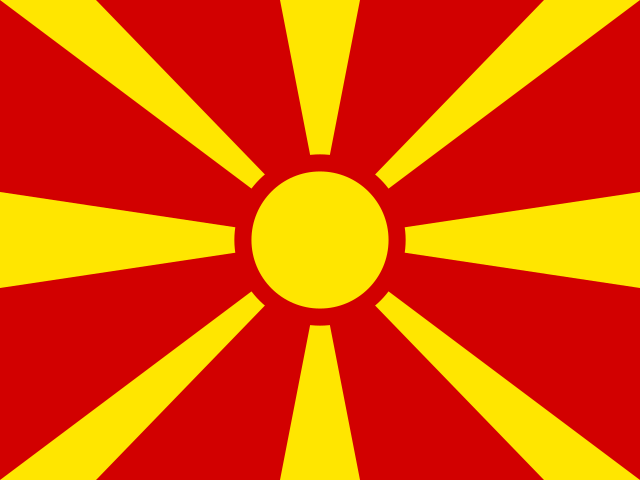
A red field bearing a golden sun with eight broadening rays that extend to the flag's edges. Article 5 of the constitution provides that the flag is adopted by law on a two-thirds majority of the Assembly, and says nothing about its meaning. The design dates from 1995, and the sun is conventionally read as the new sun of liberty of the national anthem.
North Macedonia FACTS ◢
| Capital | Skopje |
|---|---|
| Continent | Europe |
| Population | 1,820,909 (2025) |
| Area | 25,713 km² |
| Population density | 71/km² |
| Currency | Macedonian denar (MKD) |
| Official languages | Albanian, Macedonian |
| Calling code | +389 |
| Internet TLD | .mk |
| Time zone | UTC+01:00 |
| Drives on the | Right |
| ISO codes | MK / MKD |
DID YOU KNOW? ◢
- Lake Ohrid, on its border with Albania, is one of the oldest and deepest lakes in Europe.
- Mother Teresa was born in its capital, Skopje, in 1910.
- It changed its name from Macedonia to North Macedonia in 2019 as part of an agreement with neighbouring Greece.
- It's a completely landlocked country, with no coastline of its own.
North Macedonia QUICK ANSWERS ◢
What is the capital of North Macedonia?
The capital of North Macedonia is Skopje.
What is the population of North Macedonia?
North Macedonia had a population of 1,820,909 in 2025.
What currency does North Macedonia use?
North Macedonia uses the Macedonian denar (MKD).
What languages are spoken in North Macedonia?
The official languages of North Macedonia are Albanian and Macedonian.
Think you know your flags? Play Flag Daily → · Browse all countries →
MORE ON THE FLAG ◢
The flag as commonly flown is a red field with a sun whose rays reach the edges, though no instrument read for this article describes it. Ask what any of it stands for and the constitution will not tell you: it does not describe the sun, the field, the rays or the colours, and it does not describe the flag at all.
Article 5 does something else. It names the flag as one of three state symbols, and then it fixes the majority needed to adopt it: two thirds of all members of the Assembly, not two thirds of those voting and not a simple majority.
The company that requirement puts the flag in is the interesting part. The same threshold governs declaring a state of war, establishing a state of emergency, amending the constitution, and deciding to change the country's border or to join a union with other states, though those last two need a referendum as well and a flag law does not.
Key Takeaways
- Article 5 names the coat of arms, the flag and the anthem, and describes none of them.
- It requires a law passed by two thirds of the total number of Assembly members.
- The same majority is required to declare a state of war, to amend the constitution and to change the border, though a border change needs a referendum on top of it.
- Where a law needs that majority, the President is obliged to sign the promulgating decree.
- A separate provision, Amendment X, imposes a second majority on laws directly affecting the use of symbols.
- The 2019 amendment that renamed the state renamed Article 5 with it and left the flag alone.
| Requires two thirds of all Assembly members | Where |
|---|---|
| Adopting the coat of arms, the flag and the anthem | Article 5 |
| Regulating derogation from the inviolability of communications | Article 17, as replaced by Amendment XIX |
| Revoking a representative's mandate, including for six months' unexcused absence | Article 65 |
| Sitting without the public present | Article 70 |
| Deciding to change the border of the Republic, which also needs a referendum | Article 74 |
| Beginning a procedure on the President's responsibility | Article 87 |
| Regulating the organisation and work of state administration | Article 95 |
| Regulating the courts | Article 98, as replaced by Amendment XXV |
| Regulating the public prosecutor's office | Article 106, paragraphs 2 and 3 as replaced by Amendment XXX |
| Regulating local self-government, plus a second majority under Amendment XVI | Article 114 |
| Deciding to join or leave a union with other states, which also needs a referendum | Article 120 |
| Regulating the defence of the Republic | Article 122 |
| Declaring a state of war | Article 124 |
| Establishing a state of emergency | Article 125 |
| Amending the constitution, plus a second majority under Amendment XVIII for certain provisions | Article 131 |
| Adopting the constitutional law that puts the constitution into effect | Article 133 |
Article 5 names three symbols and describes none
The Macedonian text of Article 5 is two sentences. The first: "Државни симболи на Република Македонија се: грб, знаме и химна." The state symbols of the Republic are the coat of arms, the flag and the anthem.
The second sets the procedure: "Грбот, знамето и химната на Република Македонија се утврдуваат со закон кој се донесува со двотретинско мнозинство гласови од вкупниот број пратеници." The coat of arms, the flag and the anthem are established by a law adopted by a two-thirds majority of the votes of the total number of representatives.
The English text distributed by the Comparative Constitutions Project, in an edition covering amendments through 2011 and marked as amended after that, renders the same clause as "adopted by law by a two-thirds majority vote of the total number of Assembly Representatives".
That is the whole of it: no colours, no field, no rays, no proportions, and nothing attached to any of them by way of meaning. A constitution is free to describe a flag. This one names it and hands it on.
The base is the whole chamber, not the people in the room
The phrase that matters is "од вкупниот број пратеници", of the total number of representatives.
That is a different and harder test than two thirds of those present and voting. Abstentions, absences and vacancies all count against the threshold, because the denominator is the size of the chamber rather than the size of the vote. A flag law cannot be carried by a well-attended session of a divided Assembly. It needs two thirds of every seat.
Walking the Assembly's published text for that formula finds it imposing a majority in sixteen provisions, spread over rather more locations, since Article 131 uses it twice and five of the provisions are restated in the amendments that replace them. Reading where tells you what class of decision the drafters put the flag in. Article 75 mentions the formula once more without imposing it, which is the point of the next section, and Amendment XIX spells it with an extra на, so a search on the exact string above misses Article 17. Article 74 uses it for a decision to change the border of the Republic, which must then also be carried at a referendum by a majority of the total number of voters. Article 120 uses it for a decision to join or leave a union or community with other states, on the same terms. Articles 124 and 125 use it to declare a state of war and to establish a state of emergency. Article 131 uses it both for the decision to begin amending the constitution and for the decision to make the amendment. Articles 95, 98, 114 and 122 use it for the laws organising state administration, the courts, local self-government and defence, and Article 133 for the constitutional law that puts the constitution into effect.
The flag belongs to that list. Some of the list is administrative, such as revoking one member's mandate under Article 65, and some of it is the constitution's heaviest machinery, but all of it is business a bare majority cannot do.
The President cannot refuse to sign a two-thirds law
There is a second consequence, and it is easy to miss because it lives in a different article.
Article 75 provides that laws are promulgated by a decree signed by the President of the Republic and the President of the Assembly, and that the President of the Republic may decide not to sign it. The Assembly then reconsiders the law, and if it adopts it again by a majority of the total number of representatives, the President must sign. The article closes by removing the choice entirely in one case: "Претседателот е должен да го потпише указот, доколку според Уставот, законот се донесува со двотретинско мнозинство гласови од вкупниот број пратеници." The President is obliged to sign the decree if, under the constitution, the law is adopted by a two-thirds majority of the total number of representatives.
So the same clause that makes a flag law hard to pass removes the President's power to decline it. Once two thirds of the whole Assembly is there, nothing downstream in Article 75 can reopen it.
The effect, whatever the reason for it, is that a law which has cleared two thirds of every seat is treated as settled at that point, and the office that would otherwise have a further say is expressly denied one. Article 75 says nothing about symbols. The rule applies to every law the constitution puts on the higher majority.
A second majority applies to laws on the use of symbols
Article 5 is not the only provision in this constitution that bears on a symbol, and the other one is easy to miss because it is not in Article 5 and not about flags.
Amendment X replaced Article 69, which sets out how the Assembly decides. Its first paragraph gives the ordinary rule. Its second gives a different one: "За закони кои директно ги засегаат културата, употребата на јазиците, образованието, личните документи и употребата на симболите, Собранието одлучува со мнозинство гласови од присутните пратеници, при што мора да има мнозинство гласови од присутните пратеници кои припаѓаат на заедниците кои не се мнозинство во Република Македонија."
For laws directly affecting culture, the use of languages, education, personal documents and the use of symbols, the Assembly decides by a majority of the representatives present, which must include a majority of the present representatives belonging to the communities that are not a majority in the Republic.
That is a double majority, and the use of symbols is named in it. Whether a law adopting the flag under Article 5 is also a law directly affecting the use of symbols is not something the constitution answers on its face, and it does not leave the question to a court either: the same paragraph says the Committee for Relations Among the Communities resolves disputes about the provision's application.
So the two-thirds requirement in Article 5 is the threshold the constitution states for adopting the flag, and it is not necessarily the only one that would apply to a law about it. Amendment XVIII puts Article 69 itself among the provisions that need both a two-thirds majority and the community majority to amend, which is a fair measure of how much weight that paragraph is carrying.
In 2019 the article was renamed and the flag was not
On 11 January 2019 the Assembly adopted four constitutional amendments, XXXIII to XXXVI, published in the Official Gazette on 12 January 2019.
Amendment XXXIII is the one that renamed the state, and it is drafted to reach the whole document at once: "Во Уставот зборовите: „Република Македонија“ се заменуваат со зборовите: „Република Северна Македонија“, а зборот „Македонија“ се заменува со зборовите: „Северна Македонија“, освен во членот 36 од Уставот на Република Македонија." In the constitution the words Republic of Macedonia are replaced by the words Republic of North Macedonia, and the word Macedonia by the words North Macedonia, except in Article 36.
It works by find and replace across the whole document, with exactly one carve-out. Article 5 is not the carve-out, so the flag's own article was renamed by that amendment, twice over, once in each of its two sentences.
What the amendment does not do is touch the flag. Article 5 still names the same three symbols, the two-thirds requirement is unchanged, and no amendment in the set of four says anything about the coat of arms, the flag or the anthem. The state that flies the flag was renamed, the provision governing the flag was renamed, and the flag was left where it was.
The amendments also carry an unusual commencement. They enter into force not on a date but on the entry into force of the Final Agreement resolving the difference described in United Nations Security Council resolutions 817 (1993) and 845 (1993), and on the ratification of the NATO accession protocol by the First Party to that agreement. The gazette states that condition rather than a date, and nothing in the documents read here records the condition being met. So what can be said from these sources is how the flag's article was to acquire its current name, and not on which day it did.
The Assembly's own published text still says Republic of Macedonia
There is a wrinkle worth knowing about if you go and check Article 5 for yourself.
The Assembly publishes the constitution on a page headed Устав на Република Северна Македонија, Constitution of the Republic of North Macedonia. The document that page serves is the 1991 constitution with amendments I to XXXII appended. It stops there. Amendments XXXIII to XXXVI are not in it, and the words Северна Македонија do not appear anywhere in the file.
So a reader who opens the Assembly's own PDF to read the flag provision finds Article 5 in its pre-2019 wording, naming the state symbols of Република Македонија. The renaming is real and is carried by Amendment XXXIII, published separately in the Official Gazette. It is the consolidated text on the Assembly's site that has not caught up.
This is worth stating plainly rather than quietly correcting, because the two documents are both official and they do not read the same way. The amendment is the operative instrument.
What could not be read
Article 5 promises a law, and that law is what would carry any description of the flag and any meaning for the sun. It could not be opened for this article.
The Official Gazette of the Republic of North Macedonia serves its issue archive through a subscription interface that an anonymous reader cannot drive, and no state source reproducing the flag law in full could be reached. The Government's own site could not be reached, and the Assembly's site publishes the constitution, its own rules of procedure and two Acts about itself, not the general statute book.
So this article can report what the constitution requires of a flag law, and what happened to the constitution around it, and cannot report what the flag law says. Nothing read for this piece assigns the sun, the rays or the field any meaning. That is a gap in what was reachable rather than a finding about what exists, and the two should not be confused.
If you want to test whether you could pick this flag out at speed, a daily flag round gives you three guesses at one flag, and three written clues and no flag at all is the version where the sun cannot help you.
Frequently asked questions
What does the sun on the North Macedonia flag mean?
Nothing read for this article assigns it a meaning. Article 5 of the constitution names the flag as a state symbol and describes nothing about it, and the law it delegates the design to could not be opened, the Official Gazette's issue archive being closed to an anonymous reader.
So the readings in circulation are not confirmed here in either direction. What can be said is that the constitution, which is the instrument most people would expect to carry a symbolism clause, does not have one.
What does North Macedonia's constitution say about the flag?
Article 5 says two things: that the state symbols of the Republic are the coat of arms, the flag and the anthem, and that those three are established by a law adopted by a two-thirds majority of the votes of the total number of Assembly representatives. The article does not describe them, does not give their colours and does not say what they mean.
Why does the flag need a two-thirds majority?
The constitution does not explain, but it does show what company the requirement keeps. The same formula, two thirds of the total number of representatives, governs sixteen provisions of the Assembly's published text, among them: among them a declaration of a state of war under Article 124, a state of emergency under Article 125, the laws on state administration, the courts, local self-government and defence, and both stages of amending the constitution under Article 131. Article 74 uses it for a decision to change the border, and Article 120 for joining or leaving a union with other states, but each of those also requires a referendum, which a flag law does not.
There is a matching consequence elsewhere in the text: where the constitution requires that majority, the President is obliged to sign the decree promulgating the law.
Did the flag change when the country was renamed?
No. Amendment XXXIII of 2019 replaced the words Republic of Macedonia with Republic of North Macedonia throughout the constitution, with Article 36 the only exception, so Article 5 was renamed along with everything else. None of the four amendments adopted that day says anything about the coat of arms, the flag or the anthem.
Where can I read North Macedonia's flag law?
Not easily. Article 5 requires one, but the Official Gazette serves its issue archive through a subscription interface an anonymous reader cannot drive, and no state source reproducing the text in full could be reached for this article. The constitutional provision that requires the law is freely available; the law itself is not.
Sources
- Собрание на Република Северна Македонија, Устав на Република Северна Македонија - Articles 5, 17, 65, 70, 74, 75, 87, 95, 98, 106, 114, 120, 122, 124, 125, 131 and 133, and Amendments X, XVI, XVIII, XIX, XXV and XXX, in the Macedonian text as published by the Assembly, comprising the 1991 constitution and Amendments I to XXXII. Retrieved 26 August 2026.
- Службен весник на Република Македонија, Амандмани XXXIII, XXXIV, XXXV и XXXVI на Уставот, No. 6 of 12 January 2019 - the renaming amendment and its commencement condition. Retrieved 26 August 2026.
- Comparative Constitutions Project via constituteproject.org, North Macedonia (Republic of)'s Constitution of 1991 with Amendments through 2011 - the English rendering of Article 5, cited for that alone. Retrieved 26 August 2026.
PLAY ANOTHER →
Five questions a day. Everyone gets the same five.
FIVE QUESTIONSDAILYDaily CodeA short message, hidden in a different cipher every day.
ONE CIPHER A DAYDAILYOn This DayOne thing that happened today in history. Every day, a new one.
TODAY IN HISTORYDAILYGuess the CountryThree clues, three guesses. Work out where in the world it is.
THREE CLUES