
Palestine
Palestine spans the West Bank and the Gaza Strip, home to some of the oldest continuously inhabited places on Earth and cities sacred to billions across three faiths.
WHAT THE FLAG MEANS ◢
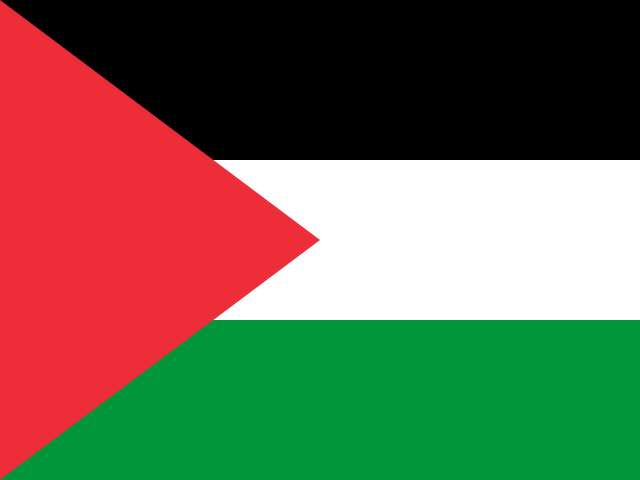
Three equal horizontal bands of black, white and green with a red triangle at the hoist, in the four pan-Arab colours that the flag of the 1916 Arab Revolt carried in a different band order. Article 8 of the 2003 Amended Basic Law calls it a flag of four colours, names none of them, and defers to the dimensions and measurements approved by the Palestine Liberation Organization. Presidential Decree No. 29 of 2005 gives no colour a meaning of its own: it says the flag symbolises Palestine's connection to the glories of its nation and to Arab and Islamic history. The dynasty reading of the bands, and the reading of the red triangle as Arab unity, are popular tradition rather than the state's.
Palestine FACTS ◢
| Capital | East Jerusalem |
|---|---|
| Continent | Asia |
| Population | 5,413,596 (2025) |
| Area | 6,020 km² |
| Population density | 899/km² |
| Currency | New shekel (ILS) |
| Official language | Arabic |
| Calling code | +970 |
| Internet TLD | .ps |
| Time zone | UTC+02:00 |
| Drives on the | Right |
| ISO codes | PS / PSE |
DID YOU KNOW? ◢
- Jericho, in the West Bank, is one of the oldest continuously inhabited cities in the world, with roots going back thousands of years.
- Bethlehem's Church of the Nativity is among the oldest churches still in use, and is a UNESCO World Heritage Site.
- The region sits along the Jordan Rift Valley, part of the same great geological trench that runs down into East Africa.
- Olive cultivation here stretches back thousands of years, and olive trees remain central to its landscape and cuisine.
Palestine QUICK ANSWERS ◢
What is the capital of Palestine?
The capital of Palestine is East Jerusalem.
What is the population of Palestine?
Palestine had a population of 5,413,596 in 2025.
What currency does Palestine use?
Palestine uses the New shekel (ILS).
What languages are spoken in Palestine?
The official language of Palestine is Arabic.
Think you know your flags? Play Flag Daily → · Browse all countries →
MORE ON THE FLAG ◢
The dynasty reading is the first thing most people meet about this flag: black for the Abbasids, white for the Umayyads, green for the Fatimids, red for Arab unity and struggle. It is confident, it is widely repeated in flag reference material, and none of the eight Palestinian flag instruments read for this article carries it.
Saying so leaves the better question open, which is what those instruments do say. Eight of them were read for this article and all eight texts are available. Four of them describe the flag without interpreting it. One promises a flag and describes nothing. One does not mention it at all. One mentions it once, in its closing sentence. And one, a presidential decree of 2005, states what the flag symbolises in a sentence that assigns no colour anything at all.
That is the unusual part. The familiar pattern is a state that says nothing about its colours and a popular reading that fills the gap. Here the state speaks, and what it says is not the sentence that circulates.
Key Takeaways
- Article 8 of the 2003 Amended Basic Law calls the Palestinian flag a flag "of four colors" and names none of the four.
- Presidential Decree No. 29 of 2005 assigns a meaning to the Palestinian flag as a whole: a connection to the glories of the nation and to Arab and Islamic history.
- None of the eight Palestinian instruments read for this article gives an individual colour a meaning. The dynasty reading belongs to accounts of the 1916 Arab Revolt flag, not to Palestine's law.
- The Hejaz flag held by the Australian War Memorial and the Palestinian flag use the same four colours in a different band order.
- Palestinian Flag Day is 30 September, marking the first raising of the flag at UN Headquarters. Resolution 69/320 of 10 September 2015 asked the Secretary-General to act within 20 days.
| Instrument | Date | What it says about the flag |
|---|---|---|
| Palestine National Charter, article 27 | 28 May 1964 | The Organization shall have a flag, an oath and an anthem, all settled by a special regulation. No colours, no shape. |
| Basic Law of the Palestine Liberation Organization | 2 June 1964 | Does not mention the flag anywhere. |
| Declaration of Independence | 15 November 1988 | Calls on Palestinians to rally around the flag as a symbol of freedom and dignity. No description. |
| Amended Basic Law, article 8 | 2003 | A flag "of four colors", with the dimensions the PLO approves. Names no colour. |
| Presidential Decree No. 29 of 2005, articles 1 and 3 | 3 December 2005 | Fixes the bands and the triangle, and states what the flag symbolises. No colour is given a meaning. |
| Law on the Sanctity of the Palestinian Flag, No. 22 of 2005, article 1 | 22 December 2005 | Names the bands black, white and green, and makes the triangle's height half its own base rather than a fraction of the flag. |
| Decree-Law No. 6 of 2006 and Law No. 5 of 2006 | 6 January and 17 February 2006 | Re-cut article 1: width half the length, triangle height one third of the length. |
What Palestine's Presidential Decree No. 29 of 2005 says the flag stands for
Article 3 of Decree No. 29 is the sentence to read. It sits inside the same instrument that fixes the flag's geometry, which makes it the closest thing there is to an official gloss on the design.
It says the flag symbolises Palestine's connection to the glories of its nation and to Arab and Islamic history. Its words for the first of those two are "بأمجاد أمتها". It then adds that the flag is one of the features and manifestations of Palestinian sovereignty, and the same article forbids raising any flag other than it, or any flag above it.
That sentence does two things, and both of them matter for the colour question.
The first is that the meaning is given to the flag, singular. There is no clause distributing it across bands. The decree spends its first article on geometry, listing the three sections and the triangle, and then in article 3 of the same decree turns to symbolism without once returning to the colours it has just named.
The second is that the meaning it does give is historical rather than chromatic. A connection to Arab and Islamic history is a claim about descent, not a code to be unpicked colour by colour. The dynasty reading is a code. They are different kinds of statement, and only one of them is in the decree.
Why Palestine's Basic Law counts four colours and names none of them
The constitutional provision is shorter still, and its silence is more pointed.
Article 8 of the 2003 Amended Basic Law, in the English text published by the Palestinian Basic Law project, reads: "The flag of Palestine shall be of four colors and in accordance with the dimensions and measurements approved by the Palestine Liberation Organization. It shall be the official flag of the country." The Arabic opens "يكون علم فلسطين بالألوان الأربعة", with the four colours, using the definite article for a set it never lists.
That is a constitution referring to the four colours as something the reader already knows, declining to write them down, and handing the measurements to the Palestine Liberation Organization rather than fixing them itself.
It is worth being precise about what that does and does not establish. It does not mean nobody knew which four. The flag had been flown for nearly forty years by 2003. It means the drafters treated the colours as settled elsewhere and the state's job as one of recognition.
What article 8 rules out is the idea that Palestine's founding text explains its flag. It does not explain it. It points at it.
The dynasty reading belongs to a different flag
The gloss is not invented. It attaches to the Hejaz flag of the Arab Revolt, and the one institution whose catalogue of an example could be read is careful about how it states it.
The Australian War Memorial holds a Hejaz flag made around 1917 or 1918, accession RELAWM16513, and its catalogue entry is careful about the design's origins. It records that the flag "is said to have been designed in June 1916 by Sharif Hussein of Mecca", whom it describes as leader of the Hejaz uprising waged with British assistance against the Ottoman Empire, and that "An alternative opinion suggests that the design of the flag was actually the work of Sir Mark Sykes, head of the British Arab Bureau, who also chose the colours to represent the past glory of Moslem Arab empires".
The colour assignments the Memorial attaches to that account are worth reading against the version in circulation. It gives "green for the Fatamid Dynasty of North Africa; white for the Umayyad Dynasty of Damascus and black for the Prophet Mohammed and the Abassid Caliphate of Baghdad", and it gives the red not to unity but to "the Khawarij who conquered North Africa and Andalusia", later standing for Hussein's Sharifians and the Hashemites.
So three of the four match the popular gloss and the fourth does not. The red that is routinely described as Arab unity is, on the account the Memorial reports, a dynastic colour like the other three.
The Memorial also records a rival derivation entirely: that the four colours were taken from lines by the Arab poet Safi al-Din al-Hilli, which it renders as "white are our deeds, black the fields of battle, our pastures are green, but our swords are red with the blood of our enemy." One museum record, three hedged accounts of the same flag, two of them explaining the palette.
The Royal Collection Trust catalogues a flag of Hejaz under Sykes's own name, its record titled "Colonel Sir Tatton Benvenuto Mark Sykes, 6th Baronet (1879-1919) - Flag of Hejaz". The record's description could not be opened from here, so what that entry says beyond the attribution in its title is not something this article can report.
None of this is Palestinian law, and none of it is offered as such by the Memorial that holds the specimen. It is the history of a palette, hedged by the institution that holds the object.
Palestine's flag does not use the Memorial's Hejaz specimen's band order
Here is the detail that gets lost when the two flags are treated as one design.
The Australian War Memorial, whose catalogue calls the Hejaz flag "also called the flag of the Arab Revolt", describes its own specimen as "divided into even horizontal stripes of black (top) green (centre) and white (bottom), with a red triangular hoist". Black, green, white.
The Memorial also states that the Hejaz flag "was the first flag to use what are now known as the pan-Arab colours of black, green, red and white".
Presidential Decree No. 29 of 2005 describes the Palestinian flag as three equal parallel sections, upper black, middle white, lower green, with the red triangle at the hoist. Black, white, green.
Same four colours, middle and bottom bands exchanged. A flag that shares its palette with others has to be told apart by order and by proportion, which is the whole skill a daily flag round tests when it shows you one and takes three guesses.
That difference also puts a limit on how far the descent claim can be pushed. It is entirely reasonable to say the Palestinian flag uses the four colours that the Arab Revolt flag put together. It is a larger claim to say it is that flag, and the band order is the reason.
The 1964 texts promise a flag and defer the drawing
The Palestinian flag enters the documentary record as a promise rather than a picture.
Article 27 of the Palestine National Charter, adopted in Jerusalem on 28 May 1964, reads in full: "This Organization shall have its flag, oath and a national anthem. All this shall be resolved in accordance with special regulations." The Arabic names the three the same way: "علم وقسم ونشيد". A flag is promised, a regulation is promised, and no colour is named.
That sentence is easy to skim past twice over. The flag is the Organization's, not the state's, which is what you would expect twenty-four years before any declaration of statehood. And the detail is deferred to a special regulation, which means the design was never in the Charter to begin with.
The Basic Law of the PLO, ratified by the National Council five days later on 2 June 1964, does not mention the flag at all. Searched end to end, the words for flag, black, green and red do not appear in it.
The regulation's own text was not obtained for this article, so what follows rests on the Palestinian National Information Centre's account of it rather than on the instrument. That account is the fullest published one, and it is the Centre's own entry on the flag. It dates a special flag regulation setting the measurements and dimensions to 1 December 1964, and says that in it the black and green each took the other's place. It adds that the flag was taken up as an emblem with the launch of the Palestinian revolution on 1 January 1965, and that the PLO adopted it as the flag of the State of Palestine on 15 November 1988.
One caution about that account, and it is the kind worth stating rather than smoothing over. The Information Centre's entry attributes to article 27 both a colour order, green then white then black, and a provision that Palestine shall have a flag. The article as published by the Institute for Palestine Studies in Arabic and by the ETH Zurich collection in English carries neither. It names no colours and it speaks of the Organization. The colour order may well be correct as history. Article 27 is not where it is written.
Nineteen days apart, two Palestinian instruments set the triangle by different rules
The 2005 decree was not the last word, and what followed is a small documented mess that took two amendments to clear.
Decree No. 29 was issued on 3 December 2005. Its article 1 puts the red triangle at the hoist with its base equal to the width of the flag and its height equal to one third of the flag's length.
Nineteen days later, on 22 December 2005, the Law on the Sanctity of the Palestinian Flag, No. 22 of 2005, restated the design in its own article 1. It repeats the bands and the hoist triangle, then gives the triangle a height equal to half the base of the triangle. Since the base equals the width, that is half the width, not a third of the length. On the two-to-one flag that later texts specify, those are different triangles.
The fix came in two steps. Decree-Law No. 6 of 2006, issued 6 January 2006, replaced article 1 with a version that fixes the width at half the length and returns the triangle's height to one third of the length. Law No. 5 of 2006, passed by the Legislative Council and issued 17 February 2006, replaced it again in almost identical terms. Two instruments, six weeks apart, both amending the same article of the same law to the same effect.
There is one further oddity in those replacements, and it should be reported as what it is rather than promoted. In the Al-Muqtafi database maintained by the Institute of Law at Birzeit University, both 2006 replacements open the amended article with the four dimensions, "بالأبعاد الأربعة". The Basic Law and the original 2005 law both carry the four colours in that slot, "بالألوان الأربعة". The sentence then continues into the dimensions and measurements, so as printed it names dimensions twice and colours not once.
Whether that entered the gazette or the transcription is not something this article can settle. The decree-law's entry in the same database also prints the top band as سواء rather than سوداء, which is plainly a slip, so the database's text of that instrument is not clean. Law No. 5's entry carries the same الأبعاد reading and prints سوداء intact, so that instrument has no transcription slip beside it to explain the reading away. The reading in that instrument has no transcription slip beside it to explain it away. The colour word survives untouched in article 8 of the Basic Law either way, and that is the provision the whole chain rests on.
What the Declaration of Independence says about the flag
The Declaration of Independence, issued in Algiers on 15 November 1988, mentions the flag once, and puts it in the last sentence of the document.
It calls on the Palestinian people to rally around their flag, to take pride in it and to defend it, so that it remains "رمزاً لحريتنا وكرامتنا", a symbol of our freedom and dignity, in a homeland that will remain a free homeland for a free people.
That is a meaning, and it is the earlier of the two a Palestinian text assigns. It is also, like the 2005 decree's, given to the flag whole. Freedom and dignity are not parcelled out to bands.
The Declaration and the decree each answer the meaning question without either reaching for the colours, which is at least a sign that the omission is a choice rather than an oversight. A drafter who wanted a dynastic gloss in the record had two obvious chances to put one there.
Why Palestinian Flag Day is 30 September
The date looks arbitrary and turns out to be a deadline.
On 10 September 2015 the General Assembly adopted resolution 69/320, titled "Raising the flags of non-member observer States at the United Nations". Its operative text decides that the flags of non-member observer States maintaining permanent observer missions at Headquarters "shall be raised at Headquarters and United Nations offices following the flags of the States Members of the United Nations", and requests the Secretary-General to take the measures necessary "within 20 days of the adoption of the present resolution".
Twenty days from 10 September is 30 September, and that is when the flag went up in New York. The Palestinian National Information Centre marks 30 September as Palestinian Flag Day for exactly that event, noting that President Mahmoud Abbas raised the flag at UN Headquarters for the first time after addressing the General Assembly in 2015.
Worth noting what the resolution does not do. Palestine's flag is never named in it, its design is never described, and its colours are never mentioned. It recalls that the State of Palestine became a non-member observer State on 29 November 2012 and then legislates a general rule about flagpoles. A national flag day resting on a procedural clause about installation timing is an odd origin, and it is documented down to the clause. If you would rather work a country out from clues than from its flag, three written clues is the game that does it.
Frequently asked questions
What do the colours of the Palestinian flag mean?
None of the eight Palestinian instruments read for this article assigns a meaning to any individual colour. Article 8 of the 2003 Amended Basic Law calls it a flag of four colours without naming them, and Presidential Decree No. 29 of 2005 names the bands only to fix the design, then gives the meaning to the flag as a whole: a connection to the glories of the nation and to Arab and Islamic history.
The readings of black, white and green as the Abbasid, Umayyad and Fatimid dynasties come from accounts of the 1916 Arab Revolt flag, which used the same four colours in a different band order.
Is the Palestinian flag the same as the flag of the Arab Revolt?
Not quite. The two flags share four colours and a hoist triangle, but the band order differs. The Australian War Memorial describes its Hejaz specimen of about 1917 to 1918 as black on top, green in the centre and white at the bottom, while Presidential Decree No. 29 of 2005 puts the Palestinian flag's black on top, white in the centre and green at the bottom.
Who designed the Palestinian flag?
None of the eight Palestinian instruments read for this article names a designer. Article 27 of the 1964 Palestine National Charter promised a flag settled by a special regulation, and the Palestinian National Information Centre dates that regulation to 1 December 1964 and credits it to the PLO Executive Committee. The origin of the underlying four-colour design is separately contested: the Australian War Memorial records both Sharif Hussein and Sir Mark Sykes as candidates and treats neither as settled.
What are the official proportions of the Palestinian flag?
Since Decree-Law No. 6 of 2006 and Law No. 5 of 2006, the flag's width is half its length, the three bands are equal, and the red triangle at the hoist has a base equal to the width and a height equal to one third of the length. The original 2005 law had made the triangle's height half its own base instead, which the 2006 amendments replaced.
When is Palestinian Flag Day and why 30 September?
Palestinian Flag Day is 30 September. General Assembly resolution 69/320 of 10 September 2015 asked the Secretary-General to act within 20 days, which put the first raising of the flag at UN Headquarters on 30 September 2015.
Sources
- Al-Muqtafi, Institute of Law, Birzeit University, Amended Basic Law of 2003, article 8, Arabic text - retrieved 26 August 2026.
- The Palestinian Basic Law project, 2003 Amended Basic Law, English text - retrieved 26 August 2026.
- Al-Muqtafi, Institute of Law, Birzeit University, Presidential Decree No. 29 of 2005 on determining the dimensions of the Palestinian flag - retrieved 26 August 2026.
- Al-Muqtafi, Institute of Law, Birzeit University, Law on the Sanctity of the Palestinian Flag No. 22 of 2005 - retrieved 26 August 2026.
- Al-Muqtafi, Institute of Law, Birzeit University, Decree-Law No. 6 of 2006 amending article 1 and Law No. 5 of 2006 - both retrieved 26 August 2026.
- Institute for Palestine Studies, Interactive Encyclopedia of the Palestine Question, Palestine National Charter, 28 May 1964, Arabic text - retrieved 26 August 2026.
- ETH Zurich, International Relations and Security Network collection, Palestine National Charter, 28 May 1964, English text - retrieved 26 August 2026.
- Institute for Palestine Studies, Interactive Encyclopedia of the Palestine Question, Basic Law of the Palestine Liberation Organization, 2 June 1964 - retrieved 26 August 2026.
- Institute for Palestine Studies, Interactive Encyclopedia of the Palestine Question, Palestinian Declaration of Independence, 15 November 1988 - retrieved 26 August 2026.
- Palestinian National Information Centre, WAFA, The Flag and Palestinian Flag Day - both retrieved 26 August 2026.
- Australian War Memorial, Hejaz flag, RELAWM16513 - retrieved 26 August 2026.
- United Nations General Assembly, resolution 69/320 of 10 September 2015 - retrieved 26 August 2026.
- Royal Collection Trust, Flag of Hejaz, RCIN 70405 - catalogue title read from the Internet Archive capture of 15 May 2025. The live page and the capture's body could not be opened from this machine.
PLAY ANOTHER →
A short message, hidden in a different cipher every day.
ONE CIPHER A DAYDAILYDaily TriviaFive questions a day. Everyone gets the same five.
FIVE QUESTIONSDAILYDaily CryptogramOne quote, one scrambled alphabet. Crack it before tomorrow.
CRACK THE QUOTEDAILYGuess the CountryThree clues, three guesses. Work out where in the world it is.
THREE CLUES