
Sri Lanka
A teardrop-shaped island off the tip of India, Sri Lanka grows some of the world's most famous tea, guards ancient rock fortresses, and shelters both elephants and blue whales.
WHAT THE FLAG MEANS ◢
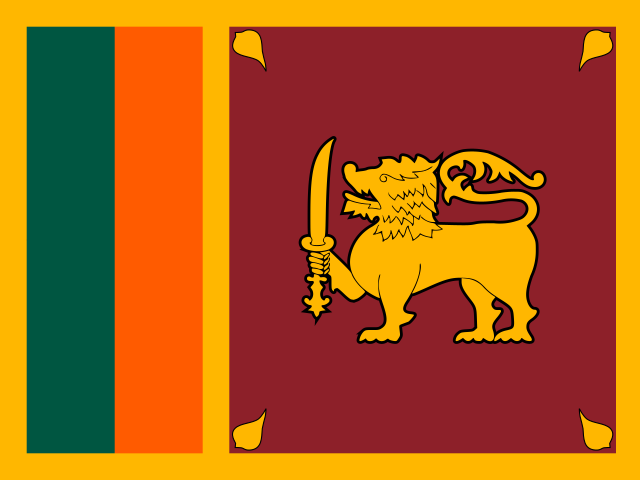
A maroon field with a yellow lion holding a sword and a yellow bo leaf in each of the field's four corners, beside two vertical stripes of green and orange at the hoist, all within a yellow border. Article 6 of the constitution prescribes the flag by reproducing it in the Second Schedule as a picture, with no words describing it and none assigning it a meaning. The government's own account supplies the readings instead: the lion for the Sinhalese and the sword for sovereignty, the bo leaves for Buddhism and for four Buddhist virtues, the orange stripe for the Tamil community and the green for the Muslim community, the maroon for the country's other religions and the yellow border for its other communities.
Sri Lanka FACTS ◢
| Capital | Colombo |
|---|---|
| Continent | Asia |
| Population | 21,756,000 (2025) |
| Area | 65,610 km² |
| Population density | 332/km² |
| Currency | Sri Lankan rupee (LKR) |
| Official languages | Sinhala, Tamil |
| Calling code | +94 |
| Internet TLD | .lk |
| Time zone | UTC+05:30 |
| Drives on the | Left |
| ISO codes | LK / LKA |
DID YOU KNOW? ◢
- It's one of the world's largest exporters of tea, known globally as Ceylon tea.
- The ancient rock fortress of Sigiriya rises about 200 metres from the plains and dates to the 5th century.
- The waters off its coast are among the best places on Earth to see blue whales, the largest animals ever to have lived.
- It was known as Ceylon until 1972.
- Cinnamon originally came from Sri Lanka, which was once a prized source of the spice.
Sri Lanka QUICK ANSWERS ◢
What is the capital of Sri Lanka?
The capital of Sri Lanka is Colombo.
What is the population of Sri Lanka?
Sri Lanka had a population of 21,756,000 in 2025.
What currency does Sri Lanka use?
Sri Lanka uses the Sri Lankan rupee (LKR).
What languages are spoken in Sri Lanka?
The official languages of Sri Lanka are Sinhala and Tamil.
Think you know your flags? Play Flag Daily → · Browse all countries →
MORE ON THE FLAG ◢
Ask what the lion, the sword and the four leaves on Sri Lanka's flag stand for and there are settled answers. Ask where those answers come from and the ground moves, because the country's own constitution does not contain them, or anything else about the flag beyond one sentence.
Article 6 of the Constitution of the Democratic Socialist Republic of Sri Lanka runs to one sentence: "The National Flag of the Republic of Sri Lanka shall be the Lion Flag depicted in the Second Schedule." Turn to that schedule, on page 239 of Parliament's own printing, and the type on the page reads "SECOND SCHEDULE", then "ARTICLE 6", then a colour plate, then "THE NATIONAL FLAG". That is all of it.
So the country's highest law defines its flag by showing it. There is no description of the lion, no naming of the colours, no ratio, no statement that the sword stands for anything. The meanings in wide circulation are real, and they are official in the sense that the Government of Sri Lanka publishes them. They are simply published somewhere other than the law.
Key Takeaways
- Article 6 of the constitution prescribes the flag by reproducing it in the Second Schedule as a plate. The schedule's entire text is "SECOND SCHEDULE", "ARTICLE 6" and "THE NATIONAL FLAG".
- The Government of Sri Lanka's web portal does assign meanings, and it goes much further than the short version: the lion's beard, nose and front paws each get a reading.
- The government gives the maroon field to the country's other religions, not to the Sinhalese majority, which it assigns to the lion.
- A separate document, Sri Lanka Standard SLS 1: 2020, describes the flag in words and fixes its colours as Pantone and CIE Lab values.
- Four institutions publish accounts of the flag's corners. No two give the same combination of what was there and when it changed.
Article 6 delegates to a plate, and the plate says nothing
Article 6 delegates. The whole of the flag's legal definition is the phrase "the Lion Flag depicted in the Second Schedule", which throws the reader forward to the schedules at the back of the volume.
The Second Schedule occupies a single printed page. It carries the heading "SECOND SCHEDULE", the cross-reference "ARTICLE 6", a colour illustration of the flag, and the caption "THE NATIONAL FLAG" beneath it. The next page is blank apart from its running head. Nothing tells the reader the panel is maroon rather than crimson, that the lion is yellow rather than gold, or that the sword means sovereignty.
That silence shapes the sections that follow. When two accounts of the flag disagree, there is no constitutional wording to arbitrate between them. The instrument has an image where the sentence would be, and the constitution now in force dates only from 1978, so it cannot speak to anything the flag did before that.
Recognising a flag and reproducing one are different skills, and this arrangement quietly favours the first. Flag Daily tests only that half: one flag a day, three guesses at the country.
The Third Schedule, immediately after, does the same thing for the national anthem: Article 7 says the words and music "are set out in the Third Schedule", and the schedule is a reproduction of the score. The drafters plainly regarded reproduction as a sufficient form of prescription for a symbol.
Who assigns the lion, the sword and the stripes their meanings
The government does, on its own portal, in a list far longer than the familiar summary. The page is filed under "National symbols of Sri Lanka" on gov.lk, and the same text is republished word for word by the Sri Lankan embassy in Ankara.
It opens with a purpose rather than a symbol: the flag "represents the country and her heritage as rallying device that integrates the minorities with the majority race". Then it itemises.
The lion "represents the Sinhala race". The sword "represents the sovereignty of the country". After that the list goes into a level of detail that no short summary keeps. Curly hair on the lion's head "indicates religious observance, wisdom and meditation". The beard "denotes purity of words". The handle of the sword "highlights the elements of water, fire, air and earth". The nose "indicates intelligence". And the two front paws "purport to purity in handling wealth".
The stripes are assigned individually and in a specific order. The orange stripe stands for the Tamil community and the green for the Muslim community, which matters because the two are easy to swap when the flag is described from memory. The bo leaves at the corners stand for Buddhism and its influence, and also for four virtues, which the portal renders as kindness, friendliness, happiness and equanimity.
The National Archives of Sri Lanka gives those four virtues their Pali names, in a page on the path to independence: the bo leaves "depict Metta (loving-kindness), Karuna (compassion), Mudita (sympathetic joy), and Upekkha (equanimity)". That is the same four, and it is the more useful rendering, because it lets a reader recognise them as the brahmaviharas rather than as a generic list of nice qualities.
None of this is in the constitution. All of it is the state's.
The maroon field and the yellow border have readings too
Both have published readings, and both are easy to leave out of a description that has only a sentence or two to work with.
The government's list says: "The border round the flag, which is yellow in color, represents other minor races." And it says of the field itself: "The maroon colored portion of the flag manifests the other minor religions."
That second one is worth slowing down for. The intuitive reading of a flag whose lion stands for the Sinhalese is that the ground behind the lion stands for them too. The government's own account says the opposite. The lion is given the majority community. The field it stands on is given the country's other religions. The border around everything is given the communities the two stripes do not name. Read that way, the flag is not a majority emblem with minorities added at the edge. It is a majority emblem set inside two layers that are explicitly about everybody else.
Whether the 1951 committee intended that reading is a separate question, and the document that would answer it is the committee's own report, which the National Archives names among the material in its independence exhibit. No online copy of that report could be located for this article. The portal states the meanings without sourcing them to the report, so the honest position is that this is the government's reading now rather than a recorded finding of the body that designed the flag.
The Sri Lankan standard that describes the flag in words
If the constitution will not describe the flag, something has to, because flags are manufactured to a tolerance. That document is Sri Lanka Standard SLS 1: 2020, the first revision of the specification for the national flag of the Democratic Socialist Republic of Sri Lanka, published by the Sri Lanka Standards Institution.
Its title page prints the line "(Supersedes SLS 693: 1985)", and its foreword repeats that the 2020 standard supersedes the 1985 one. That change has not reached every state page: the National Archives still tells readers that "The National Flag conforms to the Sri Lanka Standard Specification No. S.L.S 693-1985."
Clause 3.3 of SLS 1: 2020 is the verbal description the constitution lacks. "The left most stripe shall be green and the other saffron." To the right of the saffron stripe, separated by a yellow strip, shall be "the lion in yellow on a red background", bearing an upright sword in its right fore-paw and facing the saffron stripe. "In the four corners of the red background shall have four yellow bo-leaves." And then a clause that no picture can express: "The lion and bo-leaves shall be outlined in black as depicted in Plate 3." The black outline is a prescribed feature of the flag, and it is a fifth colour.
That clause quietly corrects two loose habits of description. The lion and the leaves are specified as yellow, not gold. And the leaves belong to the four corners of the red panel, not to the corners of the flag, whose corners are border.
Clause 3.2 fixes the ratio of width to length at 1 : 2. Clause 3.4 sends the colours to a table of CIE Lab values with a tolerance of delta E no greater than 1.5, calculated by the DE 2000 formula, alongside Pantone textile references: red 19-1863 TCX, saffron 16-1164 TCX, green 18-5322 TCX, yellow 14-0957 TCX. Table 2 then gives millimetre dimensions for eight flag sizes, from 150 by 75 mm up to 2,000 by 1,000 mm.
The standard also forbids redesign. Immediately after clause 3.3, having sent the design, characteristics and features of the lion, sword and bo leaves to its Plate 3, it adds: "The characteristics and features shall not be changed."
One caution about the plates. Printed beneath the colour illustration in Plate 3 is the line "This diagram is not for colour matching". The picture in the standard is not the colour authority. The table is. Which leaves the flag defined by a picture in one document and by numbers in another, and by no verbal description in the document that actually prescribes it.
And the standard disagrees with itself on one word. Table 1 calls the field's colour "Red". Plate 1's key, for the identical Pantone number, calls it "Maroon". Add the government portal's "maroon", the National Maritime Museum's "dark red" and Britannica's "crimson" and you have five sources and four names for a colour the constitution does not name at all.
What was in the corners before the bo leaves, and when they changed
Four institutions have published accounts of this, and no two give the same combination of what was in the corners and when it changed. It is the clearest illustration of what a picture-only prescription costs.
| Source | What was in the corners before | When the corners changed |
|---|---|---|
| Government of Sri Lanka portal | Bo leaves, already on the last king's civil standard | No change recorded |
| Sri Lanka Standards Institution, SLS 1: 2020 | Bo leaves, present in the 1951 design | 22 May 1972, "made more prominent" |
| National Archives of Sri Lanka | "four beralu" | Not dated; "as per the instructions of the Sri Lanka Flag Design Committee" |
| National Maritime Museum, object AAA0458 | "pagoda pinnacles" | 1978 |
The museum is the only one of the four describing a surviving flag rather than a design. Its object AAA0458 is a Ceylon national flag of the 1948 to 1951 pattern, printed synthetic bunting with a cotton hoist stamped "CEYLON", measuring 1,320.8 by 2,794 mm. The catalogue describes it as "dark red with a yellow border with pagoda pinnacles in each corner", with "a yellow lion holding a sword in its raised paw (the lion of Kandy)" at the centre.
A surviving flag with pinnacles in its corners is difficult to reconcile with the portal's claim that the last king's standard already carried "a bo-leaf on each of the four corners" and that the 1950 design "retained" them. The Archives page draws the contrast itself, in the other direction: it says that "instead of the four beralu in the corners, the four bo leaves were added". Whatever a beralu is, the Archives is clear it is not a bo leaf.
The Standards Institution takes a third position. Its foreword says that "On 22nd May 1972, when Sri Lanka became a Republic, the four Bo-Leaves which were in the corners of the flag were made more prominent than in the National Flag design in 1951". That has leaves in the corners already in 1951 and 1972 as a change of emphasis rather than of device. It agrees with the portal that leaves were there from the start, and it cannot be reconciled with the museum. The museum's catalogue does not merely date its object to 1948 to 1951; it tracks the design forward, saying it "was changed in 1951 to include a green and orange band" and that only "In 1978 the pagoda pinacles were replaced by Bo leaves". So the catalogue has pinnacles surviving the 1951 change that the Standards Institution says had leaves in its corners. Both cannot be right about 1951.
Britannica's entry, written by Whitney Smith of the Flag Research Center, offers the account that reconciles the dates. It says that until 22 May 1972 the corners had held "yellow spires similar to those on the tops of temples", that on that date they were replaced by leaves from the bo tree, and that the flag "incorporated further artistic modification of those leaves on September 7, 1978". Two events, six years apart, would explain why one source dates the change to 1972 and another to 1978. That is a reference work's reconstruction rather than a Sri Lankan state finding, and it should be read as one.
The instrument that would answer this is the 1972 Constitution, which is where a 22 May 1972 change to the flag would have been prescribed. No accessible copy of it could be located for this article, so the 1972 date rests on the Standards Institution's foreword and on Britannica rather than on the instrument itself.
The adoption year that Sri Lanka's own sources disagree about
The stripes were the point of the exercise. The lion flag flown at independence on 4 February 1948 was the standard of the last king of Kandy, whose kingdom had been ceded to the British in 1815 under the Kandyan Convention, an instrument whose Article 5 committed the British to protect the Buddhist order. Flying it again in 1948 restored a Sinhalese royal emblem to a country that was not only Sinhalese.
The National Archives records that a National Flag Committee was appointed on 6 March 1948 under the chairmanship of S. W. R. D. Bandaranaike, with Senarat Paranavitana as secretary and T. B. Jaya, Lalitha Rajapaksa, G. G. Ponnambalam and Sudesh Nadesan as members. The Standards Institution records the same committee as constituted by Prime Minister D. S. Senanayake, and adds the parliamentary chronology: the report was tabled in the House of Representatives on 27 February 1951, debated on 1 and 2 March, and accepted on 2 March 1951.
The government portal gives a different year. It says the design was "approved by the committee in February 1950" and that "The national flag was hoisted for the first time on March 3, 1950."
Both pages are the state's. The 1951 date has the more circumstantial support: the Standards Institution names sitting days, and the museum catalogues its 1948 to 1951 flag as the pattern the stripes replaced. But neither page cites a record, so a reader should simply know that the Sri Lankan government publishes both dates.
One more thing the standard's foreword records about that report: the committee laid down that the "widths of the stripes should be 1: 1: 5", but "the proportions and internal dimensions of the overall flag were not detailed and the five colours were not technically specified". The colours in the modern standard derive from Plate XV attached to the 1951 report. So the flag was in service for thirty-four years before its colours were technically specified, and the constitution has never specified them at all.
Sri Lanka is an easy country to place and a hard one to pin down in its own records. Guess the Country only asks for the first, from three written clues and three guesses.
Frequently asked questions
What does the lion on the Sri Lankan flag mean?
The Government of Sri Lanka's own account says the lion "represents the Sinhala race" and the sword in its paw "represents the sovereignty of the country". That reading is published on the government portal and republished by the Sri Lankan embassy in Ankara, but it is not in the constitution: Article 6 prescribes the flag by reproducing it in the Second Schedule as a picture, and the schedule assigns nothing a meaning.
What do the green and orange stripes on the Sri Lankan flag stand for?
The orange stripe stands for the Tamil community and the green stripe for the Muslim community, according to the government's published list of the flag's symbols. The order matters and is easy to reverse from memory: green is the stripe nearer the hoist edge, orange the one nearer the lion. Sri Lanka Standard SLS 1: 2020 puts it as "The left most stripe shall be green and the other saffron."
What do the four bo leaves on the Sri Lankan flag represent?
They stand for Buddhism and its influence on the nation, and for four Buddhist virtues. The National Archives of Sri Lanka names them as "Metta (loving-kindness), Karuna (compassion), Mudita (sympathetic joy), and Upekkha (equanimity)"; the government portal renders the same four as kindness, friendliness, happiness and equanimity. Sri Lanka Standard SLS 1: 2020 puts the leaves in the four corners of the red panel, not the corners of the flag, whose corners are border.
Is the lion on the Sri Lankan flag gold or yellow?
Yellow, in the only document currently in force that specifies it. Sri Lanka Standard SLS 1: 2020 clause 3.3 requires "the lion in yellow on a red background" and "four yellow bo-leaves" in the corners, and its colour table fixes that yellow at Pantone 14-0957 TCX. Calling it gold is a descriptive habit rather than a specification, and the constitution, which prescribes the flag as a picture, does not name any colour at all.
When was Sri Lanka's flag with the two stripes adopted?
Sri Lanka's own sources give two answers. The Sri Lanka Standards Institution says the National Flag Committee's report was tabled on 27 February 1951, debated on 1 and 2 March, and accepted on 2 March 1951. The Government of Sri Lanka's portal says the design was approved in February 1950 and the flag first hoisted on 3 March 1950. The 1951 date carries more circumstantial support, because the Standards Institution names the sitting days and the committee behind them, but neither page cites a record and both are published by the state.
Sources
- Parliament of Sri Lanka, The Constitution of the Democratic Socialist Republic of Sri Lanka - Article 6 at page 2 and the Second Schedule at page 239. Retrieved 26 August 2026.
- Sri Lanka Standards Institution, SLS 1: 2020, Specification for the National Flag of the Democratic Socialist Republic of Sri Lanka (First Revision) - foreword, clauses 3.2 to 3.4, Table 1, Table 2 and Plates 1 to 3. Retrieved 26 August 2026.
- Government of Sri Lanka, Country Overview: National symbols of Sri Lanka - the flag's history and the itemised list of symbol meanings. Retrieved 26 August 2026.
- Department of National Archives, Sri Lanka, Dominion Status - the National Flag Committee's appointment and membership, the four beralu, and the bo leaves as the four virtues. Retrieved 26 August 2026.
- Department of National Archives, Sri Lanka, 1815 Convention - the Kandyan Convention of 1815 and its Article 5. Retrieved 26 August 2026.
- Embassy of Sri Lanka, Ankara, National Symbols of Sri Lanka - the same government text, republished by a Sri Lankan mission. Retrieved 26 August 2026.
- Royal Museums Greenwich, National Flag of Ceylon (1948-1951), object AAA0458 - the physical 1948 to 1951 flag, its pagoda pinnacles and its measurements. Retrieved 26 August 2026.
- Whitney Smith, Flag of Sri Lanka, Encyclopaedia Britannica - the 1972 and 1978 changes to the corner devices. Read from the Internet Archive capture of 3 August 2026, the live site being unreachable from this machine. Retrieved 26 August 2026.
PLAY ANOTHER →
Five questions a day. Everyone gets the same five.
FIVE QUESTIONSDAILYDaily CodeA short message, hidden in a different cipher every day.
ONE CIPHER A DAYDAILYDaily CryptogramOne quote, one scrambled alphabet. Crack it before tomorrow.
CRACK THE QUOTEDAILYGuess the CountryThree clues, three guesses. Work out where in the world it is.
THREE CLUES