
Taiwan
A mountainous island off China's coast where night markets, chip factories and misty tea terraces coexist, Taiwan packs 23 million people onto a landmass smaller than Switzerland.
WHAT THE FLAG MEANS ◢
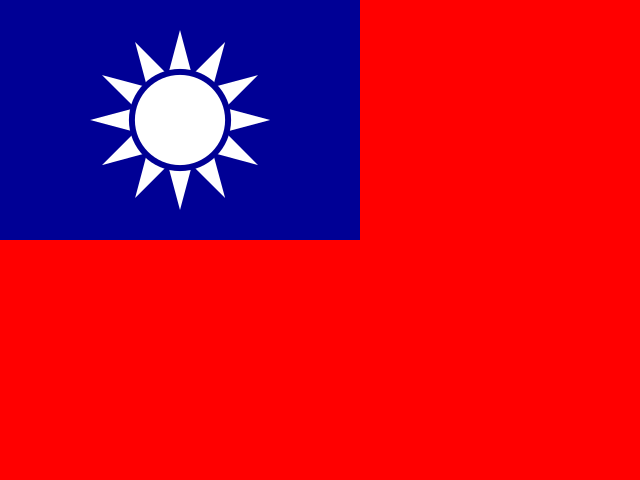
A red field with a blue canton bearing a white sun with twelve triangular rays, the 'Blue Sky, White Sun'. Article 6 of the constitution says only that the national flag shows a red field with a blue sky and a white sun in the upper left corner, and the national emblem and national flag act, which counts the twelve rays and fixes each at thirty degrees, assigns them no meaning either. Officially published glosses read the colours for the Three Principles of the People, with blue for nationalism and liberty, white for democracy and equality and red for the people's livelihood and fraternity, and read the twelve rays for the twelve months of a year and the twelve two-hour periods of a day.
Source: law.moj.gov.tw · checked 2026-08-26
Taiwan FACTS ◢
| Capital | Taipei |
|---|---|
| Continent | Asia |
| Population | 23,299,132 (2025) |
| Area | 36,193 km² |
| Population density | 644/km² |
| Currency | New Taiwan dollar (TWD) |
| Main language | Mandarin |
| Calling code | +886 |
| Internet TLD | .tw |
| Time zone | UTC+08:00 |
| Drives on the | Right |
| ISO codes | TW / TWN |
DID YOU KNOW? ◢
- Taipei 101 was the world's tallest building from 2004 until Dubai's Burj Khalifa opened in 2010.
- It produces the majority of the world's most advanced computer chips.
- Bubble tea, the milk tea with chewy tapioca pearls, was invented here in the 1980s.
- Roughly two-thirds of the island is covered in forested mountains, pushing most cities to the western plains.
Taiwan QUICK ANSWERS ◢
What is the capital of Taiwan?
The capital of Taiwan is Taipei.
What is the population of Taiwan?
Taiwan had a population of 23,299,132 in 2025.
What currency does Taiwan use?
Taiwan uses the New Taiwan dollar (TWD).
What languages are spoken in Taiwan?
Taiwan designates no official language. The language of government and education is Mandarin.
Think you know your flags? Play Flag Daily → · Browse all countries →
MORE ON THE FLAG ◢
The short answer to what Taiwan's flag means sits at the top of this page: the colours for the Three Principles of the People, the twelve rays of the white sun for the twelve months of a year and the twelve two-hour periods of a day. Both halves of that come from the Office of the President's Chinese page, which is the only one of the three state pages on the flag that gives all of it. The presidency's English page drops the twelve months, and the Ministry of the Interior drops the Three Principles. It is worth knowing where the answer comes from, because it does not come from the law.
Neither of the two texts that actually define the flag says any of it. The constitution disposes of the flag in one sentence and stops. The National Emblem and National Flag Act spends its articles 2 to 4 fixing the sun's radius, the width of the blue ring, the apex angle of every ray and the flag's proportions, and across all twenty-two of its articles and both of its annexes it interprets none of it.
The meanings come from somewhere else: the explanatory pages of the Office of the President and the Ministry of the Interior. Read the presidency's Chinese page, its English page and the ministry's page side by side and they do not agree with each other either.
Key Takeaways
- Article 6 of the Republic of China's constitution gives the flag one sentence and assigns nothing: a red ground with a blue sky and a white sun in the upper left corner.
- The National Emblem and National Flag Act, promulgated 17 December 1928 and revised once in 1954, counts the rays at twelve and fixes each one's apex angle at 30 degrees. It never says why twelve.
- The Office of the President's Chinese page reads the twelve rays as the twelve months of a year and the twelve shichen, the two-hour periods of a Chinese day. Its English page keeps the day and drops the year.
- The presidency credits the blue-sky-white-sun device to Lu Hao-tung, shown in Hong Kong on 21 February 1895, and credits Sun Yat-sen with adding the red ground.
- The act's annexed drawings, which exist only as scans and were read here off a 200 dpi render, label some of their construction points with four-character mottos, so the blue disc is built from four points named 協和萬邦.
| Text | What it says the colours mean | What it says the twelve rays mean |
|---|---|---|
| Constitution, article 6 | Nothing. It names red, blue and white and stops | Nothing. It does not mention rays at all |
| National Emblem and National Flag Act, articles 2 to 4 | Nothing. It names the colours as red, qing (the older word covering blue and green) and white | Nothing, beyond fixing twelve of them at 30 degrees each |
| Office of the President, Chinese page | Three readings per colour, including the Three Principles | Twelve months of a year and twelve shichen (two-hour periods) of a day |
| Office of the President, English page | The Three Principles, plus of, by and for the people | 12 two-hour periods, symbolising unceasing progress |
| Ministry of the Interior | Freedom, equality and fraternity, plus a moral instruction each | Twelve shichen (two-hour periods) a day and twelve months a year |
Taiwan's constitution gives the flag one sentence
One sentence, and it is worth reading before anything else, because everything usually attached to it is absent from it.
Taiwan is governed under the 1947 Constitution of the Republic of China, and article 6 of it reads, in full: "中華民國國旗定為紅地,左上角青天白日。" The Office of the President's own English text renders it "The national flag of the Republic of China shall be of red ground with a blue sky and a white sun in the upper left corner."
That is the whole provision. It assigns no symbolism, counts no rays, sets no proportions and fixes no colour value. The words are 紅 for red, 青 for the sky and 白 for the sun, and 青 is the older colour word that covers blue and green together, so the flag's blue is never called 藍 in law.
The Three Principles of the People do appear in this constitution, five articles earlier. Article 1 of the constitution begins "中華民國基於三民主義" and the presidency's English gives it as "The Republic of China, founded on the Three Principles of the People, shall be a democratic republic of the people, to be governed by the people and for the people." The document names the Three Principles and describes the flag, in the same chapter, without ever connecting the two. The connection is made elsewhere, on pages that are not the law.
The flag act gives the geometry and no gloss
The detail sits in a separate statute, the 中華民國國徽國旗法, the National Emblem and National Flag Act. It was promulgated by the National Government on 17 December 1928 and its whole text was revised once, by the President, on 23 October 1954. Those two entries are the entire legislative history. Nothing has been amended since.
Article 2 of the act defines the emblem as a circle in blue and white, and its second subparagraph reads "白日居中,並有十二道白尖角光芒。" The Ministry of Justice's English translation gives that as "A white sun in the middle, with 12 white rays with pointed angles." The act's article 3 then turns the emblem into geometry. The sun's radius stands to the blue circle's radius as 1 to 3. The distance from the centre to a ray's tip is twice the sun's radius. The blue ring's width is one fifteenth of the sun's diameter. And article 3 of the act, subparagraph 5: "每道白尖角光芒之頂角為三十度,十二角為三百六十度。" Each ray's apex angle is 30 degrees, and the twelve together make 360.
Article 4 of the act does the same for the flag. Proportions of 3 to 2, a blue canton covering a quarter of the field, the sun's radius to the horizontal length of the blue rectangle as 1 to 8. Even the flagpole is legislated: article 5 of the act says "The pole for the national flag shall be white with a round golden top."
Twenty-two articles, and not one of them says what any of it stands for.
One small thing worth flagging for anyone working from the translation rather than the Chinese. The act's article 3, subparagraph 6 requires the rays pointing up, down, left and right to face particular compass directions, and the Chinese gives them as 北南西東, north, south, west, east. The official English reads "The white rays' upper, lower, left, and right sides with pointed angles shall face north, south, east, and west." Left has become east and right west. The drawings settle it: the annex marks 卯角向東 and 酉角向西, and the west point of the emblem is the one on the left.
What do the twelve rays on Taiwan's flag mean?
Twelve months of a year and twelve shichen, the two-hour periods of a Chinese day, according to the Office of the President's Chinese page and the Ministry of the Interior. The presidency's own English page keeps only half of that.
The Office of the President's Chinese page on the national flag says "白日的12道光芒,代表著一年12個月,一天12個時辰" and then goes on to say the rays symbolise the nation's lifeblood living on in the world as time moves forward. Twelve months of the year, twelve shichen of the day: two counts, one for each unit of twelve.
The Ministry of the Interior says the same pair in the other order, on a page headed 國旗的意義, the meaning of the national flag: "「十二道光芒」代表光華四射,普照全球,並象徵每天十二個時辰,每年十二個月". Twelve shichen every day, twelve months every year, prefaced by an image of radiance shining outward and lighting the whole world.
The Office of the President's English page carries a completely different text from its Chinese one, and where the two overlap the English is narrower: "The 12 points of the white sun in the emblem represent the Chinese conceptualization of a day's being divided into 12 two-hour periods, which symbolizes unceasing progress." The months have gone.
A shichen is two hours, so twelve of them is a complete day rather than a half of one. Both halves of the Chinese reading work the same way: the rays count out one full cycle of time, once as a day and once as a year. Whether you would recognise those twelve rays from memory is a separate question, and three guesses at one flag a day is the fastest way to find out.
The three pages that gloss the colours do not agree
The three state pages read for this article all assign the colours meanings, and no two of them assign the same set.
The Office of the President's Chinese page gives each colour three readings stacked together: "青色代表光明純潔、民族和自由" and then the same shape for the other two, so blue carries brightness and purity, nationalism, and freedom; white carries candour and selflessness, democracy, and equality; red carries a refusal to fear sacrifice, the people's livelihood, and fraternity. The middle term in each triple is one of the Three Principles of the People, the doctrine the constitution's own article 1 says the Republic is founded on.
The Office of the President's English page keeps the Three Principles and adds a fourth layer the Chinese page does not have, mapping each colour onto Abraham Lincoln's formula: "the blue signifies brightness, purity, and freedom, and thus a government that is of the people", with white for by the people and crimson for for the people. It also introduces bloodshed alongside sacrifice, which the Chinese does not.
The Ministry of the Interior drops the Three Principles entirely. Its page says "我國國旗由「青、白、紅」三種顏色組合而成,分別象徵「自由」、「平等」與「博愛」", the three colours standing for freedom, equality and fraternity, and then reads each one as an instruction to the citizen rather than a political doctrine: blue as the high sky, telling us to hold a lofty character and high aspirations; white as the bright sun, telling us to be open and unblemished; red as the colour the country was dyed by the blood of the revolution's fallen, telling us to have a spirit of sacrifice and struggle.
None of those three glosses is the law, and nothing in the law contradicts any of them. They are the state explaining its own emblem in three offices, in two languages, on pages last touched years apart, and the differences between them are what a reader should carry away rather than any one version of the list.
The act's drawings spell out mottos in their point labels
The annexes do something the articles never do.
Both annexes are published as scans with an empty text layer, so nothing here was extracted from the file. The characters below were read by eye off a 200 dpi render of the sheets, and the two annexes are named in the sources at the foot of this page for anyone who wants to check the reading.
The design articles are bare geometry, but a drawing has to name its construction points. Most of the labels on these two sheets are the conventional Chinese ordinal sets, the equivalents of A, B, C, D and 1 to 12: the sun's four points are 甲乙丙丁 and the outer edge of the blue ring 戊己庚辛, which are the first eight Heavenly Stems, and the twelve ray tips are 子丑寅卯辰巳午未申酉戌亥, the twelve Earthly Branches. The outer circle, the corners of the flag and the corners of its canton are labelled another way entirely, with phrases.
The notation block for the emblem opens "協和萬邦=青地圓形": the four points 協, 和, 萬 and 邦, set at north, east, south and west on the outer circle, define the blue disc. Read round, they spell a four-character phrase meaning harmony among the ten thousand states. The construction step says so in as many words, calling the result "圓周協萬和邦四點成協和萬邦圓即得青地圓形", the 協和萬邦 circle. That step lists the four points in pairs across the diameters, 協 opposite 萬 and 和 opposite 邦, before naming the phrase they spell going round, so one sentence prints the same four characters in two orders.
The flag sheet does it twice more. "天地人和=紅地" puts 天, 地, 人 and 和 at the four corners of the red field, spelling heaven, earth, humanity, harmony. "天日月星=青色長方形" puts 天, 日, 月 and 星 at the four corners of the blue canton, spelling heaven, sun, moon, stars. The emblem sheet carries two more sets. Four characters sit loose around the emblem diagram, one on each cardinal axis, running 自, 平, 由, 等 clockwise from the west. Pairing them across the two diameters gives 自由 and 平等, freedom and equality. That pairing is a reading. The sheet itself only places the four characters. Four more at the corners of that sheet read 光明普照 clockwise from the top left, brightness shining everywhere.
The ray labels are worth going back to. The twelve Earthly Branches are also the names of the twelve shichen, 子時 through to 亥時, so the drawing hangs the twelve time-period names on the twelve rays, one to each. That is not the act saying what the rays are for. The branches are the ordinary way to number twelve of anything in Chinese, and a draughtsman needing twelve labels would reach for them whatever the rays meant. But it is the closest the instrument itself comes to the reading the state pages publish, and a reader who opens the annex will find it there.
自由平等 and 光明普照 both echo in the glosses, though one of them less exactly than it looks. The Ministry of the Interior's rays sentence has 光華四射,普照全球 against the annex's 光明普照: what the two share is the two-character compound 普照, not a phrase. 自由 and 平等 recur intact, in the ministry's colours sentence, which lists 自由, 平等 and 博愛 as what the three colours stand for. Two of the words the state now uses to explain the flag were already sitting in the legal drawing of it, as the names of points on a diagram.
Two adoption dates, both from the presidency
The presidency gives one date on its Chinese page and a different one on its English page.
The Chinese page ties adoption to the statute: after the Northern Expedition succeeded and the country was unified, on 17 December of the seventeenth year of the Republic, the blue-sky-white-sun-over-red flag was formally passed into law by the National Government and issued for national use. That is 1928, and it is exactly the promulgation date the act's own legislative history records.
The English page dates it differently: "The current ROC national flag was officially adopted on May 5, 1921." That is seven years earlier, well before the 1928 statute existed. The English page also supplies the pre-history the Chinese page skips: before the Wuchang Uprising the armies of the revolution flew different flags province by province, an eighteen-star flag in the Wuhan area, a five-colour flag in Shanghai, and the blue sky with white sun in Guangdong, Guangxi, Yunnan and Guizhou. Under the first Provisional Government the five-colour flag was the national flag and the blue-sky-white-sun served the navy.
Nothing on either page reconciles the two. The English page gives its 1921 date flatly, without naming an actor or attaching a qualification to it, and the Chinese page names the National Government and the statute. Anyone quoting one adoption year for this flag is choosing between them without saying which.
Who designed Taiwan's flag, and who added the red
The presidency credits the device to one man and its red ground to another.
Its English page states that the blue-sky-white-sun portion of the flag was "originally designed by Lu Hao-tung, a martyr of the Chinese revolution", and that "Lu presented his design in a meeting of the Xing-Zhong Hui (Society for Regenerating China) in Hong Kong on February 21, 1895." The Chinese page adds the second hand: Sun Yat-sen, named there as 國父, the father of the nation, took Lu Hao-tung's blue-sky-white-sun flag as his model and added red as the ground colour, producing the flag known as 青天、白日、滿地紅, blue sky, white sun, whole ground red.
Sun is still in the statute, in a place that has nothing to do with the design. Article 6 of the flag act, a different article 6 from the constitution's and a rule about hanging rather than design, requires government offices, schools, organisations and military units to hang the flag above the portrait of the father of the nation, at the centre of the front of their auditoriums and assembly halls. The statute has not been amended since 1954, so that instruction stands as written.
What the act measures, and the one thing it never measures
A separate annex to the act tabulates ten standard flag sizes, numbered one to ten, in centimetres. They run from 16 by 24 up to 240 by 360, and the act's article 19 picks one of them out: "商店住戶所懸之國旗,以後附之國旗各號尺度表內第六號為標準。" Shops and households are to fly No. 6, which the table gives as 96 by 144 centimetres.
The sizes annex prints two notes of its own, and the second explains the arithmetic: "每號約大其前一號三分之一其縱度橫度數目皆爲八之倍數以便計算". Its own account of itself is that each size is about a third larger than the one before, and that the height and length figures are all multiples of eight so the sums are easy. The heights hold to that: 16, 24, 32, 48, 64, 96, 128, 160, 192, 240. The lengths hold everywhere but one, the 36 centimetres of No. 2.
What the act never fixes anywhere, across twenty-two articles, its annexed drawings and its table of ten sizes, is a colour value. The red is 紅, the sky is 青, the sun is 白, and the flagpole's finial is 金黃色. A statute precise enough to specify the width of a ring as one fifteenth of a diameter leaves the actual shade of the flag to the words alone. Words alone turn out to be enough to place a country: Guess the Country gives you three written clues and three guesses, and never shows you a flag at all.
Frequently asked questions
What does the Taiwan flag mean?
There is no legal answer, only official explanations. Article 6 of the Republic of China's constitution describes the flag as a red ground with a blue sky and a white sun in the upper left corner and assigns no meanings, and the National Emblem and National Flag Act fixes the geometry without interpreting it. The Office of the President and the Ministry of the Interior both publish glosses, and they differ from each other.
Why does the sun on Taiwan's flag have twelve rays?
No instrument says why. Article 2 of the National Emblem and National Flag Act states that there are twelve, article 3 of the same act gives each an apex angle of 30 degrees so that the twelve total 360, and neither goes any further. The act's annexed drawing does label the twelve ray tips with the twelve Earthly Branches, which are also the names of the twelve shichen, the two-hour periods of a Chinese day, but a drawing that labels twelve points with the standard set of twelve labels is not an explanation. The Office of the President's Chinese page reads the rays as the twelve months of a year and the twelve shichen of a day, and the Ministry of the Interior gives the same pair. The presidency's English page mentions only the twelve two-hour periods.
What do the colours of Taiwan's flag stand for?
According to the Office of the President's Chinese page, each colour has three readings at once, one of which is one of the Three Principles of the People: blue for brightness and purity, nationalism and freedom; white for candour, democracy and equality; red for a refusal to fear sacrifice, the people's livelihood and fraternity. The same office's English page keeps the Three Principles and lays Abraham Lincoln's formula over them, so that blue gives a government of the people, white by the people and crimson for the people. The Ministry of the Interior drops the Three Principles and gives simply freedom, equality and fraternity. None of those three readings appears in the constitution or in the flag act.
Who designed Taiwan's flag?
The Office of the President credits the blue-sky-white-sun device to Lu Hao-tung, who it says presented the design at a meeting of the Xing-Zhong Hui in Hong Kong on 21 February 1895. The same office credits Sun Yat-sen with taking that design as his model and adding the red ground, producing the flag known as blue sky, white sun, whole ground red.
When was Taiwan's flag adopted?
Two dates are current, both from the Office of the President. Its English page says the flag was officially adopted on 5 May 1921. Its Chinese page ties adoption to the statute passed on 17 December 1928, which is also the promulgation date recorded in the National Emblem and National Flag Act's own legislative history. The act's text was revised once afterwards, on 23 October 1954.
Sources
- Ministry of Justice, Laws and Regulations Database of the Republic of China (Taiwan), 中華民國憲法 - retrieved 26 August 2026.
- Office of the President, Republic of China (Taiwan), Constitution of the Republic of China, main text - retrieved 26 August 2026.
- Ministry of Justice, Laws and Regulations Database, 中華民國國徽國旗法, its English translation, its legislative history and its two annexes, 國徽圖案及說明、國旗圖案及說明、國徽國旗圖樣 and 國旗各號尺度表 - retrieved 26 August 2026. The annexes are scans with no text layer and were read by eye off a 200 dpi render.
- Office of the President, Republic of China (Taiwan), 國旗 - retrieved 26 August 2026.
- Office of the President, Republic of China (Taiwan), National flag - retrieved 26 August 2026.
- Ministry of the Interior, 國旗懸掛禮儀網, 國旗的意義 - page dated 28 August 2020, retrieved 26 August 2026.
PLAY ANOTHER →
A short message, hidden in a different cipher every day.
ONE CIPHER A DAYDAILYDaily CryptogramOne quote, one scrambled alphabet. Crack it before tomorrow.
CRACK THE QUOTEDAILYDaily TriviaFive questions a day. Everyone gets the same five.
FIVE QUESTIONSDAILYOn This DayOne thing that happened today in history. Every day, a new one.
TODAY IN HISTORY