
Timor-Leste
Occupying the eastern half of an island it shares with Indonesia, Timor-Leste became the 21st century's first brand-new sovereign nation and still trades in US dollars.
WHAT THE FLAG MEANS ◢
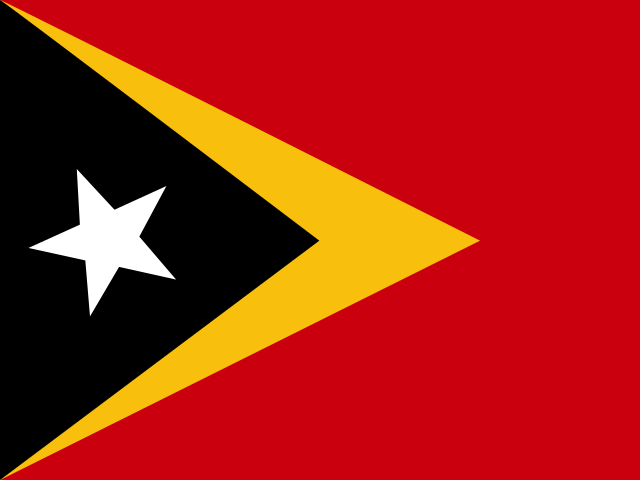
A red field with a yellow triangle at the hoist reaching half the flag's length, overlaid by a shorter black triangle bearing a white five-pointed star. Section 15 of the 2002 constitution legislates the colours: yellow is the traces of colonialism, black the obscurantism that needs to be overcome, red the struggle for national liberation, and white peace. The same section gives the star itself as the light that guides.
Timor-Leste FACTS ◢
| Capital | Dili |
|---|---|
| Continent | Asia |
| Population | 1,418,517 (2025) |
| Area | 14,919 km² |
| Population density | 95/km² |
| Currency | United States dollar (USD) |
| Official languages | Portuguese, Tetum |
| Calling code | +670 |
| Internet TLD | .tl |
| Time zone | UTC+09:00 |
| Drives on the | Left |
| ISO codes | TL / TLS |
DID YOU KNOW? ◢
- It became fully independent in 2002, making it one of the world's youngest nations.
- It shares the island of Timor with Indonesia, holding the eastern half.
- Portuguese is one of its official languages, a legacy of centuries of colonial rule.
- Its coral-rich waters are part of the Coral Triangle, among the most biodiverse marine regions on Earth.
Timor-Leste QUICK ANSWERS ◢
What is the capital of Timor-Leste?
The capital of Timor-Leste is Dili.
What is the population of Timor-Leste?
Timor-Leste had a population of 1,418,517 in 2025.
What currency does Timor-Leste use?
Timor-Leste uses the United States dollar (USD).
What languages are spoken in Timor-Leste?
The official languages of Timor-Leste are Portuguese and Tetum.
Think you know your flags? Play Flag Daily → · Browse all countries →
MORE ON THE FLAG ◢
Yellow for the traces of colonialism, black for obscurantism, red for the struggle, white for peace. Those four readings are not a tradition anyone assembled after the fact. They are clause 2 of Section 15 of Timor-Leste's constitution, and they carry exactly the same legal weight as the sentence beside them that fixes how far each triangle reaches across the cloth.
The more unusual thing is where in the constitution they sit. Section 156 lists ten matters that a constitutional revision law has to respect: national independence and the unity of the State, the rights and freedoms of citizens, the separation of powers, the independence of the courts, and six more. Two of those ten are not principles at all. They are objects. One is the date on which independence was proclaimed. The other is the National Flag.
And of the ten, only two can be revised at all: the flag, and the republican form of government. Not the date of the proclamation, and not the other seven. The route left open for those two is one that a two-thirds majority in Parliament does not on its own control.
Key Takeaways
- Section 15 of the 2002 constitution both draws the flag and assigns its colours a meaning, so the gloss is statutory text rather than folklore.
- The constitution defines the flag in its own words but leaves the coat of arms and the anthem to ordinary law, which did not arrive until January 2007.
- Section 156 lists the flag among ten matters a constitutional revision law must respect, and makes it one of only two that may be revised at all, through a national referendum.
- White and the star are two separate glosses. White is peace. The star is the light that guides. Accounts that fuse them into one phrase add something the section does not say.
- Reading yellow as the country's wealth is real Timorese law, but it belongs to the coat of arms, not to the flag.
Timor-Leste's flag can only be changed by referendum
Section 155 of the constitution sets the ordinary bar for amendment: changes are approved by a two-thirds majority of sitting members. Section 156 then carves out the matters that even a two-thirds majority must respect, and the ninth item on that list is bare enough to quote whole. In the Portuguese text it reads "A Bandeira Nacional". The tenth is barely longer: "A data da proclamação da independência nacional". The National Flag, and the date of the proclamation of national independence.
Clause 2 of the same section supplies the only exit. "As matérias constantes das alíneas c) e i) podem ser revistas através de referendo nacional, nos termos da lei", which is to say that the matters in paragraphs c) and i) may be revised through a national referendum, in accordance with the law. Paragraph c) is the republican form of government. Paragraph i) is the flag.
That is a narrow gate. Section 66 of the constitution, which governs referendums generally, bars from referendum any matter within the exclusive constitutional competence of Parliament, the Government or the courts, and makes a referendum binding only where the number of voters exceeds half the registered electorate. The annotated edition of the constitution reads Section 156 clause 2 as an express exception to the first of those rules, opened for two subjects and no others.
That edition, coordinated by Pedro Carlos Bacelar de Vasconcelos and published by the University of Minho's law school in October 2011, sorts the ten items into two kinds: normative principles on one side, and on the other the two that concern "aspetos simbólicos do Estado (a bandeira e a data da proclamação da independência)", the symbolic aspects of the State. It also notes that the constitution never says how the special referendum would be started, leaving that to a law: "A Constituição não determina expressamente como se pode dar início a este processo referendário especial".
One reading in the literature goes the other way. A footnote in Catherine Arthur's study of the flag, citing Michael Leach's Nation-Building and National Identity in Timor-Leste, says the adoption of the 1975 flag was protected by Article 156, "which stipulated that this decision was ‘incapable of future revision.’" That is what clause 1 looks like read alone. Clause 2 is the part that says otherwise.
The flag is also the only one of the three national symbols that the constitution describes itself. Section 14 names all three, flag, coat of arms and anthem, and sends the last two to ordinary law. That law did not arrive until January 2007. For the anthem the constitution wrote its own stop-gap into Section 166, adopting the melody for national ceremonies until Parliament legislated. Section 15 had already drawn the flag, so there was nothing to fill in.
What Section 15 says about Timor-Leste's flag
Section 15 is one paragraph of geometry and one list of meanings. The Portuguese text is the one to read, because it is one of the two official languages of the Republic under Section 13, and because on this section the Portuguese and the Tetum agree with each other and the published English does not.
Clause 1 opens: "A Bandeira Nacional é rectangular e formada por dois triângulos isósceles de bases sobrepostas, sendo um triângulo preto com altura igual a um terço do comprimento que se sobrepõe ao amarelo, cuja altura é igual a metade do comprimento da bandeira." The National Flag is rectangular and formed by two isosceles triangles whose bases are superimposed; a black triangle whose height equals one third of the length lies over the yellow one, whose height equals half the length of the flag.
The relation is worth slowing down on, because it is the detail most often reversed. Both triangles stand on the same base. The yellow reaches half way across the flag. The black reaches a third of the way. The yellow is the longer of the two, and the black lies over it rather than the other way round.
The rest of the clause places the star and closes the field: a white five-pointed star in the centre of the black triangle, "que simboliza a luz que guia", which symbolises the light that guides; one of its points turned towards "a extremidade superior esquerda da bandeira", the upper left extremity of the flag; and "A parte restante da bandeira tem a cor vermelha", the remaining part of the flag being red.
Clause 2 is the colour list, and the legal word for the first of them is "Amarelo", which is yellow rather than gold. The Ministry of Justice's Tetum text of the constitution agrees, giving the colour as "Kinur" and its meaning as "kolonializmu nia ain-fatin", colonialism's footprints, and the star as "naroman ne’ebé hatudu dalan", the light that shows the way.
Nothing in the section fixes a shade, a ratio or a proportion beyond those two fractions. Nor does the national symbols law that followed. Its Annex A is one colour illustration of the flag headed "Anexo A: Bandeira Nacional", with no dimensions and no colour specification of any kind printed anywhere on the page. The law then requires what it never states. Article 1.5 obliges any reproduction to respect "o desenho, as cores, o texto e as proporções definidos na presente lei", the design, colours, text and proportions defined in the law, and the law specifies neither the shades nor the proportions. Article 4 sizes the flag in cloth widths from "um pano de 45 centímetros de largura" upwards and permits other sizes "desde que mantidas as devidas proporções". Article 23 makes altering "as proporções" an offence. The only proportions written down in either instrument are Section 15's two fractions.
White is peace. The star is something else
This is the subtlest place where the popular summaries and the constitution part company, and it is easy to miss because the two glosses sit in different clauses of the same section.
The star is glossed in clause 1, as part of the description of the design: the five-pointed white star means the light that guides. White is glossed in clause 2, in the colour list, and means peace. Two elements, two readings, in two different clauses.
Merging them produces a phrase that Section 15 does not contain: the star as a guiding light of peace. Even a peer-reviewed study of this flag does it. Catherine Arthur, writing in the Journal of Southeast Asian Studies in 2018, summarises the design by saying that "the five-pointed white star represents the peace which has been desired for so long", which quietly transfers clause 2's gloss for the colour onto clause 1's charge and leaves the light that guides out altogether.
The distinction matters because the constitution is being unusually careful here. It gives the star a job that no colour in the list is given: not a value, but a direction.
Timorese law does read yellow as wealth, but on the coat of arms
Search for what Timor-Leste's flag means and you will meet, sooner or later, the claim that yellow stands for the wealth or natural riches of the country. It contradicts Section 15 flatly. It is also not invented, and tracing it is more useful than dismissing it, because the reading is Timorese law attached to a different emblem.
Lei n.º 2/2007, de 18 de Janeiro, the national symbols law, describes the coat of arms in Article 6 and then glosses it. The light yellow that tints the contours of the black part of Mount Ramelau, the bands and margins of the open book, the ears of corn and rice, the cogwheel, the rama-inan and the diman "simboliza a Riqueza", symbolises Wealth. In the same list, the black at the centre of the mountain "simboliza o obscurantismo a vencer", the obscurantism to be overcome, in almost the constitution's own words for the flag's black.
| Colour | On the flag, Section 15 of the constitution | On the coat of arms, Article 6 of Lei n.º 2/2007 |
|---|---|---|
| Yellow | The traces of colonialism | Wealth |
| Black | The obscurantism that needs to be overcome | The obscurantism to be overcome |
| Red | The struggle for national liberation | Love of the homeland and the struggle for national liberation |
| White | Peace | Peace, for the white at the centre of the circumference with the star and the rays |
So Timorese law gives yellow one meaning on the flag and an unrelated one on the coat of arms, in two instruments five years apart. There is a second source of the confusion too. Arthur records that the Fretilin party flag's own yellow signified the natural richness of the land, and notes in passing, citing Michael Leach's Nation-Building and National Identity in Timor-Leste, that the national flag's yellow originally carried that meaning as well and was changed before independence was restored in 2002. Neither claim could be checked against a Timorese instrument for this article: no Timorese text that could be opened records what the yellow meant before 2002. What is checkable is the current text, and it says colonialism.
The same statute accounts for the other confusion as well. Article 6.2 gives the five points of the coat of arms' white star as "a luz da generosidade e honestidade que guia o Povo para a Paz", the light of generosity and honesty that guides the People to Peace, and its white rays as "a luz da solidariedade e a determinação de levar a paz a todo o mundo". So a guiding light coupled to peace is Timorese law too. It is the law of the coat of arms, and it is very close to the phrase Section 15 declines to use of the flag: Section 15 glosses the star and the white apart.
The flag dates from 1975, not from 2002
Timor-Leste's flag was not designed for the country that raised it in 2002. The constitution makes the point in its first sentence. The preamble opens with independence "proclamada pela Frente Revolucionária do Timor-Leste Independente (FRETILIN) em 28 de Novembro de 1975", which then "vê-se internacionalmente reconhecida a 20 de Maio de 2002". Independence proclaimed by Fretilin on 28 November 1975, internationally recognised on 20 May 2002. The preamble puts 2002 as the moment the 1975 proclamation was recognised, not as the moment the state began. Section 1 clause 2 puts the same date in the operative text: 28 November 1975 is the day of the Proclamation of Independence of the Democratic Republic of Timor-Leste. The continuity here is a continuity of design rather than of every gloss ever attached to it, since the reading of the yellow as natural richness is, on Arthur's account citing Leach, one that did not survive.
What happened to the flag in the twenty-seven years between those two dates is set out, in the state's own voice, in the preamble to Decreto do Governo n.º 5/2011, the regulation on raising the flag on solemn days. After the proclamation of 28 November 1975, it says, "a Bandeira Nacional deixou de ser hasteada nos mastros do território nacional durante os 24 anos da ocupação estrangeira", the National Flag ceased to be raised on the masts of the national territory during the 24 years of foreign occupation. The decree's twenty-four counts the occupation, which ended in 1999, rather than the whole interval to 2002. The flag returned, the same preamble records, only with the Restoration of Independence on 20 May 2002.
Arthur's study fills in what flying it meant in the interval. Under the Indonesian occupation the only flag that could lawfully be flown was the Merah-Putih, the red and white of Indonesia, and flying the Timorese flag instead was read, correctly, as a declaration. She records the Tetum phrase "mate bandeira-hun", to be one of those who die by the flagpole, as a colloquial term for selfless patriotism.
The design's family resemblances point the same way. Arthur records that Fretilin created its party flag in 1974, in a decade when anti-colonial movements across the Portuguese empire were reaching for the same vocabulary, and she sets the Timorese flag beside those of Mozambique and Angola, writing that FRELIMO constructed the Mozambican national flag and that the MPLA authored the Angolan one. All three use red, black and yellow with a five-pointed star, and Mozambique's carries a triangle too.
In 2001 the most popular option was a flag that was never adopted
Arthur records that the only formal debate over whether an independent Timor-Leste should keep this flag took place in 2001, and the record of it is a United Nations document.
Under Directive no. 2001/3, a Constitutional Commission was set up in each of the thirteen districts to gather views on the constitution to come. Between 18 June and 14 July 2001 they held 212 public hearings across the 65 sub-districts. About 38,000 people attended, close to a tenth of the electorate, and every hearing was tape-recorded and archived for the Constituent Assembly. The reports were handed to the Transitional Administrator on 16 August 2001.
The executive summary devotes a short section to the flag, and it is worth having in full:
There was equal and strong support for both the RDTL and CNRT flags, both having been used in the struggle for independence. The RDTL flag marked the birth of a sovereign state on 28 November 1975, whereas the CNRT flag is seen as symbolic of national unity and that used on 30 August 1999. An incorporation of these two flags seemed to be the most popular compromise.
The CNRT was the umbrella resistance council, which on Arthur's account took that name in a 1998 reform, and she records that its flag had appeared on the ballot paper of the popular consultation of 30 August 1999, which the constitution's own preamble names as the act that confirmed the will to independence. So the two candidates each carried a founding date.
The compromise the hearings favoured, a flag combining the two, is not what the Constituent Assembly adopted. It kept the 1975 flag, and Section 15 is its description. The annotated edition puts it with some restraint: "Também aqui o peso da memória não facilitou a construção dos consensos que, apesar da polémica, acabaram por prevalecer." Here too the weight of memory did not make it easy to build the consensus which, despite the controversy, eventually prevailed.
The same summary lists what people proposed for national symbols more broadly, among them the traditional house, Mount Ramelau as the place of the ancestors, a traditional sword, spear or dagger, cotton, rice, the island itself, the crocodile, the dove, the rooster and the sun. None of it went onto the flag. Several of those elements do appear on the coat of arms that Parliament approved six years later, where Article 6 of Lei n.º 2/2007 assembles Mount Ramelau, the ears of corn and rice, the rama-inan and the diman.
Where it must be flown, and the fine for redrawing it
Lei n.º 2/2007 is where the flag's daily life is regulated, and it is stricter than most.
It ranks the symbols: flag first, then anthem, then coat of arms, with respect owed in that order. It makes them "atributos exclusivos do estado", exclusive attributes of the state, whose use by private persons depends on authorisation. It requires the flag to be flown daily at a list of places that includes the Presidency, Parliament, the Government, the courts, the police and defence commands, village headquarters, the national headquarters of legally registered political parties, border posts and diplomatic missions, and on merchant navy vessels subject to navigation rules and international practice. It orders schools to raise it solemnly at least once a week during the school year. Spread flat without a mast, it must lie with its longer side horizontal and the star to the left.
Article 23 of the law lists what counts as disrespect, and the second item on that list is a warning to anyone tempted to redraw it: "Mudar-lhe a forma, as cores, as proporções ou o dístico, ou acrescentar-lhe inscrições". Changing its form, its colours, its proportions or its device, or adding inscriptions to it. Using it as clothing, as a tablecloth or on the label of a product for sale is on the same list. A worn flag is to be handed to a military unit for incineration. Breach is a contravention, and the fine runs from 100 to 500 US dollars, doubled for a repeat offence.
Article 29 of the same law closes the circle back to Section 15 of the constitution. Teaching "o padrão e do significado da bandeira nacional", the pattern and the meaning of the national flag, is compulsory in every school, public or private, at every level of education. The gloss is not merely written into the constitution. The law requires it to be taught.
Whether that happened is a separate question, and Parliament answered it. Resolução do Parlamento Nacional n.º 10/2010 recommended that the Government reinforce the application of the 2007 law and establish an obligation to raise the flag solemnly in schools at least once a week, which the 2007 law had already imposed three years earlier. The 2011 decree that followed says in its own preamble that the flag was by then being hoisted only for National Day commemorations, and requires a raising ceremony in every state institution and school on the first Monday of every month.
The official English texts disagree about which way the star points
One last thing, for anyone working from an English translation. Section 15 says one point of the star is turned towards the upper left of the flag. The English texts published by Timor-Leste's own institutions disagree with the Portuguese, and with each other.
The official English translation of the constitution renders the sentence as "The white star has one of its ends turned towards the left side end of the flag", which drops the corner and keeps the side. The Government's national symbols page, which otherwise reproduces Section 15 almost word for word and cites it as its source, has "The white star has one of its ends turned towards the upper right end of the flag", which keeps the corner and inverts it. The Portuguese page on the same site says "extremidade superior esquerda", and so does the Ministry of Justice's Portuguese text of the constitution. The Tetum text agrees: the star's point turns to the flag's upper part on the left-hand side.
The same English page adds three words to the first colour, giving yellow as the traces of colonialism "in Timor-Leste's history", where the Portuguese has only "os rastos do colonialismo". Small drift, on a page that is quoting a constitutional provision.
If you are learning this flag well enough to draw it or to pick it out of a line-up, as Flag Daily asks you to do from one image and three guesses, the Portuguese text is the one to trust: yellow half way, black a third of the way, star at the hoist with a point to the upper left, everything else red.
Frequently asked questions
What do the colours of the Timor-Leste flag mean?
Section 15 of the 2002 constitution assigns them directly: yellow stands for the traces of colonialism, black for the obscurantism that needs to be overcome, red for the struggle for national liberation, and white for peace. They are legal text rather than convention, and can be read in Portuguese and in Tetum in the constitution itself.
What does the star on the Timor-Leste flag mean?
The constitution glosses it separately from the colours. In the description of the design, the white five-pointed star in the black triangle symbolises the light that guides. It is not given the meaning of white, which is peace, so descriptions that call it a guiding light of peace are fusing two separate provisions into one.
Which triangle on the Timor-Leste flag is bigger?
The yellow one. The constitution gives the yellow triangle a height equal to half the flag's length and the black triangle a height equal to one third, and both stand on the same base at the hoist, so the black lies over the yellow and stops short of it. It is an easy relation to reverse.
Why does Timor-Leste use the flag Fretilin proclaimed in 1975?
Because the constitution treats 2002 as recognition of the 1975 proclamation rather than a fresh start: its preamble says independence proclaimed by Fretilin on 28 November 1975 was internationally recognised on 20 May 2002. The alternative considered in the 2001 public hearings was the CNRT resistance flag, and the most popular option there was a combination of the two, which was not adopted.
Can Timor-Leste change its national flag?
Only by national referendum. Section 156 of the constitution lists the National Flag among the matters a constitutional revision law must respect, and then allows just two of those matters, the flag and the republican form of government, to be revised through a national referendum under the law. An ordinary two-thirds amendment in Parliament cannot do it.
Sources
- Ministério da Justiça, Jornal da República, Constituição da República Democrática de Timor-Leste, Portuguese text (PDF) - Sections 1, 13, 14, 15, 66, 155, 156, 166 and the preamble. Retrieved 27 August 2026.
- Ministério da Justiça, Jornal da República, Constituição da República Democrática de Timor-Leste, Tetum text (PDF) - Artigu 15. Retrieved 27 August 2026.
- Government of Timor-Leste, Constitution of the Democratic Republic of Timor-Leste, official English text (PDF) - Sections 15 and 156. Retrieved 27 August 2026.
- Parlamento Nacional, Lei n.º 2/2007, de 18 de Janeiro (Símbolos Nacionais), Jornal da República Série I n.º 1, 18 January 2007 - Articles 1, 3, 4, 6, 9, 10, 18, 23, 24, 27, 29 and Annex A. Retrieved 27 August 2026.
- Parlamento Nacional, Resolução do Parlamento Nacional n.º 10/2010, de 28 de Abril, sobre os símbolos nacionais, Jornal da República Série I n.º 16 (PDF). Retrieved 27 August 2026.
- Governo de Timor-Leste, Decreto do Governo n.º 5/2011, Regulamento do Hastear da Bandeira Nacional em Dias Solenes - preamble and Article 1 of the annexed regulation. Retrieved 27 August 2026.
- Governo de Timor-Leste, Símbolos Nacionais and National Symbols. Retrieved 27 August 2026.
- UNTAET Constitutional Affairs Branch, Office of Political Affairs, Constitutional Commission Public Hearings Executive Summary, Dili, September 2001, in the UNTAET daily briefing of 19 September 2001. Retrieved 27 August 2026.
- Pedro Carlos Bacelar de Vasconcelos (coord.), Constituição Anotada da República Democrática de Timor-Leste (PDF), Escola de Direito da Universidade do Minho, October 2011, annotations to Articles 14, 15 and 156. Retrieved 27 August 2026 from the Ministério da Justiça library.
- Catherine E. Arthur, 'From Fretilin to freedom: The evolution of the symbolism of Timor-Leste's national flag', Journal of Southeast Asian Studies 49(2), 2018, pp. 227-249. Read as the accepted author manuscript in the University of Manchester's Research Explorer repository, which refuses direct requests. Retrieved 27 August 2026 from the Internet Archive capture of 7 July 2022.
PLAY ANOTHER →
One thing that happened today in history. Every day, a new one.
TODAY IN HISTORYDAILYDaily TriviaFive questions a day. Everyone gets the same five.
FIVE QUESTIONSDAILYDaily CryptogramOne quote, one scrambled alphabet. Crack it before tomorrow.
CRACK THE QUOTEDAILYGuess the CountryThree clues, three guesses. Work out where in the world it is.
THREE CLUES