
Mozambique
A long ribbon of a country strung down southeast Africa's coast, Mozambique trades in Indian Ocean beaches, coral reefs and a Portuguese-speaking culture stitched with Swahili and Arab threads.
WHAT THE FLAG MEANS ◢
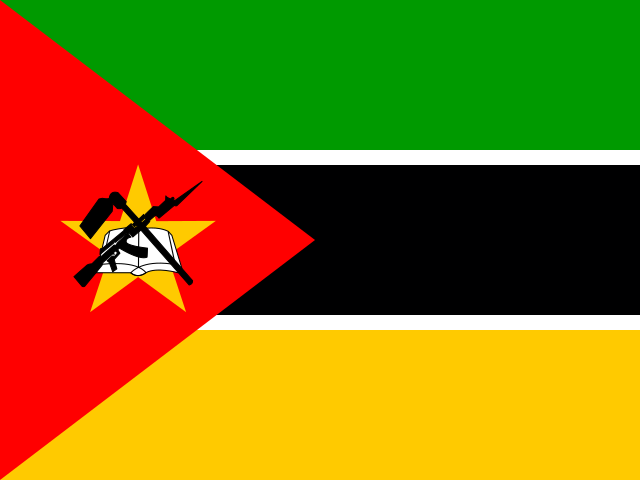
Green, black and golden yellow horizontal bands split by white fimbriations, with a red hoist triangle bearing a golden yellow star, an open book, a hoe and an AK-47. The constitution assigns every element a meaning: green the riches of the soil, black the African continent, golden yellow the riches of the subsoil, white the justness of the Mozambican people's struggle and peace, and red the centuries-old resistance to colonialism, the armed struggle for national liberation and the defence of sovereignty. It gives the star the spirit of international solidarity of the Mozambican people, and makes the book, the hoe and the weapon stand for study, production and defence.
Mozambique FACTS ◢
| Capital | Maputo |
|---|---|
| Continent | Africa |
| Population | 35,631,653 (2025) |
| Area | 801,590 km² |
| Population density | 44/km² |
| Currency | Mozambican metical (MZN) |
| Official language | Portuguese |
| Calling code | +258 |
| Internet TLD | .mz |
| Time zone | UTC+02:00 |
| Drives on the | Left |
| ISO codes | MZ / MOZ |
DID YOU KNOW? ◢
- It has a coastline of roughly 2,500 kilometres along the warm Indian Ocean.
- Portuguese is its official language, a legacy that makes it one of Africa's few Lusophone nations.
- The Bazaruto Archipelago is a haven for dugongs, one of the last strongholds for these sea mammals in East Africa.
- Its flag is the only national flag in the world to feature a modern rifle.
Mozambique QUICK ANSWERS ◢
What is the capital of Mozambique?
The capital of Mozambique is Maputo.
What is the population of Mozambique?
Mozambique had a population of 35,631,653 in 2025.
What currency does Mozambique use?
Mozambique uses the Mozambican metical (MZN).
What languages are spoken in Mozambique?
The official language of Mozambique is Portuguese.
Think you know your flags? Play Flag Daily → · Browse all countries →
MORE ON THE FLAG ◢
Mozambique's flag is drawn and interpreted inside the country's own constitution. One article lists five colours, gives each of them a meaning, sets out where they go, and then says what the star means and what the book, the hoe and the weapon mean.
What that article will not do is call the weapon by its name. It says uma arma, a weapon, and stops there: no make, no model, no Kalashnikov, no bayonet. Everything else anyone knows about the object comes from looking at the flag rather than from reading the law.
The argument about this flag turns on a sentence from 1984, when the design entered the constitution behind an opening line naming the governing party's flag as its base.
Key Takeaways
- The constitution gives a meaning to every colour and every object on the flag. It calls the rifle only uma arma, a weapon, and never names it.
- The design entered the constitution through Lei n.º 1/84 of 27 April 1984, whose replacement article opens by saying the national flag has the Frelimo party flag as its base.
- From 1984 the book, hoe and rifle stood for a party watchword, Estudar, Produzir, Combater. In 1990 the third word became defence.
- Article 302 of the 2004 constitution required a law changing the flag and the emblem within one year, passed by the two-thirds majority any constitutional change needs. Parliament voted the change down on 19 December 2005, by 156 votes to 79.
- That transitional provision has no counterpart in the revised constitution published in 2018, which dropped three of the 2004 text's five transitional articles together. The flag article itself came through the revision unchanged in substance, differing only in two grammatical endings and a printer's error.
| Element | 1975 constitution, article 68 | Lei n.º 1/84, replacing article 77 | 1990 constitution, article 193 | Constitution in force |
|---|---|---|---|---|
| Layout | Four colours set diagonally from the upper hoist corner | Horizontal bands, red triangle at the hoist | As set in 1984 | As set in 1984 |
| Origin | Article 68 says nothing about it | The flag has the Frelimo flag as its base | The clause is gone | Still absent |
| The star | Red, inside the cogwheel, for internationalist spirit | Golden yellow, for proletarian internationalism | No colour given, for the spirit of international solidarity | The same |
| Book, hoe, weapon | Education, defence and vigilance, the peasantry, agricultural production | The watchword Estudar, Produzir, Combater | Study, production and defence | The same |
| Red | Resistance to colonialism, the armed liberation struggle, the revolution | The same three | Resistance to colonialism, the armed liberation struggle, the defence of sovereignty | The same |
| White | The justness of the people's struggle, and the peace that struggle aims to establish | The justness of the people's armed struggle, and peace | The justness of the Mozambican people's struggle, and peace | The same |
What Mozambique's constitution calls the rifle
Nothing more specific than a weapon.
The flag article says the red triangle holds a star, "tendo sobre ela um livro ao qual se sobrepõem uma arma e uma enxada cruzadas" - having above it a book, over which a weapon and a hoe are crossed. That is the whole description of the object that makes this flag famous. There is no calibre, no manufacturer, no bayonet and no country of origin.
The two Mozambican state pages that publish the flag's meaning reproduce the same wording and add nothing to it. The Presidency's page and the Foreign Ministry's national symbols page both close on the constitution's own sentence: "O livro, a enxada e a arma simbolizam o estudo, a produção e a defesa." The book, the hoe and the weapon symbolise study, production and defence.
That order is worth holding on to, because it is easy to meet a reversed version that gives the rifle defence, the hoe farming and the book education. Only the rifle survives the swap. The hoe is production, which is broader than farming, and education is borrowed from the article next door.
Education belongs to the next article, the one describing the national emblem. There the same three objects sit on a map of Mozambique and represent "a educação, a defesa e vigilância, o campesinato e a produção agrícola" - education, defence and vigilance, the peasantry and agricultural production. That is a different set from the flag's, and it spreads four meanings across three objects.
The flag article says study, production and defence. The emblem article says education, defence and vigilance, peasantry and agricultural production. They sit one article apart and the constitution keeps them distinct.
The 1984 law says the national flag has Frelimo's flag as its base
The design reached the constitution on 27 April 1984, in a supplement to the Boletim da República, as Lei n.º 1/84.
Its preamble is one sentence of explanation: on the occasion of the 4th Congress of the Frelimo Party the new national flag was created, and so the text of article 77 of the constitution needs changing. That congress sat the previous April, so the flag is dated to 1983 while the law writing it into the constitution is dated 1984. Two of the outlets that covered the 2025 proposal date it to 1983 as well: RTP gives the flag's current version as 1983, and Polígrafo África dates its adoption to May 1983. The Boletim of 29 April 1983 refers to the moment of the fourth congress in the present tense.
Then comes the replacement article, and its first line is the one that has been argued over ever since: "A Bandeira Nacional tem como base a Bandeira da Frelimo" - the national flag has as its base the flag of Frelimo, the Mozambique Liberation Front. The sentence runs on to describe Frelimo as the vanguard that united the Mozambican people against colonialism, led the armed liberation struggle, proclaimed independence and founded the republic.
That is not a critic's characterisation. It is the constitutional text of the day naming the party's flag as the basis of the country's. The 1990 constitution dropped the sentence and no text since has restored it, but it stood for six years, signed by Samora Machel.
The flag it replaced used the same five colours in a different arrangement. Article 68 of the 1975 constitution set four of them "dispostas diagonalmente, partindo do canto superior esquerdo", running diagonally from the upper hoist corner, with the device in the upper hoist quadrant and, inside the cogwheel, "uma estrela vermelha", a red star. Its meaning then was "o espírito internacionalista do Povo moçambicano", the internationalist spirit of the Mozambican people.
One thing the two texts do not explain is their own numbering. The flag is article 68 in the 1975 constitution and article 77 in the text Lei n.º 1/84 amends, so the provision was renumbered at some point in the nine years between them. Which amendment did that is not settled by any of the sources consulted for this article.
How Study, Produce, Fight became study, production and defence
The book, the hoe and the weapon have been on Mozambican flags since independence, and they have carried three different meanings in three different texts.
In 1975 they were glossed the way the emblem still is. The cogwheel stood for the working class and industrial production, the book for education, and the crossed weapon and hoe were there "simbolizando a defesa e vigilância e a classe camponesa e a produção agrícola" - symbolising defence and vigilance and the peasant class and agricultural production.
Lei n.º 1/84 replaced that with something blunter. The three objects no longer stood for functions and classes. They stood for a slogan: "O livro, a enxada e a arma consagram a palavra de ordem" - the book, the hoe and the weapon enshrine the watchword - and the watchword was "Estudar, Produzir, Combater". Study, produce, fight.
The same law made the star "amarelo dourado", golden yellow, and assigned it "o internacionalismo proletário", proletarian internationalism.
Six years later, with the one-party state ending, the 1990 constitution rewrote both lines without altering the picture. The watchword became a list of three nouns and the third of them changed: estudo, produção, defesa. Study, production, defence. Combater, to fight, had become defesa, defence. The star lost its specified colour and its proletarian internationalism, and became simply a star symbolising "o espírito de solidariedade internacional do povo moçambicano", the spirit of international solidarity of the Mozambican people.
Red moved too. In 1975 and again in 1984 it stood for centuries-old resistance to colonialism, the armed liberation struggle and "a revolução". From 1990 the third item is "a defesa da soberania", the defence of sovereignty. White lost a word in the other direction: the 1984 text made it the justness of the people's armed struggle, and the 1990 text dropped the adjective.
So the objects never moved. The sentences underneath them were rewritten twice, and each rewrite pulled a piece of 1980s vocabulary out of the constitution while leaving the rifle exactly where it was.
The 2004 constitution set a one-year deadline for a law changing the flag
The constitution that replaced the 1990 one did something with the flag that rarely gets mentioned, and it did it in the transitional provisions rather than in the flag article.
Among the transitional provisions of the 2004 text, article 302 reads: "As alterações da bandeira nacional e do emblema da República de Moçambique são estabelecidas por lei" - changes to the national flag and to the emblem of the Republic of Mozambique are established by law - "no prazo de um ano, a contar da entrada em vigor da Constituição", within one year, counting from the constitution's entry into force. The article goes on to require that the law be approved under article 295(1) of the same constitution, which governs constitutional amendment: "As alterações da Constituição são aprovadas por maioria de dois terços dos deputados da Assembleia da República", changes to the constitution are approved by a two-thirds majority of the deputies of the Assembleia da República. In the text in force the same rule is article 303(1).
It is worth being exact about what that provision does. It does not describe a new flag, and it does not command that the flag change. It assumes that it will, and sets a deadline and a majority for the law that would do it. The same constitution had just finished drawing the existing flag, in article 297, in substantially the words it still uses. Five articles later it made arrangements for replacing it.
Article 306 puts the constitution's own entry into force on the day after the validation and proclamation of the results of the 2004 general elections, and article 302 counts its year from entry into force. So the clock started the day after the result was proclaimed rather than on the day it was proclaimed.
Which day that was, this article cannot tell you. None of the sources consulted for it records the date the 2004 election results were validated and proclaimed, so the date the one-year period expired is not established here. The frame around it is. The constitution was approved by the Assembleia da República on 16 November 2004 and published in the Boletim da República of 22 December 2004, and it tied its own commencement to an election result rather than to a calendar date. A constitution cannot come into force before it is made, so the one-year period cannot have run out before late 2005. That puts the vote of 19 December 2005 at the edge of the period rather than comfortably inside it, and which side of the edge it falls on is not something these sources settle.
Why Mozambique's parliament voted to keep the rifle
Because Frelimo, whose flag it had been, held the numbers, and said the case for changing it had not been made.
The Assembleia da República took the question on 19 December 2005. According to the Lusa agency report carried by RTP, the proposal to alter the flag and the emblem drew 156 votes against, from the governing Frelimo benches, and 79 in favour, from the opposition Renamo-União Eleitoral.
Frelimo's Edson Macuácuá put the governing party's position in a line: there are no "razões sociais, históricas e políticas que justifiquem a mudança dos actuais símbolos nacionais", no social, historical or political reasons justifying a change to the current national symbols. Frelimo, he said, had voted for the sovereignty of the people and the history of the country.
Renamo's José Manteigas answered with the argument Lei n.º 1/84 had already conceded: "Moçambique continua sem bandeira e emblema nacionais, pois os actuais são da FRELIMO" - Mozambique still has no national flag or emblem, because the current ones are Frelimo's. Twenty-one years earlier the constitutional text had said as much, approvingly.
The law article 302 called for was never made, so its one-year period ran out unused. Parliament does not always leave a transitional deadline to lapse. Article 304, two articles further down the same title, gave three years from entry into force for the provincial assembly elections article 142 provides for, and on 16 November 2007 Lei n.º 26/2007 rewrote it so the elections would be held by 2009 instead. That amendment can be placed inside its own deadline without knowing the commencement date. Both periods run from the same commencement, and the constitution was only approved on 16 November 2004, so it cannot have come into force before the day it was made - entry into force is later than that date, and three years from it cannot expire before 17 November 2007. Lei n.º 26/2007 is dated the 16th. The period was still running when it was moved, by at least a day. Its preamble puts the change as "o adiamento das primeiras eleições das Assembleias Provinciais", the postponement of the first provincial assembly elections, and argues that the delay will make the process more transparent. One transitional deadline was moved in time. The other was left to expire.
The flag deadline is not in the constitution any more
When the constitution was revised in 2018, the transitional provision holding that deadline did not survive into the new text.
The number survived. Article 302 of the constitution in force is a live article on an unrelated subject, headed "(Limites circunstanciais)" and providing that no amendment to the constitution may be approved while a state of siege or a state of emergency is running. Looking up article 302 today finds that, not the flag.
The revised text published with Lei n.º 1/2018, in the Boletim da República of 12 June 2018, renumbers the whole document. The flag article becomes article 305, and it comes through the revision unchanged in substance: the same five colours with the same meanings, the same star, the same closing sentence about study, production and defence. The printings differ in their agreement endings, where the 2004 text has "estão dispostos" with "alternadas" against the 2018 text's "estão dispostas" with "alternados", and in one printer's error, where the 2004 issue sets "dopovo" with no space against the "do povo" of the 1990 text, the 2018 text and both government pages. Neither difference changes what the article says.
What was rewritten wholesale is the transitional title, and that is the thing worth seeing before reading anything into the flag provision's absence. In the 2004 text, Título XVII held five articles: the flag and emblem deadline at 302, the Conselho Constitucional at 303, the deadline for the provincial assembly elections at 304, prior law at 305 and entry into force at 306. In the revised text it holds three: a new transitional article at 311, setting the timetable for the 2018 decentralisation reforms, then prior law at 312 and entry into force at 313. Three of the five went, all three of them provisions whose work was finished or overtaken. The other two did not reappear so much as carry straight over. Article 312 repeats the prior-law clause, and article 313 reprints the 2004 commencement clause word for word, still keyed to the validation and proclamation of the "resultados eleitorais das Eleições Gerais de 2004", more than thirteen years earlier, and still followed by "Aprovada pela Assembleia da República, aos 16 de Novembro de 2004" and the signature of Joaquim Alberto Chissano.
So the revised text is a republication that carries its own history forward, down to the signature of a president who had left office long before - Armando Emílio Guebuza was already President of the Republic when Lei n.º 26/2007 was promulgated in November 2007. Of the five transitional articles the 2004 text carried, the flag deadline is one of exactly three the revision does not. The revision leaves a constitution that draws the flag in full and says nothing at all about changing it: the design, its gloss, and no deadline.
Is Mozambique's flag really the only one with a modern firearm?
That claim travels everywhere with this flag, and no Mozambican state source makes it.
It belongs to the reporting rather than to the law. Macao News states it flatly in its coverage of the 2025 proposal. The constitution does not say it, the Presidency's page does not say it, and the Foreign Ministry's national symbols page does not say it, which is unsurprising: the job of those texts is to say what the flag is, not how it ranks against other flags.
The whole claim also rests on one adjective. Weapons of older kinds appear on other national flags and national arms, and it is the word modern that narrows the field. Whether the narrowed version survives a full survey of the world's flags is not something the Mozambican sources settle, and this article has not run that survey, so treat the superlative as a slogan rather than a fact. The rifle itself is unusual enough without it.
The question came back in November 2025
On 14 November 2025 the politician Venâncio Mondlane delivered a draft constitutional revision to the Assembleia da República, proposing to take the Kalashnikov off the flag.
Speaking outside the parliament in Maputo, he made the case in terms of what a national symbol does to the people who grow up under it: "os efeitos psicológicos de usar, num símbolo nacional, um elemento belicoso, um elemento de guerra", the psychological effects of using a warlike element, an element of war, in a national symbol. Flags and national symbols, he said, transmit values and patterns of behaviour.
The draft is the work of Anamola, the party Mondlane founded and has led since its formalisation in August 2025, and it came out of a design competition rather than a state process. The figures reported for that competition do not agree. Mondlane told Lusa that 5,000 designs were submitted, that 144 were selected against 14 basic criteria and that three reached a final. Polígrafo África, two days later, reported more than 3,000 proposals and a winner chosen with about 24,000 of 38,000 votes cast. Macao News, four days after that, reported more than 5,000 proposals and nearly 80,000 votes. The two prize figures, 300,000 meticais and 5,000 US dollars, are close enough to be one prize quoted in two currencies.
The proposal has a legal half and an arithmetical half, and they are worth keeping apart. A private competition has no effect on a national symbol, which is what Polígrafo África was establishing when it rated as false the social media posts claiming in November 2025 that Mozambique had a new flag. Then the arithmetic. Because the design is written into the constitution rather than into an ordinary statute, changing it needs the two-thirds majority of the deputies that article 303(1) requires, and Macao News puts Frelimo at 171 of the assembly's 250 seats. Anamola holds none.
The design Anamola put forward drops the rifle and the hoe and keeps the book. RTP reports that the draft went to the parliamentary benches, which hold the power of legislative initiative, with the speaker of the parliament and the specialised committees notified. Where it goes next is theirs to decide, and on the evidence of 2005 what settles a question like this is the vote rather than the drawing.
For a quick sense of what national flags usually put on themselves, Flag Daily shows you one flag and gives you three guesses at the country. The Angola factsheet covers another flag whose emblem came out of a liberation movement.
Frequently asked questions
Why is there an AK-47 on Mozambique's flag?
Because the design was built on the flag of Frelimo, the liberation movement that fought Portuguese rule and became the governing party. The law that put it into the constitution, Lei n.º 1/84 of 27 April 1984, opens its replacement article by saying the national flag has the Frelimo flag as its base, and gives the book, the hoe and the weapon the party watchword Estudar, Produzir, Combater, study, produce, fight. The constitution has never named the weapon, calling it only uma arma.
What do the book, the hoe and the rifle on Mozambique's flag mean?
In the constitution in force they stand for study, production and defence, in that order: the book is study, the hoe is production, the weapon is defence. The 1984 text said something different, that the three objects enshrined the Frelimo watchword Estudar, Produzir, Combater, meaning study, produce and fight. The word for fighting was replaced by the word for defence in the 1990 constitution.
Has Mozambique ever tried to change its flag?
Yes, and the deadline came from the constitution itself. Article 302 of the 2004 constitution required a law altering the flag and the emblem within a year of that constitution coming into force, approved by the two-thirds majority any constitutional change needs. The Assembleia da República voted the change down on 19 December 2005 by 156 votes to 79. Parliament never made that law, and the revised constitution published in 2018 dropped the transitional provision without replacing it. Fact-checking a claim of a new Mozambican flag in November 2025, Polígrafo África reported the 1983 design as unchanged.
What do the colours on the Mozambican flag mean?
The constitution assigns each colour a meaning. Green is the riches of the soil, black the African continent, golden yellow the riches of the subsoil, white the justness of the Mozambican people's struggle and peace, and red the centuries-old resistance to colonialism, the armed struggle for national liberation and the defence of sovereignty. The star stands separately for the spirit of international solidarity of the Mozambican people.
Is Mozambique the only country with a gun on its flag?
The usual version of that claim specifies a modern firearm, and the whole claim rests on that adjective, because weapons of older kinds appear on other national flags and national arms. No Mozambican state source makes the claim, and this article has not surveyed every flag in the world to test it. What can be said from the sources is that the object is a rifle, that the constitution calls it only a weapon, that parliament voted against removing it in 2005, and that a fresh proposal to remove it was lodged in November 2025.
Sources
- Assembleia Popular, Lei n.º 1/84 de 27 de Abril, giving new wording to article 77 of the constitution, in Boletim da República, I Série, n.º 17, Suplemento, 27 April 1984 - retrieved from the Gazettes.Africa archive, 26 August 2026. The scan has no usable text layer, so the passage is transcribed from the page image and saved beside this article.
- Constituição da República Popular de Moçambique, 1975, articles 67 to 69, in Boletim da República, I Série, n.º 1, 25 June 1975 - retrieved from the Gazettes.Africa archive, 26 August 2026.
- Boletim da República, I Série, n.º 17, Suplemento, 29 April 1983, Resolução n.º 3/83, which refers to the fourth congress of the Frelimo Party as then taking place - retrieved 26 August 2026.
- Conselho Constitucional de Moçambique, Constituição da República de Moçambique, 1990, article 193 - retrieved 26 August 2026. This PDF, and the 2004 constitution and Lei n.º 26/2007 below, are third-party digitisations: each reproduces the gazette pages, printed pagination and Imprensa Nacional imprint included, under a Pandora Box electronic-edition watermark.
- Conselho Constitucional de Moçambique, Constituição da República de Moçambique, 2004, articles 295, 297, 298, 302, 304 and 306, as published in Boletim da República, I Série, n.º 51, 22 December 2004 - retrieved 26 August 2026.
- Conselho Constitucional de Moçambique, Constituição da República, revised text published with Lei n.º 1/2018, articles 302, 303, 305, 306 and 311 to 313, in Boletim da República, I Série, n.º 115, 12 June 2018 - retrieved 26 August 2026. This one is a gazette scan without that watermark.
- Conselho Constitucional de Moçambique, Lei n.º 26/2007 de 16 de Novembro, altering article 304 of the constitution, in Boletim da República, I Série, n.º 46, Suplemento, 16 November 2007 - retrieved 26 August 2026. Its preamble and replacement article are transcribed from the page image beside this article.
- Presidência da República de Moçambique, A Bandeira Nacional - retrieved 26 August 2026. The page template serves its text through the site's content record rather than in the delivered page, so the record itself is saved beside this article.
- Ministério dos Negócios Estrangeiros e Cooperação, Símbolos Nacionais - retrieved 26 August 2026.
- Lusa via RTP, Parlamento moçambicano rejeita mudança da bandeira e emblema nacionais, 19 December 2005 - retrieved 26 August 2026.
- Lusa via RTP, Reforço policial após Venâncio levar à AR proposta para tirar Ak-47 da bandeira moçambicana, 14 November 2025 - retrieved 26 August 2026.
- Polígrafo África, Moçambique tem uma nova bandeira nacional?, 16 November 2025 - retrieved 26 August 2026.
- Macao News, Mozambique opposition party proposes removing AK-47 from national flag, 20 November 2025 - retrieved 26 August 2026.
PLAY ANOTHER →
One quote, one scrambled alphabet. Crack it before tomorrow.
CRACK THE QUOTEDAILYDaily TriviaFive questions a day. Everyone gets the same five.
FIVE QUESTIONSDAILYDaily CodeA short message, hidden in a different cipher every day.
ONE CIPHER A DAYDAILYOn This DayOne thing that happened today in history. Every day, a new one.
TODAY IN HISTORY