
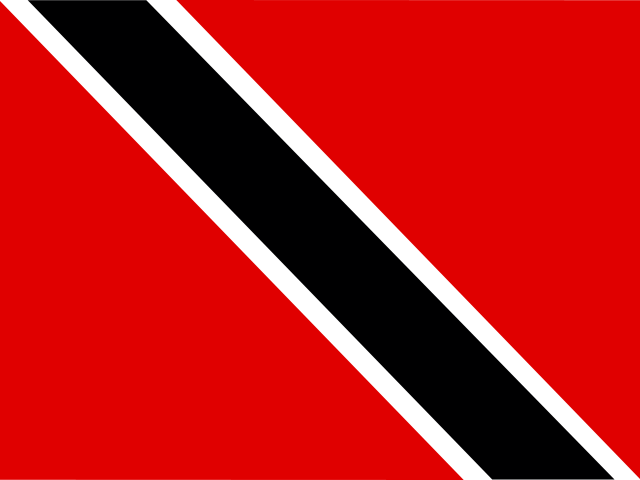
Trinidad and Tobago
A twin-island nation off the coast of Venezuela, Trinidad and Tobago gave the world the steelpan and Carnival, and floats on some of the Caribbean's richest oil and gas reserves.
WHAT THE FLAG MEANS ◢
A red field crossed by a black diagonal band edged in white, running from the upper hoist to the lower fly. The National Emblems of Trinidad and Tobago (Regulation) Act describes that geometry and gives the colours no meaning. The government's own published account of the flag reads red for the warmth of the sun and the vitality of the land and its people, black for strength and for the dedication of a people joined by one bond, and white for the sea that binds the islands and the equality of all under the sun.
Trinidad and Tobago FACTS ◢
| Capital | Port of Spain |
|---|---|
| Continent | North America |
| Population | 1,367,764 (2025) |
| Area | 5,128 km² |
| Population density | 267/km² |
| Currency | Trinidad and Tobago dollar (TTD) |
| Official language | English |
| Calling code | +1868 |
| Internet TLD | .tt |
| Time zone | UTC-04:00 |
| Drives on the | Left |
| ISO codes | TT / TTO |
DID YOU KNOW? ◢
- The steelpan, one of the few acoustic instruments invented in the 20th century, was created in Trinidad.
- It is home to the Pitch Lake, the largest natural deposit of asphalt in the world.
- Its Carnival is one of the most famous street festivals in the Caribbean.
- Calypso and soca music both originated here.
Trinidad and Tobago QUICK ANSWERS ◢
What is the capital of Trinidad and Tobago?
The capital of Trinidad and Tobago is Port of Spain.
What is the population of Trinidad and Tobago?
Trinidad and Tobago had a population of 1,367,764 in 2025.
What currency does Trinidad and Tobago use?
Trinidad and Tobago uses the Trinidad and Tobago dollar (TTD).
What languages are spoken in Trinidad and Tobago?
The official language of Trinidad and Tobago is English.
Think you know your flags? Play Flag Daily → · Browse all countries →
MORE ON THE FLAG ◢
The reading of red for the sun and the vitality of the land and its people, black for strength and dedication, and white for the sea and equality is the government of Trinidad and Tobago's own. It has been published under the state's name since independence, and the national library authority and the foreign ministry both still publish it today.
What it is not is law. Trinidad and Tobago has a statute that describes the national flag, and that statute assigns the three colours nothing whatsoever. It names them as pigments in a heraldic blazon and stops.
That gap, between the description the law gives and the meaning the government publishes, is the whole story of this flag. The law in question is odd in its own right: it sat on the books unproclaimed for thirteen years before anyone could use it.
Key Takeaways
- The National Emblems of Trinidad and Tobago (Regulation) Act, Chap. 19:04, describes the flag in the Schedule and gives its colours no meaning. The word "colour" does not appear anywhere in the Act.
- The familiar red, white and black readings are the government's own, traced by the national library to a 1962 Ministry of Home Affairs publication.
- The Act was passed in 1967 and did not come into force until 1 December 1980. Its commencement clause named the Governor-General, an office the republic abolished in 1976, and no Governor-General had used the power in the nine years before that.
- The Act never states the flag's proportions. The 5:3 ratio comes from the same 1962 government account, not from the statute.
- The state's own pages disagree about who designed it: two credit a committee, and the national library's biography of Carlisle Chang credits him.
Where Trinidad and Tobago's colour meanings actually come from
The National Library and Information System Authority, NALIS, publishes the fullest version. Red "is the colour most expressive of our country. It represents the vitality of the land and its people; it is the warmth and energy of the sun, the courage and friendliness of the people."
White "is the sea by which these lands are bound: the cradle of our heritage; the purity of our aspirations and the equality of all men under the sun."
Black, in NALIS's wording, "represents for us the dedication of the people joined together by one strong bond. It is the colour of strength, of unity, of purpose and of the wealth of the land."
The same passage has a fourth clause. NALIS adds that "The colours chosen represent the elements Earth, Water and Fire which encompass all our past, present and future and inspire us as one united, vital, free and dedicated people."
NALIS names its source at the foot of the passage: "Trinidad and Tobago. Ministry of Home Affairs. Our Flag and Other National Emblems. Trinidad: Government of Trinidad and Tobago, 1962. Print."
So this is not folklore and not a foreign encyclopaedia's invention. It is a government publication from the year of independence, reproduced by the national library, named and dated. That is a real provenance, and it is why the reading belongs in any account of the flag.
The Ministry of Foreign and CARICOM Affairs gives the three readings in nearly the same words on its own national flag page, with one addition the library's version does not make. Where NALIS leaves the three elements unassigned, the ministry matches one of them: "Red represents the fire element."
That sentence is the only place in either state account where a colour is tied to an element. Black to earth and white to water is our own inference from what remains, and neither ministry writes it down.
The National Emblems Act's description of the flag, in full
The Act defines the National Flag as the flag "described in Part II of the Schedule", and Part II is short enough to quote entire:
"On a Red Field, a Bend Dexter Sable bordered Silver, that is to say, there is on the Red Field a diagonal from left to right in Black bordered with White. The width of the Black and White bands joined side by side at the upper dexter corner of the Flag is one-fifth of the full length of the Flag, and the width of each White band is one-sixth of the width of the White and Black bands together."
That is all of it. A blazon, its translation into plain English, and two fractions.
Anyone checking that against the version the state publishes online will find a discrepancy, because what NALIS prints as "The official description of the Flag" is longer than the statutory one. It carries a closing sentence Part II does not have, giving the black band "four-sixths of the total width of the White and Black", which works the Act's two fractions out rather than adding a rule. It also sets a semicolon where the Act has a comma after "bordered Silver", and the national symbols page prints "one sixth" for the Act's "one-sixth". The state's published official description is not, quite, the one in the law.
The word "colour" appears nowhere in the Act, in any section or any part of the Schedule. Neither does "symbol". The three colour names appear only as instructions for drawing.
The Act does contain the word "significance" exactly once, and the placement is almost comic. Section 8 lets the President make regulations, including for "the distribution of information relating to the growth, cultivation and significance of the National Flower". Parliament contemplated the state explaining what one of its emblems means. The emblem it picked was the chaconia.
The constitution is no help either. The Constitution of the Republic of Trinidad and Tobago, enacted as the Schedule to Act 4 of 1976, contains no mention of the flag, the coat of arms or any national emblem.
| The claim | Where it is written | What kind of source that is |
|---|---|---|
| The design: red field, black bend edged white, band widths | Schedule, Part II, Chap. 19:04 | Statute |
| Red for the sun and vitality; white for the sea and equality; black for strength and dedication | Ministry of Home Affairs, 1962, via NALIS; near-identical wording on the foreign ministry's page | Government publication, not law |
| Red is the fire element | Ministry of Foreign and CARICOM Affairs | Government publication, not law |
| Proportions of 5:3, and 2:1 at sea | Quoted by NALIS from the same 1962 account | Government publication, not law |
| The diagonals must point to the peak of the staff | NALIS | Government publication, not law |
Trinidad and Tobago's flag law took thirteen years to come into force
The Act has two dates that do not sit comfortably together. It is Act No. 14 of 1967, assented to on 14 July 1967. Its commencement is 1 December 1980.
The original 1967 text records what the commencement turned on. Section 1(2) said the Act would come into operation on a date appointed by the Governor-General. In 1976 Trinidad and Tobago became a republic and stopped having one, leaving the commencement clause aimed at an office that no longer existed.
That covers the last four years of the gap and not the first nine. From the assent in July 1967 until the republic there was a Governor-General, holding exactly the power the clause conferred, and no proclamation was made. The republic explains why an amending Act was needed in 1980; it explains nothing about 1967 to 1976, and neither the Act, the amending Act nor the proclamation says what the wait was for.
Parliament's amendment, thirteen years on, was one word. The National Emblems of Trinidad and Tobago (Regulation) (Amendment) Act, Act No. 17 of 1980, assented to on 24 April 1980, amends section 1(2) of the 1967 Act by substituting for "Governor-General" the word "President".
That amending Act runs to three sections, and the third gives away what had been happening in the meantime. Its section 3 provides that all acts or things done by the Committee established by section 4 of the 1967 Act "shall be deemed to have been lawfully and validly done". The Committee had been operating under a statute that was not yet in operation, and Parliament had to reach back and bless the lot.
President Ellis Clarke then issued the proclamation. Legal Notice No. 197 of 1980 fixes "the 1st day of December, 1980 to be the date on which the said Act shall come into operation".
Section 8 of the Act, the regulation-making power, has never been used. The consolidated edition to 31 December 2016 puts it in one line: "This Chapter contains no subsidiary legislation." No regulations have been made "providing for the proper use of the National Flag on all occasions".
Which means the detailed flag etiquette the state publishes, the special days for flying it, the half-masting, the rule that a flag flown on certain office-holders' cars should be removed or sheathed when they are not travelling on official duty, is guidance rather than regulation. The only subsidiary instruments the legislative library records against the Chapter since 2016 are the 2025 proclamation and order dealing with the coat of arms, and neither is a flag regulation.
The Act does not say what shape the flag is
Read Part II again and something is missing. The band widths are given as fractions of the flag's length. The flag's length is given as a fraction of nothing.
The word "proportion" does not appear in the Act, and no section fixes the ratio of hoist to fly. The angle at which the black band crosses the field depends on the shape of the flag it is drawn on, and the statute leaves that shape open.
The 5:3 that Trinidad and Tobago actually flies is in the 1962 account, which NALIS quotes: "The dimensions of the National Flag shall be in the proportions of five to three (5:3). For flags carried at sea the dimensions shall be two to one (2:1)."
A different shape ashore and afloat, and neither ratio in the Act. Nor is the rule that keeps the flag the right way up. NALIS states that "The Black and White diagonals must always point to the peak of the staff", which is what stops it being flown as a mirror image, and Part II never says it.
Anyone who has tried to redraw a flag from memory knows how much of the difficulty is in exactly these unstated details. A flag a day and three guesses tests whether you can recognise one. Drawing it correctly is a harder question than most national statutes answer.
Who designed the flag: a committee, or Carlisle Chang?
Trinidad and Tobago's independence was settled at an Independence Conference in London on 28 May 1962. On 8 June the Secretary of State for the Colonies announced that independence would come on 31 August that year, which left under three months to invent a country's emblems.
NALIS records how it was done. A committee "appointed by Government to advise on the design of the Flag and the Coat of Arms of the new Nation, to choose a Motto for it, and to consider suggestions from the public on these matters, submitted its report on June 26." Cabinet approved it immediately and a picture of the flag was published.
On the question of authorship, the state's own pages give two answers.
The library's national symbols page says flatly that "The national flag was designed by the Independence Committee". The Ministry of Foreign and CARICOM Affairs says it "was selected from a series of designs created by the Independence Committee in 1962". Both credit a body, and neither names a person as the flag's designer.
The same library's biography of the artist Carlisle Chang, who died in 2001, tells it differently. It says that "Arguably two of the most valuable gifts Chang has given to Trinidad and Tobago are the designs for the coat of arms and national flag for independence from Britain in 1962". It records that "He had the honour of chairing the National Flag and Coat of Arms Committee", and adds that he had already done the job once: "Prior to this, he performed a similar task of designing the flag and arms for the failed West Indies Federation."
The symbols page does name people, but for the other emblem. It says the Coat of Arms was designed by a committee formed in 1962, and that "The committee included noted artist Carlyle Chang and designer George Bailey." It spells his forename Carlyle there, where the biography has Carlisle.
That matters, because it is the library itself putting Chang inside a 1962 emblems committee. The accounts reconcile if the committee Chang chaired is the body the other pages call the Independence Committee, and the flag is a committee design steered by its chairman: the symbols page has him on the 1962 committee for the arms, and the biography has him chairing one whose remit covered the flag and the arms together. The reconciliation is still ours, not the state's, and the pages have never been squared with each other. Anyone citing one designer for this flag is citing one national library page against two others.
Only one of the two emblems needs a licence
The Act's enforcement sections are not symmetrical, and the asymmetry is easy to miss.
Sections 5 and 6 build a licensing regime: the Minister grants licences to use or display the coat of arms in business, or to sell goods bearing it, and using or selling it without one is an offence. Every clause in both sections is about the coat of arms. The flag is not mentioned in either.
Section 7 covers both, and only for damage: anyone who "mutilates, cuts or tears or in any way defaces the Coat of Arms or the National Flag" commits an offence.
So the Act makes selling goods bearing the coat of arms an offence without a licence, and does not do the same for the flag. Section 8(b) contemplated royalties on representations of both, but no regulations were ever made, so no royalty scheme exists for either.
Section 3 is the one provision that does put the flag under state control. It declares that "the copyright in the design of the National Flag and the Coat of Arms is vested in the State in perpetuity", giving the state the rights and privileges of a registered design proprietor under the Patents and Designs Act while exempting it from that Act's sections 22 to 28.
A national flag whose copyright the state holds in perpetuity, and which the Act's own licensing regime does not cover. Both of those are in the same short Act.
The Schedule has been rewritten twice, and never for the flag
The Schedule to Chap. 19:04 has three parts: the coat of arms, the flag, the national flower. Two of the three have been rewritten by Parliament since 1967, and both changes are recent.
In 2019 the flower moved. Act No. 10 of 2019 deleted the chaconia entry and substituted "The Double Chaconia (Warszewiczia cv 'David Auyong')."
In 2025 the arms did. Act No. 1 of 2025 replaced the Arms clause, taking out the three ships of the period of Christopher Columbus and putting in their place "in base a gold Steelpan and its iconic two pan sticks, also gold". It came into force on 25 February 2025 by proclamation, and a Legal Notice made in December 2025 extended the use of the former arms to 2 January 2031.
Part II has never been touched. Set beside the 1967 gazette print, the description in the consolidated edition is identical word for word, the gazette's enclosing quotation marks aside, and the mechanism to change it plainly works.
Whatever else is true of red, white and black in Trinidad and Tobago, then, it is not that Parliament has never had the chance to say. It has amended the Schedule around the flag twice, and left the flag's colours exactly as unexplained as it found them.
For a flag this well known, that silence is the most reliable fact about it. Try picking Trinidad and Tobago out of three written clues instead and the flag never comes into it at all.
Frequently asked questions
What do the colours on the Trinidad and Tobago flag mean?
The government's own account, published by the Ministry of Home Affairs in 1962, republished by NALIS, and given in nearly the same words by the Ministry of Foreign and CARICOM Affairs, reads red as the warmth and energy of the sun and the vitality of the land and its people, white as the sea that binds the islands and the equality of all under the sun, and black as strength and the dedication of a people joined by one bond. It is a government reading rather than a legal one: the National Emblems of Trinidad and Tobago (Regulation) Act describes the flag and assigns the colours no meaning at all.
The same account adds that the three colours stand for the elements earth, water and fire, which it ties to the country's past, present and future. The foreign ministry alone matches one element to one colour, giving red the fire element.
Does any Trinidad and Tobago law say what the flag's colours mean?
No. The Act defines the National Flag as the flag described in Part II of its Schedule, and Part II is a blazon plus two fractions. The word "colour" does not appear anywhere in the Act, and the Constitution of the Republic of Trinidad and Tobago mentions no national emblem at all.
Who designed the flag of Trinidad and Tobago?
The state's own sources disagree. NALIS's national symbols page and the Ministry of Foreign and CARICOM Affairs both credit the Independence Committee as a body without naming a designer. NALIS's own biography of the artist Carlisle Chang credits him with the designs for both the flag and the coat of arms, and records that he chaired the National Flag and Coat of Arms Committee, having previously designed the flag and arms of the West Indies Federation.
The symbols page does name Chang, though for the coat of arms rather than the flag: it puts him and the designer George Bailey on the 1962 committee that produced the arms. It spells his forename Carlyle, where the biography has Carlisle.
What are the official proportions of the Trinidad and Tobago flag?
The Act does not give any. It fixes the black and white bands as fractions of the flag's length and never states the ratio of the flag itself. The familiar 5:3, and 2:1 for flags carried at sea, comes from the 1962 government account quoted by NALIS, which is a published description rather than a statutory one.
Why did the National Emblems Act take until 1980 to come into force?
No instrument says. Its commencement clause let the Governor-General appoint the start date, and from the 1967 assent to the republic in 1976 there was a Governor-General holding exactly that power who never used it. Trinidad and Tobago then became a republic and no longer had one, and the 1980 amending Act substituted "President" for "Governor-General" - which explains why an amending Act was needed, and nothing about the first nine years. The same Act validated everything the Committee had already done under a statute that was not yet in operation. President Ellis Clarke then proclaimed 1 December 1980 as the commencement date.
Sources
- Ministry of the Attorney General and Legal Affairs, National Emblems of Trinidad and Tobago (Regulation) Act, Chap. 19:04, consolidated edition updated to 31 December 2016 - retrieved 26 August 2026.
- Digital Legislative Library of Trinidad and Tobago, National Emblems of Trinidad and Tobago (Regulation) Act, holding the original Act No. 14 of 1967, Act No. 17 of 1980, Legal Notice No. 197 of 1980, Act No. 10 of 2019, Act No. 1 of 2025, Legal Notice No. 66 of 2025 and Legal Notice No. 468 of 2025 - retrieved 26 August 2026.
- Digital Legislative Library of Trinidad and Tobago, Constitution of the Republic of Trinidad and Tobago - retrieved 26 August 2026.
- National Library and Information System Authority (NALIS), National Flag - retrieved 26 August 2026.
- National Library and Information System Authority (NALIS), National Symbols - retrieved 26 August 2026.
- National Library and Information System Authority (NALIS), Biographies A-C, entry for Carlisle Chang (1921-2001) - retrieved 26 August 2026.
- Ministry of Foreign and CARICOM Affairs, National Flag - retrieved 26 August 2026.
PLAY ANOTHER →
Three clues, three guesses. Work out where in the world it is.
THREE CLUESDAILYOn This DayOne thing that happened today in history. Every day, a new one.
TODAY IN HISTORYDAILYDaily CodeA short message, hidden in a different cipher every day.
ONE CIPHER A DAYDAILYDaily CryptogramOne quote, one scrambled alphabet. Crack it before tomorrow.
CRACK THE QUOTE