
Ukraine
The largest country entirely within Europe, Ukraine rolls out endless black-earth wheat fields that helped earn it the nickname 'breadbasket of Europe'.
WHAT THE FLAG MEANS ◢
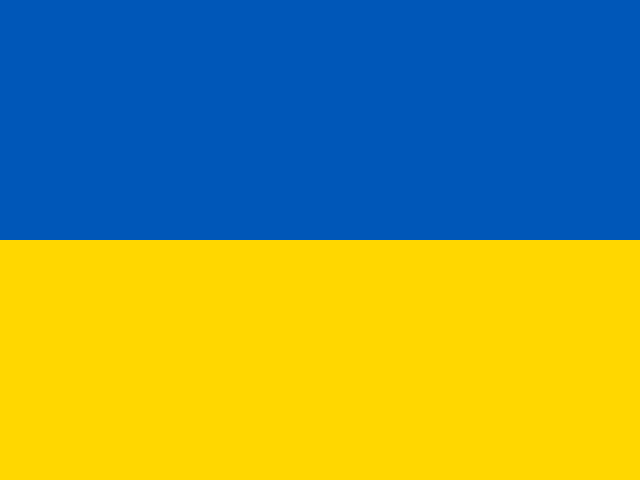
Two equal horizontal bands, blue over yellow. Article 20 of the constitution calls it a banner of two equally sized horizontal bands of blue and yellow, gives the colours no meaning, and leaves the description of the state symbols to a law adopted by two thirds of parliament. The order of the bands and the proportion of 2:3 come instead from the resolution by which parliament adopted the flag in 1992. The colours are conventionally read as a blue sky above golden fields of ripe wheat.
Ukraine FACTS ◢
| Capital | Kyiv |
|---|---|
| Continent | Europe |
| Population | 38,980,376 (2025) |
| Area | 603,550 km² |
| Population density | 65/km² |
| Currency | Hryvnia (UAH) |
| Official language | Ukrainian |
| Calling code | +380 |
| Internet TLD | .ua |
| Time zones | UTC+02:00, UTC+03:00 |
| Drives on the | Right |
| ISO codes | UA / UKR |
DID YOU KNOW? ◢
- It's the biggest country lying entirely within Europe by land area.
- Its famously fertile 'chernozem' black soil makes it one of the world's leading grain and sunflower-oil exporters.
- Kyiv is one of Europe's oldest capitals, with roots stretching back well over a thousand years.
- Its capital's metro boasts Arsenalna station, among the deepest underground stations in the world.
Ukraine QUICK ANSWERS ◢
What is the capital of Ukraine?
The capital of Ukraine is Kyiv.
What is the population of Ukraine?
Ukraine had a population of 38,980,376 in 2025.
What currency does Ukraine use?
Ukraine uses the Hryvnia (UAH).
What languages are spoken in Ukraine?
The official language of Ukraine is Ukrainian.
Think you know your flags? Play Flag Daily → · Browse all countries →
MORE ON THE FLAG ◢
Ukraine's constitution gives the flag one sentence, and the sentence is doing less work than it looks. It names two colours and calls the bands equal. It does not say which colour sits on top, it does not fix a proportion, and it assigns the colours nothing.
What article 20 does instead is promise a law. The sixth of its seven paragraphs reserves the description of the state symbols, and the rules for using them, to an act of parliament carried by two thirds of the chamber. No such law has been passed. In June 2011 the Constitutional Court of Ukraine recorded as much, and struck down a provision that regulated the flag without one. A draft tabled in 2015 got one reading in 2016 and is still a bill.
So the specification everybody actually uses, blue uppermost and yellow beneath in a ratio of two to three, is not in the constitution at all. It comes from one paragraph of a parliamentary resolution dated 28 January 1992, four years before the constitution was written.
Key Takeaways
- Article 20 of the 1996 constitution names the flag's two colours in one sentence and assigns them nothing.
- The same article requires a law, passed by a two-thirds majority, to set the description of the state symbols and the rules for their use.
- The Constitutional Court found in June 2011 that no law governing the flag's use had been passed under that procedure, and asked parliament to make one.
- Which band is uppermost and the 2:3 proportion come from a parliamentary resolution of 28 January 1992, not from the constitution.
- The Soviet Ukrainian constitution of 1978 described its flag in far more detail than the current constitution gives this one.
| Instrument | Date | What it fixes | What it leaves out |
|---|---|---|---|
| Constitution of Ukraine, art. 20 | 28 June 1996 | Two equally sized horizontal bands, blue and yellow | Which band is uppermost, the proportion, any meaning |
| Verkhovna Rada resolution No. 2067-XII | 28 January 1992 | Upper band blue, lower band yellow, ratio 2:3 | Any meaning, any shade |
| Constitution of the Ukrainian SSR, art. 167 | 20 April 1978 | Red over azure, hammer, sickle, star, ratio 1:2 | Any meaning |
| Cabinet resolution No. 1081 | 20 October 2021 | Satin cloth, two burial sizes, no marks of any kind | Everything outside the military funeral ritual |
| The law article 20 requires | - | Nothing | Everything article 20 assigns to it |
Ukraine's constitution never says which band is on top
The operative sentence of article 20 reads: "Державний Прапор України - стяг із двох рівновеликих горизонтальних смуг синього і жовтого кольорів." The Ministry of Foreign Affairs of Ukraine rendered it, on the English state symbols page its site showed in March 2001, as "The State Flag of Ukraine is a banner of two equally-sized horizontal bands of blue and yellow."
Read it closely and the sentence names the colours in an order without saying that the order is the flag's. There is no word for upper and no word for lower. There is no proportion either. A constitution that is elsewhere precise enough to name the coat of arms of the Zaporozhian Host, in the very next paragraph, leaves the flag's geometry at two bands and two colours.
The precision lives one instrument back. The resolution by which the Verkhovna Rada adopted the flag on 28 January 1992 says exactly what the constitution does not: "Затвердити Державним прапором України національний прапор, що являє собою прямокутне полотнище, яке складається з двох рівних за шириною горизонтально розташованих смуг: верхньої - синього кольору, нижньої - жовтого кольору, із співвідношенням ширини прапора до його довжини 2:3."
Upper band blue, lower band yellow, two units of height to three of length. Ukraine's legal database does not record any act amending or repealing that resolution, and its current version is the text as adopted. It is a page of the parliamentary record from four years before the constitution, and it is still where the flag's shape is written down.
The two-thirds law that article 20 requires
The sixth paragraph of article 20 is short and its consequences are not: "Опис державних символів України та порядок їх використання встановлюються законом, що приймається не менш як двома третинами від конституційного складу Верховної Ради України."
The description of the state symbols and the order of their use are established by a law that no fewer than two thirds of parliament's constitutional composition must vote for. Three hundred votes, on the chamber of 450 that article 76 of the same constitution fixes.
Parliament began on this almost at once. On 3 September 1996, two months after the constitution passed, it proposed that the Cabinet run a competition for the great coat of arms and the text of the anthem, and bring back proposals "згідно з вимогами статті 20 Конституції України".
The anthem part of that work finished. Ukraine has a Law on the State Anthem, No. 602-IV, adopted on 6 March 2003, which sets the words of the first verse and the refrain. It is the one clause of article 20 that has produced its law. The flag was not in the 1996 competition at all, and no comparable step has been taken for it since. Instead there is a trail of attempts, and each one says out loud that the law is missing:
- 9 February 2001. A presidential decree sets out arrangements for using the state symbols expressly "на період до законодавчого врегулювання зазначеного питання", for the period until the matter is regulated by legislation.
- 23 August 2014. A second presidential decree instructs the Cabinet to "підготувати та внести в установленому порядку на розгляд Верховної Ради України законопроект про опис, порядок використання і захист державних символів України".
- 23 July 2020. The Chairman of the Verkhovna Rada creates a working group of deputies, staff and outside experts to draft that law, opening with the words "З метою реалізації положень статті 20 Конституції України". Order No. 254-r of the following day added a member to it.
Twenty-four years after the constitution, parliament was still forming a committee to write the law the constitution had asked for.
Is it still missing? Parliament keeps a public bill register, and a bill is where a law has to start. A title search on прапор returns four results, which is not a blank. Three of them concern one bill. The Cabinet of Ministers tabled a Draft Law on the State Flag of Ukraine on 16 October 2015 as bill No. 3334. A deputy lodged a draft resolution on 29 December 2015, numbered 3334/П, asking the chamber to adopt that bill as a base. Parliament put the bill on the agenda on 26 January 2016 and passed it in first reading on 2 February 2016. It carried over into the current convocation as bill No. 0866 on 29 August 2019.
The fourth result is a different flag. Bill No. 2229, "Проєкт Закону про Прапор Національної Гідності", tabled by a people's deputy on 4 October 2019, is about a Flag of National Dignity, not the state flag that article 20 leaves undescribed.
Back on the flag bill, the card for No. 3334 shows how far it got, and the carry-over card shows how long ago. The last dated step on the card for bill No. 0866 is 3 September 2019, and its status line now reads "Опрацьовується в комітеті", being processed in committee. The register still lists it as included in the chamber's agenda, by a resolution of 10 February 2026.
A search on державних символів turns up three other bills, all of them amendments to other acts about how local councils may use symbols. So the law article 20 asks for is not a law.
It is a bill that passed one reading a decade ago, was left being prepared for a second reading that never came, and has sat in committee since 2019, in a parliament that was separately convening a group to draft the wider symbols law in 2020.
The Constitutional Court struck down a flag rule in 2011
The case that forced the point was not about the Ukrainian flag at all. It was about a Soviet one.
In April 2011 parliament amended the law on commemorating the victory in the Great Patriotic War of 1941 to 1945 so that copies of the Banner of Victory would be raised officially on Victory Day, 9 May, on buildings and flagpoles, beside the State Flag of Ukraine. A citizen asked the Constitutional Court what that meant. The Court answered a larger question.
Because the amendment prescribed how the State Flag of Ukraine was to be used, the Court held, it fell inside article 20's sixth paragraph and needed a two-thirds majority. It had been passed by fewer votes than that. The provision was struck down on 16 June 2011 for a defect of procedure rather than of content.
Then the Court said the thing worth quoting. "В Україні немає спеціального закону, який би врегульовував порядок використання Державного Прапора України та був прийнятий з дотриманням відповідної конституційної процедури, що породжує невизначеність у використанні цього державного символу та його захисті як конституційної цінності." Ukraine has no special law governing the use of the State Flag passed under the proper constitutional procedure, which produces uncertainty about the use of that symbol and its protection.
The fourth operative point of the decision is one sentence: "Запропонувати Верховній Раді України законодавчо встановити порядок використання державних символів України, зокрема Державного Прапора України." A court proposing to a parliament that it legislate. Twenty-five years after it was made, the decree of 2001, expressly a stopgap until legislation arrived, is still on the statute database with no repealing act recorded against it.
Soviet Ukraine's constitution described its flag in far more detail
The Constitution (Fundamental Law) of the Ukrainian SSR of 20 April 1978 gave the flag an article of its own, and it is not a short one. Article 167 fixed two horizontal bands, "верхньої - червоного кольору, яка становить дві третини ширини прапора, і нижньої - лазурового кольору, яка становить одну третину ширини прапора", with a gold hammer and sickle in the upper part at one third of the length from the staff, a red five-pointed star above them edged in gold, and the closing line "Відношення ширини прапора до його довжини - 1:2."
Proportions of the bands, position of the charges, a ratio. Everything the present article 20 omits. What it did not do, and this is the continuity worth noticing, was say what any of it meant. On the question of meaning the Soviet text and the Ukrainian one are identical: silent.
There is a strange overlap at the end of it. Parliament approved the blue and yellow flag on 28 January 1992. It rewrote article 166 of the 1978 constitution on 14 February 1992 so that the symbols of Ukraine as an independent state were to be approved by the Verkhovna Rada. But article 167 of that same text, still describing the red and azure banner with its hammer and sickle, was not removed until 19 June 1992, by an amending law whose item 24 reads simply that articles 167 and 168 are deleted. For nearly five months the constitution in force described one flag while the country flew another.
Blue and yellow came back in stages, 1991 to 1992
The restoration ran through the same body, in stages, across almost exactly a year.
On 24 June 1991 the Presidium of the Supreme Soviet of the Ukrainian SSR resolved to form a competition jury, to run an open competition for designs of the state coat of arms, and to hold a conference that October on the symbols of a sovereign Ukraine: arms, anthem, flag. The financing came out of the parliamentary secretariat's budget. On 9 December 1991 the Presidium passed the culture commission's proposals on state symbolism to four other commissions for opinions, along with draft instruments on the anthem and on amending the constitution.
Between those two dates the country became independent, and the flag arrived before the paperwork did. The Ukrainian Institute of National Remembrance, a Ukrainian state body which publishes information materials for Flag Day, dates the moment precisely: "4 вересня 1991 року, вже після проголошення незалежності України, національний синьо-жовтий прапор замайорів над Верховною Радою України."
The resolution of 28 January 1992 came almost five months after the flag went up over the building that passed it.
The Institute takes the design much further back than that. It puts the first appearance of the modern combination in the revolutions of 1848: "Уперше такий прапор замайорів у червні 1848 року на міській ратуші Львова." And it names an instrument for 1918, the year of the Ukrainian People's Republic: "Офіційно стяг затвердили 27 січня 1918 року в Тимчасовому законі про флот УНР", the Provisional Law on the Fleet of the Ukrainian People's Republic, under which the merchant fleet's flag was a cloth of two colours, "блакитному і жовтому кольорах".
That wording is worth holding onto. The 1918 blue is блакитний, azure or light blue. The 1992 resolution and the 1996 constitution both say синій, which is a darker blue. Nothing in either instrument explains the change, and none of the Ukrainian instruments and state publications in the source list explains it either. The Institute's own history uses the older жовто-блакитні for the pre-modern period, switches to синьо-жовтий at 1848, and then goes back and forth: the passage it quotes about Kyiv in 1917 has блакитно-жовті, and its account of Hetman Skoropadskyi's service standards in 1918 has блакитно-жовтій. It never marks the switch, in either direction.
The 1918 instruments themselves could not be opened. They are not in the Verkhovna Rada's legal database, which begins with the Soviet period, and the central state archives that hold the republic's papers answer a browser-check page to a headless browser as well as to a plain fetch. So the Provisional Law on the Fleet is reported as a Ukrainian state body reports it, not from its own text.
The manufacturing rule that exists covers military funerals
The one instrument that tells a manufacturer how to make a Ukrainian flag confines itself to one ceremony.
The Cabinet of Ministers approved a Procedure for the Manufacture of the State Flag of Ukraine on 20 October 2021. Its first paragraph sets the limit: "Цей Порядок встановлює вимоги до виготовлення Державного Прапора України, який використовується під час військового поховального ритуалу." The requirements are for the flag used during the military funeral ritual.
Inside that scope it is exact. The cloth is satin. Both faces must be identical. The ratio is 2:3, restating the 1992 resolution. There are two sizes, 160 by 240 centimetres for a standard coffin and 200 by 300 for a zinc one, with a tolerance of two per cent. And the fourth paragraph forbids adding anything at all: "Забороняється на полотнищі Державного Прапора України розміщувати будь-які прикраси, емблеми, позначки, літери, слова, цифри, зображення та малюнки будь-якого характеру."
For the material itself the resolution does not legislate. It points at a standard: section 4, General Technical Requirements, of ДСТУ 4512:2006, the national standard titled Державний прапор України. Загальні технічні умови.
That standard is real and current. Ukraine's national standards catalogue, kept by the state standardisation body UkrNDNC, lists it as adopted by order No. 13 of 27 January 2006, in force from 1 September 2006, in Ukrainian, thirteen pages in the catalogue's own count, with no amendments recorded and no replacement. The catalogue names the 2021 Cabinet resolution as the legal act attached to it.
Whether it fixes the shades of blue and yellow cannot be answered from the published instruments. ДСТУ 4512:2006 is sold rather than published, and its text was not obtainable. The published instruments say nothing about shade: the constitution gives "синього і жовтого", the 1992 resolution gives "синього кольору" and "жовтого кольору", and neither adds a coordinate, a swatch or a reference.
One instrument assumes the answer already exists. Article 3 of the presidential decree of 9 February 2001, the same decree that is expressly a stopgap until legislation arrives, directs the Commission on State Awards and Heraldry under the President to submit the characteristics of the colours of the State Flag and the small coat of arms "визначених законодавством України", determined by the legislation of Ukraine. The decree treats the shades as something Ukrainian legislation has already fixed. Which legislation, it does not say, and the published instruments do not fix them. If a Ukrainian colour specification exists in law, it is inside a thirteen-page standard behind a paywall, reachable in the statute book only by a cross-reference in a rule about coffins.
So who says it means sky and wheat?
Blue sky over fields of ripe wheat is the reading attached to this flag almost everywhere, this site's own country summary included. It is not the constitution's reading, because the constitution assigns nothing, and it is not the 1992 resolution's either, that document being a description and a ratio. The foreign ministry's own state symbols page quotes the first five of article 20's seven paragraphs, adds not one word of interpretation, and stops one paragraph short of the sixth, which is the one that hands the description to a law.
A state body that does offer a reading offers a different one. The Ukrainian Institute of National Remembrance closes its Flag Day materials like this: "Державний Прапор як символ нашої країни є втіленням національної єдності, честі та гідності, традицій державотворення, історії та сьогодення." National unity, honour and dignity, the traditions of state-building, history and the present, with neither a sky nor a field anywhere in it.
The nearest thing to the familiar reading in any of these documents is not official at all. It is a quotation the Institute reproduces from the writer Serhii Yefremov, describing the Freedom Festival in Kyiv on 29 March 1917, where the blue and yellow banners in the crowd are glossed in passing as "сонце і небо", sun and sky. A journalist's aside, in a crowd, seventy-nine years before the constitution. And note what it is not: the sun is not wheat.
The wheat reading may well be old, and it is close to universal, which is a different thing from being official. The honest position is that Ukraine has never told anyone what its flag means, and that the country has spent thirty years not passing the law in which it would have to.
If you want to test whether you can tell a blue-and-yellow flag from its neighbours at a glance, Sweden's flag uses the same two colours in a completely different arrangement, and a daily flag round gives you one flag and three guesses at the country.
Frequently asked questions
Why is the Ukrainian flag blue and yellow?
No Ukrainian legal instrument says why. Article 20 of the constitution names the two colours and assigns them no meaning, and the parliamentary resolution of 28 January 1992 that fixed the design does the same. The blue sky over ripe wheat reading is popular rather than official, and a Ukrainian state body that publishes Flag Day materials offers a different gloss entirely, calling the flag an embodiment of national unity, honour and dignity, and the traditions of state-building.
Does Ukraine have a law about its flag?
Not the one its constitution calls for. Article 20 requires a law adopted by two thirds of the Verkhovna Rada to set the description of the state symbols and the rules for using them. The Constitutional Court found on 16 June 2011 that Ukraine had no special law governing the use of the flag passed under that procedure, and formally proposed that parliament establish one. A draft Law on the State Flag of Ukraine tabled by the Cabinet of Ministers in 2015 passed its first reading on 2 February 2016, never got a second one, and has sat in committee since 2019, and the Chairman of the Verkhovna Rada created a working group to draft the wider symbols law on 23 July 2020.
Which stripe of the Ukrainian flag is on top?
Blue. That is not stated in the constitution, which names the two colours without saying which is uppermost. It comes from the Verkhovna Rada's resolution of 28 January 1992, which specifies the upper band blue, the lower band yellow, and the width of the flag to its length as 2 to 3.
What was the Soviet Ukrainian flag?
Article 167 of the 1978 Constitution of the Ukrainian SSR set red across the upper two thirds of the flag and azure across the lower third, with a gold hammer and sickle in the upper part at one third of the length from the staff and a gold-edged red star above them. The ratio was 1:2. That article was deleted from the constitution on 19 June 1992, nearly five months after parliament had already adopted the blue and yellow flag.
When is Ukraine's Flag Day?
23 August. It was established by presidential decree No. 987 of 23 August 2004. The 9am flag-raising ceremony in Kyiv, Sevastopol, regional and district centres and other settlements was not in that decree as signed, which asked only for a set of measures to mark the day. It was added in 2009, when decree No. 602/2009 of 7 August replaced the decree's article 2. Flag Day sits the day before Independence Day on 24 August.
Sources
- Verkhovna Rada of Ukraine, Constitution of Ukraine, 28 June 1996 No. 254k/96-VR, arts. 20 and 76 - retrieved 26 August 2026.
- Verkhovna Rada of Ukraine, Resolution No. 2067-XII of 28 January 1992 on the State Flag of Ukraine - retrieved 26 August 2026.
- Constitutional Court of Ukraine, Decision No. 6-rp/2011 of 16 June 2011, case No. 1-23/2011 - retrieved 26 August 2026.
- Verkhovna Rada of Ukraine, Constitution (Fundamental Law) of the Ukrainian SSR, 20 April 1978 No. 888-IX, first edition, arts. 166-168 - retrieved 26 August 2026.
- Verkhovna Rada of Ukraine, Law No. 2480-XII of 19 June 1992 amending the Constitution (Fundamental Law) of Ukraine, item 24 - retrieved 26 August 2026.
- Verkhovna Rada of Ukraine, Law No. 2113-XII of 14 February 1992 amending the Constitution (Fundamental Law) of Ukraine, item 16 - retrieved 26 August 2026.
- Cabinet of Ministers of Ukraine, Resolution No. 1081 of 20 October 2021 approving the Procedure for the Manufacture of the State Flag of Ukraine - retrieved 26 August 2026.
- President of Ukraine, Decree No. 79/2001 of 9 February 2001 on questions of the use of the state symbols of Ukraine - retrieved 26 August 2026.
- President of Ukraine, Decree No. 667/2014 of 23 August 2014 on measures to regulate the description, use and protection of the state symbols of Ukraine - retrieved 26 August 2026.
- President of Ukraine, Decree No. 987/2004 of 23 August 2004 on the Day of the State Flag of Ukraine - current version and the first edition of 23 August 2004, both retrieved 26 August 2026.
- President of Ukraine, Decree No. 602/2009 of 7 August 2009 amending decree No. 987 of 23 August 2004 - the decree that replaced article 2 and added the 9am ceremony, retrieved 26 August 2026.
- Chairman of the Verkhovna Rada of Ukraine, Order No. 253 of 23 July 2020 creating the working group on the draft law on the state symbols of Ukraine - retrieved 26 August 2026.
- Chairman of the Verkhovna Rada of Ukraine, Order No. 254-r of 24 July 2020 amending the composition of that working group - retrieved 26 August 2026.
- Verkhovna Rada of Ukraine, bill register: Draft Law on the State Flag of Ukraine, bill No. 3334 of 16 October 2015 and its carry-over bill No. 0866 of 29 August 2019 - title searches on прапор and державних символів run 26 August 2026.
- Verkhovna Rada of Ukraine, Resolution No. 347/96-VR of 3 September 1996 on the state symbols of Ukraine - retrieved 26 August 2026.
- Verkhovna Rada of Ukraine, Law of Ukraine on the State Anthem of Ukraine, 6 March 2003 No. 602-IV - retrieved 26 August 2026.
- Presidium of the Supreme Soviet of the Ukrainian SSR, Resolution No. 1238-XII of 24 June 1991 on measures regarding the state symbolism of Ukraine - retrieved 26 August 2026.
- Presidium of the Verkhovna Rada of Ukraine, Resolution No. 1946-XII of 9 December 1991 on the culture commission's proposals on the state symbolism of Ukraine - retrieved 26 August 2026.
- State Enterprise UkrNDNC (national standardisation body), national standards catalogue, title search on прапор - a catalogue search rather than a permanent record address; it returns the entry for DSTU 4512:2006, State Flag of Ukraine. General technical conditions. Run 26 August 2026.
- Ukrainian Institute of National Remembrance, Information materials for the Day of Independence of Ukraine and the Day of the State Flag of Ukraine, Internet Archive capture of 25 February 2022 - the page on uinp.gov.ua now returns 404, so the link is to the archive, retrieved 26 August 2026.
- Ministry of Foreign Affairs of Ukraine, State Symbols of Ukraine, Internet Archive capture of 3 March 2001 - the ministry's site refuses automated and headless access, so the link is to the archive of its eng/symbols.html page, retrieved 26 August 2026.
PLAY ANOTHER →
Five questions a day. Everyone gets the same five.
FIVE QUESTIONSDAILYDaily CryptogramOne quote, one scrambled alphabet. Crack it before tomorrow.
CRACK THE QUOTEDAILYGuess the CountryThree clues, three guesses. Work out where in the world it is.
THREE CLUESDAILYOn This DayOne thing that happened today in history. Every day, a new one.
TODAY IN HISTORY