
United States
A continent-spanning federation of 50 states stretching from Atlantic to Pacific and out to the tropics and the Arctic, the United States is the world's largest economy.
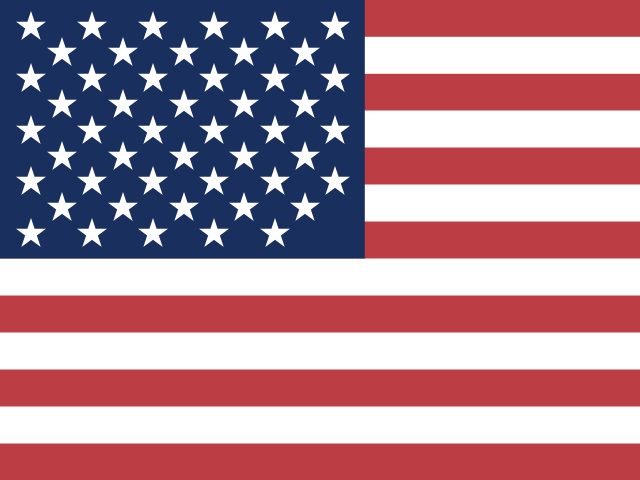
WHAT THE FLAG MEANS ◢
Thirteen red-and-white stripes, with fifty white stars on a blue canton, one for each state. Title 4 of the United States Code prescribes the alternate red and white stripes and a star for each state, and gives the colours no meaning at all. The only meaning any instrument that establishes the flag assigns to an element of the flag is in the resolution of 1777, which describes the stars as representing a new constellation. Reading the thirteen stripes for the original colonies is convention rather than law. The familiar reading of red as hardiness and valour, white as purity and innocence and blue as vigilance, perseverance and justice comes from the 1782 report to Congress on the Great Seal, which explains that seal's own tinctures while noting that its colours are the flag's.
United States FACTS ◢
| Capital | Washington, D.C. |
|---|---|
| Continent | North America |
| Population | 341,784,857 (2025) |
| Area | 9,826,675 km² |
| Population density | 35/km² |
| Currency | United States dollar (USD) |
| Official language | English |
| Calling code | +1 |
| Internet TLD | .us |
| Time zones | UTC-10:00, UTC-09:00, UTC-08:00, UTC-07:00, UTC-06:00, UTC-05:00 |
| Drives on the | Right |
| ISO codes | US / USA |
DID YOU KNOW? ◢
- It's a federation of 50 states plus a capital district, Washington, D.C.
- Alaska reaches into the Arctic while Hawaii sits deep in the tropical Pacific.
- Its national parks system, beginning with Yellowstone in 1872, was the first of its kind in the world.
- The Grand Canyon, carved by the Colorado River, plunges more than a mile deep.
- It put the first humans on the Moon in 1969.
United States QUICK ANSWERS ◢
What is the capital of the United States?
The capital of the United States is Washington, D.C.
What is the population of the United States?
The United States had a population of 341,784,857 in 2025.
What currency does the United States use?
The United States uses the United States dollar (USD).
What languages are spoken in the United States?
The official language of the United States is English.
Think you know your flags? Play Flag Daily → · Browse all countries →
MORE ON THE FLAG ◢
The Continental Congress created the flag of the United States on a Saturday, in one sentence, without a drawing, without a designer and without an arrangement for the stars.
You can read the whole thing in about fifteen seconds. It runs to thirty-one words, counting the word Resolved and the one word the manuscript carries above the line.
Two names have been attached to it since. Neither is in the record Congress kept.
Key Takeaways
- The resolution of 14 June 1777 runs to thirty-one words. It sits in the journal between a cash advance to three captains and the appointment of John Paul Jones to the Ranger.
- Charles Thomson, the Secretary of Congress, changed the wording twice while writing it into the journal, erasing "consist" and then "distinguished by".
- Francis Hopkinson billed Congress in 1780 for a body of design work that the journal's editor lists as including the naval flag, and what he asked to be paid in was wine. The Board of Treasury rejected the account for want of vouchers, and gave three grounds for refusing it even with them: one of its members knew that on the Treasury work he "was not the only person consulted", a salaried officer should not be charging at all, and Hopkinson was reported to have called the wine a compliment he half expected not to get.
- The Betsy Ross story enters the public record in 1870, told by her grandson and sworn to by three relatives who had worked in her flag business, and it dates the episode to June 1776, a year before Congress resolved anything.
- Section 1 of Title 4 of the United States Code still reads "forty-eight stars". It has not been amended since 1947, and it does not need to be.
| Instrument | Date | What it fixes | What it says the flag means |
|---|---|---|---|
| Resolution of the Continental Congress | 14 June 1777 | Thirteen stripes, alternate red and white, and thirteen white stars in a blue union | The stars represent "a new constellation". Nothing else. |
| An Act making an alteration in the Flag of the United States (1 Stat. 341) | 13 January 1794 | Fifteen stripes and fifteen stars, from 1 May 1795 | Nothing |
| An Act to establish the flag of the United States (3 Stat. 415) | 4 April 1818 | Back to thirteen stripes, twenty stars, and one more on each new state's admission | Nothing |
| Title 4, United States Code, chapter 1 (sections 1 and 2, 61 Stat. 642; section 8 added 1998) | 30 July 1947 | Sections 1 and 2: thirteen stripes and "forty-eight stars", plus one on each admission | Nothing about the colours. Section 4 prints the pledge to the flag "and to the Republic for which it stands"; 7(m) makes half-staff "a mark of respect"; 8(a) makes an inverted flag a distress signal; 8(j) says the flag "represents a living country"; and Proclamation 2605, printed under section 10, calls it "universally representative" of the principles of the justice, liberty and democracy the people of the United States enjoy. |
| Executive Order 10834 | 21 August 1959 | The positions of the stars and the proportions, by an attached diagram | Nothing |
What Congress resolved on 14 June 1777
Here it is in full, from the Journals of the Continental Congress for Saturday 14 June 1777, page 464. The double bars are the editor's mark for a word inserted into the manuscript:
Resolved, That the flag of the ||thirteen|| United States be thirteen stripes, alternate red and white: that the union be thirteen stars, white in a blue field, representing a new constellation.
Note what is not in it. No proportions. No shade of red or blue. No arrangement of the stars, and no point count either, so the five-pointed star that everyone now draws is convention rather than anything the resolution required.
And no designer. The resolution names nobody, thanks nobody and pays nobody.
None of that vagueness hurt it. A flag that has to be read across open water needs a strong pattern and very little else, which is the same property that makes one recognisable when a game shows you a flag and gives you three guesses at the country.
The context is worth as much as the text. The three entries immediately before it are a letter referred to the Marine Committee, a cash advance to Captains Steel, Irwin and Kearsley, and a grant of authority to the Marine Committee over the continental ships in the Delaware. The entry immediately after it is a complaint that Captain John Roach is "a person of doubtful character", which leads, on the next page, to John Paul Jones being given the Ranger instead.
The flag arrives in a run of entries about ships. It reads less like the founding of a national emblem than like a specification for what the navy should fly.
The man who wrote it down changed his mind twice
The resolution was not handed to Congress on paper. It was composed at the desk.
The 1909 study of the flag by George Canby and Lloyd Balderston worked from a photographic facsimile of the manuscript journal and read the corrections off it. Charles Thomson, the Secretary of Congress, first wrote "Resolved That the Flag of the United States consist of." He erased consist and wrote be distinguished above it, and over of he wrote by, so that it read "be distinguished by 13 stripes". Then he erased distinguished by as well and left the sentence as it stands.
The authors drew the obvious inference: "If the resolution had been handed in in writing as the report of a committee, it would hardly have been twice changed in recording it."
Whether Thomson framed the wording alone or with others in the room, they concluded, "cannot be determined". Their verdict on the whole entry is worth quoting, because it is the opposite of how the day is usually described: "Altogether the resolution seems to be the belated official recognition of a fact already accomplished."
Their reading is that the flag was already in use, and that Congress was catching up with it rather than inventing anything.
What "a new constellation" was meant to say
The resolution gives the colours nothing. It gives the stars something. They are "representing a new constellation".
That is a real assignment of meaning, made by the body with the authority to make it. It is also easy to misread. A constellation is a group of stars considered together, and the point being made is about the group rather than about any individual star.
Five years later the same idea turns up in the same journal, explained. When Congress adopted the Great Seal on 20 June 1782, the design put thirteen stars in a glory above the eagle, and the remarks entered beneath it gloss them: "The Constellation denotes a new State taking its place and rank among other sovereign powers."
That is a sentence about the seal, not about the flag. But it is the nearest thing to a contemporary explanation of the word the flag resolution had used, and it comes from a report Ford's edition records as being in the handwriting of Charles Thomson, the same officer who had written that resolution into the journal five years earlier. The device was not solely his either. Ford's footnote records the report as adapted from one by William Barton, which was itself, in the endorsement's words, an "improvement on the Secretary's device".
Where the valour and purity reading comes from
The short answer is that red is valour, white is purity, blue is vigilance, and that it comes from a 1782 report about the Great Seal. That answer is right, and the sentence it compresses is more interesting than the compression.
The reading is real, it is primary, and it was written about a different object.
The remarks entered in the journal beneath the Great Seal blazon read:
The colours of the pales are those used in the flag of the United States of America. White signifies purity and innocence. Red hardiness and valour and Blue the colour of the Chief signifies vigilance perseverance and justice.
Three things are worth pulling out of that.
The first is that red is not simply valour. The text says "hardiness and valour", and the popular version has quietly dropped a word.
The second is the blue. "Blue the colour of the Chief" is doing precise heraldic work. The chief is the horizontal band across the top of the seal's shield, and the remarks have already said it "unites the whole and represents Congress". There is no chief on the flag. The blue being glossed sits on a charge that exists on one object and not on the other.
The third cuts the other way, and it is why this is not a simple case of a borrowed gloss. The passage opens by tying the two together itself: "The colours of the pales are those used in the flag of the United States of America." The author is not confusing them. He is saying, correctly, that he took the shield's colours from the flag, and then explaining what he means by them on the shield.
What has happened since is that the explanation travelled back along that sentence to the object the colours had come from. It began as a note about a seal.
Two claims on the design, and neither one settles it
The two claims do not fit each other, and neither fits the record cleanly.
Francis Hopkinson made his in writing, at the time, to the people who would have known, although the surviving record of it never uses the word flag. The journals call him Treasurer of Loans. In 1780 he wrote to the Board of Admiralty claiming a string of designs and sent in an account for them. What he asked to be paid in was wine.
The Board of Treasury reported on the account on 27 October 1780 and did not pay it. It had already "rejected it for want of vouchers to support the charges", and it went on to say it would not have paid even with vouchers, for three reasons. The first is hedged at every joint: "it is within the knowledge of one of the Members of the Board, that with respect to the charges of the works incidental to the Treasury, the said Francis Hopkinson was not the only person consulted on those exhibitions of Fancy, and therefore cannot claim the sole merit of them and not entitled in this respect to the full sum charged". Three qualifiers in one sentence. It rests on what one unnamed member of the Board happened to know; it is confined to the works incidental to the Treasury, and the record does not settle which charges fell under that head; and the shortfall it justifies is only the part of the sum attributable to that work. The second reason carries no limit of scope, though it is offered as a view rather than a finding: "the Board are of opinion the public is entitled to those little assistances given by Gentlemen who enjoy a very considerable salary under Congress without Fee or further reward".
The third reason, which the Board introduces with "and lastly", rests on the same kind of footing as the first: "it appears to the Board by a relation of a conversation" between Hopkinson and one of its members that he "viewed the success of his application for the wine as very uncertain, and considered it in the light of compliment due to him for these works of Fancy". On that account he had half expected to be refused, and thought of the wine as a courtesy rather than a fee. The journal's editor, in a footnote, describes the "fancy work" as designs "for the naval flag of the United States, seals (including the great seal of the United States), and currency".
So the contemporary record has a man submitting an account for a body of design work, in writing, to a government that answered him. The Board never writes the word flag; it is Ford's footnote, added in 1910, that identifies what the fancy work was. The answer was not that he was wrong. It was that one member believed he had had help on the Treasury work, and that a salaried officer does not invoice for any of it.
Elizabeth Claypoole, born Elizabeth Griscom and known by her first married name as Betsy Ross, left no claim of her own on paper. On the affidavits' own evidence she told the story out loud, often. It entered the public record through her grandson William Canby, who read a paper on it before the Pennsylvania Historical Society in March 1870, ninety-three years after the resolution. Printing came later, through the second edition of Preble's history of the flag.
Canby looked for corroboration before he published, and the 1909 authors record what he found. He "examined all the records of the period to which he had access, in the hope of finding some confirmation of the story, but without success", then went to Washington with letters from the society, searched the government records, and "found nothing beyond the flag resolution of June 14, 1777, already well known".
The paper he read in March 1870 was, in their words, an account "telling of his fruitless search" with the family story attached to it.
To shore it up he gathered sworn affidavits from three relatives who had worked in her flag business: a daughter, a niece and a granddaughter. He read his written narrative aloud to each of them, and what each swore to was the correctness of that narrative, adding a separate statement of her own that forms part of the affidavit. Her daughter Rachel Fletcher affirmed hers before a New York notary on 31 July 1871, and it opens exactly as sworn hearsay does:
I remember having heard my mother, Elizabeth Claypoole, say frequently that she, with her own hands (while she was the widow of John Ross), made the first Star Spangled Banner that ever was made.
The famous detail is in it. Shown a rough drawing, she is said to have objected that the flag was square when it should be a third longer than its width, that the stars were "scattered promiscuously over the field" when they should be "in lines, or in some adopted form, as a circle or a star", "and that the stars were six-pointed in the drawing, and she said they should be five-pointed".
There is one hard problem with the account, and it is a date. The affidavit places the visit "in the month of June, 1776, or shortly before the Declaration of Independence". That is a full year before Congress resolved anything about a flag.
The family's own book concedes the difficulty. Printing the affidavit in 1909, the authors added underneath it that "among so many particulars, it is probable that some, at least, are confused, especially in regard to order of time."
One document of the period does connect her to flags. A minute of the Pennsylvania State Navy Board for 29 May 1777 orders payment to "Elizabeth Ross, for fourteen pounds, twelve shillings, two pence for making Ship's Colours, &c. put into William Richards' Store." She was a working Philadelphia flagmaker, and that document proves it. It does not say which colours. The 1909 authors, arguing her case, could get no further than "extremely probable that the colors furnished by Elizabeth Ross included the new national ensign."
The United States flag has had fifteen stripes
Congress provided for the admission of Kentucky by an Act of 4 February 1791 and of Vermont by an Act of 18 February 1791, and then did the obvious thing to the flag. An Act of 13 January 1794 provided that from 1 May 1795 "the flag of the United States, be fifteen stripes alternate red and white. That the Union be fifteen stars, white in a blue field."
Fifteen stripes stayed law for twenty-three years, because the Act that replaced them did not take effect until 4 July 1818. The whole of the War of 1812 falls inside that window, so the star-spangled banner of the song, whichever cloth it was, carried fifteen stripes and fifteen stars. It is not the flag on the pole today.
The Act that ended the experiment set the stars at twenty, which is the fifteen of 1794 plus one for each state admitted in between. On 4 April 1818 Congress passed "An Act to establish the flag of the United States", which put the stripes back to thirteen, set the stars at twenty, and added the rule that has governed ever since: "on the admission of every new state into the Union, one star be added to the union of the flag; and that such addition shall take effect on the fourth day of July then next succeeding such admission."
That is the design decision that made the flag survive two more centuries of statehood. The stripes were frozen and the stars were made to grow, and the thirty states admitted since have each been added under that same rule, which no Act has changed. Few flags carry a rule for their own growth inside the instrument that establishes them, which is worth having in mind while running through the flags of every country.
It is also where the best known fact about the flag turns out to be an inference. The 1818 Act does not say the thirteen stripes stand for the original colonies. Neither does the 1777 resolution, and neither does the modern Code. The number is thirteen because it was thirteen in 1777 and Congress chose to go back to it. Everything beyond that is a reading, however reasonable a reading it is.
Why United States law still says forty-eight stars
Look up the flag in the United States Code today and section 1 of Title 4 tells you:
The flag of the United States shall be thirteen horizontal stripes, alternate red and white; and the union of the flag shall be forty-eight stars, white in a blue field.
Forty-eight. That text was enacted on 30 July 1947, when forty-eight was correct, and it has never been amended. Alaska and Hawaii arrived in 1959 and the sentence stayed as it was.
It is not an error, and nobody needs to fix it. Section 2, sitting directly underneath, carries the 1818 rule forward: "On the admission of a new State into the Union one star shall be added to the union of the flag". The two sections are read together, so the first states a position and the second states a process, and the process has overtaken the position twice.
What the statute never says is how the stars are laid out. Section 5 of the same chapter, which establishes the codified display rules for civilians, points outside itself for its definition: "The flag of the United States for the purpose of this chapter shall be defined according to sections 1 and 2 of this title and Executive Order 10834 issued pursuant thereto." The definition is scoped to that chapter, but it tells you where the design actually lives. Dwight Eisenhower signed that order on 21 August 1959, the day Hawaii was admitted. The first line of its design part is as plain as the 1777 resolution and carries just as little meaning: "The flag of the United States shall have thirteen horizontal stripes, alternate red and white, and a union consisting of white stars on a field of blue."
How those fifty stars are ranked is not in the order's text at all. Its section 2 points at a diagram attached to it, and its section 3 sends the proportions to that same attachment. The current flag was made official by a drawing pinned to a procurement order, and it took effect on 4 July 1960.
What the Flag Code says the flag is
For all the silence about colours, the Code is not mute about the flag. The Flag Code is sections 4 to 10 of Title 4, and it opens by printing the Pledge of Allegiance, in which allegiance is pledged "to the Flag of the United States of America, and to the Republic for which it stands". The flag is one of the two things pledged to, and the Republic is what it stands for. Whatever else that is, it is not silence.
Two configurations are given meanings outright. The flag "should never be displayed with the union down, except as a signal of dire distress in instances of extreme danger to life or property", and, on the President's order, it is flown at half-staff on the death of principal figures of government "as a mark of respect to their memory". Section 7(m) opens "By order of the President", so the second needs an order before it operates and the first does not. Congress is not inventing that. Section 5 introduces the display rules that follow it as a "codification of existing rules and customs", so what is being written down is a custom that already existed.
A Presidential proclamation of 1944, printed in the Code beneath section 10, opens with a flat declaration that the flag "is universally representative of the principles of the justice, liberty, and democracy enjoyed by the people of the United States". That proclamation is about whether the flag may be printed on lend-lease packing cases, and the sentence is a recital rather than its operative part. Even so, it is a formal statement, in an instrument printed in the Code, of what the flag is taken to represent.
Buried further into section 8, in a subsection about costumes and lapel pins, is a sentence of pure assertion:
The flag represents a living country and is itself considered a living thing.
That is the United States Code saying what the flag is. It has been in Title 4 since 1998, when the Flag Code was moved there, and it is offered as the reason a lapel replica should be worn over the heart.
Section 8 talks about the colours as colours exactly once, and even then it is about something else. Subsection (d) directs bunting rather than a flag for a speaker's desk, a platform front and decoration generally, and specifies it as "blue, white, and red, always arranged with the blue above, the white in the middle, and the red below". An order, then, but no meaning.
So the instruments are not silent about the flag. Across two centuries, and in instruments of very different weight, they have said that the stars are a new constellation, that the Republic is what the flag stands for, that an inverted flag is a distress call, that half-staff is a mark of respect, that the flag is universally representative of the principles of a justice, liberty and democracy the American people enjoy, and that it is a living thing. What none of the instruments that make the flag has ever said is what the colours mean.
Frequently asked questions
Who designed the American flag?
The resolution of 14 June 1777 credits nobody, and the wording was worked out at the secretary's desk, since the manuscript journal shows the sentence altered twice as it was written down. Francis Hopkinson billed Congress in 1780 for design work the journal's editor identifies as including the naval flag, and the Board of Treasury refused to pay, for want of vouchers and because a salaried officer should not be charging for such work at all. The Betsy Ross attribution enters the public record in 1870, through a paper her grandson read aloud to a historical society after he had searched the government records in Washington for corroboration and found nothing beyond the resolution itself.
What do the colours of the American flag mean?
None of the instruments that make the flag assigns them a meaning: not the 1777 resolution, not the Acts of 1794 or 1818, not Title 4 of the Code, and not Executive Order 10834. The familiar reading was written in 1782 to explain the tinctures of the Great Seal, and although that report notes that the shield's colours are the flag's, the meanings it gives are attached to the seal's own charges.
The report, which Ford's edition records as being in the hand of Charles Thomson, Secretary of Congress, glossed white as "purity and innocence", red as "hardiness and valour" and blue as "vigilance perseverance and justice". The blue he was glossing is the colour of the chief, a band that exists on the seal and not on the flag.
Did Betsy Ross make the first American flag?
The evidence is a family recollection, not a contemporary document, and it is dated wrongly. Her daughter's affidavit places the episode in June 1776, a year before Congress resolved on a flag, and the family's own 1909 book concedes that some of the particulars in that affidavit are probably confused about "order of time". Two further affidavits, from a niece and a granddaughter, swore to the correctness of her grandson's written account after he read it to them.
A Pennsylvania State Navy Board minute of 29 May 1777 does record a payment to her for making ship's colours, which establishes that she made flags without establishing which ones.
Why does the American flag have thirteen stripes?
Because the 1777 resolution set thirteen, Congress raised the number to fifteen in 1794 with effect from 1795, and the Act of 4 April 1818 returned it to thirteen permanently while making the stars grow instead. None of those instruments says the thirteen stripes stand for the original colonies; that reading is a natural inference from the number rather than anything the statute books state.
How many times has the American flag changed?
The stripes have changed twice, from thirteen to fifteen in 1795 and back to thirteen in 1818. The stars have changed far more often, because the 1818 rule adds one on the 4 July following each state's admission, so the union has been redrawn with every wave of new states.
The current fifty-star arrangement was fixed by Executive Order 10834, signed on 21 August 1959 and effective from 4 July 1960.
Sources
- Journals of the Continental Congress, 1774-1789, vol. VIII, Worthington Chauncey Ford ed., Government Printing Office, 1907, p. 464, the resolution of 14 June 1777 and the Marine Committee business around it. Retrieved 21 August 2026.
- Journals of the Continental Congress, 1774-1789, vol. XXII, Government Printing Office, 1914, pp. 338-340, the Great Seal device and the "Remarks and explanation" of 20 June 1782. Retrieved 21 August 2026.
- Journals of the Continental Congress, 1774-1789, vol. XVIII, Government Printing Office, 1910, pp. 983-985, the Board of Treasury's report of 27 October 1780 on Francis Hopkinson's account. Retrieved 21 August 2026.
- Acts of the First Congress of the United States, Library of Congress, 1 Stat. 189 and 191, the admission of Kentucky and Vermont. Retrieved 21 August 2026.
- Acts of the Third Congress of the United States, Library of Congress, 1 Stat. 341, ch. 1, approved 13 January 1794. Retrieved 21 August 2026.
- Acts of the Fifteenth Congress of the United States, Library of Congress, 3 Stat. 415, ch. 34, approved 4 April 1818. Retrieved 21 August 2026.
- United States Code, 2023 Edition, Title 4, Chapter 1 - The Flag, U.S. Government Publishing Office, sections 1, 2 and 8. Retrieved 21 August 2026.
- Executive Order 10834 of 21 August 1959, The Flag of the United States, National Archives and Records Administration, read alongside the Federal Register of 25 August 1959, 24 FR 6865. Retrieved 21 August 2026.
- George Canby and Lloyd Balderston, The Evolution of the American Flag, Ferris & Leach, Philadelphia, 1909: pp. 56-58 for the Pennsylvania State Navy Board minute and the manuscript corrections, Appendix B p. 103 for the parentage, Appendix C pp. 109-110 for William J. Canby's fruitless search of the government records and how the affidavits were taken, and Appendix D pp. 112-118 for the affidavits themselves. Retrieved 21 August 2026.
PLAY ANOTHER →
Three clues, three guesses. Work out where in the world it is.
THREE CLUESDAILYDaily TriviaFive questions a day. Everyone gets the same five.
FIVE QUESTIONSDAILYDaily CodeA short message, hidden in a different cipher every day.
ONE CIPHER A DAYDAILYDaily CryptogramOne quote, one scrambled alphabet. Crack it before tomorrow.
CRACK THE QUOTE