
Bhutan
A Himalayan kingdom that measures success in Gross National Happiness and keeps its forests thick by law. Bhutan only opened to television and the internet in 1999.
WHAT THE FLAG MEANS ◢
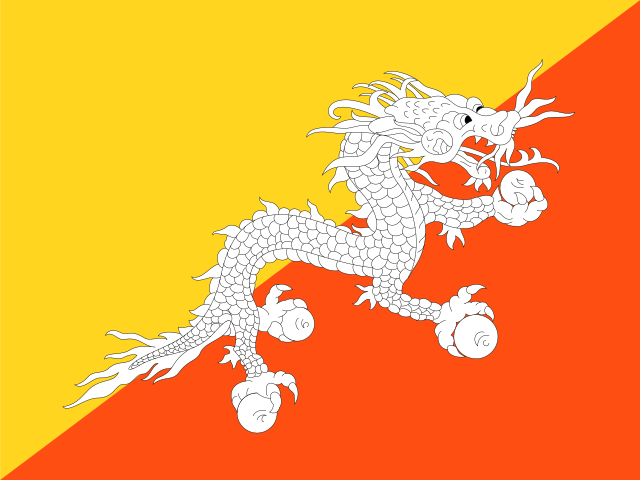
Divided diagonally from the lower hoist to the upper fly, yellow above and orange below, with a white dragon lying along the division and gripping jewels in its claws. The constitutional schedule that defines the flag gives the yellow the secular tradition, personified by the King as upholder of both the spiritual and secular foundations of the kingdom, and the orange the spiritual tradition and the flourishing of the Kagyu and Nyingma schools. The dragon carries the name of the kingdom, Druk; its whiteness stands for the undefiled thoughts of a people of different ethnic and linguistic origins. No state text says what the jewels mean.
Source: dlgdm.gov.bt · oag.gov.bt · bhutan.gov.bt
Bhutan FACTS ◢
| Capital | Thimphu |
|---|---|
| Continent | Asia |
| Population | 796,682 (2025) |
| Area | 38,394 km² |
| Population density | 21/km² |
| Legal tender | Ngultrum (BTN) and Indian rupee (INR) |
| National language | Dzongkha |
| Calling code | +975 |
| Internet TLD | .bt |
| Time zone | UTC+06:00 |
| Drives on the | Left |
| ISO codes | BT / BTN |
DID YOU KNOW? ◢
- It was one of the first countries on Earth to become carbon negative, absorbing more carbon than it emits.
- Its constitution requires at least 60% of the land to remain forested for all time.
- The clifftop Tiger's Nest monastery clings to a rock face roughly 900 metres above the valley floor.
- Bhutan famously measures progress through Gross National Happiness rather than GDP alone.
- It never had traffic lights in its capital; officers direct traffic by hand instead.
Bhutan QUICK ANSWERS ◢
What is the capital of Bhutan?
The capital of Bhutan is Thimphu.
What is the population of Bhutan?
Bhutan had a population of 796,682 in 2025.
What currency does Bhutan use?
Bhutan uses the Ngultrum (BTN) and Indian rupee (INR).
What languages are spoken in Bhutan?
Bhutan designates no official language. The national language of Bhutan is Dzongkha.
Think you know your flags? Play Flag Daily → · Browse all countries →
MORE ON THE FLAG ◢
Most national flags are explained by tradition. Bhutan's is explained by law.
The Constitution of the Kingdom of Bhutan carries a First Schedule headed "The National Flag and the National Emblem of Bhutan". Article 1, section 5 makes it binding: "The National Flag and the National Emblem of Bhutan shall be as specified in the First Schedule of this Constitution." Four short paragraphs then say what each element stands for.
The state has said what its flag means in two instruments, thirty-six years apart. The English is not even a translation to be argued with: Article 35, section 4 provides that where the Dzongkha and English differ, "each text shall be regarded as equally authoritative and courts shall reconcile the two texts".
What they say is not what gets repeated. The white dragon is almost always glossed as standing for purity. The constitution never uses the word.
Key Takeaways
- The flag's meaning is set out in the First Schedule of the Constitution adopted on 18 July 2008, not left to custom.
- That schedule gives the white dragon "the undefiled thoughts of the people", tied to their "different ethnic and linguistic origins".
- The earlier National Flag Rules of 1972 say much the same in older words: civil and monastic where the constitution says secular and spiritual.
- The constitution's English is not a translation. Both language texts are equally authoritative.
- Neither instrument explains the jewels in the dragon's claws, although the same schedule glosses the jewel on the national emblem.
| Element | National Flag Rules, 1972 | First Schedule, 2008 |
|---|---|---|
| Yellow half | "civil tradition" | "the secular tradition" |
| Orange half | "monastic tradition of Buddha's teachings" | "the spiritual tradition" |
| The dragon | "the name of the Kingdom of Druk" | "the name of the Kingdom" |
| Its whiteness | "inner thought and deeds are pure" | "the undefiled thoughts of the people" |
Why is there a dragon on Bhutan's flag?
Because it carries the country's name. The First Schedule puts it plainly: "The dragon that fully presses down the fimbriation symbolizes the name of the Kingdom, which is endowed with the spiritual and secular traditions." The 1972 Rules said it more directly still, that the dragon "signifies the name of the Kingdom of Druk, having monastic and civil traditions".
Druk means dragon, and the name traces to one event. The Centre for Bhutan Studies dates it to 1189, when Tsangpa Gyare Yeshey Dorji went to choose a monastery site in the Namgyiphu valley and, as its account has it, "a dragon thundered, resonating thrice in the clear winter sky". He read the thunder as a measure of how far his teachings would carry. The monastery became known as Druk Ralung and his school came to be called Druk. The school took hold in Bhutan after Zhabdrung Ngawang Namgyal arrived in 1616 and went on to unify and found the modern Bhutanese state, and its name became the country's.
That is where the thunder in "Land of the Thunder Dragon" comes from. The constitution's glossary is terser: "Druk: Bhutan."
Why is the dragon white, if not for purity?
Because of what Bhutanese are held to have in common. Neither instrument treats the white as an abstract virtue.
The First Schedule: "The white dragon symbolizes the undefiled thoughts of the people that express their loyalty, patriotism and great sense of belonging to the Kingdom although they have different ethnic and linguistic origins."
The 1972 Rules, at provision 1(4): "It signifies that although there are many peoples in the kingdom whose conduct of body and speech are not similar, their inner thought and deeds are pure."
The subject in both is the population, and the point is that the loyalty holds across difference. Strip that out and "purity" is left attached to nothing.
The word does have an official pedigree, which is why it circulates. A booklet titled The Kingdom of Bhutan, published by His Majesty's Government of Bhutan and dated to 1972 by the vexillologist Michel Lupant, who quotes it, reads: "Its colour, the white of purity, expresses the loyalty of the country's many racial and linguistic groups." Even there it is half a sentence, and the other half carries the meaning.
What do the yellow and orange halves of the Bhutan flag mean?
They are the two halves of Bhutanese statecraft. Yellow is "the secular tradition", and the paragraph then does something a summary usually loses:
"It personifies His Majesty the King, whose noble actions enhance the Kingdom. Hence, it symbolizes that His Majesty is the upholder of the spiritual and secular foundations of the Kingdom."
So yellow is not the King's half of a divided authority. It is the King as guarantor of both halves, which is what the 1972 Rules concluded too: the yellow "signifies the basis of both monastic and civil traditions".
Orange is "the spiritual tradition", and both instruments name schools rather than stopping at Buddhism in general: "the Kagyu and Nyingma traditions in particular" in 2008, "the traditions of Kagyud and Nyingma flourish in harmony" in 1972.
A third official reading is more concrete than either. The Royal Government's Bhutan Portal explained the colours as garments: yellow "represents the yellow scarf worn by His Majesty", orange "the orange scarf worn by the Je Khenpo, the religious head of the country". That yellow reading is the oldest of the three. An undated manuscript describing the 1956 flag, taken from the archives of His Majesty's Secretariat, already had it, in the translation published by the Centre for Bhutan Studies: "As he wears the yellow robe, the yellow represents the being of His Majesty."
Which way does the diagonal run on Bhutan's flag?
From the lower hoist to the upper fly, with yellow above the line and orange below it. The 1972 Rules fix the orientation in a clause: the orange half "extends from bottom and forms the fluttering end", so orange reaches the loose edge that flies, and yellow holds the edge at the pole.
The dragon lies along that division rather than across the middle, and the reason is mechanical. On the earlier square version it was set parallel to the fly, which the Centre for Bhutan Studies records did not survive contact with a flagpole: "the flag always slumped when hoisted whereby the dragon faced the earth". Rotated onto the diagonal, it climbs towards the upper fly whatever the cloth does. The flag's most memorable feature was placed by physics rather than chosen for meaning, which is worth remembering the next time it turns up in Flag Daily.
The same round of changes squared off the proportions. During a visit by the Gangtok-based Political Officer of India in the late 1950s, it was noticed that a square flag did not flutter like the rectangular Indian one hoisted above his camp, and the Bhutanese flag was redesigned to that flag's nine feet by six. The lower half turned from red to orange in 1968 or 1969, on the King's command.
What about the jewels in the dragon's claws?
Nothing official explains them, which is the one gap in an unusually well documented flag. The Royal Government does describe them. The Bhutan Portal, run by the Ministry of Information and Communications, records in its own spelling that "The dragon holds norbu(jewel) by its claws." Neither instrument says what they mean.
The contrast inside the constitution is sharp. The same First Schedule goes on to the national emblem, where jewels get the treatment the flag's do not. One elliptical sentence hands out three meanings at once: the lotus "symbolizes absence of defilements", the wish-fulfilling jewel "the sovereign power of the people", and the two dragons "the name of the Kingdom".
The wealth reading that turns up everywhere comes from the same booklet as the purity line, which called the jewels "symbols of the land's wealth and perfection". It is Bhutanese and it is official, but it is publicity rather than law, and the law that followed did not adopt it.
Frequently asked questions
What does the dragon on the Bhutan flag mean?
It stands for the name of the country. The First Schedule of Bhutan's constitution says the dragon "symbolizes the name of the Kingdom", and the 1972 National Flag Rules say it signifies "the name of the Kingdom of Druk". Druk means dragon, and Bhutanese call their country Druk.
Why is the dragon on the Bhutan flag white?
For the loyalty of the people rather than for an abstract purity. The constitutional schedule gives the white dragon "the undefiled thoughts of the people" across "different ethnic and linguistic origins", and the 1972 Rules call their "inner thought and deeds" pure despite differences of "conduct of body and speech". Neither text calls the white itself purity, and the constitution does not use the word at all.
What do the yellow and orange on the Bhutan flag stand for?
Yellow is the secular tradition and orange the spiritual one. The schedule makes yellow personify the King as upholder of both foundations rather than only the secular one, and names the Kagyu and Nyingma schools under the orange.
Which way is the Bhutan flag divided?
Diagonally, from the lower hoist corner to the upper fly corner, with the yellow half above the line and the orange half below it. The 1972 Rules place the orange at "the fluttering end", which is the free edge away from the pole.
What are the jewels the dragon holds on the Bhutan flag?
They are norbu, and no Bhutanese instrument says what they mean. A government portal records that the dragon holds them in its claws; the flag rules and the constitutional schedule both stop at the dragon's colour and position.
Sources
- Royal Government of Bhutan, The Constitution of the Kingdom of Bhutan (First Schedule; Article 1, section 5; Article 35, section 4) - retrieved 12 August 2026.
- Office of the Attorney General of Bhutan, The National Flag Rules of Bhutan, 1972 - retrieved 12 August 2026.
- Ministry of Information and Communications, Bhutan's National Flag, Bhutan Portal, archived 7 January 2020 - retrieved 12 August 2026. The live site did not respond.
- Dorji Penjore and Sonam Kinga, The Origin and Description of the National Flag and National Anthem of the Kingdom of Bhutan, The Centre for Bhutan Studies, 2002, in Heidelberg University Library's FID4SA repository; read as the author's PDF, the repository download being behind a bot check - retrieved 12 August 2026.
- Michel R. Lupant, Flags over Bhutan, International Congress of Vexillology 23, published by FIAV - retrieved 12 August 2026.
PLAY ANOTHER →
A short message, hidden in a different cipher every day.
ONE CIPHER A DAYDAILYGuess the CountryThree clues, three guesses. Work out where in the world it is.
THREE CLUESDAILYDaily CryptogramOne quote, one scrambled alphabet. Crack it before tomorrow.
CRACK THE QUOTEDAILYDaily TriviaFive questions a day. Everyone gets the same five.
FIVE QUESTIONS