
Brunei
A tiny, oil-rich sultanate on the island of Borneo, wrapped in rainforest and ruled by one of the world's longest-reigning monarchs. Brunei is split into two chunks by a slice of Malaysia.
WHAT THE FLAG MEANS ◢
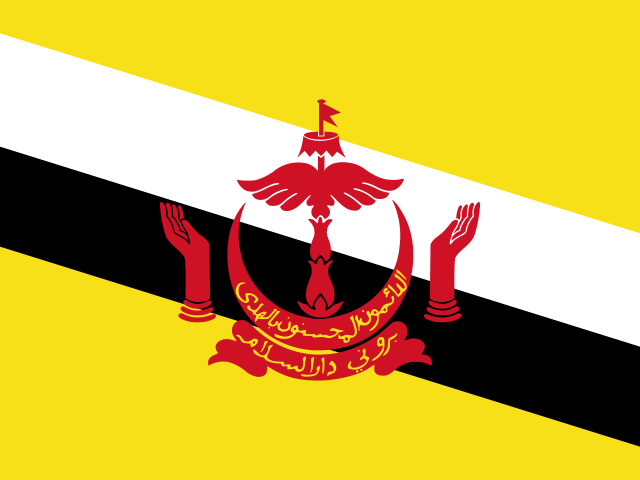
A yellow field crossed by white and black diagonal stripes with a red state crest in the centre. Yellow is the sultan's colour, white and black those of the Pengiran Bendahara and Pengiran Pemancha. The crest gathers a royal parasol, a wing, upraised hands and a crescent for Islam carrying the motto 'Always render service by God's guidance', over a scroll reading 'Brunei Darussalam'.
Brunei FACTS ◢
| Capital | Bandar Seri Begawan |
|---|---|
| Continent | Asia |
| Population | 466,330 (2025) |
| Area | 5,765 km² |
| Population density | 81/km² |
| Currency | Brunei dollar (BND) |
| Official language | Malay |
| Calling code | +673 |
| Internet TLD | .bn |
| Time zone | UTC+08:00 |
| Drives on the | Left |
| ISO codes | BN / BRN |
DID YOU KNOW? ◢
- It sits on the island of Borneo, which it shares with Malaysia and Indonesia.
- Much of the country is still covered in old-growth tropical rainforest.
- Kampong Ayer, its historic water village, is a sprawling settlement built on stilts over the river.
- Its ruler is one of the longest-serving current monarchs in the world.
Brunei QUICK ANSWERS ◢
What is the capital of Brunei?
The capital of Brunei is Bandar Seri Begawan.
What is the population of Brunei?
Brunei had a population of 466,330 in 2025.
What currency does Brunei use?
Brunei uses the Brunei dollar (BND).
What languages are spoken in Brunei?
The official language of Brunei is Malay.
Think you know your flags? Play Flag Daily → · Browse all countries →
MORE ON THE FLAG ◢
Brunei's flag is a yellow field cut by two diagonal stripes, white above black, with a red crest in the middle. The stripes are usually explained as standing for two of the sultanate's senior ministers, and the explanation almost always arrives hedged: traditionally, or said to represent.
It is not a popular reading. It is the Brunei government's own account, published by the Information Department at the Prime Minister's Office, and it names both offices outright.
The colours were adopted, the department writes, because "the principal signatories to the agreement were the Sultan, the Pengiran Bendahara and the Pengiran Pemancha whose colours of yellow, white and black respectively, were accordingly incorporated in the new flag". That agreement is the Supplementary Agreement of 1905 and 1906, which put a British Resident into a protectorate Brunei had already accepted in 1888. Three sealers, three field colours, and the flag has carried the same three ever since.
Key Takeaways
- Brunei's Information Department states that yellow, white and black are the personal colours of the Sultan, the Pengiran Bendahara and the Pengiran Pemancha.
- Only two ministers are represented because the other two wazir posts stood empty when the agreement was sealed.
- The treaty text carries exactly three Brunei seals, and they are those three offices.
- The state motto is inscribed on the crescent. The scroll beneath the crest reads "Brunei Darussalam".
- The revised Constitution the Attorney General's Chambers publishes does not mention the flag, the crest, an emblem or a coat of arms anywhere.
| Element | Official Malay name | What the government says it means |
|---|---|---|
| Yellow field | not named | The Sultan's colour |
| Upper white stripe | not named | The Pengiran Bendahara's colour |
| Lower black stripe | not named | The Pengiran Pemancha's colour |
| Flag inside the crest | Bendera | Royal regalia |
| Umbrella inside the crest | Payung Ubor-Ubor | Royal regalia |
| Wing of four feathers | Sayap | Protection of justice, tranquility, prosperity and peace |
| Pair of raised hands | Tangan, or kimhap | The government's pledge to promote welfare, peace and prosperity |
| Crescent | Bulan | Islam, the national religion |
What do the white and black stripes on Brunei's flag mean?
They are two men's colours, and the government explains how they got there.
Before 1906, the Information Department records, "Brunei had no state flag but individual flags or personal standards were very much in use", and the most important of those were the Sultan's and the wazirs'. A wazir was one of four principal state officials to whom the Sultan delegated executive and administrative power. Each had a colour: the Pengiran Bendahara white, the Pengiran Digadong green, the Pengiran Pemancha black, and the Pengiran Temenggong red.
When Brunei signed the 1906 agreement, the department writes, "it was felt that the state should fall in line with international practice in regard to the adoption of a flag for the state". Sketches were made. What was adopted put the Sultan's yellow across the whole field and laid the two ministers' colours across it as a band.
So the stripes are not a colour scheme. They are a record of who was in the room, and the flag has carried that record unchanged for more than a century.
Why only two ministers, and not all four?
Because two of the four chairs were empty, and the government says so directly.
The Information Department's explanation runs to one sentence. Read it carefully, because it is written about the two wazirs who were not in the room: "the reason why the colours of the wazirs were not incorporated in the new flag was that at that time there were only two wazirs living, the signatories to the agreement". It adds that the Pengiran Digadong and the Pengiran Temenggong "had died and their positions has not been filled at the time of the signing of the agreement".
That is close to right and loose in one place. B. A. Hussainmiya's history of the 1906 agreement (Brunei Press, 2006) sets out the four offices and their functions. It then dates both vacancies to 1885, and gives two different causes: the Digadong post fell empty when its holder Pengiran Matassan died, while the Temenggong post fell empty because its holder was Sultan Hashim himself, who took the throne in June 1885.
Read against that, the missing red is not a bereavement. Red is absent from the flag because the Temenggong had been promoted into the yellow.
Neither absence lasted. Hussainmiya records both posts recreated under Sultan Omar Ali Saifuddien III from the 1960s, and a fifth and senior wazir, the Perdana Wazir, arrived on 6 February 1970. Nobody revisited the flag. It still shows the roster of 1906.
Who actually sealed the 1906 agreement?
Three Brunei seals, and the document lists them in order.
Hussainmiya reproduces the Supplementary Agreement of 3 December 1905 and 2 January 1906 in full as Appendix 4, alongside the 1888 Protectorate Treaty it supplements. That earlier treaty placed Brunei "under the protection of Great Britain" while adding that "such protection shall confer no right on Her Majesty's Government to interfere with the internal administration of that State". Closing that gap is what the 1905 and 1906 document did, by giving Brunei a British Resident whose advice "must be taken and acted upon on all questions in Brunei, other than those affecting the Mohammedan religion".
Beneath the text sit four marks. One is the signature of Sir John Anderson, the High Commissioner, dated 2 January 1906. Those other three are the "Seal of HIS HIGHNESS SULTAN HASHIM", the "Seal of the PANGIRAN BANDAHARA" and the "Seal of the PANGIRAN PEMANCHA", an older romanisation of the same two offices the stripes belong to.
That is the whole Brunei side of the page, and it matches the three colours exactly. Hussainmiya also explains why the two ministers were there at all: they "argued rightly that their consent was needed before the enforcement of any serious decisions involving Brunei". Their stripes record a requirement of Brunei's traditional order, not a courtesy.
What does each part of Brunei's crest mean?
Only the crest gets an official gloss element by element, and it is published in Brunei in Brief, the Information Department's own handbook.
Five parts are named, in Malay: the Bendera, the flag; the Payung Ubor-Ubor, the royal umbrella; the Sayap, the wing; the Tangan or kimhap, the hand; and the Bulan, the crescent. Of those, the Bendera and the Payung Ubor-Ubor "have been royal regalia since the creation of the crest". A wing of four feathers, the Sayap, symbolises "the protection of justice, tranquility, prosperity and peace in the country". Tangan, or kimhap, "signifies the government's pledge to promote welfare, peace and prosperity". And the Bulan is "the symbol of Islam, the national religion of Brunei Darussalam".
Two elements get switched around constantly, including on pages that otherwise have the crest right. The motto is on the crescent: the characters inscribed there are the national slogan, and the handbook gives its meaning, not a transliteration, as "Always render service by God's guidance". Its lettering is Arabic script in yellow. The scroll beneath the crest carries something else entirely, the country's name, "Brunei Darussalam", which the handbook translates as "Brunei, the abode of peace".
Both readings are stable: the handbook's 2018 edition repeats the crest section word for word, so this is settled official wording rather than one writer's phrasing.
Does Brunei's Constitution describe the flag?
No, and this is the part worth knowing before repeating the usual line about 1959.
Brunei in Brief is careful about the sequence in which that year's change happened: the crest "was superimposed in 1959 after the promulgation of the Constitution of Brunei on September 29, 1959". After, not by. Search the Constitution itself, in the revised edition the Attorney General's Chambers publishes, and the words flag, crest, emblem and coat of arms do not appear anywhere in it. Its nearest thing to a national symbol is Article 82, which provides that the official language shall be the Malay language.
Statute is thin here too. Brunei's Emblems and Names (Prevention of Improper Use) Act, Chapter 94, bars commercial use of a list of "specified emblems", and the list in its Schedule reaches the royal standards and official seals, the State Seal of Brunei Darussalam and the Brunei Coat-of-Arms. The State Flag is not on it.
So the design, the measurements and the meanings all rest on the government's published account rather than on a flag act, and neither of these two documents supplies a definition of what Brunei's colours stand for.
How is the flag actually specified?
By carpentry, in inches.
Brunei's flag is described by the Information Department as four component portions, two parallelograms and two trapeziums. The diagonal band runs "from a point 2½ inches below the top left corner to a point of the same distance from the bottom corner of the right side", and the standard "measures 72 inches long by 36 inches wide", a height to width ratio of 1:2.
Split the band and the two stripes come out unequal. Black measures 7.5 inches and white a full inch more, so the Bendahara's stripe is 8.5 inches and measurably the broader of the two. Whether that follows his seniority the department does not say, and it would be a guess to claim it does.
Placement of the crest is given by anatomy rather than by centre point: "the forefingers of the upright arms which support the red crest are equidistant at 24 inches from the left and right sides of the flag". Subtract those two measurements from the 72-inch length and the hands span exactly 24 inches, one third of the flag.
Shrink all of that to a quiz thumbnail and the crest collapses into a red blob, leaving two unequal stripes as the only thing to work from. Brunei's Borneo neighbours are no help: Malaysia shares the yellow and a crescent but none of the geometry, and Indonesia shares neither. Take the flag away altogether and three clues and three guesses is the harder version of the same problem.
Frequently asked questions
Are the two stripes on Brunei's flag really two government ministers?
Yes, and the claim comes from Brunei's own government rather than from folklore. The Information Department at the Prime Minister's Office states that the flag's yellow, white and black are the colours of the Sultan, the Pengiran Bendahara and the Pengiran Pemancha, whom it names as the principal signatories to Brunei's 1905 and 1906 agreement with Great Britain.
Why are there two stripes rather than four?
Brunei had four wazirs, but only two were in office to be represented. The Information Department says the Pengiran Digadong and Pengiran Temenggong posts were unfilled when the agreement was signed, which left their green and red out of the design. B. A. Hussainmiya's history of the 1906 agreement dates both vacancies to 1885 and gives one of the two causes as promotion rather than death: the Temenggong of the day became Sultan.
What does the writing on Brunei's flag say?
Two separate inscriptions, and they are frequently swapped for each other. The crescent carries the state motto, whose meaning Brunei in Brief gives as "Always render service by God's guidance". The scroll below the crest carries the country's name, "Brunei Darussalam", translated in the same handbook as "Brunei, the abode of peace".
Has Brunei's flag changed since 1906?
The one change Brunei's own account describes is the crest, superimposed on the centre in red in 1959. Brunei's wording puts that after the Constitution was promulgated on 29 September 1959 rather than by it, and the published Constitution does not mention it. Everything else is as adopted in 1906, the yellow field and the white and black band, and the Information Department still publishes the design as 72 inches by 36.
Nor was the design revised when the two empty wazir posts were recreated from the 1960s, so the colours still record the 1906 line-up rather than the current one.
What is the wing on Brunei's crest for?
Called the Sayap, it is a wing of four feathers, and the Information Department's handbook says it symbolises the protection of justice, tranquility, prosperity and peace in the country. It sits above the pair of raised hands, named Tangan or kimhap, which stand for the government's pledge to promote welfare, peace and prosperity.
Sources
- Information Department, Prime Minister's Office, Brunei Darussalam, The Brunei Darussalam State Flag - retrieved 12 August 2026.
- Information Department, Prime Minister's Office, Brunei Darussalam, Brunei in Brief, 2017 edition, the National Flag and National Crest sections, PDF pages 28 to 35 - retrieved 12 August 2026.
- Information Department, Prime Minister's Office, Brunei Darussalam, Brunei in Brief, 2018 edition, the same two sections, PDF pages 15 to 19 - retrieved 12 August 2026.
- Attorney General's Chambers, Brunei Darussalam, Constitution of Brunei Darussalam, Constitutional Matters I, revised edition 2022, Article 82 - retrieved 12 August 2026.
- Attorney General's Chambers, Brunei Darussalam, Laws of Brunei Chapter 94, Emblems and Names (Prevention of Improper Use), section 2 and the Schedule, Part I - retrieved 12 August 2026.
- B. A. Hussainmiya, Brunei: Revival of 1906, A Popular History (Bandar Seri Begawan: Brunei Press, 2006), Appendix 3 and Appendix 4 (pages 74 to 77) and chapter 8 (pages 51 to 56), hosted by the Faculty of Arts and Social Sciences, Universiti Brunei Darussalam - retrieved 12 August 2026.
PLAY ANOTHER →
One quote, one scrambled alphabet. Crack it before tomorrow.
CRACK THE QUOTEDAILYOn This DayOne thing that happened today in history. Every day, a new one.
TODAY IN HISTORYDAILYDaily TriviaFive questions a day. Everyone gets the same five.
FIVE QUESTIONSDAILYDaily CodeA short message, hidden in a different cipher every day.
ONE CIPHER A DAY