
Cape Verde
A scatter of ten volcanic islands off West Africa, Cape Verde has no natural rivers, exports its musicians to the world, and turned isolation into one of Africa's most stable democracies.
WHAT THE FLAG MEANS ◢
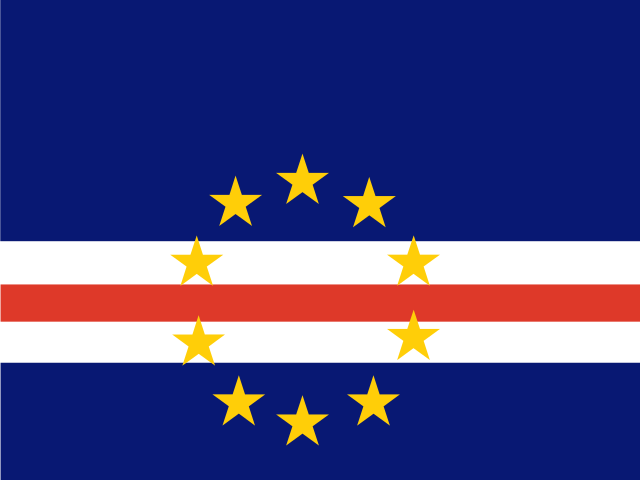
A blue field crossed by a band of white, red and white below centre, with a ring of ten yellow five-pointed stars. The stars stand for the archipelago's ten islands, set in a circle as a sign of union; blue is the sky and sea, white is peace, and red the people's effort.
Cape Verde FACTS ◢
| Capital | Praia |
|---|---|
| Continent | Africa |
| Population | 527,326 (2025) |
| Area | 4,033 km² |
| Population density | 131/km² |
| Currency | Cape Verdean escudo (CVE) |
| Official language | Portuguese |
| Calling code | +238 |
| Internet TLD | .cv |
| Time zone | UTC-01:00 |
| Drives on the | Right |
| ISO codes | CV / CPV |
DID YOU KNOW? ◢
- It's an archipelago of ten islands, only nine of which are inhabited.
- It gave the world morna, the soulful music made famous by 'barefoot diva' Cesária Évora.
- Its island of Fogo is home to an active volcano that last erupted in 2014.
- The islands were uninhabited when Portuguese sailors arrived in the 15th century.
Cape Verde QUICK ANSWERS ◢
What is the capital of Cape Verde?
The capital of Cape Verde is Praia.
What is the population of Cape Verde?
Cape Verde had a population of 527,326 in 2025.
What currency does Cape Verde use?
Cape Verde uses the Cape Verdean escudo (CVE).
What languages are spoken in Cape Verde?
The official language of Cape Verde is Portuguese.
Think you know your flags? Play Flag Daily → · Browse all countries →
MORE ON THE FLAG ◢
Ask why Cape Verde changed its flag and the Government of Cabo Verde, as the country styles itself in Portuguese, answers on its own website in two sentences.
The page it publishes under Símbolos opens with them: "A revisão constitucional de 1992 definiu uma nova bandeira para Cabo Verde. Até então, o país dividia as mesmas cores da bandeira da Guiné-Bissau." The constitutional revision of 1992 defined a new flag; until then, the country shared the same colours as the flag of Guinea-Bissau.
What replaced those colours is a flag in five horizontal parts, blue above and below with white, red and white between them, and a ring of ten yellow stars low on the hoist side. The constitutional article describing it works in fractions, medians and degrees. It never says what any of it means.
Key Takeaways
- The current flag arrived with the Constitution of 1992, carried by Lei Constitucional 1/IV/92 of 25 September 1992.
- Article 8 of that Constitution describes the flag purely as geometry, assigning no meaning to the blue, the white, the red or the stars.
- Every meaning in circulation comes from the Government's symbols page instead: blue for the sky and sea, white for the peace the people want, red for the people's effort.
- The flag it replaced was built on the flag of the PAIGC, the party that carried both Cape Verde and Guinea-Bissau to independence.
- Guinea-Bissau's own Constitution still prescribes that older design, black star and all.
| The claim | Date | Where it comes from | What it establishes |
|---|---|---|---|
| Independence, under a flag adapted from the PAIGC's | 5 July 1975 | Érico Veríssimo's account, in Expresso das Ilhas | that the first flag was the party's design, extended |
| Relations with Guinea-Bissau severed after the coup in Bissau | 14 November 1980 | Expresso das Ilhas | that the political tie broke twelve years before the flag did |
| The present flag defined | 25 September 1992 | Tribunal Constitucional, Leis Constitucionais | which instrument carries it: Lei Constitucional 1/IV/92 |
Why did Cape Verde change its flag?
Because the government changed, and the new one treated the symbols as inherited property rather than settled fact.
Cape Verde's Constitution sets out the sequence in its own preamble. Political opening was announced in 1990. A constitutional law followed, "revogando o artigo 4º da Constituição e institucionalizando o princípio do pluralismo", repealing Article 4 and institutionalising the principle of pluralism. Then came the first competitive legislative elections, in January 1991, with presidential elections in February.
The Movimento para a Democracia took office with what Expresso das Ilhas describes as a qualified majority in Parliament, and opened a competition for a new flag and anthem. The architect Pedro Gregório won it, and told Expresso das Ilhas why he entered: a flag "não pode, no meu entender, ser confundido com outro povo ou outra nação" - cannot, in his view, be confusable with another people or another nation.
That decision was contested at the time and has been since. It returned to Parliament in 2015, in a complaint that the national symbols had been affronted "como já fora feito quando trocaram a bandeira e o hino nacional" - as had already been done when they swapped the flag and the anthem.
What was on Cape Verde's flag before 1992?
A red vertical band at the hoist with yellow above green beside it, carrying a black star ringed by an emblem. It is the arrangement Guinea-Bissau still flies.
Érico Veríssimo, who designed the 1975 flag, describes the commission in his book on the run-up to independence, quoted by Expresso das Ilhas. He was approached days before independence to design the country's arms, which would then be set into the PAIGC's own flag. His list of elements carries their meanings with it: "a concha que significava a vocação marítima de homem cabo-verdiano... as espigas de milho - a base alimentar de Cabo Verde; a estrela negra - a África; a roda dentada e o livro, que simbolizavam a ideia do desenvolvimento e estudo." A shell for the Cape Verdean's maritime vocation, ears of maize for the country's food staple, the black star for Africa, a cogwheel and a book for development and study. A pickaxe was in the first version and was removed.
The two flags were close enough that Expresso das Ilhas describes them as one flag with differences. Cape Verde's had the maize around the star; Guinea-Bissau's carried the five-pointed star alone, which the paper records as the PAIGC's symbol since 1956.
More than the flag was shared. Quoting Humberto Cardoso's history of the single-party period, the same report notes that the anthem was identical in both countries. Even the mottoes were near-twins: Unidade-Luta-Progresso for Guinea, Unidade-Trabalho-Progresso for Cape Verde.
What do the ten stars on the Cape Verde flag mean?
The ten islands, and the fact that they are arranged in a ring rather than a row.
The Government's symbols page is what is usually being quoted, named or not: "As dez ilhas do arquipélago estão representadas por estrelas, dispostas em círculo, sinal de união." The archipelago's ten islands are represented by stars, arranged in a circle, a sign of union. The circle is doing work in that sentence, and it is the half most often dropped.
Ten is exact rather than loose. Article 6 of the Constitution defines the territory as "as ilhas de Santo Antão, São Vicente, Santa Luzia, São Nicolau, Sal, Boa Vista, Maio, Santiago, Fogo e Brava", then adds "os ilhéus e ilhotas", the islets and smaller islets, as a separate category. So the ten counts islands, and no islet is competing for a star.
Nor is it a count of populations. Cape Verde's embassy in Brazil describes Santa Luzia as "a única ilha desabitada de Cabo Verde", the country's only uninhabited island, its settlement defeated across centuries by the lack of water. It has the same star as Santiago.
Gregório's account of the ring appears on no official page. He describes a country of emigration, open to the world and so open to receiving people from anywhere: "nenhum ponto é mais importante do que outro" - no point is more important than another.
What Cape Verde's Constitution says the colours mean: nothing
Worth knowing before repeating anyone's reading of this flag.
Article 8 is headed Símbolos nacionais, and opens by naming the flag, the anthem and the arms as "símbolos da República de Cabo Verde e da soberania nacional". Its second paragraph then begins: "A Bandeira Nacional é constituída por cinco rectângulos dispostos no sentido do comprimento e sobrepostos." Five rectangles laid lengthwise and stacked. In the constitutional text the three stripes are rectangles too, which is why the flag is described as five parts rather than as a field with stripes on it.
From there the description never leaves the drawing office. Clause (c) reads: "As faixas adjacentes aos rectângulos azuis são de cor branca e a que fica entre estas é de cor vermelha." The bands adjacent to the blue rectangles are white and the one between them is red. That is the entire treatment of the red stripe. No blood, no effort, no struggle.
Clause (d) treats the stars the same way. Ten yellow five-pointed stars "com o vértice superior na posição dos noventa graus" define a circle placed by intersecting two medians. Islands are not mentioned.
So a colour meaning quoted for Cape Verde comes from the executive rather than the constitutional text. The Government's symbols page supplies all three: "O azul predominante da bandeira simboliza o céu e o mar", the predominant blue symbolises the sky and the sea, and the stripes "referem-se à construção do país, sendo o branco a paz que o povo quer e o vermelho o esforço do povo" - they refer to the building of the country, white being the peace the people want and red the people's effort.
Guinea-Bissau's Constitution behaves identically. Its Article 22 prescribes three rectangular bands "marcada com uma estrela negra de cinco pontas" and explains none of it, while the arms in the next paragraph still carry a yellow shell and the motto «UNIDADE LUTA PROGRESSO».
Is the circle of stars copied from the European flag?
Both designs put a ring of yellow stars on blue, so the comparison is easy to make. No Cape Verdean state source makes it, and one Cape Verdean source records where the claim came from.
Expresso das Ilhas, reporting the resistance to the 1992 change, lists it among the criticisms of the time: there were comments that the flag "denotava um certo anti-africanismo, por retirar o protagonismo das cores típicas das bandeiras africanas, amarelo, vermelho e verde, e assumir um visual semelhante à bandeira da União Europeia". It denoted a certain anti-Africanism, in stripping the prominence from the colours typical of African flags and taking on a look similar to the European Union's.
That is a charge levelled by opponents, not a design note, and the two are worth keeping apart. Neither Article 8, nor the Government's symbols page, nor the State Reform unit's page on the national symbols mentions Europe at all.
Gregório's answer on the colours is climate rather than continent: "apesar do nome, Cabo Verde, de verde temos pouco" - despite the name, Cabo Verde, we have little green. What is constant, he says, is the blue of sea and sky, the white of the waves, and the red of iron. He explains that last one through the tempering of a hoe before the rains come.
Where the ring of stars actually sits
Not in the middle, which is the first thing to get wrong when drawing it from memory.
Article 8 divides the flag by area rather than by stripe width. The upper blue rectangle takes half the flag, the lower blue rectangle a quarter, and each of the three stripes between them exactly a twelfth. Add those five figures and they come to precisely one, which is the tell that the text is a specification rather than a description. It is enough to redraw the flag from, which is a harder standard than the daily flag round sets: there you get the flag in front of you and three guesses at the country.
Two medians place the ring. One is the median of the second vertical quarter counting from the left, the other the median of the second horizontal quarter counting from the lower edge. A second quarter runs from one quarter to one half, so its midline sits at three eighths. That puts the centre three eighths of the way in from the hoist and three eighths of the way up.
Nothing states the radius. It is fixed anyway by the clause's last sentence, which requires the lowest star to sit on the midline of the lower blue rectangle. That rectangle occupies the bottom quarter of the height, so its midline is an eighth of the way up. Take one from the other and the radius has to be a quarter of the flag's height. What Article 8 never fixes at all is the flag's proportions.
Harder still is three clues and no flag at all, where the geometry cannot help you.
Frequently asked questions
Why did Cape Verde replace its 1975 flag?
The Government of Cabo Verde's own account is that the 1992 constitutional revision defined a new flag because until then the country shared the same colours as Guinea-Bissau's. The change followed the end of single-party rule, and the replacement came from a public competition won by the architect Pedro Gregório.
What do the ten stars on the Cape Verde flag stand for?
The ten islands of the archipelago, set in a circle the Government describes as a sign of union. The Constitution names those ten islands in its territorial article and lists the archipelago's islets separately, so the number counts islands only. Santa Luzia, which has no inhabitants, still gets a star.
Does Cape Verde's Constitution say what the flag's colours mean?
No. Article 8 specifies the five rectangles the flag is made of, their fractions of its area and the placement of the ten stars, then stops. Every colour meaning in circulation comes from the Government's symbols page rather than from the constitutional text, including blue for the sky and sea and red for the people's effort, both of which that page states in as many words.
What did the flag of Cape Verde look like before 1992?
It used the three-band layout Guinea-Bissau still has, a red vertical band with yellow and green horizontal ones, and carried a black star ringed by an emblem. Its designer, Érico Veríssimo, lists those elements as a shell for maritime vocation, maize for the food staple, the black star for Africa, and a cogwheel and book for development and study.
Who designed the current flag of Cape Verde?
The architect Pedro Gregório, who won the competition the incoming government opened after the 1991 elections. His stated reason for entering was that a people's flag should not be confusable with another nation's, and he explains the blue as the two constants of Cape Verdean life, sea and sky.
Sources
- Governo de Cabo Verde, Constituição da República, Articles 6 and 8 - retrieved 12 August 2026.
- Governo de Cabo Verde, Símbolos: Bandeira - retrieved 12 August 2026.
- Tribunal Constitucional de Cabo Verde, Leis Constitucionais - retrieved 12 August 2026.
- Expresso das Ilhas, "Afrontamento" de bandeira, 12 July 2015 - retrieved 12 August 2026.
- Assembleia Nacional Popular da Guiné-Bissau, Constituição da República da Guiné-Bissau, 1996, Article 22 (PDF hosted by FEC) - retrieved 12 August 2026.
- Unidade de Coordenação da Reforma do Estado, Governo de Cabo Verde, Símbolos da Nação - retrieved 12 August 2026.
- Embaixada da República de Cabo Verde no Brasil, Santa Luzia - retrieved 12 August 2026.
PLAY ANOTHER →
A short message, hidden in a different cipher every day.
ONE CIPHER A DAYDAILYDaily TriviaFive questions a day. Everyone gets the same five.
FIVE QUESTIONSDAILYGuess the CountryThree clues, three guesses. Work out where in the world it is.
THREE CLUESDAILYDaily CryptogramOne quote, one scrambled alphabet. Crack it before tomorrow.
CRACK THE QUOTE