
Guinea-Bissau
A small West African nation where the mainland dissolves into the Bijagos, a scatter of more than 80 islands and islets that shelter saltwater hippos, sea turtles and mangrove channels reachable only by boat.
WHAT THE FLAG MEANS ◢
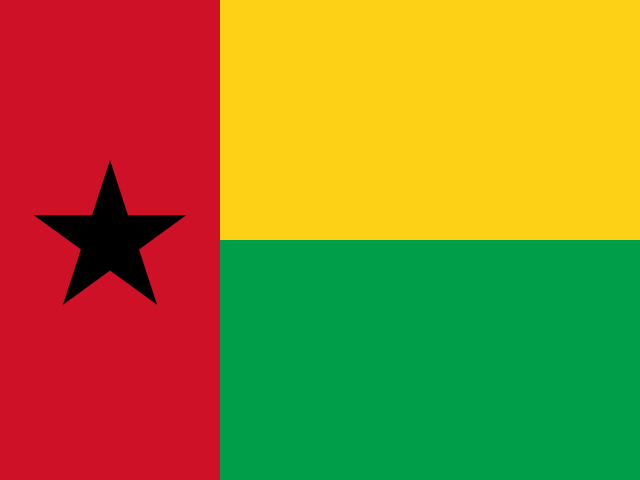
A red vertical band at the hoist bearing a black five-pointed star, beside horizontal bands of yellow over green. The constitution gives the three bands, their colours and their positions, and assigns none of it a meaning. The colours are conventionally read as red for the blood of the independence struggle, yellow for the sun and green for the land, with the black star for African unity, the same Black Star that Ghana put on its flag and that is usually traced to the movement that won independence.
Guinea-Bissau FACTS ◢
| Capital | Bissau |
|---|---|
| Continent | Africa |
| Population | 2,249,515 (2025) |
| Area | 36,125 km² |
| Population density | 62/km² |
| Currency | West African CFA franc (XOF) |
| Official language | Portuguese |
| Calling code | +245 |
| Internet TLD | .gw |
| Time zone | UTC±00:00 |
| Drives on the | Right |
| ISO codes | GW / GNB |
DID YOU KNOW? ◢
- Its Bijagos Archipelago is a UNESCO biosphere reserve made up of more than 80 islands and islets.
- The islands are home to rare saltwater-tolerant hippos that swim between the mangroves.
- The Bijagos beaches are a major nesting site for endangered sea turtles.
- Cashew nuts are the country's biggest export crop.
Guinea-Bissau QUICK ANSWERS ◢
What is the capital of Guinea-Bissau?
The capital of Guinea-Bissau is Bissau.
What is the population of Guinea-Bissau?
Guinea-Bissau had a population of 2,249,515 in 2025.
What currency does Guinea-Bissau use?
Guinea-Bissau uses the West African CFA franc (XOF).
What languages are spoken in Guinea-Bissau?
The official language of Guinea-Bissau is Portuguese.
Think you know your flags? Play Flag Daily → · Browse all countries →
MORE ON THE FLAG ◢
Guinea-Bissau's constitution describes its flag in one paragraph, in the flat register of a specification. Three rectangular bands. Red vertical, yellow and green horizontal, upper and lower right. A black five-pointed star on the red.
The paragraph immediately after it describes the arms, and does something the flag paragraph does not: it puts words on them. Two palms in a circle, a yellow shell at the base, and a ribbon carrying a motto in capitals.
Then, a hundred articles later, the constitution comes back to the flag and does something stranger. It makes it unamendable.
Key Takeaways
- Article 22 of the constitution describes the flag in the flat register of a specification and assigns it no meaning.
- The arms carry a motto in the constitutional text itself, three words in capitals. The flag carries no words at all.
- Article 130 lists ten things no revision may affect, and the national symbols, the flag and the anthem are the fourth item on that list.
- The same black five-pointed star appears twice in Article 22, once on the flag and once on the arms, and is explained in neither place.
- The constitution's preamble names the PAIGC and Amilcar Cabral, so the party the star is usually traced to is named in the document. The constitution never connects them.
Article 22 describes the flag and reads nothing into it
The Constitution of the Republic of Guinea-Bissau, in the Assembleia Nacional Popular edition published on the Presidency's site, is dated December 1996, and its preamble adopts it to take effect from 16 May 1984. Article 22 is the symbols article. Its first clause is a list:
"Os símbolos nacionais da República da Guiné-Bissau são a Bandeira, as Armas e o Hino."
The national symbols of the Republic of Guinea-Bissau are the Flag, the Arms and the Anthem. Then the flag:
"A Bandeira Nacional da República da Guiné-Bissau é formada por três faixas rectangulares, de cor vermelha, em posição vertical, e amarela e verde, em posição horizontal, respectivamente do lado superior e do lado inferior direitos. A faixa vermelha é marcada com uma estrela negra de cinco pontas."
The National Flag is formed of three rectangular bands, red in vertical position, and yellow and green in horizontal position, on the upper and lower right respectively. The red band is marked with a black five-pointed star.
That is the whole of it. Not a colour is given a referent. The star is given a colour, a point count and a position on the red band, and no referent either.
The arms get a motto and the flag gets only a description
Article 22's third clause is where the difference shows:
"As Armas da República da Guiné-Bissau consistem em duas palmas dispostas em círculo, unidas pela base, onde assenta uma concha amarela, e ligadas por uma fita em que se inscreve o lema «UNIDADE LUTA PROGRESSO». Na parte central superior insere-se uma estrela negra de cinco pontas."
Two palms arranged in a circle, joined at the base, where a yellow shell rests, linked by a ribbon on which is inscribed the motto UNITY STRUGGLE PROGRESS. In the upper central part is a black five-pointed star.
Three things follow from reading those two clauses side by side.
First, the constitution is perfectly willing to put a statement of national purpose into a symbol. It writes UNIDADE LUTA PROGRESSO into the constitutional text in capitals, inside the guillemets, as part of the blazon. That is a meaning, fixed by the highest law in the country.
Second, it gives that treatment to the arms and withholds it from the flag, in adjacent clauses of one article, written at the same time by the same hand.
Third, the same charge appears in both clauses. A black five-pointed star sits on the red band of the flag, and a black five-pointed star sits in the upper central part of the arms. The constitution describes it identically both times, and explains it neither time.
Article 130 puts Guinea-Bissau's flag beyond amendment
Chapter II of Title IV covers constitutional revision. Article 127 allows the National People's Assembly to revise the constitution at any moment. Article 129 requires a two-thirds majority. Article 131 forbids any revision during a state of siege or emergency.
Article 130 is the limit:
"Nenhum projecto de revisão poderá afectar:"
No revision project may affect.
Ten items follow, lettered a) to j) in the instrument and numbered here for reference:
- The unitary structure and republican form of the state
- The secular status of the state
- The territorial integrity of the nation
- "Símbolos nacionais e Bandeira e Hino Nacionais", national symbols and the national Flag and Anthem
- Citizens' rights, liberties and guarantees
- Workers' fundamental rights
- Universal, direct, equal, secret and periodic suffrage in choosing the holders of elective office in the organs of sovereignty
- Political and expressive pluralism, political parties and the right of democratic opposition
- The separation and interdependence of the organs of sovereignty
- The independence of the courts
The flag sits in that company. It is entrenched on the same terms as the republic itself, and against the same standard as judicial independence.
There is a drafting oddity in the clause worth noting rather than resolving. Article 22(1) has already said the national symbols are the Flag, the Arms and the Anthem, so naming the symbols and then the flag and the anthem separately is a belt-and-braces list that mentions two of the three twice and the arms only by inclusion. The protection covers all three either way.
The vocabulary of the revision chapter looks like a second oddity and is not one. Article 130 binds a projecto de revisão, a revision project. Article 129 sets the two-thirds bar for propostas de revisão, revision proposals. Article 131, forbidding revision during a state of siege, names both. So Article 130 names only the first of the two words the chapter uses.
It does not need the other. Article 127(2) says the initiative for constitutional revision belongs to the deputies, and Article 128 calls what at least a third of them submit a projecto.
That the deputies are the whole of it is the drafters' own usage rather than a reading imposed on them. Article 91(1) uses the identical formula for ordinary legislation and names two holders: A iniciativa legislativa compete aos deputados e ao Governo, the legislative initiative belongs to the deputies and to the Government. Article 100(1)(e) is where the Government's propostas de lei come from, so in this constitution a proposta is the Government's instrument and a projecto the deputies'. Where the drafters mean to include the Government they say so, and in Article 127(2) they do not. And there is no second route. Article 85(a), listing what the Assembly can do, gives it the power to carry out constitutional revision nos termos dos artigos 127° e seguintes, under the terms of Articles 127 and following. There is one way in, and Article 130 is standing in it.
What none of it does is say what the protected thing means.
The preamble names the party the star is traced to
The star is not mysterious in the way the flag's silence makes it sound. It is generally identified as the Black Star, the Pan-Africanist emblem the Ghanaian flag also carries, reaching Guinea-Bissau through the movement that fought the war of independence. That identification is a reading rather than anything the constitution states.
The constitution knows exactly who that movement was, because its preamble is about them. It opens:
"O PAIGC, fundado em 19 de Setembro de 1956, cumpriu exemplarmente o seu Programa Mínimo, que consiste em libertar os povos da Guiné e Cabo Verde"
The PAIGC, founded on 19 September 1956, fulfilled its Minimum Programme in exemplary fashion, which was to liberate the peoples of Guinea and Cape Verde, winning the sovereignty of their respective states. The preamble goes on to credit the party with building the state apparatus after independence, to say that with the Readjustment Movement of 14 November the Party reoriented its action and corrected errors, and then to name the party by the man it belonged to:
"o partido de Amílcar Cabral"
The party of Amilcar Cabral. So the constitution records, in its own voice, that one movement liberated two countries, and the Cape Verdean flag is the other end of that sentence.
So the document contains the party, its founding date, Cabral's name and the two countries. It contains the black star, twice. It never joins them up.
That is a choice a drafter had to make. Everything needed for the sentence is already on the page.
African unity is in the constitution, four articles before the star
The reading usually given for the black star is African unity, or the African people. That phrase is in the constitution. It is simply nowhere near the flag.
Article 18 sets out the country's international posture, and its third clause reads:
"Sem prejuízo das conquistas alcançadas através da luta de libertação nacional, a República da Guiné-Bissau participa nos esforços que realizam os Estados africanos, na base regional continental, em ordem à concretização do princípio da unidade africana."
Without prejudice to the gains achieved through the national liberation struggle, the Republic of Guinea-Bissau takes part in the efforts made by African states, on a regional and continental basis, towards realising the principle of African unity.
The principle of African unity, named as such, as a constitutional commitment, in the same title of the same document. Four articles later a black five-pointed star goes onto the flag and onto the arms, and the two are never introduced to each other.
Between them sits Article 20, which describes the armed forces as the Revolutionary Armed Forces of the People, "instrumento de libertação nacional ao serviço do povo", an instrument of national liberation in the service of the people. The liberation vocabulary runs right through Title I. It stops at the edge of Article 22 and does not cross.
What Guinea-Bissau's colours are said to mean
The reading you will meet is that the red is for the blood shed in the independence struggle, the yellow for the sun, the green for the land and forests, and the black star for African unity or for the African people.
Nothing in Article 22 supports any of it, and nothing elsewhere in the constitution does either. The word for flag occurs three times in the whole document: twice in Article 22 and once in the entrenchment list of Article 130. There is no colour standard, no proportion, and no gloss.
No Guinea-Bissau statute on the flag could be opened for this article. The country's official gazette, its National People's Assembly and its government portal did not respond when this article was researched, and the constitutional text quoted here comes from the edition published on the Presidency's site. If a flag law exists that assigns the colours meanings, this piece has not read it.
What can be said is what the instrument does. It fixes the design, entrenches it against every future parliament, and leaves the reading to everybody else. If you would like to see how well the design works without the reading, Flag Daily shows you one a day and gives you three guesses at the country.
Frequently asked questions
What do the colours of the Guinea-Bissau flag mean?
Article 22 of the constitution does not say. It gives the flag as three rectangular bands, red vertical and yellow and green horizontal on the upper and lower right, with a black five-pointed star on the red, and assigns no meaning to any of them.
The readings in circulation, red for the blood of the independence struggle, yellow for the sun and green for the land, are conventional. No Guinea-Bissau instrument opened for this article states them.
What does the black star on the Guinea-Bissau flag mean?
The constitution does not say, in either of the two places it appears. Article 22 puts a black five-pointed star on the red band of the flag and another in the upper central part of the coat of arms, and explains neither.
It is generally identified as the Pan-Africanist Black Star, reaching Guinea-Bissau through the PAIGC. The constitution's preamble names the PAIGC and calls it the party of Amilcar Cabral, without ever connecting either to the star.
Can Guinea-Bissau change its flag?
Not by constitutional revision. Article 130 lists ten matters that no revision project may affect, and the fourth is the national symbols and the national Flag and Anthem.
That places the flag alongside the republican form of the state, territorial integrity, citizens' rights and the independence of the courts, all of which are outside the reach of the two-thirds majority that Article 129 otherwise requires.
Does anything in Guinea-Bissau's constitution carry a motto?
Yes, the coat of arms. Article 22 blazons it as two palms arranged in a circle, joined at the base where a yellow shell rests, linked by a ribbon inscribed with the motto UNIDADE LUTA PROGRESSO, unity, struggle, progress, with a black five-pointed star set in the upper central part.
That motto is written into the constitutional text itself. The flag, described in the paragraph immediately before, carries no words at all.
Is the Guinea-Bissau flag related to Cape Verde's?
Guinea-Bissau's constitution does not address the resemblance between the two flags, and does not mention where its own design came from at all. What its preamble does record is that one movement was behind both countries: the PAIGC's Minimum Programme, it says, was to liberate the peoples of Guinea and Cape Verde and win the sovereignty of their respective states.
Cape Verde is generally said to have flown a closely related design before adopting the one it uses now. That is a reading in circulation. Guinea-Bissau's constitution says nothing about it, and Cape Verde's was not opened for this article.
Sources
- Constituição da República da Guiné-Bissau, December 1996 edition, Preamble and Articles 18, 20, 22, 85, 91, 100 and 127 to 131 - Assembleia Nacional Popular, published by the Presidency of the Republic of Guinea-Bissau. The preamble adopts the constitution to take effect from 16 May 1984. Retrieved 30 August 2026.
- What could not be reached: any Guinea-Bissau statute or government description of the flag. The Boletim Oficial, the National People's Assembly and the government portal did not respond. The constitutional text quoted here is the Presidency's own published edition. Checked 30 August 2026.
PLAY ANOTHER →
One quote, one scrambled alphabet. Crack it before tomorrow.
CRACK THE QUOTEDAILYOn This DayOne thing that happened today in history. Every day, a new one.
TODAY IN HISTORYDAILYDaily CodeA short message, hidden in a different cipher every day.
ONE CIPHER A DAYDAILYDaily TriviaFive questions a day. Everyone gets the same five.
FIVE QUESTIONS