
People's Republic of China
China is one of the world's oldest continuous civilisations and its most populous nation for most of modern history, stretching from Himalayan peaks to Pacific coastlines across a landscape the size of a continent.
WHAT THE FLAG MEANS ◢
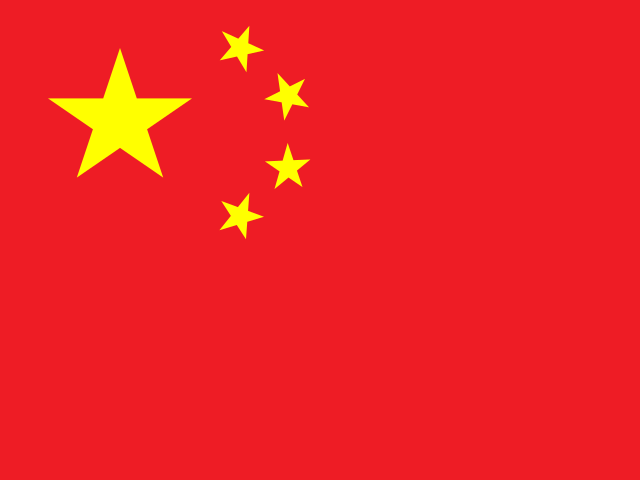
A red field with five yellow five-pointed stars in the upper hoist - one large, four smaller ones arching to its right, each turned so a point aims at its centre. Red stands for revolution, and the official 1949 explanation reads the five stars together, rather than one by one, as the unity of the revolutionary people under Communist Party leadership.
People's Republic of China FACTS ◢
| Capital | Beijing |
|---|---|
| Continent | Asia |
| Population | 1,406,585,000 (2025) |
| Area | 9,596,961 km² |
| Population density | 147/km² |
| Currency | Chinese yuan (renminbi) (CNY) |
| Official language | Standard Chinese |
| Calling code | +86 |
| Internet TLD | .cn |
| Time zones | UTC+06:00, UTC+08:00 |
| Drives on the | Right |
| ISO codes | CN / CHN |
DID YOU KNOW? ◢
- The Great Wall of China is the longest wall ever built, winding for thousands of kilometres.
- It gave the world paper, printing, gunpowder and the compass - often called its Four Great Inventions.
- Giant pandas live in the wild only in its mountainous bamboo forests.
- It spans a huge east-to-west distance but officially runs on a single time zone.
- The Terracotta Army, thousands of life-sized clay soldiers, was buried to guard China's first emperor over 2,000 years ago.
People's Republic of China QUICK ANSWERS ◢
What is the capital of the People's Republic of China?
The capital of the People's Republic of China is Beijing.
What is the population of the People's Republic of China?
The People's Republic of China had a population of 1,406,585,000 in 2025.
What currency does the People's Republic of China use?
The People's Republic of China uses the Chinese yuan (renminbi) (CNY).
What languages are spoken in the People's Republic of China?
The official language of the People's Republic of China is Standard Chinese.
Think you know your flags? Play Flag Daily → · Browse all countries →
MORE ON THE FLAG ◢
Ask what the five stars on China's flag mean and you will almost always get the same answer. The large star is the Communist Party. Four small ones are four social classes, gathered around it. That reading is real, it is old, and unusually for a flag, it has a traceable origin and a printed date.
What it does not have is a statute behind it.
China's flag is defined in law twice over. The Constitution disposes of it in one line: Article 141, as the text now stands, says "中华人民共和国国旗是五星红旗" - the national flag of the People's Republic of China is the five-star red flag - and stops there. It was Article 136 before the 2018 amendment renumbered the chapter, which is why older commentaries cite that number. The flag law then hands every question of appearance to a 1949 document, the 国旗制法说明 or Explanation of the Method of Making the National Flag, which fixes every star's size, centre and rotation. Neither says what a single star stands for.
That itemised meaning came from elsewhere, and the paper trail is unusually complete: a booklet printed for delegates, a draft resolution Mao Zedong edited by hand, and the shorter sentence the assembly actually passed.
Key Takeaways
- The resolution adopted on 27 September 1949 gives the flag one meaning and no more: it symbolises "the great unity of China's revolutionary people".
- Mao struck a longer description of the design off the draft. Delegates then cut the first half of his replacement clause as well.
- Zeng Liansong's winning entry had a hammer and sickle inside the large star, removed so the flag would not resemble the Soviet Union's.
- His original four small stars stood for a different four groups from the classes now quoted everywhere.
- The specification does require each small star to point at the large one. Its 1949 official reason is unity around a single centre, plus the fact that it looks tidier.
| The claim | Date | Where it comes from | What it actually establishes |
|---|---|---|---|
| Large star the Party, four small stars four classes | 22 September 1949 | Reference Materials on National Flag Designs, design no. 32 | A preparatory group's amendment of the designer's own note |
| Red for revolution, five yellow stars for unity | Distributed 27 September 1949 | The draft resolution, as edited by Mao | Wording that was proposed and then cut back |
| The flag symbolises the great unity of China's revolutionary people | 27 September 1949 | The adopted resolution | The only symbolism the assembly voted for |
| Every star's position and angle | 28 September 1949 | Explanation of the Method of Making the National Flag | The shape is prescribed; the meaning is not |
| Flag red and flag star yellow as measured colours | In force 1 December 1991; revised 1996 and 2004 | National standard GB 12982, now GB 12982-2004 | The colours became quantitative, and yellow is what it calls them |
What do the five stars on China's flag mean?
The four-classes reading has an address. It is in a booklet printed for delegates on 22 September 1949, five days before the vote.
The preparatory committee for the new Political Consultative Conference had called publicly for designs in mid-July 1949, through the People's Daily and other papers, with a deadline of 20 August. Its brief asked that the flag show the character of the new state: a people's democratic dictatorship led by the working class and based on the worker-peasant alliance. Commentary published on the National People's Congress site puts the response at 3,012 flag designs.
Thirty-eight of them were reprinted for delegates as Reference Materials on National Flag Designs, each numbered, by the committee's sixth group, the body charged with drafting the flag, emblem and anthem. Zeng Liansong's was no. 32. In that booklet the four small stars are explained as "工人阶级、农民阶级、小资产阶级、民族资产阶级等四大阶级" - the working class, the peasant class, the petty bourgeoisie and the national bourgeoisie, four great classes.
So the reading is authentic, and official in the weak sense that a committee printed it. It is not what anyone then voted on.
What the resolution that adopted China's flag actually says
One sentence, with the stars left uncounted and unassigned.
The manuscript of the draft resolution survives in the Central Archives, and a study by Zhang Shunyue of the Institute of Contemporary China Studies traces what became of it. Written in pencil, it read "国旗为红地五星旗", the national flag is the red flag with five stars; Mao struck that and rewrote it to name the state. After the clause came a long passage, crossed out in brush ink and now mostly illegible, which appears to have described the design. Mao replaced the whole of it with twenty-one characters: "红色象征革命,五颗黄星象征中国革命人民大团结" - red symbolises revolution, the five yellow stars symbolise the great unity of China's revolutionary people.
That is the version printed and handed to delegates on 27 September 1949. It is not the version they passed. The adopted text drops the words "红色象征革命,五颗黄星" and reads: "四、全体一致通过:中华人民共和国的国旗为红地五星旗,象征中国革命人民大团结。" Item four, passed unanimously: the flag is the red flag with five stars, symbolising the great unity of China's revolutionary people.
Two rounds of deletion, both moving the same way. Explanation was being taken away, not added.
Even the flag's name went with it. Its text says 红地五星旗, the red flag with five stars, and that is not what anyone calls it now. Zhou Enlai, chairing, read the result out as 五星红旗, the five-star red flag, and it was his wording that reached the newspapers the next morning.
Nor was the design settled by then. Zhang's study lists what delegates said that morning: Li Zhuchen proposed dropping the small stars altogether and flying a single large one, and Zhang Yuanshan won unanimous applause for a narrower point, changing every "小星" in the making instructions to "小五角星", small five-pointed star.
Zeng Liansong's design had a hammer and sickle on it
It also had four small stars standing for a different four groups.
Zeng was a former party member, out of contact with the organisation since 1941, working in Shanghai as a researcher. He set out his starting point later: "我首先着眼于政权特征", he looked first at the character of the state power. "为此,我设计以红色象征革命,以一颗内含镰刀斧头的大五角星象征共产党、象征人民军队": so red stood for revolution, and a large five-pointed star containing a 镰刀斧头, literally a sickle and axe and conventionally rendered in English as a hammer and sickle, stood for the Communist Party and for the people's army.
His accompanying note describes the flag as a red ground bearing "带有斧头镰刀的、光明的巨型五角星一颗", one bright giant five-pointed star carrying that emblem, with four golden medium stars beside it. His envelope arrived on 11 August, nine days before the deadline, was logged as document no. 1232, re-registered three days later as no. 1305, and filed by mistake among the national anthem entries.
His four small stars were not the four classes either. Wu Haiyong, a party-history researcher writing in the Guangming Daily, sets the original wording beside the change: "四颗小五角星原解释为对应“小资产阶级、中等资产阶级、知识分子、其他民主人士等四大阶级与集团”,已调整为:“工人阶级、农民阶级、小资产阶级、民族资产阶级等四大阶级。”" Zeng's four were the petty bourgeoisie, the middle bourgeoisie, the intelligentsia and other democratic figures, "four great classes and groups". Those were adjusted to the four classes quoted above, which Wu attributes to keeping the note consistent with Mao's essay On the People's Democratic Dictatorship.
The emblem went in the same pass. The preparatory committee's sixth group met on 24 August 1949 and resolved, in Wu's account, "为避免与苏联国旗雷同,拟不采取斧头镰刀形式" - to avoid duplicating the Soviet flag, it proposes not to adopt the sickle-and-axe form. So design no. 32 reached delegates with a plain large star and a rewritten note. Peng Guanghan, the group's secretary, said later that the changes were settled in discussion and made by him.
Why does each small star on China's flag look tilted?
Because the specification requires it, and this is the one piece of symbolism the state did explain.
That specification is reproduced as an appendix to the flag law, so it is still operative text. Divide the flag into four equal rectangles, take the upper left one, split it ten parts down and fifteen across, and every star has a fixed centre. A circumscribed circle three tenths of the flag's height carries the large star, with a point straight up; the four small circles are one tenth. Then: "此四颗小五角星均各有一个角尖正对大五角星的中心点", each of the four small stars has one point aimed directly at the centre of the large star.
That is why the small stars sit at four different angles rather than upright, and it is checkable on any flag you can see clearly. A Xinhua answer to readers' questions, carried by the People's Daily on 15 November 1949 and quoted at length in the National People's Congress commentary on the Constitution, gives two reasons: "这是表示围绕着一个中心而团结,在形式上也显得紧凑美观" - it expresses unity around a single centre, and in form it also looks compact and attractive.
That same answer, as the commentary reproduces it, is the closest thing to an official reading of the stars, and it declines to separate them: "旗上的五颗五角星及其相互关系象征共产党领导下的革命人民大团结" - the five stars on the flag, and their relationship to one another, symbolise the great unity of the revolutionary people under the leadership of the Communist Party.
Are the stars gold or yellow?
Yellow, and for a reason the record states rather than leaves to guesswork.
Zeng's own note called them 黄金色, golden. The making specification does not: its description of the field reads "旗面左上方缀黄色五角星五颗", five yellow five-pointed stars set in the upper left, and yellow is the only colour word it gives them. Xinhua's 1949 answer, as the same commentary reproduces it, explains why: "星用黄色是为着在红地上显出光明,黄色较白色明亮美丽", yellow is used so the stars show bright against the red ground, being brighter and more attractive than white. Vietnam uses the same pairing for a single star with nothing beside it, which is why the two get mixed up.
Words were not enough, though, and the standards body says so plainly. China's National Institute of Standardization calls the 1949 wording "定性而非定量", qualitative rather than quantitative, and records what followed: flags flown at important sites and sold in shops varied in colour, size and specification. A working group spent nearly a year on the colours, making flags in more than thirty reds and sending them to over 2,000 people for comment, which settled the values now named 国旗红, flag red, and 国旗五星黄, flag star yellow. They took effect as GB 12982-1991 on 1 December 1991, were revised in 1996, and were revised again as the current GB 12982-2004.
If you want to find out whether you can actually tell one red-and-yellow star flag from another, a daily flag round settles it in three guesses, and naming a country from three written clues is the version with no flag to look at.
Frequently asked questions
What do the four small stars on China's flag represent?
In the booklet printed for delegates on 22 September 1949 they stand for four classes: workers, peasants, the petty bourgeoisie and the national bourgeoisie. That is a committee's note on a submitted design, not law. The resolution adopted five days later assigns no meaning to any individual star, and neither the Constitution nor the flag law does either.
Did China's flag ever have a hammer and sickle on it?
It did, before adoption. Zeng Liansong put one inside the large star to stand for the Communist Party and the people's army. The preparatory committee's sixth group resolved on 24 August 1949 against that form, so as not to duplicate the Soviet flag, and the version reprinted for delegates has a plain star.
Who designed the Chinese flag?
Zeng Liansong, an economic researcher in Shanghai, whose entry arrived nine days before the competition closed in August 1949. It was logged twice, as document no. 1232 and then as no. 1305, and misfiled at first among the national anthem submissions. Delegates saw it as design no. 32 in a booklet that numbered all thirty-eight shortlisted designs and listed their designers.
Why are the small stars on the Chinese flag rotated at different angles?
The making specification requires each to turn one point towards the centre of the large star, which puts each at its own angle. Xinhua's 1949 explanation gives the reason as unity around a single centre, and adds that the arrangement looks compact. That document also fixes each small star's centre by coordinates and its circumscribed circle at a tenth of the flag's height.
Is 五星红旗 the flag's legal name?
Yes, and it has been since 1954, though it is not the name the founding resolution used. Article 104 of the 1954 Constitution wrote 五星红旗 in, every constitution since has repeated it, and the flag law says the same in its own second article. Zhang Shunyue's study traces how that spoken form displaced the 红地五星旗 of the resolution text within a day.
Sources
- Ministry of Foreign Affairs of the People's Republic of China, Constitution of the People's Republic of China, Chapter 4, Article 141 - retrieved 12 August 2026.
- National People's Congress of China, Chapter 4: National Flag, National Emblem, Capital, in A General Interpretation of the Constitution of the PRC by Xu Anbiao and Liu Songshan - retrieved 12 August 2026.
- Communist Party Members Network, publishing the National People's Congress text of the Law of the People's Republic of China on the National Flag, with the Explanation of the Method of Making the National Flag appended - retrieved 12 August 2026.
- Zhang Shunyue, Institute of Contemporary China Studies, "From 红地五星旗 to 五星红旗: an examination of the name of the new China's national flag", Contemporary China History Studies 2025 no. 2 - retrieved 12 August 2026.
- Wu Haiyong, Guangming Daily, "This is how the five-star red flag rose", 16 September 2022 - retrieved 12 August 2026.
- China National Institute of Standardization, The evolution of the National Flag standard, 12 October 2024 - retrieved 12 August 2026.
PLAY ANOTHER →
Three clues, three guesses. Work out where in the world it is.
THREE CLUESDAILYDaily CodeA short message, hidden in a different cipher every day.
ONE CIPHER A DAYDAILYDaily TriviaFive questions a day. Everyone gets the same five.
FIVE QUESTIONSDAILYOn This DayOne thing that happened today in history. Every day, a new one.
TODAY IN HISTORY