
Vietnam
An S-shaped stretch of Southeast Asia running from misty northern highlands to the Mekong Delta, Vietnam grows enough coffee to rank among the world's biggest exporters.
WHAT THE FLAG MEANS ◢
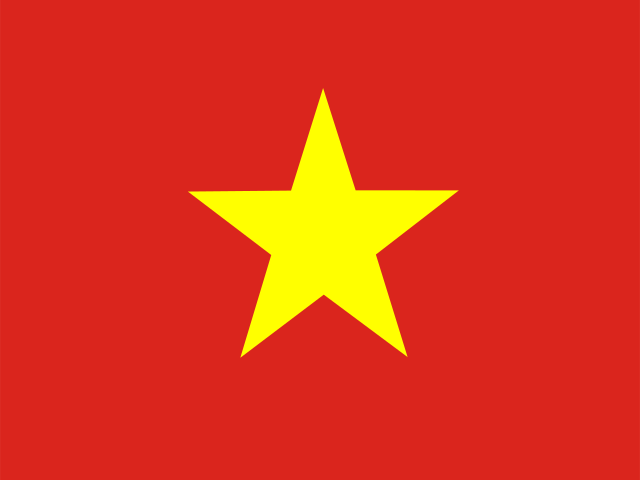
A red field with a single large five-pointed gold star at the centre, the flag two thirds as wide as it is long. Article 13 of the constitution fixes those proportions and that design and assigns them no meaning. The red is conventionally read for revolution and the blood of struggle, and the star's five points for the scholar, the farmer, the worker, the merchant and the soldier.
Vietnam FACTS ◢
| Capital | Hanoi |
|---|---|
| Continent | Asia |
| Population | 101,598,527 (2025) |
| Area | 331,690 km² |
| Population density | 306/km² |
| Currency | Vietnamese đồng (VND) |
| Official language | Vietnamese |
| Calling code | +84 |
| Internet TLD | .vn |
| Time zone | UTC+07:00 |
| Drives on the | Right |
| ISO codes | VN / VNM |
DID YOU KNOW? ◢
- It's one of the world's largest exporters of coffee, especially robusta beans.
- Ha Long Bay's thousands of limestone karst islands rising from the sea are a natural wonder.
- Its long, narrow shape gives it a coastline stretching over 3,000 kilometres.
- The Mekong Delta is so fertile it's often called the country's rice bowl.
Vietnam QUICK ANSWERS ◢
What is the capital of Vietnam?
The capital of Vietnam is Hanoi.
What is the population of Vietnam?
Vietnam had a population of 101,598,527 in 2025.
What currency does Vietnam use?
Vietnam uses the Vietnamese đồng (VND).
What languages are spoken in Vietnam?
The official language of Vietnam is Vietnamese.
Think you know your flags? Play Flag Daily → · Browse all countries →
MORE ON THE FLAG ◢
The meaning of Vietnam's flag was settled in July 1940 by a regional committee of a party that did not yet govern anything, and none of the four state instruments read for this article has repeated it since.
Four state instruments describe this flag. The decree that created it in 1945, the constitution of 1946, the National Assembly's reunification resolution of 1976 and article 13 of the constitution in force today all give the design and stop. None of them says what the red is, or the gold, or the five points.
So the reading you have met is older than the state that flies the flag, and it has never been written into the state's own law.
The harder question is who drew it. Two names are in the record, the ministry asked to certify the better-known one reported that it could find no document proving it, and neither is settled.
Key Takeaways
- The Southern Region Party Committee, meeting at Tân Hương in July 1940, adopted the flag and assigned the meanings: red for revolution, gold for the colour of the nation, and the five points for sĩ, nông, công, thương, binh.
- It deliberately left the shape of the star's points open: "hình bầu hay nhọn đều được", rounded or pointed, either will do. Sắc lệnh 249-SL of 30 November 1955 closed that off and made them straight.
- Sắc lệnh 05-SL of 5 September 1945 fixed the flag in two lines and assigned it nothing. The 1946 constitution, the 1976 resolution and article 13 of the 2013 constitution do the same.
- Vietnam's State Records and Archives Department footnotes the colour meanings to a file in National Archives Centre III, sheet 62. That is a government record, not a law.
- Asked in 2001 to recognise Nguyễn Hữu Tiến as the designer, the Ministry of Culture and Information replied that four national archives held no document proving it.
Who drew Vietnam's flag, and why the state would not certify him
The name on the plaques is Nguyễn Hữu Tiến, a schoolteacher from Hà Nam province who joined the underground movement in 1927, escaped from Côn Đảo prison in 1935, and was executed by the French at Hóc Môn on 28 August 1941.
The Party's own publishing house, Nhà xuất bản Chính trị quốc gia Sự thật, tells the story in detail. Working on propaganda for the Southern Region Party Committee in the winter of 1939, it says, he bent over a printing stone at night and the image of the flag appeared gradually, in its words, "theo bàn tay đưa lượn thận trọng, lẹ làng", following a hand moving carefully and lightly. It reports that the design was discussed and agreed with the general secretary of the Party, Nguyễn Văn Cừ, and the Southern Region secretary, Võ Văn Tần.
That account is the one in the school books and on dozens of provincial government pages. It is also the account the central government declined to endorse when it was asked to.
The 2001 letter, and what it actually says
In 2001 the People's Committee of Hà Nam province, his birthplace, submitted a proposal asking for Nguyễn Hữu Tiến to be recognised as the man who drew the national flag.
The reply is official document 1393/VHTT-BTCM, signed by Lưu Trần Tiêu, Deputy Minister of Culture and Information, on 18 April 2001, and Tuổi Trẻ quotes its finding in full. Its finding is a list of places that were searched and came back empty: "Tất cả các nguồn tài liệu hiện có tại Cục Lưu trữ Trung ương Đảng, tại Viện Lịch sử Đảng trực thuộc Học viện Chính trị quốc gia Hồ Chí Minh, tại Bảo tàng Cách mạng Việt Nam, Bảo tàng Hồ Chí Minh đều không có tài liệu nào chứng minh đồng chí Nguyễn Hữu Tiến là người vẽ lá cờ Tổ quốc".
All existing sources of material at the Party Central Archives Department, at the Institute of Party History under the Hồ Chí Minh National Academy of Politics, at the Museum of the Vietnamese Revolution and at the Hồ Chí Minh Museum contain no document proving that comrade Nguyễn Hữu Tiến was the person who drew the flag of the Fatherland.
Having no basis to prove it, the ministry said in the same letter that it could not put the recommendation to the Prime Minister.
That is a stronger statement than "we are not sure".
The evidence that is missing, item by item
The state-level research project on the Nam Kỳ uprising went further. Its head, Trần Giang, said the editorial board discussed the attribution and concluded there was no adequate scientific basis for it, so it was left out of the work.
The gaps behind that conclusion are specific.
He was not in the room. The Tân Hương conference of July 1940 is where the uprising was decided, and where the flag was adopted. Nguyễn Hữu Tiến was not present.
Nothing was found with him. Three days after that conference, on 30 July 1940, he was arrested in Sài Gòn - Chợ Lớn along with Nguyễn Thị Minh Khai. French Sûreté records list 74 items and materials seized in that arrest, and none is a flag or a material or tool connected with drawing or printing one. That figure reaches us through Tuổi Trẻ's reading of the Sûreté file rather than from the file itself.
He never said so himself. He was held for months in the same cell as another communist, Nguyễn Văn Cung, and told him a great deal. He never told him he had drawn the flag. Even when Cung said he had seen the flag in the interrogation room at Bót Catinat, Nguyễn Hữu Tiến said nothing.
The popular account can be traced to one conversation. The writer Sơn Tùng, whose book carried the attribution to a wide readership, rested it on a talk in a forest hospital with a man called Năm Thái, whose real name, home province and unit Sơn Tùng did not know. Asked about the researchers who reject his account, he did not defend it as proven: "Tôi biết thế nào viết thế ấy. Tôi yêu con người này và viết về con người này. Còn sự thật lịch sử như thế nào, tôi nghĩ các nhà khoa học cứ tiếp tục làm rõ".
In translation: I wrote what I knew. I loved this man and I wrote about him. As for the historical truth, I think the scholars should keep on clarifying it.
The other name, and an April 1940 account of the drawing
The second name is Lê Quang Sô, born 1894 at Chợ Gạo in Mỹ Tho, a Confucian-educated intellectual who read French, had travelled to China in 1927, and had served time on Côn Đảo. The researcher Lê Minh Đức identifies him as the designer, working from the memoirs of people who were there.
What makes that account worth reading is that it describes a process rather than a moment of inspiration, and that the question was put by someone outside the party apparatus. Early in 1940 Phan Văn Khỏe, secretary of the Mỹ Tho provincial committee, raised with Sô the demand for a front flag broad enough to unite the social classes. Sô took the problem to a reform-minded Confucian scholar, Lê Kiến Đức, who had once sold land to help pay for the party committee's bookshop in Mỹ Tho. Lê Kiến Đức framed it this way:
"Mỗi nước đều có lá cờ của mình, trong đó chứa đựng ý nghĩa của nó như cờ Pháp, cờ Liên Xô, cờ Nhật… Còn mình lấy cái gì làm nội dung đây…"
In translation: every country has its own flag, and it contains its meaning, like the French flag, the Soviet flag, the Japanese flag. What are we going to take as our content?
Sô's answer was structural. The Party already had the red flag with hammer and sickle; the Front would add another red flag; the red field had to stay, and what went inside it had to be worked out. Sô then drew star after star, "vẽ đi vẽ lại nhiều lần", and settled on a five-pointed gold one "vì thấy đẹp", because they thought it looked good. They moved it around the field repeatedly before putting it in the centre. Phan Văn Khỏe agreed the sketch. This is placed at about April 1940.
Set the two evidentiary bases side by side and the difference is visible. The Nguyễn Hữu Tiến account rests on one conversation with a man whose real name, province and unit the writer did not know. The Lê Quang Sô account rests on memoirs written between 1960 and 1972 by cadres who had regrouped to the north, commissioned by the Central Party History Research Board, plus the testimony of surviving witnesses, presented by a named researcher and endorsed as a finding by the Tiền Giang provincial committee.
That makes it better evidenced. It does not make it proven, and memoirs recorded twenty years after the fact are exactly the material the ministry's letter says the archives do not corroborate. The Institute of Party History had still not ruled when this was reported. The honest position is that Vietnam's flag has no documented designer.
The meaning was fixed in July 1940, by a party committee
Three months after that drawing, the Southern Region Party Committee met at Tân Hương and decided the form of the future government, the slogans, the policies, and the flag.
The record of what it decided about the flag is the most complete statement of meaning anywhere in this story: "Quốc kỳ là cờ đỏ sao vàng năm cánh, nền đỏ tượng trưng cho cách mạng, năm cánh sao tượng trưng cho tầng lớp sĩ, nông, công, thương, binh đoàn kết, màu vàng có ý nghĩa là màu dân tộc."
The national flag is the red flag with the five-pointed gold star; the red field symbolises the revolution, the five points of the star symbolise the classes sĩ, nông, công, thương, binh in unity, and the yellow means the colour of the nation.
It fixed proportions too, provisionally: rectangular with the length one and a half times the breadth, which is the two-thirds ratio still in force, and the star one third of the flag's length, placed at the centre.
And it left one thing open on purpose. "Riêng cánh sao không qui định cụ thể, hình bầu hay nhọn đều được." As for the points of the star, nothing specific is laid down; rounded or pointed, either will do.
So the meanings do have an origin, and it is a documented one. What they do not have is any subsequent instrument. The body that assigned them was a regional committee of a party that would not hold power for another five years, and when that party did take power it wrote the flag into law four times without once repeating what it had said at Tân Hương.
Vietnam's 1945 decree describes the flag and assigns it nothing
The flag became the state's on 5 September 1945, three days after the declaration of independence, by Sắc lệnh số 05-SL. Võ Nguyên Giáp, then Minister of the Interior, signed it on behalf of the chairman of the Provisional Government. The decree abolished the cờ quẻ ly, the flag of the short-lived government that preceded it, and fixed the new one.
The State Records and Archives Department reproduces it, and clause II is the whole description: "a) Hình chữ nhật, bề ngang hai phần ba bề dài; b) Nền màu đỏ tươi, ở giữa có sao năm cánh màu vàng tươi"
Rectangular, its breadth two thirds of its length; a bright red field, in the middle a five-pointed bright yellow star.
Notice the colour, and then notice what is absent. The 1945 decree is more particular about shade than anything since: it says đỏ tươi and vàng tươi, bright red and bright yellow, where the current constitution says only đỏ and vàng. And it says nothing at all about what any of it stands for.
What the 1946, 1976 and 2013 texts each left out
The National Assembly wrote the flag into the constitution adopted on 9 November 1946, and the sentence is shorter than the decree's: "Cờ của nước Việt Nam dân chủ cộng hòa nền đỏ, giữa có sao vàng năm cánh". The flag of the Democratic Republic of Vietnam is a red field, in the middle a five-pointed gold star.
The proportions are gone, and so is tươi.
After reunification, on 2 July 1976, the National Assembly of a unified Vietnam passed a resolution in the same register: "Quốc kỳ nước Cộng hoà xã hội chủ nghĩa Việt Nam nền đỏ, ở giữa có ngôi sao vàng năm cánh". A red field, in the middle a five-pointed gold star, and again no proportions and no meaning.
Article 13(1) of the constitution now in force, passed by the thirteenth National Assembly at its sixth session on 28 November 2013 and published as a scan by the government itself, restores the ratio: "Quốc kỳ nước Cộng hòa xã hội chủ nghĩa Việt Nam hình chữ nhật, chiều rộng bằng hai phần ba chiều dài, nền đỏ, ở giữa có ngôi sao vàng năm cánh."
The national flag of the Socialist Republic of Vietnam is rectangular in shape, its width equal to two thirds of its length, a red field, in the middle a five-pointed gold star.
That is the entire constitutional provision on the flag. The rest of article 13 moves on to the emblem, the anthem, the national day and the capital.
Set the four side by side and the pattern is easier to see than to describe.
| Instrument | Date | Ratio | Shade wording | Meaning assigned |
|---|---|---|---|---|
| Sắc lệnh 05-SL | 5 September 1945 | 2:3 | đỏ tươi, vàng tươi | none |
| Constitution | 9 November 1946 | not stated | đỏ, vàng | none |
| National Assembly resolution | 2 July 1976 | not stated | đỏ, vàng | none |
| Constitution, art. 13(1) | 28 November 2013 | 2:3 | đỏ, vàng | none |
The ratio leaves and comes back, the shade words are dropped in 1946 and never restored, and the last column does not change.
One limit on all of this is worth stating rather than glossing. Vietnam has had five constitutions, in 1946, 1959, 1980, 1992 and 2013. The 1946 and 2013 texts were read for this article, along with the 1945 decree and the 1976 resolution. The 1959, 1980 and 1992 texts were not opened. The claim here is about the four instruments actually read.
In 1955 the star's points were straightened
The flag was redrawn once, and the change is easy to miss because it is neither a colour nor a layout.
A revised model followed, which Vietnam's State Records and Archives Department dates to 1956 while attributing the revised appendix to Sắc lệnh số 249-SL of 30 November 1955. The department puts the difference from the 1945 flag in one clause: "những cánh sao vàng từ nay không làm theo đường cong như trước mà làm theo đường thẳng". From now on the points of the gold star are not made with a curved line as before but with a straight line.
That is Tân Hương's open question being closed fifteen years later. The 1940 conference said rounded or pointed, either will do; the 1955 decree picked one. That is why stars on flags of the period vary: until 1955 the curve was a matter of the drawer's hand, exactly as Tân Hương had left it.
If you want to see how much a detail like that matters to recognition, Flag Daily shows you one flag a day and gives you three guesses at the country. Star flags are where most people find out how little of a design they had actually stored.
Where the five classes on Vietnam's star come from
The reading that circulates today is not the Tân Hương text word for word, and it is not editorial invention either. It sits in the commentary the State Records and Archives Department, publishing through National Archives Centre III, writes around the 1945 decree, and it carries footnotes.
The red field, that commentary says, stands for red blood, for ardour, will and faith, and for "tinh thần hy sinh chiến đấu cách mạng của nhân dân Việt Nam", the spirit of revolutionary sacrifice and struggle of the Vietnamese people. The gold star stands for "ánh sáng của vai trò lãnh đạo cách mạng", the light of the leading role of the revolution, and is also the yellow of the skin. The five points stand for the unity of the classes: sĩ, nông, công, thương, binh.
Both of those quoted phrases carry the same footnote: Trung tâm Lưu trữ quốc gia III, Phông Phủ Thủ tướng, Mục lục 2, Hồ sơ 15, tờ 62. National Archives Centre III, Prime Minister's Office fonds, inventory 2, file 15, sheet 62.
That is worth pausing on, because it is more than a citation of taste. The meanings are sourced to a specific sheet of a specific government file. They are a documented position of the state, held in its archives. They are still not law, and the difference between a file in the Prime Minister's fonds and an article of the constitution is the whole answer to what this flag officially means.
The five are worth translating carefully, because English versions drift. Sĩ is the scholar or intellectual. Nông is the farmer. Công is the worker. Thương is the merchant or trader. Binh is the soldier. It is an old Vietnamese ordering of society rather than a list of political constituencies, and the merchant is the part that falls out of retellings and gets replaced with youth.
Vietnam is not unusual in having a state gloss its own law does not carry. China's flag, whose large star and four small ones are often explained the same confident way, has the same shape of problem in its own instruments.
When the flag was questioned in the National Assembly
One last thing the record contains, which is a reminder that none of this was ever as settled as it now looks. It was raised, formally, on the floor.
At the second session of the first National Assembly, on 31 October 1946, Hồ Chí Minh answered a question from a delegate about the flag. He did not argue the design. He argued the cost of it: "Lá cờ đỏ sao vàng đã nhuộm bao nhiêu máu chiến sĩ Việt Nam ở Nam Bộ và Nam Trung Bộ, đã đi từ Á sang Âu, lại từ Âu sang Á, tới đâu cũng được chào kính cẩn, bây giờ trừ khi cả 25 triệu đồng bào còn ra không ai có quyền gì mà đòi thay đổi nó"
The red flag with the gold star has been dyed with so much blood of Vietnamese fighters in Nam Bộ and southern Trung Bộ, it has gone from Asia to Europe and from Europe back to Asia, and everywhere it went it was saluted with respect; now, unless it is all twenty-five million compatriots, nobody has any right to demand that it be changed.
Nine days later it was in the constitution.
Frequently asked questions
What do the colours on the Vietnamese flag mean?
Officially, nothing: the 1945 decree, the 1946 constitution, the 1976 resolution and article 13 of the 2013 constitution all describe the flag and stop. The meanings were assigned in July 1940 by the Southern Region Party Committee, five years before the state existed, and the State Records and Archives Department publishes a version of them today footnoted to a file in National Archives Centre III rather than to any law.
What do the five points of the star stand for?
Five classes of society, in the traditional Vietnamese ordering sĩ, nông, công, thương, binh: scholars, farmers, workers, merchants and soldiers. That list is in the July 1940 conference record and in the state archives commentary, not in the 1945 decree, the 1946 constitution, the 1976 resolution or the constitution in force. English retellings frequently substitute youth for merchants, which no Vietnamese source supports.
Who designed the Vietnamese flag?
Nobody has been officially recognised. The account in wide circulation names Nguyễn Hữu Tiến, but in 2001 the Ministry of Culture and Information reported that four national archives held no document proving it and said it could not put the recommendation to the Prime Minister. A second candidate, Lê Quang Sô, rests on memoir evidence describing a drawing session in about April 1940.
When did Vietnam adopt the red flag with the gold star?
The Southern Region Party Committee adopted it in July 1940. It became the state flag on 5 September 1945 by decree 05-SL, three days after the declaration of independence, and the National Assembly confirmed it in the constitution adopted on 9 November 1946.
Has the design changed since 1945?
Once, in the star. Sắc lệnh 249-SL of 30 November 1955 issued a revised model in which the points are drawn with straight lines rather than the curved lines used before. The field, the colours and the two-thirds proportion of the model were not altered, though the wording describing the colours had already lost the 1945 decree's đỏ tươi and vàng tươi, bright red and bright yellow, by the time of the 1946 constitution.
Sources
- Cục Văn thư và Lưu trữ nhà nước (State Records and Archives Department of Vietnam), "Cờ đỏ sao vàng - Biểu tượng thiêng liêng của dân tộc Việt Nam" - text of clause II of Sắc lệnh 05-SL, the 1946 constitutional wording, the 2 July 1976 resolution, Sắc lệnh 249-SL of 30 November 1955 and the straight-line revision, the state gloss on the colours with its National Archives Centre III footnotes, and Hồ Chí Minh's 31 October 1946 answer. Retrieved 26 August 2026.
- Hiến pháp nước Cộng hòa xã hội chủ nghĩa Việt Nam 2013, official text, Cổng Thông tin điện tử Chính phủ - article 13, read from the government's own scan at datafiles.chinhphu.vn, which has no text layer and was rendered and transcribed. Retrieved 26 August 2026.
- Tuổi Trẻ, "Nguyễn Hữu Tiến hay Lê Quang Sô?" - official document 1393/VHTT-BTCM of 18 April 2001 quoted in full, the Trần Giang findings on the Tân Hương conference, the 74 seized items and the cellmate, the July 1940 conference record of the flag and its meanings, the Lê Quang Sô account via Lê Minh Đức, and Sơn Tùng's own account of his source. Retrieved 26 August 2026.
- Nhà xuất bản Chính trị quốc gia Sự thật, "Nguyễn Hữu Tiến - Người đầu tiên vẽ lá cờ Tổ quốc" - the Party publisher's account of the design and of Nguyễn Hữu Tiến's life and execution. Retrieved 26 August 2026.
PLAY ANOTHER →
A short message, hidden in a different cipher every day.
ONE CIPHER A DAYDAILYOn This DayOne thing that happened today in history. Every day, a new one.
TODAY IN HISTORYDAILYDaily CryptogramOne quote, one scrambled alphabet. Crack it before tomorrow.
CRACK THE QUOTEDAILYGuess the CountryThree clues, three guesses. Work out where in the world it is.
THREE CLUES