
Costa Rica
A small slice of Central America between two oceans, Costa Rica abolished its army in 1948 and now runs on rainforest, volcanoes and famously abundant wildlife.
WHAT THE FLAG MEANS ◢
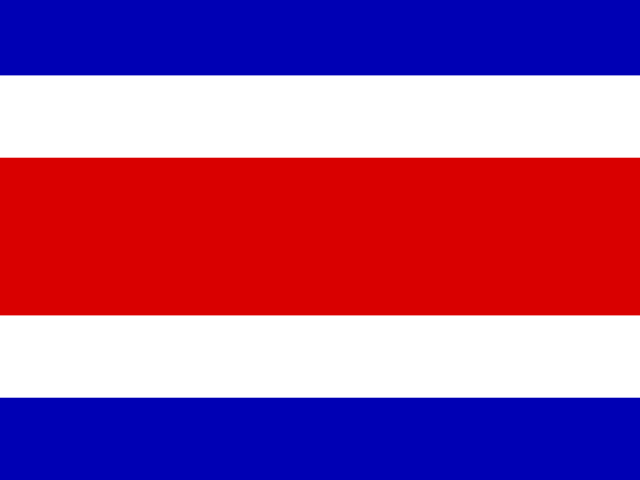
Five horizontal bands - blue, white, a double-width red centre, white and blue. The governing law assigns the blue the sky, the white peace and the red the blood of those who fell for liberty; a longer official reading of energy, courage and warmth circulates alongside it. A separate state flag, reserved for the supreme powers and diplomatic posts, carries the coat of arms on a white oval in the red band.
Costa Rica FACTS ◢
| Capital | San José |
|---|---|
| Continent | North America |
| Population | 5,152,950 (2025) |
| Area | 51,180 km² |
| Population density | 101/km² |
| Currency | Costa Rican colón (CRC) |
| Official language | Spanish |
| Calling code | +506 |
| Internet TLD | .cr |
| Time zone | UTC-06:00 |
| Drives on the | Right |
| ISO codes | CR / CRI |
DID YOU KNOW? ◢
- It abolished its military in 1948 and has had no standing army since.
- Despite covering a tiny fraction of the planet, it holds around 5% of the world's known species.
- It generates almost all of its electricity from renewable sources.
- 'Pura vida', meaning 'pure life', is its unofficial national motto and everyday greeting.
Costa Rica QUICK ANSWERS ◢
What is the capital of Costa Rica?
The capital of Costa Rica is San José.
What is the population of Costa Rica?
Costa Rica had a population of 5,152,950 in 2025.
What currency does Costa Rica use?
Costa Rica uses the Costa Rican colón (CRC).
What languages are spoken in Costa Rica?
The official language of Costa Rica is Spanish.
Think you know your flags? Play Flag Daily → · Browse all countries →
MORE ON THE FLAG ◢
Costa Rica's law does say what its flag's colours mean, which makes it unusual. Article 1 of Ley 10178, in force since May 2022, gives blue the sky, white peace, and the double-width red band in the middle "la sangre de los caídos por la libertad", the blood of those who fell for liberty.
What makes it more unusual is the date. The flag is from 1848. For the first 174 years of its life, no Costa Rican instrument said what any of its colours stood for. The founding decree describes stripes and fractions and stops. So did the law that replaced it in 1906. The meanings that most people quote were written down by the Executive, in booklets, and they do not match the ones the Legislative Assembly eventually put in the statute.
And there is a second thing the usual account leaves out. Costa Rica does not have one flag. It has two, they are legally distinct, and on every day but one only one of them is yours to fly.
Key Takeaways
- No Costa Rican flag instrument assigned the colours a meaning until Ley 10178 in 2022, 174 years after the flag was decreed.
- The statute reads the red band as the blood of the fallen. The government's own published gloss reads it as energy, courage and warmth, and never mentions blood.
- The plain five-band flag is the "bandera nacional" and any citizen may fly it. The arms-bearing "pabellón nacional" is restricted to the three supreme powers, the electoral tribunal and diplomatic posts, and is barred from private houses on every day but 12 November.
- Decreto 147 of 29 September 1848 defined only the arms-bearing version. The plain flag entered the law as an afterthought for merchant ships.
- The coat of arms carried five stars until 1964, when a law added two and named all seven provinces.
What does the law say the colours of the Costa Rican flag mean?
Officially, three things, and the official answer changed in 2022.
The governing text is Ley 10178, the Ley que regula el uso del pabellón, la bandera y el escudo nacionales, published in the official gazette La Gaceta No. 86 on 11 May 2022. Its first article both describes and interprets the flag in one sentence:
la primera y la quinta son de color azul que representan el cielo de nuestro país, la segunda y la cuarta blancas que representan la paz y una franja roja en el centro, de un ancho dos veces mayor que las demás que representa la sangre de los caídos por la libertad
In translation: the first and the fifth are blue in colour and represent the sky of our country, the second and fourth white and represent peace, and a red band in the centre, twice as wide as the others, which represents the blood of those who fell for liberty.
Article 2 then restates the three readings as a colour specification, pinning blue to Pantone Reflex Blue and red to Pantone 485C, though it misspells the trademark as "panthone" in the red clause. The clause for white is four words long: "Blanco: representa la paz."
That is the whole of what the statute says. Blue is the sky. White is peace. Red is blood. No purity, no ideals, no warmth of character, and no second meaning attached to any band.
Casa Presidencial publishes a different set. Its national-symbols page gives blue as "el cielo que cubre y protege a Costa Rica", the sky that covers and protects Costa Rica; white as "la paz que se vive en el país y la pureza de sus ideales", the peace lived in the country and the purity of its ideals; and red as "la energía, valentía y el desprendimiento de las personas costarricenses cuando defienden su sistema democrático", the energy, courage and selflessness of Costa Ricans when they defend their democratic system. The fuller version in the Imprenta Nacional's 2018 symbols book adds to red "calidez del modo de ser del costarricense, que se extiende a los otros países del mundo", the warmth of the Costa Rican way of being, extended to other countries of the world.
Read the two side by side and the disagreement is not about emphasis. It is about whether the red band is about death or about temperament.
| Band | Ley 10178, articles 1 and 2 | The Executive's published gloss |
|---|---|---|
| Blue | the sky of the country | the sky that covers and protects Costa Rica |
| White | peace | peace, and the purity of its ideals |
| Red | the blood of those who fell for liberty | energy, courage, selflessness, and warmth of character |
Why does Costa Rica have two flags?
Because the law defines two, gives them different names, and orders schools to teach the difference.
Chapter I of Ley 10178 covers the bandera nacional: five horizontal bands, no emblem, and a wide permission. Article 6 opens "Todo costarricense podrá hacer uso de la bandera de Costa Rica", every Costa Rican may make use of it, subject to four rules of respect. Article 4 adds the everyday cases. It permits the flag on houses, premises, buildings and transport of any kind during the national holidays, or to mark an event of patriotic significance. It also lets a citizen who wants the flag permanently hoisted do so, in a suitable place. Article 3 turns the permission into an obligation for the state: the flag must fly outside every public building and institution and take a preferred place inside it, and it must fly at the country's ports of entry and exit.
Chapter III covers the pabellón nacional, and it is a different object with a different status. Article 12 calls it "el principal simbolo nacional, siendo la máxima representación ceremonial del Estado costarricense", the principal national symbol and the state's highest ceremonial representation. Article 13 gives it the same five bands, with the coat of arms embroidered on a white ground at the centre of the red one. Article 15 fixes that ground as a white ellipse thirty centimetres on its major axis by twenty on its minor, its centre sixty centimetres from the hoist.
Then the restrictions. Article 14 confines the pabellón to the principal buildings of the three supreme powers, which it names as Casa Presidencial, the Legislative Assembly and the Supreme Court of Justice. It adds the Supreme Electoral Tribunal, and the state's diplomatic and consular posts abroad. It is prohibited "en casas particulares, edificios públicos o privados", in private houses and in public or private buildings, and in any other use the law does not provide for. Article 16 adds that it goes up at six in the morning, comes down at six in the evening, is used only in official acts, and that a room may hold only one.
There is one day when the place restriction lapses, and the law never reconciles the two provisions. Article 16(c) says the pabellón may be hoisted "únicamente, en los espacios definidos en el artículo 14 de esta ley", only in the places article 14 defines. Article 17, which makes 12 November the Día del Pabellón Nacional, then closes with the opposite: "Igualmente, podrán izar el pabellón nacional, en este día, aquellos particulares que asi lo deseen, para lo cual deberán hacerlo con el respeto debido." Private individuals who wish to may hoist the pabellón on that day, doing so with due respect. So the most restricted symbol in Costa Rican law is open to anyone for one day a year. The article that opens it sits a few paragraphs below the one that shuts it, and nothing in the statute says which governs. The rest of article 16 is untouched either way: even on 12 November the pabellón goes up at six and comes down at six, and the respect the article demands is explicit.
The law expects the distinction to be misunderstood. Article 19 makes public and private schools teach civic instruction on correct use, respect, and, in the published text's own slightly mangled wording, "las diferencias existentes e entre el pabellón nacional y la bandera nacional" - the stray "e" is in the gazette, and is the law's second visible drafting slip.
If telling one five-band flag from another sounds easy, a daily flag round gives you three guesses at one, and three written clues and no flag at all is the harder version.
What did the 1848 decree actually say?
It defined the arms-bearing flag, in geometry, and said nothing about meaning. What it replaced was the Central American federation design of 1823, three horizontal bands with blue outside and white in the middle, which Costa Rica flew until 28 September 1848 and which its neighbour Nicaragua still carries.
The flag dates to Decreto No. 147 of 29 September 1848, issued during the first administration of Dr José María Castro Madriz. The number needs stating carefully, because the Ministry of Culture and Youth's own volume cannot keep it straight. The volume prints the roman CLXVII, which is 167, in five places, the roman CXLVII, 147, in one, and the arabic 147 in two more. The tie-breaker is a separate instrument: Decreto No. 768 of 1949, which created the Day of the Pabellón, opens its grounds "Que por Decreto N° 147 del 29 de setiembre de 1848". The ministry reprints the 1848 article itself from the National Archive's own Colección de leyes y decretos:
El Pabellón Nacional de la República será tricolor, con cinco franjas colocadas horizontalmente, en esta forma: una franja roja ocupará el centro, que será comprendida entre dos blancas, a cada una de las cuales seguirá una azul.
In translation: the National Pabellón of the Republic shall be tricolour, with five bands placed horizontally, in this form, a red band shall occupy the centre, which shall be enclosed between two white ones, each of which shall be followed by a blue one. The article continues with the fractions, one sixth of the flag's width for each outer band and two sixths for the red, and with the arms embroidered on a white ground in the centre of the red band. Then it stops.
Ley No. 18 of 27 November 1906 replaced it and behaved the same way. Its first article gives the band order, then adds one line on proportion: "Las fajas blancas y azules serán de igual anchura; la roja doble ancho." The white and blue bands are of equal width, the red double. No colour is glossed, in that article or in the thirteen that followed it when the law was enacted.
The 1906 law is also where the two-flag rule hardens. Article 3 is blunt: "Los particulares no podrán, en ningún caso, enarbolar el Pabellón Nacional." Private persons may in no case fly the National Pabellón, allowing them only to decorate their houses on civic holidays with pennants in the national form and colours. The plain flag gets its legal definition almost in passing, in article 9. Merchant ships' flags and streamers, it says, "representarán simplemente los colores nacionales en la forma indicada en el artículo 1º", shall simply represent the national colours in the form indicated in article 1. And then the operative words: "sin escudo ni inscripciones de ninguna especie", with no arms and no inscriptions of any kind.
So for 174 years the flag Costa Ricans actually own was the residue left when you removed the arms from the real one. Ley 10178 inverted that: the citizens' flag now opens the statute and the ceremonial one comes third.
Nothing between the two assigns a colour a meaning either. The Ministry of Culture and Youth reprints the whole chain, and it was read end to end for this article: the 1929 and 1934 amendments to the 1906 law, the 1949 decree that created the Day of the Pabellón, the 1964 law that rewrote the arms, the 1976 reform of who may use them on letterhead, a 1994 regulation on flag number plates, and the 1998 decree that fixed the arms' colours. Every one of them measures, permits or forbids. None interprets. One document that would be worth reading was not reached: article 24 of Ley 10178 required the Executive to issue implementing regulations within two months of publication, and no such reglamento was found in the sources open here.
Who designed the flag, and was it really the French revolution?
The design is credited by tradition to Pacífica Fernández Oreamuno. The causal story usually attached to it is not something Costa Rican sources will assert.
She was the wife of José María Castro Madriz and the country's first First Lady. The Imprenta Nacional's 2018 book, published by the state printer, gives her the design and hedges the whole clause: "La historia cuenta que el diseño de la actual bandera fue inspirado en la bandera de Francia". The story goes that the design of the present flag was inspired by the flag of France. Inspired by the flag. Not by a revolution, not by a particular year, and with no mechanism named.
The Ministry of Culture and Youth is franker still. Its 2010 volume on the national symbols, discussing the 1848 arms, records that tradition says she embroidered them, "sin embargo no conocemos si ella fue la autora de su composición", however we do not know whether she was the author of its composition. It then reports the flag story in the same register, including a concrete and rather satisfying version of the mechanism: that she produced the national flag "juntando dos banderas francesas por sus franjas rojas", joining two French flags by their red stripes. Lay two French tricolours side by side, overlap the red, and you get blue, white, red, white, blue in exactly the 1:1:2:1:1 proportion the decree specifies.
The ministry's verdict on all of it is one sentence: "Tales aseveraciones no pueden descartarse", such assertions cannot be ruled out. It then notes as a vexillological aside that most nations emancipated during the eighteenth and nineteenth centuries built their flags from the French colours, which makes the resemblance weak evidence of any particular influence.
The version that circulates in English usually goes further, attributing the red band to the February 1848 revolution in France. No Costa Rican government text reached for this article makes that claim. The nearest thing to a narrative account is a 1956 literary retelling that the ministry reprints, and its imagery is 1789 rather than 1848: she wanted a flag like that of the great people who took the Bastille and proclaimed the Rights of Man.
What is documented is the debut. The pabellón was first raised on 12 November 1848 in the Plaza Mayor of San José, and the press of the day, quoted by the ministry, hoped that "ese pabellón tricolor sea de hoy en adelante, el emblema bajo el cual aparezcan personificados el orden y la libertad de un pueblo", a sentence that carries on to a peace "fundada en el convencimiento". That date is now fixed in law: article 17 of Ley 10178 makes 12 November the Día del Pabellón Nacional.
Who said the red is not blood?
The man who wrote the words of the national anthem, and he said it in print in 1903.
José María Zeledón Brenes won the competition to replace the anthem's older, more warlike lyric, and afterwards published his own account of what he had meant by the flag's colours. The Ministry of Culture and Youth reprints it from El Noticiero of 12 December 1903. He set out, in his words, "apartándome de la añeja rutina que no perdona la sangre donde quiera que campea el rojo", departing from the stale routine that never forgives the blood wherever red appears. His reading put the blue firmament as a protective mantle over a sleeping peace, and the red in the flush that labour brings to a working face.
That reading is why the Executive's gloss sounds the way it does. The protective mantle is Zeledón's image, and so is the pairing of white with peace. The lyric he wrote, declared the anthem's official words by decree in 1949, carries the line "blanca y pura descansa la paz", white and pure the peace rests. Both images are still in the Executive's gloss a century later. Casa Presidencial has the sky covering and protecting the country; the Imprenta Nacional's 2018 wording keeps the mantle itself, giving blue the sky that covers Costa Rica like a protective mantle.
The writer Alberto F. Cañas put the point plainly in a letter of 30 October 1970 to President José Figueres Ferrer, reprinted in the same volume, advising on Figueres's proposal at the United Nations that national anthems drop their warlike content: "El rojo de la franja central no huele a sangre para el poeta", the red of the central band does not smell of blood to the poet.
Which is the sharp edge of Ley 10178. The one meaning the anthem's author explicitly refused is the one the Assembly wrote into article 1 in 2022, and it is now the statutory reading of the band.
Why did the coat of arms go from five stars to seven?
Because provinces were added, and a law in 1964 counted them.
The arms sit on the pabellón and not on the plain flag, so this is a change most people never see on a flag at all. Article 11 of the 1906 law placed between the volcano peaks and the myrtle palms "cinco estrellas de igual magnitud y colocadas en figura de arco", five stars of equal magnitude arranged in an arc. It does not say what they stand for. The provinces reading belongs to the Imprenta Nacional, looking back from 2018: two stars were added to the five already there "en representación de las siete provincias, dado que Puntarenas y Limón también ya se habían declarado como tales".
Ley No. 3429 of 21 October 1964, under the administration of Francisco J. Orlich Bolmarcich, rewrote that article. The Ministry of Culture and Youth quotes the replacement: the space between the volcanoes and the palms is now filled by "siete estrellas de igual magnitud, colocadas en arco que representarán las provincias de San José, Alajuela, Cartago, Heredia, Guanacaste, Puntarenas y Limón". Puntarenas and Limón had since become provinces, so the count moved to seven and the law named all of them. The same statute retired the term Escudo de Armas in favour of Escudo Nacional, a change the ministry's own author disputes on heraldic grounds.
Article 9 of Ley 10178 carries that seven-star wording forward almost unchanged, provinces named in the same order. It fixes no number of points for the stars and gives them no colour; the silver comes from an executive decree of 1998 that also added smoke to the three mountains so that they would read as the volcanoes the law had always called them.
Frequently asked questions
What do the three colours of the Costa Rican flag mean?
Under article 1 of Ley 10178, blue represents the sky of the country, white represents peace, and the double-width red band represents "la sangre de los caídos por la libertad", the blood of those who fell for liberty. That statutory wording dates only from 2022. Casa Presidencial separately publishes a reading in which white also carries the purity of the country's ideals and red carries energy, courage and selflessness rather than blood, so the two official answers differ on the red band.
Why does the Costa Rican flag sometimes have a coat of arms on it?
Because that is a different flag with a different legal name. The plain five-band version is the bandera nacional; the version with the arms on a white ellipse in the red band is the pabellón nacional, which article 12 of Ley 10178 calls the principal national symbol. Article 14 restricts the pabellón to the principal buildings of the three supreme powers, the Supreme Electoral Tribunal and Costa Rica's diplomatic and consular posts, and prohibits it in private houses. There is one exception: article 17 lets any private person hoist it on 12 November, the Day of the Pabellón Nacional, if they wish.
Can anyone fly the Costa Rican flag?
The plain flag, yes. Article 6 of Ley 10178 permits every Costa Rican to make use of the bandera nacional subject to its rules of respect, and article 4 lets a citizen keep it permanently hoisted in a suitable place. The arms-bearing pabellón nacional is a different matter: article 14 bans its use in private houses and in any location the law does not name, and article 16 limits it to official acts between six in the morning and six in the evening. The one exception to the private-house ban is 12 November, when article 17 permits any private person to hoist it if they wish.
Who designed the flag of Costa Rica?
Tradition credits Pacífica Fernández Oreamuno, wife of José María Castro Madriz, and Costa Rican state sources report it as tradition rather than as record. The Imprenta Nacional's 2018 symbols book prefaces the France-inspired account with "La historia cuenta que", the story goes that. The Ministry of Culture and Youth says of the attributions that they "no pueden descartarse", cannot be ruled out, and states that it is not known whether she composed the design or merely embroidered the first one.
How many stars are on Costa Rica's coat of arms and why?
Seven, one for each province. The 1906 law specified five stars in an arc; Ley No. 3429 of 21 October 1964 replaced that clause with seven and named them: San José, Alajuela, Cartago, Heredia, Guanacaste, Puntarenas and Limón. Puntarenas and Limón had been raised to provinces in the interval. Article 9 of the current law keeps the seven-star wording, and the stars appear on the coat of arms, which means they appear on the pabellón nacional and not on the plain flag.
Sources
- Imprenta Nacional de Costa Rica, La Gaceta No. 86, 11 May 2022, pages 4 to 6: Ley 10178, Ley que regula el uso del pabellón, la bandera y el escudo nacionales - retrieved 13 August 2026.
- Ministerio de Relaciones Exteriores y Culto de Costa Rica, consolidated text of Ley 10178 from the Sistema Costarricense de Información Jurídica - retrieved 13 August 2026.
- Ana Patricia Pacheco Ureña (comp.), Costa Rica: sus Símbolos Nacionales, Ministerio de Cultura y Juventud, Centro de Investigación y Conservación del Patrimonio Cultural, 2010, ISBN 978-9977-59-220-6. PDF - retrieved 13 August 2026. Reproduces Decreto 147 of 1848 from the Archivo Nacional's Colección de leyes y decretos, T. X, page 354; Ley 18 of 1906 from the same series, T. II, page 748; the 1964 replacement of article 11; and José María Zeledón Brenes's 1903 account from El Noticiero.
- Imprenta Nacional de Costa Rica, Editorial Digital, Símbolos Nacionales de la República de Costa Rica, 2018 - retrieved 13 August 2026.
- Presidencia de la República de Costa Rica, Símbolos Nacionales - retrieved 13 August 2026.
- Presidencia de la República de Costa Rica, Firmada ley que regula el uso del pabellón, la bandera y el escudo de Costa Rica, 25 April 2022 - retrieved 13 August 2026.
PLAY ANOTHER →
One thing that happened today in history. Every day, a new one.
TODAY IN HISTORYDAILYDaily TriviaFive questions a day. Everyone gets the same five.
FIVE QUESTIONSDAILYDaily CryptogramOne quote, one scrambled alphabet. Crack it before tomorrow.
CRACK THE QUOTEDAILYDaily CodeA short message, hidden in a different cipher every day.
ONE CIPHER A DAY